Smilax
(the ancient Greek name used by Theophrastus). American China Root. TRIBE Smilaceae of ORD. Liliaceae. This genus embraces, according to Alph. de Candolle, 187 species of stove, greenhouse, or hardy, sarmentose shrubs, rarely dwarf and sub-herbaceous, broadly dispersed over temperate and tropical regions. Flowers small, dioecious, pedicellate, in umbels (or cymelets), often numerous; stamens of the males six, rarely indefinite; staminodes of the females six or fewer; umbels pedunculate or sessile, axillary or terminal. Leaves alternate, distichous, or rarely opposite, often perennial; petioles furnished with two tendrils; floral leaves usually reduced to bracts. Smilax is, on the whole, one of the most important genera from an economic standpoint. The roots of several species constitute the well-known Sarsaparilla of our shops. The rootstocks of S. China are eaten by the Chinese; and those of S. Pseudo-China are used in the manufacture of a kind of beer in South Carolina. A selection of species grown in gardens is given below. They boast of no particular beauty, but are plants of considerable interest, and mostly hardy. A sandy-loam soil is best adapted to their requirements. Propagation may be effected by divisions of the root. S. aspera (rough).* Prickly Ivy. fl. whitish or flesh-coloured, fragrant; spikes longer or shorter than the leaves. July. l. frequently cordate at base, hastate or deltoid-lanceolate, acuminate or cuspidate, sometimes white-spotted. Stems prickly. h. 5ft. to 10ft. South Europe, &c., 1648. (S. F. G. 959.)
S. a. angustifolia (narrow-leaved). l. narrow, elongated. (L. B. C. 1799, under name of S. sagittaefolia.)
S. a. mauritanica (Mediterranean).* fl. greenish-yellow, fragrant. A very beautiful, half-hardy, evergreen climber, of considerable size, well suited for conservatory decoration. 1884. (G. C. n. s., xxii. p. 185.)
S. a. punctata (spotted). A variety having the leaves spotted with white. (R. G. 683.)
S. asperrima (very rough). A garden name for a plant which at present cannot be determined.
S. auriculata (auricled). fl. small, very fragrant. fr., berry small, globular. l. green, glossy, and widened at the base so as to become sub-hastate; the front portion three-nerved, with two short, additional nerves in the widened basal angles. Stems striated, freely furnished with short, white, recurved spines. Southern United States, 1884. An elegant, half-hardy, evergreen climber.
S. australis (Southern). fl. white, or pale green or purple; umbels many-flowered, on axillary peduncles. Summer. l. from ovate-lanceolate or oblong to nearly orbicular, 2in. to 4in. long, or rarely much larger; petioles short and twisted. Stems and branches usually more or less armed with scattered prickles. h. 3ft. to 5ft. or more. Australia, 1791. SYN. S. latifolia.
S. Bona-nox (Good-night). fl. greenish-white; peduncles longer than the petioles. June and July. l. tardily deciduous, varying from round-cordate and slightly contracted above the dilated base to fiddle-shaped and halberd-shaped or three-lobed, green and shining on both sides, cuspidate-pointed, the margins often somewhat bristly-ciliate or spinulose. Branches and branchlets sparsely armed with small, rigid prickles. h. 5ft. to 10ft. North America, 1739. SYN. S. tamnoides.
S. B.-n. hastata (halberd-shaped). l. narrower than in the type, thickly beset with prickles on the margins. 1820.
S. B.-n. rubens (reddish). l., tendrils purplish. Branches sparsely prickly. (W. D. B. 108, under name of S. rubens.)
S. China. China Root. fl. greenish-white; peduncles much shorter than the leaves, longer than the petioles. August. l. deciduous, ovate-rounded, the young ones abruptly narrowed and acute at the base, at length sub-cordate, acute, cuspidate, or retuse at apex, entire. h. 20ft. China and Japan, 1759. The edible root is very large, fleshy, and reddish.
S. discolor (discoloured). l. about 9in. long and 4in. broad, oblong-ovate, suddenly acuminate, firm, irregularly blotched when young with purplish-brown, five-nerved. Mexico.
S. glauca (glaucous). fl. greenish-white; peduncles longer than the petioles, flattened. July. l. tardily deciduous or partly persistent, ovate, rarely sub-cordate, glaucous beneath, and sometimes also above (as well as the young branchlets), abruptly mucronate, the edges smooth and naked. Branches terete, and, as well as the somewhat quadrangular branchlets, armed with scattered, stout prickles, or naked. h. 3ft. North America, 1815. (B. M. 1846; W. D. B. 111, under name of S. Sarsaparilla.) S. glycyphylla (sweet-leaved). Botany Bay Tea and Tree fl., perianth nearly globular in bud; peduncles axillary and simple, or a few of the upper ones in a terminal panicle. Summer. l. lanceolate or ovate-lanccolate, 1 1/2in. to 3in. long or rarely more, acute or acuminate, narrowed or rounded, or rarely almost cordate at base, rigid, often glaucous or white beneath, sometimes green on both sides; petioles twisted, bearing slender tendrils. Australia. Plant glabrous, unarmed. Greenhouse.
S. herbacea (herbaceous). Carrion Flower. fl. carrion-scented; peduncles elongated, 3in. to 4in., or sometimes 6in. to 8in., long, twenty to forty-flowered. June. l. much shorter than the peduncles, long-petiolate, membranous, ovate-oblong or rounded, mostly cordate, mucronate-tipped, smooth. Stem herbaceous, never prickly, erect and recurved, or climbing. North America, 1699.
S. h. Simsii (Sims'). l. ovate-acuminate, sub-acute or obtuse at base, small. (B. M. 1920, under name of S. herbacea.)
S. lanceolata (lance-shaped). fl. greenish-white; umbels sometimes panicled; peduncles short, seldom exceeding the petioles, terete. June and July. l. thinnish, rather deciduous, varying from ovate-lanceolate to lanceolate-oblong, narrowed at base into the short petiole, shining above, paler or glaucous beneath, many of them without tendrils. Branches terete, unarmed. h. 15ft. to 20ft. North America, 1785.
S. latifolia (broad-leaved). A synonym of S. australis.
S. macrophylla maculata (large-leaved, spotted). A synonym of S. ornata.
S. marmorea (marbled). A garden name for a plant which probably belongs to S. ornata.
S. officinalis (officinal). fl. unknown. l. oblong, slightly acute at base, abruptly acuminate at apex, membranous, 5in. to 7 1/2in. long; petioles 2in. to 5in. long, the margins inflexed, sheathing. Young branches sub-cylindric, becoming somewhat quadrangular, armed with reflexed prickles. Chiriqui, &c., (about) 1866. (B. M. Pl. 289.)
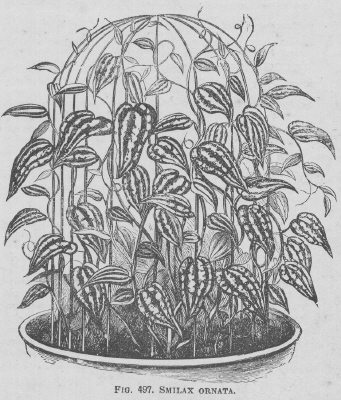
S. ornata (adorned).* l. ovate, acuminate, at length cordate at base, freely spotted with silvery-grey on a deep green ground, the marking being confined to the spaces between the veins; petioles prickly at back. Branches angular, armed with short prickles. Native place unknown, 1865. A handsomely-marked, greenhouse species.(I. H. 439.) SYN. S. macrophylla maculata.
S. Pseudo-China (false China). fl. greenish; peduncles two to four times the length of the petioles. July. l. 3in. to 5in. long, ovate-cordate, or on the branchlets ovate-oblong, cuspidate-pointed, green on both sides, often rough-ciliated, thin, becoming firm in texture. Stems and branches unarmed, or with a very few weak prickles. North America, 1759.
S. quadrangularis (four-angled). A synonym of S. rotundifolia.
s. rotundifolia (round-leaved).* fl. greenish; peduncles flattened, rather longer than the pedicels, few-flowered. June. fr. blue-black, globular. l. thin, ovate or round-ovate, entire, 2in. to 4in. long, abruptly pointed, mostly rounded or slightly cordate at base. Stem climbing high, armed with scattered prickles. North America. (T. S. M. 610.) SYN. S. quadrangularis (W. D. B. 109).
S. salicifolia variegata (variegated Willow-leaved). l. elliptic-lanceolate, finely marbled with white between the ribs, and thus appearing to be marked with four irregularly-margined, white bands, very ornamental. Branches angular, rarely sub-terete, armed with recurved prickles. Para, 1867. Greenhouse. (I. H. 521, under name of S. longifolia foliis-variegatis.) S. Shuttleworthii (Shuttleworth's). l. large, cordate, acuminate, deep green, marked with confluent blotches of silvery-grey, the young ones purplish at back; petioles curiously deflexed at base. Columbia, 1877. A free-growing, stove climber.
S. tamnoides (Black Bryony-leaved). A synonym of S. Bona-nox.