Sophronitis
(from sophron, modest; in reference to the pretty little flowers of the original species). ORD. Orchideae. A small genus (four or five species) of dwarfgrowing, tufted, cool-house, epiphytal Orchids, inhabiting the Organ Mountains of Brazil. Flowers very showy, scarlet or violet, borne in short, few-flowered racemes, or solitary from the top of the pseudo-bulb; sepals free, equal, flat, spreading; petals similar or broader; lip erect, the lateral lobes broad and connivent, wholly concealing the short and rather thick column, the middle lobe sub-recurved, entire; pollen masses eight. Leaves coriaceous or fleshy, complicated, at length unfolding, spreading. Pseudo-bulbs clustered on a rhizome, one or two-leaved. The species are well worthy the attention of cultivators, and have the advantage of occupying but little space. They require to be grown in small pans, or on blocks or rafts. The material they prefer is very fibry peat, to which may be added a little crushed charcoal. Perfect drainage is necessary. All the Sophronites require abundance of moisture throughout the year. Propagation may be effected by divisions, made just as growth commences.
S. cernua (drooping). fl. rose-red, yellowish in the centre, small, produced in short, effuse, axillary racemes; column white, with dark purple wings. Winter. l. solitary, ovate, apiculate, rather above 1in. long. h. 3in. 1827. (B. M. 3677; B. R. 1129; L. & P. F. G. iii. p. 11.)
S. coccinea (scarlet). A synonym of S. grandidora.
S. grandiflora (large-flowered).* fl. brilliant scarlet or cinnabarred, of stout substance, over 3in. in diameter, solitary; sepals linear-oblong, obtuse; petals three times as wide as the sepals; lip undivided, ovate, cucullate at base. Winter. l. solitary, oblong, acute, dark green. Stems short, ovate, terete. A very beautiful species. SYNS. S. coccinea (F. d. S. 1716), Cattleya coccinea. A remarkable hybrid between this species and Cattleya intermedia, raised by Messrs. Veitch, five years ago, produced flowers in 1886, and has been described by Reichenbach, in the "Gardeners' Chronicle," n. s., vol. xxvi., p. 263, under name of Laelia Batemaniana. This plant has the short peduncle of a Sophronitis and a short-stalked, Laelia-like flower of a light purple rose-madder, with the very lightest mauve hue, which appears to get deeper as the flower gets older; the middle lacinia of the trifid lip is of the warmest Dahlia carmine, with a light mauve hue; the side laciniae and disk are white, with a light mauve-purple border. The change in nomenclature brought about by this extraordinary cross is given in Prof. Reichenbach's words: "Hence I must reduce Sophronitids as Laelia cernua, pterocarpus, militaris, purpurea, grandiflora, for those who accept changes, and leave alone Sophronitis violacea with a remodelled character."
S. g. purpurea (purple). fl. purplish; petals blunt. l. cuneate-elliptic, acute. Pseudo-bulbs very short, thick, fusiform. 1878.
S. g. rosea (rosy). fl. of a clear rosy-lake or carmine-rose. A rare form. (Gn. xxv., p. 474.)
S. grandiflora (large-flowered), of Hooker. A synonym of S. militaris.
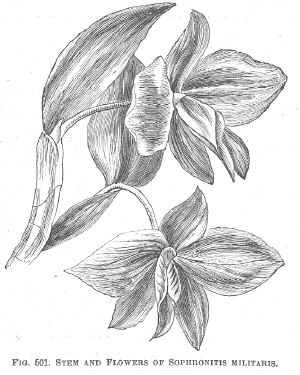
S. militaris (military).* fl. solitary, fully 3in. across; sepals and petals bright cinnabar or deep crimson, the former oblong-lanceolate, the latter roundish-elliptic; lip yellow, streaked with bright red, three-lobed, the side lobes incurved, the front one flat and acuminate. November and December. l. solitary, elliptic. Pseudo-bulbs oblong-cylindrical. h. 6in. 1837. the finest species in the genus; it should be found in every collection. 501. SYN. S. grandiflora (B. M. 3709; F. M. 329; L. & P. F. G. iii., p. 11, f. 237; L. S. O. 5; P. M. B. ix. 193).
S. pterocarpa (wing-fruited). fl. rosy-purple; lip ovate, crested; ovary six-winged, long-beaked; raceme short, corymbose. March. l. coriaceous, roundish-oblong. h. 3in. 1842. A rare plant in gardens. (L. & P. F. G. iii., p. 11, f. 239.)
S. violacea (violet).* fl. violet, solitary; lip obovate, acute, naked, gibbous at base; column with large, fleshy, obtuse, falcate wings; scape terminal, many-bracted at base. Winter. l. solitary, linear, dark green, longer than the scape. Pseudobulbs oval, small. h. 3in. 1838. (B. M. 6880; L. & P. F. G. iii., p. 11, f. 238.)