Spiraea
(the old Greek name used by Theophrastus, probably from speiras, to wind; alluding to the fitness of the plants for forming into garlands). Meadow-sweet. ORD. Rosaceae. A genus comprising about fifty species of handsome (mostly deciduous and hardy) shrubs, subshrubs, or herbs, broadly dispersed over the temperate and sub-frigid regions of the Northern hemisphere, rarely found in the tropics. Flower pink or white, axillary or terminal, variously clustered; calyx persistent, with an urceolate, campanulate, or concave tube, and a limb of four or five imbricated or valvate lobes; petals four or five, rounded, shortly clawed; stamens twenty to sixty, in one, two, or three series. Leaves alternate, simple or pinnate, or twice or thrice ternate; stipules free, or adnate in a sheath at the bases of the petioles, rarely obsolete. The shrubby species succeed in almost any soil in open situations. The perennials prefer moist places and loamy soil, particularly S. palmata and S. Ulmaria, which succeed well by the side of water. Shrubby Spiraeas are propagated by cuttings of the young wood, inserted in sandy soil, and kept close and shaded until rooted; or by means of the root-offsets which are so freely produced by most of the species. The perennials may be increased by divisions.
S. acutifolia (acute-leaved). A synonym of S. hypericifolia acuta.
S. alba (white). A synonym of S. salicifolia paniculata.
S. alpina (alpine). fl. White; sepals ascending; corymbs terminal, stalked, and in many instances leafless, large in proportion to the leaves, June and July. l. oblong-lanceolate, sessile, serrulated, glabrous; midrib branched. h. 4ft. to 6ft. Siberia, 1806.
S. amurensis (Amur). A synonym of Neillia amurensis.
S. ariaefolia (White-bean-leaved). A synonym of S. discolor arioefolia. S. Aruncus (Aruncus). Goat's Beard. fl. whitish, in many slender spikes, disposed in a long, compound panicle. June. l. thrice-pinnate; leaflets thin, lanceolate-oblong, or the terminal ones ovate-lanceolate, taper-pointed, sharply cut and serrated. h. 4ft. Northern hemisphere, 1633. herbaceous perennial.
S. A. americana (American). A form with the interrupted male flowers scarcely larger than the female ones. Follicles more than twice as long as broad. North America, Japan, and China. In the Japanese Alps, this sometimes occurs only 1ft. in height.
S. A. triternate (triternate). fl., carpels twice (often more than three times) as long as broad. l. frequently clothed with ashy pubescence beneath. Himalaya.
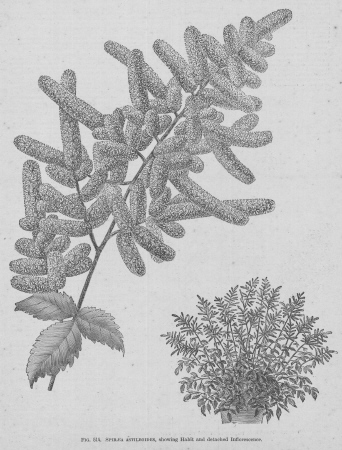
S. astilboides (Astilbe-like). fl. white, in spicate panicles. Summer. Japan. In general aspect, this species resembles S. Aruncus, but it is considerably dwarfer in stature, and much more graceful in character. A handsome perennial., for which we are indebted to Mr. Wm. Bull.
S. barbata (bearded). A synonym of Astilbe japonica.
S. bella (pretty). fl. of a beautiful red colour; calyx lobes deflexed; cymes terminal, spreading, and, as well as the rated, petiolate, glaucous beneath. Stems glabrous, rufous. h. 2ft. to 3ft. Himalaya, 1820. (B. M. 2426.)
S. betulifolia (Birch-leaved). fl. Creamy-white; corymbs large, flat, several times compound. June. l. simple, oval or ovate, cut-toothed towards the apex; stipules obsolete. h. 1ft. to 2ft. Northeastern Asia and North America, 1819. Shrub nearly smooth, SYN. S. corymbosa (L. B. C. 671).
S. Blumei (Blume's). fl. White; cymes pedunculate, terminal, and, as well as the calyx, glabrous. l. obovate, obtuse, deeply toothed at the apex, rather smooth. h. 3ft. to 6ft. Japan. (B. H. 1858, 37, f. 2.) S. Boursierii (Boursier de la Riviere's). A synonym of S. discolor dumosa.
S. caespitosa (tufted). fl. White, densely spicate-racemose. Summer. l. small, silky, entire; radical ones rosulate, spathulate; cauline ones linear, minute. h. 6in. Northern Mexico, Nevada, &c.
S. callosa (Callous-leaved). A synonym of S. japonica.
S. c. alba (white). A synonym of S. japonica alba.
S. c. rosea (rosy). A synonym of S. japonica splendens.
S. c. superba (superb). A synonym of S. japonica superba.
s. cana (hoary-leaved). fl. White; sepals spreading; styles thick; corymbs somewhat racemose, the lateral ones pedunculate, loosely few-flowered. June and July. l. ovate, 1/2 in. to 1 1/2in. long, acute, quite entire or slightly toothed, hoary-villous. h. 1ft. to 2ft. Croatia, 1825.
S. canescens (hoary). fl. pale pink or white; corymbs crowded, and, as well as the branches, tomentose. Summer. l. oval or obovate, obtuse, stalked, quite entire, villous. Himalaya, 1879. An erect branched, canescent shrub, with the habit of S. hypericifolia.
S. cantoniensis (Canton).* fl. white and showy, disposed in terminal umbels. Early summer. l. small, simple, lanceolate, three-lobed, deeply toothed. h. 3ft. to 4ft. Japan, 1843. A glabrous, hardy, evergreen shrub. SYN. S. Reevesiana (B. R. XXX. 10). There is a double-flowered variety of this species in cultivation, which is highly desirable. (F. d. S. 1097.)
S. ceanothifolia (Ceanothus-leaved). A synonym of S. chamaedrifolia. S. chamaedrifolia (Germander-leaved). fl. white, disposed in hemispherical corymbs; sepals reflexed; pedicels slender, elongated. June and July. l. ovate, deeply serrated at the apex, pubescent, h. 1ft. to 2ft. South-eastern Europe to Japan, &c., 1789. SYN. S. ceanothifolia.
S. c. flexuosa (flexuous). fl. generally smaller than those of the type. l. elliptic-lanceolate, unequally serrated, hardly incised. Eastern Siberia, &c. SYN. S. flexuosa.
S. c. ulmifolia (Elm-leaved). fl. white, disposed in nearly hemispherical, terminal corymbs; sepals reflexed. June and July. l. ovate-lanceolate, acute, flat, sharply serrated, glabrous. h. 3ft. to 5ft. Siberia, &c., 1790. A handsome shrub. (B. R. 1222 and L. B. C. 1042, under name of S. chamaedrifolia.)
S. chinensis (Chinese) fl. pure white, small, slightly fragrant, arranged in small, hemispherical corymbs. March. l. ovate-oblong, 1 1/2in. long, acute, much wrinkled, deeply serrated, sub-trilobed, beneath, as well as on the branches, pubescent. h. 2ft. Central China, 1843. SYN. S. pubescens, of Lindley (B. R. xxxiii. 38).
S. confuse (confused). A synonym of S. media. S. corymbosa (corymbose). A synonym of S. betulifolia.
S. crenifolia (crenate-leaved). fl. white, in many-flowered, racemose corymbs, generally subtended by foliaceous bracts; stamens longer than the petals. Summer. l. stalked, round-oval, sharply toothed, rarely entire. North-east Asia.
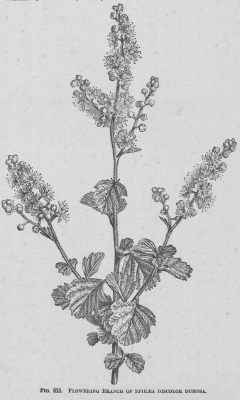
S. decumbens (decumbent). fl. white, in terminal corymbs. Summer. l, roundish-oval, crenately-toothed. Tyrol. A dwarf, trailing shrub, suitable for covering rocks and banks. (G. C. n. s., xii., p. 752.) S. discolor ariaefolia (discoloured, White-bean leaved). fl. dirty-white, in elegant, nodding panicles. Summer. l. rigid, cuneate at base, dark green above, silvery beneath; those on young growths about the size and shape of those of the Hawthorn. h. 4ft. to 10ft. North-west America. SYN. S. arioefolia (B. R. 1365).
S. d. dumosa (brambly). This differs from the last-named plant in its less compound panicles and much smaller stature. SYN. S. Boursierii (R. H. 1859, 519), S. dumosa.
S. Douglasii (Douglas').8 fl. rose-coloured, nearly sessile, in a dense, terminal, thyrsoid panicle, 6in. to 9in. in length. August. l. simple, oblong-lanceolate, obtuse, serrulated towards the apex, covered with a white down beneath. h. 3ft. North-west America. (B. M. 5151; L & P. F. G. ii. 178; R. H. 1846, 6.)
S. D. Nobleana (Noble's). fl, purplish-red; inflorescence looser less toothed, pubescent or almost glabrous beneath. California, 1859. (B. M. 5169 and I. H. 286, under names of S. Nobleana).
S. dumosa (brambly). A s synonym of S. discolor dumosa.
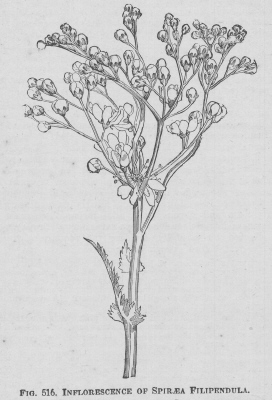
S. Filipendula (Filipendula).* Dropwort, fl, white, or rosy outside, 3/4in. in diameter; cymes loose, panicled; peduncles slender. June and July. l. interruptedly pinnate, glabrous, 4in to 10in. long, chiefly radical; leaflets many, sessile, deeply cut-serrate, 1/3in. to 1/2in. long, the terminal one three-lobed; stipules of cauline leaves toothed. Stem 2ft. to 3ft. high, erect, grooved, with a few small leaves. Europe (Britain), &c. Tuberous, herbaceous perennial.(Sy. En. B. 416.) There is a form of this with double flowers.
S. flagellate (white-like). A synonym of S. hypericifolia.
S. flexuosa (flexuous). A synonym of S. chamaedrifolia flexuosa. S. Fortunei (Fortune's). A synonym of S. japonica.
S. gracilis (slender). fl. white, corymbose (white long, capillary pedicels); corymbs in lax, spreading, rounded, glabrous panicles. July and August. l. obtuse or orbicular, elliptic, glabrous, glaucous beneath, serrated at the apex. Branches hairy. h. 2ft. Nepaul, 1820. (L. B. C. 1403, under name of S. vaccinifolia.)
S. grandiflora (large-flowered). fl. white, corymbose, July and August. l. pinnate; leaflets serrately incised. h. 2ft. to 3ft. Siberia, &c. Sub-shrub. This much resembles S. sorbifolia, but the flowers are twice as large as those of that species, and the leaves are smaller. SYN. S. Pallasii.
S. grandiflora (large-flowered), of Hooker. A synonym of Exochorda grandiflora.
S. grandiflora (large-flowered), of Loddiges. A synonym of S. salicifolia grandiflora.
S. hydrangeaefolia (Hydrangea-leaved). A synonym of S. japonica splendens.
S. hypericifolia (Hypericum-leaved). fl. white, in either peduncled corymbs or sessile umbels; pedicels glabrous or slightly downy. June and July. l. obovate-oblong, three or four-nerved, entire or toothed, glabrous, slightly downy. h. 4ft. to 6ft. Asia Minor to Eastern Siberia, &c., 1640. SYN S. flagellate.
S. h. acuta (acuta-leaved). fl. in sessile corymbs. l. spathulate, elongated, acute, perfectly entire or rarely three to five-toothed, rather glabrous. SYN. S. acutifolia.
S. h. Besseriana (Besser's). fl. in rather loose, terminal corymbs. l. mostly entire. Plant rather glabrous. (L. B. C. 1252.)
S. h. crenata (crenate-leaved). A variety with obovate leaves. S. h. thalictroides (Meadow-rue-leaved). fl. in a few-flowered, sessile corymb; stamens as long as the petals. June and July. l. smooth, glaucous, obovate, entire; those on the barren shoots cuneate-obovate or sub-deltoid. Mongolia. SYN. S. thalictroides.
S. japonica (Japanese). fl. rosy-red, disposed in terminal, flat corymbs. June. l. glabrescent; simple, lanceolate, acute, sharply serrated; serratures thickened at the tips. h. 4ft. to 6ft. China, Japan, &c., 1859. A very handsome and desirable, greenhouse, evergreen shrub. SYNS. S. callosa (L. & P. F. G. ii. 191.), S. Fortunei (B. M. 5164 F. d. s. 871.)
S. j. alba (white). fl. white, A compact, pretty bush, not more than 1ft. high. SYN. S. callosa alba.
S. j. rubra (red). A very handsome variety, having dark red flowers (R. H. 1862, p. 100.)
S. j. splendens (splendid). fl. peach-colorued. A dwarf-growing, floriferous plant, adapted for forcing. Garden origin. SYNS. S. callosa rosea, s. hydrangeaefolia, S. splendens.
S. j. superba (superb). fl. deep rose-red. A fine garden form. SYN. S. callosa superba.
S. japonica (Japanese), of gardens. The plant commonly known by this name is Astilbe japonica (which see).
S. laevigata (smooth). fl. white, tinged with rose, dioecious; male panicles larger and looser, in longer, interrupted racemes; female panicles smaller and more dense, in closely-packed, continuous racemes of smaller flowers. June. l. entire, oblong-lanceolate, glaucous, glabrous. h. 2ft. to 3ft. Siberia.
S. laxiflora (loose-flowered). A s synonym of S. vaccinifolia. S. Lindleyana (Lindley's).* fl. white, disposed in lager, terminal panicles. September. l. large, unequally pinnate; leaflets eleven to twenty-one, sessile, ovate-lanceolate, coarsely serrated, glaucous beneath. h. 4ft. to 8ft. Himalayas. (B. R. 33.)
S. lobata (lobed). Queen of the Prairie. fl. deep peach-blossom colour, handsome; sepals and petals often in fours; panicle compound-clustered. June. l. interruptedly pinnate; terminal leaflet very large, seven to nine-parted, the lobes incised and toothed; stipules reniform. h. 2ft. to 8ft. North America, 1765. A glabrous, herbaceous perennial. The bruised foliage exhales the odour of Sweet Birch. (R. G. 397.) SYN. S. venusta (of gardens).
S. L. albicans (whitish). A chance seedling, raised near Metz, differing from the type in its lighter rose-coloured flowers. SYN. S. venusta albicans.
S. media (intermediate). fl. white, corymbose, stamens longer than the petals. June and July. l. elliptic-lanceolate, acute, more or less serrated, three or four-ribbed, hairy beneath, rarely entire or with a few large teeth towards the apex. Branches terete, sub-erect. h. 2ft. to 4ft. Northern Asia, &c. SYNS. S. confuse, S. oblongifolia.
S. m. rotundifolia (round-leaved), fl. pure white, scented, corymbose, abundantly produced. l. elliptic, three-toothed at apex. Japan, 1885. A handsome garden variety. (G. C. n. s., xxiii. 56.)
S. Millefolium (Milfoil-leaved). fl. whitish, in many-flowered racemes at the tips of the branches. Summer. l. glabrous above, stellate-tomentose beneath, much resembling in cutting those of the common Milfoil. California, &c., 1880. A low, evergreen shrub. SYN. Chamaebatia foliolosa.
S. Nobleana (Noble's). A variety of S. Douglasii.
S. oblongifolia (oblong-leaved). A synonym of S. media.
S. opulifolia (Guelder Rose-leaved). A synonym of Neillia opulifolia. S. Pallasii (Pallas'). A synonym of S. grandiflora.
S. palmate (palmate-leaved).* fl. of a brilliant crimson, disposed in large, corymbose panicles. June to August. l. palmately five to seven-lobed; lobes oblong, acuminated, acutely and doubly serrated. Stems (as well as the peduncles) crimson. h. 1ft. to 2ft. Japan, 1823. A beautiful, herbaceous perennial; it is one of the most striking and effective species in cultivation.(B. M. 5726.)
S. p. alba (white). This differs form the type in its white flowers and lighter green leaves.
S. p. elegans (elegant). A very fine garden plant, having large, paniculate corymbs of white flowers with red anthers, and pinnatisect leaves. 1878. (F & P. 1878, 463) Although figured under this name, and reputed to be a hybrid between S. palmate and Astilbe japonica, this probably has nothing to do with either and Astilbe japonica, this probably has nothing to do with either of the plants named, and may, after all, only be a form of S. Ulmaria.
S. p. purpurascens (purplish). A form with purplish-tinted foliage.
S. paniculata alba (white-panicled). A synonym of S. salicifolia paniculata.
S. Pectinata (comb-like). fl. whitish; raceme wooly, often compound, somewhat capitate, elongated in fruit. Summer. l. rigid, much attenuated and linear at the base, twice or thrice three-cleft; lobes linear, acute. Stems tufted, creeping; branches short, erect, leafy. h. 6in. to 12in. North America. Herbaceous perennial. (H. F. B. A. i. 28.)
S. prunifolia flore-pleno (Prunus-leaved, double-flowered).* fl. pure white, produced in fascicles along the whole length of the branches. Spring. l. small, glabrous, connate at base, and irregularly serrated in the upper half. h. 3ft. China and Japan, 1845. One of the most familiar garden plants in the genus (S. Z. F. J. i. 70.) S. pubescens (downy). fl. white; sepals erect; corymbs hemi-spherical. March. l. ovate-oblong, incised-serrated, pubescent beneath. h. 2ft. Mongolia, 1843.
S. pubescens (downy), of Lindley. A s synonym of S. chinensis.
S. Reevesiana (Reeves'). A synonym of S. cantoniensis.
S. reticulate (netted). A synonym of Astilbe japonica variegata.
S. rhamnifolia (Rhamnus-leaved). A synonym of S. vaccinifolia.
S. salicifolia (Willow-leaved). fl. rosy or pink, disposed in terminal, racemose, dense, sub-cylindric cymes. July and August. l. oblong-lanceolate, glabrous, from 2in. to 3in. long, equally or unequally serrated. Stems 3ft. to 5ft. high, stoloniferous. Europe (naturalised in Britain).
S. s. alpestris (alpine). l. shorter than those of S. s. carnea. Branches very short. A small shrub.
S. s. carnea (flesh-coloured). fl. flesh-coloured; panicles consisting of more or less spicate racemes. l. lanceolate. Bark of the branches yellowish.
S. s. grandiflora (large-flowered). fl. pink, twice as large as those of the type. An ornamental, free-growing shrub. (L. B. C. 1988, under name of S. grandiflora.)
S. s. latifolia (broad-leaved). fl. white. l. ovate-oblong. Bark of the branches reddish.
S. s. paniculata (panicled). fl. white, in large, branching panicles. Bark of branches reddish. SYNS. S. alba (G. C. n. s., xii., p. 753; W. D. B. 33), S. paniculata alba.
S. sorbifolia (Sorbus-leaved). fl. white, disposed in a thyrse-like panicle. July and August. l. stipuled, pinnate; leaflets sessile, opposite, lanceolate, doubly and sharply serrated. h. 3ft. to 6ft. Siberia, 1759.
S. splendens (splendid). A synonym of S. japonica splendens.
S. thalictroides (Meadow-rue-leaved). A synonym of S. hypericifolia thalictroides.
S. Thunbergii (Thunberg's). fl. white, axillary, mostly ternate; ovary free, not inflated. Spring. l. exstipulate, linear or linear-lanceolate, attenuated and acute at both ends, mostly argutely serrulated, rarely entire, glabrous on both sides. h. 1ft. to 3ft. Japan. (S. Z. F. J. i. 69.)
S. tomentosa (tomentose). fl. rose-coloured or rarely white, in short racemes, crowded into a dense panicle. July. l. simple, ovate or oblong, serrated; under surface (as well as the stems) very woolly. h. 3ft. North America, 1736. (T. S. M. 485.)
S. trifoliata (three-leaved). A synonym of Gillenia trifoliata.
S. trilobata (trilobed-leaved). fl. pure white; sepals ascending; corymbs numerous, compact, umbel-like. May. l. roundish, lobed, crenated, glabrous, reticulately veined. Branches ascending horizontally. h. 1ft. to 2ft. Altaian Alps, 1801. A very handsome, low, erect shrub. (W. D. B. 68, under name of S. triloba.)
S. Ulmaria (Ulmaria).* Queen of the Meadows; common Meadow-sweet, &c. fl. white, 1/4in. to 1/3in. in diameter; cymes corymbose, very compound, 2in. to 6in. in diameter, pubescent. June to August. l. interruptedly pinnate, white and downy beneath; radical ones 1ft. to 2ft. long; terminal leaflet 1in. to 3in. long, acutely lobed; lateral ones entire, alternate, very small; stipules leafy, half-ovate, toothed. Stems 2ft. to 4ft. high, erect, furrowed. Europe (Britain), &c. Herbaceous perennial. (Sy. En. B. 415.) S. U. phyllantha (leaf-flowered). fl., sepals distinct, stipitate, transformed into whorled, lanceolate, sharply-serrated leaves; petals and stamens wanting, or, if present, more or less deformed.
S. vaccinifolia (Whortleberry-leaved). fl. white, in large, loose, shaggy panicles. July and August. l. smooth, ovate, crenate, on long petioles, glaucous beneath. Branches weak, round, downy. h. 1ft. to 2ft. Himalaya, 1838. SYNS. S. laxiflora (L. & P. F. G. ii. 183), S. rhamnifolia.
S. venusta (charming). A garden synonym of S. lobata.
S. v. albicans (whitish). A synonym of S. lobata albicans.
S. vestita (clothed). fl. white, 1/4in. in diameter; calyx lobes obtuse; cymes oblong, much-branched, very many-flowered. June. l. pinnatisect, sometimes hoary with thick white tomentum beneath; lateral leaflets small or wanting; terminal one 2in. to 6in. in diameter, palmately three to five-lobed, the lobes acutely lobulate and toothed. h. 1ft. to 1 1/2ft. Himalayas, 1838. Perennial. (B. R. 1841, 4, under name of S. kamtschatica himalensis.)