Stamen
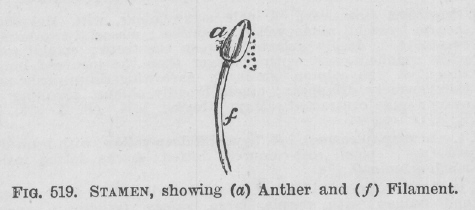
(from stamen, a thread; in allusion to the slender form). One of the male organs of flowers. In the Stamens the pollen is formed and ripened, before it is set free to fall on the stigma, and, through it, to gain access to and fertilise the ovules (see Ovule and Pollen). There are usually several Stamens in a flower, and the whole assemblage of them is often called the andraecium (from the Greek words aner, andros, a male, and oikos, a house). A complete Stamen is made up of two chief parts, the anther (a) and the filament (f) or stalk supporting the anther. In many plants, the filaments are long, and cause the anthers to project from the corolla or perianth. In other plants, they are shorter than the corolla; and in some there are no filaments (e.g., in Orchids, in which the anther and the styles are adherent to one another). The filaments are usually free from one another, and are long and slender; but in many plants they are broad, or bear outgrowths (Deutzia), or are united into groups by their base (Hypericum), or grow together so as to form a more or less complete tube (Eucharis, Hibiscus). The anther is usually oval or linear; and in by far the greater number of plants it is evidently made up of two lobes, separated lengthwise by a portion called the "connective," which is similar in structure to the filament, and, in many anthers, is evidently a prolongation of it. The connective is very narrow and inconspiouous in some plants; broad in others, so that the lobes are widely separated. In some it is prolonged beyond the lobes at the tip, as a plate, or backwards in spurs or outgrowths of various forms. The uses of these variations in form and position, the structure of the walls of the two pollen-spaces in each lobe, and the course of development of the pollen, are described under Nectary, Pollen, and Pollination. Stamens vary in number from one (Hippuris) to an indefinite number (Ranunculus); but most frequently there are three, four, or five, arranged in one circle, or six, eight, or ten, in an outer and an inner circle. On the number and arrangement of the Stamens, Linnaeus founded the great divisions in the classification named after him, and for years so widely used, and which is still frequently employed, as a most convenient key for rapidly determining the names of plants.