Stanhopea
(named in honour of Earl Stanhope, 1781-1855, President of the Medico-botanical Society). SYN. Ceratochilus. ORD. Orchideae. A genus including about thirty species of beautiful, stove, epiphytal Orchids, natives of tropical America, from Brazil to Mexico. Flowers large, few, in a loose raceme, pedicellate; sepals and petals free, spreading, the latter sometimes undulated; lip thick and fleshy, variable and remarkable in structure; the hinder portion (hypochil) usually saccate, the middle part (mesochil) often two-horned, and the anterior portion (epichil) more or less movable; column erect or incurved; pollen masses two; bracts membranous, spathe-like; scape deflexed or pendulous. Leaf ample, plicate-veined, contracted into the petiole. Stem very short, many-sheathed, one-leaved, usually thickened below into a fleshy pseudo-bulb. Although the flowers of the Stanhopeas are ephemeral, lasting but a few days in perfection, yet their free-blossoming habit should secure their presence in all collections. Some of the flowers are very handsome, and many are very strongly perfumed.
On account of the peculiar manner in which they are produced, the plants should be grown in baskets made even more open at the bottom and sides than is usual for other Orchids, as the racemes are pendulous, and often come out from beneath the basket. The latter should be suspended in a stove or house devoted to East Indian and Brazilian Orchids, and kept watered liberally during the period of growth. When at rest, the roots should be kept rather dry. The plants should be surrounded with fresh sphagnum, a few lumps of turfy peat, and some charcoal. The leaves should be sponged occasionally with clean water, as they are liable to be attacked by thrips and red spider. Propagation is effected by division of the old plants.
S. aurea (golden). A synonym of S. Wardii aurea.
S. Bucephalus (bull-horned).* fl. emitting a powerful fragrance; sepals, petals, and hypochil pale rich yellow, with purple dots and small blotches everywhere except on the hypochil; hypochil boat-shaped; mesochil two-horned; epichil roundish-ovate, cuspidate; raceme deflexed, consisting of several flowers. August. l. stalked, oblong, acuminate, plicate. h. 2ft. South Mexico to Peru, 1843. A remarkably handsome Orchid. (B. M. 5278; B. R. 1845, 24.)
S. B. guttata (spotted). fl., sepals, petals, and hypochil of a deep apricot-colour; each petal, and the hypochil, marked with four brown blotches.
S. B. Roezlii (Roezl's). fl., sepals, petals, and base of the lip deep saffron-yellow, spotted with brown; horns and column white, the latter also dotted with purple. Nicaragua, 1874. (R. G. 785.)
S. cirrhata (tendrilled). fl. absolutely solitary; sepals white, obtuse, much longer than the ovate, yellow petals; lateral horns of the yellow and violet lip produced from the hypochil, which is three-ribbed within, and rounded outside; mesochil wanting; epichil ovate, undivided; bracts spathe-like, imbricated, longer than the ovaries; column wingless, extended into a pair of feelers, as in some Odontoglots. h. 1ft. Nicaragua, 1840. (G. C. 1850, p. 295; L. & P. F. G. i. p. 31, 19.) S. deltoidea (deltoid). fl. of a palish yellow, dotted over with crimson specks, large; lip orange-coloured, blackish-brown at the base, and marked on each side with a reddish-brown spot. Peru (?), 1862.
S. Devoniensis (Duke of Devonshire's). fl. pale creamy-yellow, thickly and irregularly spotted with deep crimson-purple, sweetly scented; dorsal sepal and petals barred near the base; lip whitish, purple-spotted; hypochil sub-globose, with a deep purple stain over the lower half; mesochil short, two-horned; epichil obtusely angled, rhomboid, obsoletely three-toothed at the end; peduncle bearing two flowers. July and August. l. shortly petiolate, lanceolate, plicate, pale green. Pseudo-bulbs ovate, ribbed. h. 1 1/2ft. Guatemala, 1853. (F. d. S. 974; L. S. O. 1.)
S. eburnea (ivory-like). fl. white, fragrant; lip oblong, twice as long as the petals; hypochil and mesochil dull purple, or spotted with purple on the upper side, the latter solid, changing, truncate; epichil ovate; column very long; bracts shorter than the ovary; scape lax, pendulous. June. Venezuela, Guiana, and Brazil, 1828. (B. M. 3359; B. R. 1529.)
S. e. spectabilis (remarkable). fl. pale straw-coloured, powerfully scented; sepals broad; petals narrow; lip white, varnished, unmarked, except a pair of crimson lines, and a few small crimson dots at the base. Venezuela, 1868. (I. H. 531.)
S. ecornuta (hornless). fl. in pairs, about 4 1/2in. across; hypochil somewhat slipper-shaped, extremely fleshy, bright orange, passing into pure white towards the point, handsomely purple-blotched on its sides, hornless, but having four little tumours; the rest of the flower pure white, except a few purple spots near the base of the firm, concave petals; bracts shorter than the ovary; scape short, pendulous. Central America, 1854. According to Dr. Lindley, this "may be regarded as a species with the hypochil (or lower half of the lip) alone present." (B. M. 4885; L. & P. F. G. i. 31; F. d. S. 181 and R. X. O. i. 43, under name of Stanhopeastrum ecornutum.) S. florida (flowery). fl. white, large; sepals and petals marked on the inside with small, purple spots; lip covered with small, purple dots, and having a large blotch on each side between the two keels. Mexico (?), 1880. (G. C. xvi. pp. 561, 565; R. G. ii. 39.)
S. gibbosa (gibbous). fl. dull yellow, blotched and barred with dull crimson, the colouring becoming darker on the sepals, about 6in. in diameter; hypochil incurved, keeled on each side; mesochil furnished with ligulate-falcate horns; epichil oblong, acute. June and July. Central America, 1870. A fine species, somewhat resembling S. Wardii.
S. grandiflora (large-flowered).* fl. pure white, except a few crimson dots on the middle and basal parts of the lip, fully 6in. in diameter when expanded, very fragrant; hypochil roundish, two-horned in front; mesochil solid, truncate, hornless, but obsoletely three-toothed; epichil ovate; column very long; scape short, pendent. l. broadly lanceolate, plicate. Pseudo-bulbs ovate, furrowed. Trinidad, 1824. SYN. Ceratochilus grandiflorus (B. iv. 176).
S. graveolens (strong-smelling). fl. having an extremely powerful and disagreeable odour; sepals and petals delicate straw-colour; lip at the base, and the central parts of the flower generally, of a rich, deep apricot-yellow, while the horns and upper end of the lip are like ivory turning yellow; column very broad, winged to near the base, so as to have almost the form of a parallelogram; bracts narrow, scarcely equalling the ovary; spike expanded. Guatemala (?), 1843.
S. g. aurita (eared). A variety with flowers wholly of a deep apricot-colour.
S. guttulata (slightly spotted). A synonym of S. oculata. S. inodora (scentless). fl. pale straw-colour, with the short, saccate hypochil alone yellow, scentless; mesochil two-horned, two-toothed, deeply sulcate between the teeth; epichil some-what rounded-ovate, entire, longer than the incurved horns; wings of the column gradually narrowing downwards until they entirely disappear; bracts broadly oblong, equalling the ovary; spike contracted. May. Mexico, 1844. (B. R. 1845, 65; R. X. O. 165.)
S. i. amoena (pleasing). fl., hypochil deep yellow, with brownishred eyes; epichil rose-coloured, dotted; horns dotted inside, much acuminate.
S. insignis (remarkable).* fl. of a pale dull yellow, richly spotted and stained with purple, large, showy, fragrant; hypochil globose, split in front; mesochil bearing falcate, incurved horns; epichil roundish-ovate, entire, shorter than the horns; column remarkable for its broadly-winged margin, which gives it almost the shape of a battledore; spike drooping, three or four-flowered. August and September. l. broadly lanceolate, dark green, plaited. Pseudo-bulbs clustered, ovate, furrowed. Brazil, 1826. A very handsome species, the type of the genus. (B. M. 2948-9; B. R. 1837; L. B. C. 1985; R. X. O. 164.)
S. i. flava (yellow). fl. wholly yellowish, very sweet-scented.
S. macrochila (large-lipped). fl. white or cream-coloured, marked with crimson spots disposed in lines. Mexico, 1859. (I. H. vi. p. 71.)
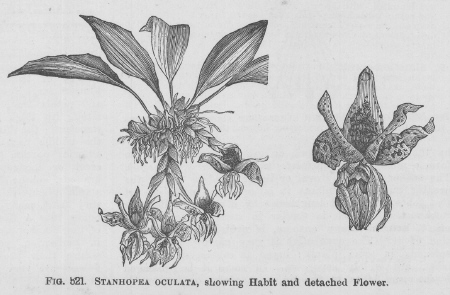
S. Martiana (Martius'). fl., sepals pale straw-coloured, with a few small, vinous spots; petals white, larger-spotted, and with a broad blotch of crimson at base; lip white; hypochil short, sessile, scrotiform; mesochil short, with nearly straight, cirrhose horns; epichil oblong-linear, obscurely three-toothed; column pubescent, the margins scarcely dilated; peduncles two-flowered. Autumn. l. lanceolate, plicately veined. Pseudo-bulbs ovate, furrowed. Mexico, 1843. A magnificent and distinct species. (F. d. S. 2112-3; B. R. 1843, 44, under name of S. M. bicolor.) SYN. S. velata. S. oculata (eyed).* fl. usually lemon-coloured, with a large number of lilac spots on the sepals, a smaller number on the petals, a deep yellow eye, and two, or occasionally four, large, dark brown spots on the side of the hypochil, which is very much lengthened out, as if unguiculate; horns semi-terete, ascending, acute; peduncle bearing a drooping raceme of about six flowers. July to November. l. large, broadly lanceolate, nerved. Pseudo-bulbs small. Mexico, 1829. A free-flowering and very showy species. See Fig. 521. (B. M. 5300; B. R. 1800.) SYNS. S. guttulata, Ceratochilus oculatus (L. B. C. 1764). Numerous varieties of this species occur in gardens, varying in colour and in the spotting of the lip. Most of them are sweet-scented.
S. o. Barkeriana (Barker's). See S. o. Lindleyi.
S. o. crocea (saffron-yellow). A synonym of S. ornatissima.
S. o. Lindleyi (Lindley's). fl. of a dull wine-red, but little spotted. S. o. Barkeriana is probably the same as this.
S. ornatissima (very ornate). fl. of a deep orange-colour, spotted with red, and marked towards the base with large blotches of reddish-brown; spikes drooping, six to seven-flowered. l. plaited. Peru (?), 1862. (I. H. 325; R. G. 189, under name of S. oculata crocea.)
S. platyceras (broad-horned). fl. nankeen-yellow, marked with purplish dots and circles of small points, large; hypochil marked on each side with one large, brownish-purple spot. New Grenada, 1868. This plant is closely related to S. grandiflora. (Ref. B. 108.) S. pulla (blackish). fl. apricot-yellow, small; lateral sepals oblong, acute, reflexed, the upper one narrower; petals very bright yellow, shorter, narrower, ligulate, acute, very bright yellow; lip very bright, shining, like a plump shoe with a roundish knob at its top and with sharp, semi-oblong side borders; inside stands a nearly square body with four keels, converging like the letter V; between this and the apical knob is an inconspicuous, transverse slit; knob white; the side borders and V-like keels brownish-purple; peduncle short, strong, two-flowered. Pseudo-bulbs short, conical, ribbed, dark. Costa Rica, 1877. (R. X. O. 205.)
S. quadricornis (four-horned). fl. pale yellow, sparingly spotted with crimson; hypochil oblong, having two prominent horns standing erect on the lower edge of the cavity; mesochil two-horned, fleshy, excavated; epichil ovate, entire, shorter than the terete, incurved horns; bracts very short, narrow. Central America. (B. R. 1838, 5.)
S. radiosa (rayed). A synonym of S. saccata.
S. Reichenbachiana (Reichenbach's). fl. of a delicate shining white; sepals and petals becoming ochre-coloured; hypochil becoming rosy, semi-globose, prolonged on the upper border into an angle; mesochil solid, with a deep channel, abrupt in front; epichil triangular, rather convex. Columbia, 1879. A curious plant, resembling S. eburnea, but larger and more conspicuous.
S. Ruckeri (Rucker's). "A noble species, with the habit of S. Wardii, and its general colour, except that it is paler; but the epichil is beautifully stained with pink, and the eyes of the hypochil are very faint. It is distinctly separated by the peculiar form of the hypochil, which, instead of being oblong, is so much narrowed to the base as to be obovate; by the entire want of lateral teeth on its margin; and by the presence of a very strong, inflexed tooth, in which the wide, not closed-up fissure of the mesochil terminates" (Lindley). Nicaragua, 1843. (L. J. F. 375, under name of S. R. speciosa.) S. saccata (saccate). fl. greenish-yellow, regularly speckled, but not blotched, with brown, deep yellow at base, small; sepals and petals turned completely back on the ovary; hypochil very deep and incurved; mesochil reduced to space sufficient for the development of two broad, flat horns; epichil oval, three-lobed; bracts shortened. Guatemala, 1836. SYN. S. radiosa (I. H. viii. 270).
S. Shuttleworthii (Shuttleworth's). fl. having the sepals, petals, and basal part of the lip apricot-colour, with dark purple blotches; front part of the lip whitish-yellow, with dark purplish spots on the anterior blade; column whitish, with a green middle part, spotted with purple on the inside. Columbia, 1876. This is allied to S. insignis.
S. tigrina (tiger-marked).* Lynx Flower. fl. deep orange-yellow, richly blotched with purplish-brown, powerfully scented, as much as 8in. in diameter; hypochil roundish, yellow, having radiating, toothed lamellae within the cavity; mesochil two-horned; epichil oval, equally trifid, equalling the flat, falcate horns; column excessively broad; raceme three or four-flowered. July to September. l. large, broadly lanceolate, deep green, plicate. Mexico, 1836. This is, without doubt, the finest species of the genus. (B. M. 4197; B. R. 1839, 1; F. d. S. 713-5, under name of S. t. superba.)
S. t. lutescens (yellowish). fl. brilliant yellow, inclining to orange, barred with deep chocolate, very large and handsome. Guatemala. A grand variety for exhibition.
S. t. nigro-violacea (blackish-violet). fl. wholly of a deep brown-purple, except the edges of the sepals and petals and the upper half of the lip. S. tricornis (three-horned). fl. whitish-ochre, with darker tips, having crimson spots on the disk and base of the petals and on the base of the sepals; dorsal sepal reflexed over the ovary, the lateral ones spreading; petals entirely covering the lip; hypchil marked on the outside with white, longitudinal lines, rough within and purple dotted, half-globular; epichil orange-ochre, having a third horn at the base in addition to the two present at the side; horns ligulate, acute; peduncle pendent, two-flowered. Pseudo-bulbs small. Peru, 1879. (L. & P. F. G. i. p. 31; F. M. n. s. 469.)
S. velata (veiled). A synonym of S. Martiana.
S. venusta (charming). A form of S. Wardii.
S. Wardii (Ward's).* fl. showy, and deliciously scented; sepals and petals golden-yellow, much dotted with purple; lip pale yellow, with two large, dark velvety-purple spots on the deep yellow, oblong, depressed hypochil; mesochil having two fleshy horns dotted with purple; epichil roundish-ovate, acute, with two semi-terete, falcate, sub-cirrhose horns, also thickly spotted with purple; racemes drooping, several-flowered. l. broad, acuminate, plicate. Guatemala and Venezuela, 1836. (B. M. 5289; L. S. O. 20.) S. venusta is a whole-coloured variety of this species. S. graveolens (F. d. S., Aug., 1846) is a form of S. Wardii, having flowers of a dirty-white colour, merging into golden-yellow at the centre.
S. W. aurea (golden). fl. of a deep orange-yellow, large and fragrant; hypochil bearing two dark spots "which are in some manner lost in the flood of yellow that surrounds them" (Lindley). Summer and autumn. 1835. SYN. S. aurea.
S. Warscewicziana (Warscewicz's). fl., sepals and petals dirty-white, the latter very acuminate; hypochil yellowish-white, globose, highly glabrous within; mesochil two-horned, deeply sulcate, with reflexed teeth; epichil finely dotted with red; horns very acute, incurved; column broadly winged, unguiculate bracts much shorter than the ovary. Chiriqui Mountains. (R. X. O. ii. 125.) S. xytriophora (pitcher-bearing). fl. of a pale straw-yellow, with purple markings on the base of the lip and purplish dots on the rhomboid epichil; hypochil remarkably short. Peru, 1868.