Stapelia
(named by Linnaeus after Boderus a Stapel, a physician of Amsterdam, and commentator on Theophrastus; he died in 1631). Carrion Flower. Including Caruncularia, Gonostemon, Orbea, Tridentea, and Tromotriche. ORD. Asclepiadeae. A large genus (upwards of sixty species have been described) of low, thickly fleshy, leafless, greenhouse succulents, confined to South Africa. Flowers usually large and showy, but having a foetid odour (like carrion), solitary, twin, or rarely fascicled, at the base or sides of the branches, on short, or rarely long, peduncles; calyx five-parted, with five glands within the base; corolla livid-purple or pale yellow, spotted and marbled, with a very short tube, and a much-spreading, five-lobed limb, the lobes broad or narrow, valvate; corona double, the outer horizontally spreading and deeply five-lobed, the inner consisting of five scales; stamens affixed at the base of the corolla. Stems deeply four-angled and toothed; young specimens sometimes having a caducous, rudimentary leaf at the apex of the teeth. A selection of the species most worthy of cultivation is given below. All require a thoroughly well-drained compost. This can be obtained by using a good supply of pieces of brick rubbish amongst the sandy loam in which they are potted. During winter, they should have but little water. A shelf near the glass, in a light, sunny, airy place, is best adapted for them. Propagated by cuttings. Several plants formerly included under Stapelia, will now be found under Duvalia, Huernia, Piaranthus, and Podanthes (which see).
S. anguinea (snake-speckled). fl. glabrous; corolla yellow, marked with numerous rufous spots; orb large, marked with large spots of two forms, dark brown-yellow on the sides near the base; gynostegium dotted with dark brown; peduncles solitary in the axils of the branchlets. June and July. Branches erect, with sub-recurved teeth. h. 6in. 1812. (L. B. C. 828; B. M. 1169, under name of S. picta.)
S. Asterias (star-fish).* Starfish Flower. fl. large; corolla of an obscure violet-colour, the segments variegated with transverse, yellowish stripes, the bottom dark purple; segments lanceolate, oblique, with revolute margins, ciliated, wrinkled; peduncles often solitary. May to November. Branches many, erect, toothed; teeth short and erect, or slightly incurved with an acumen. h. 6in. 1795. One of the handsomest species. (B. M. 536; L. B. C. 453.) S. barbata (bearded). A synonym of Huernia barbata.
S. Bayfieldii (Bayfield's). fl., corolla 2 1/2in. to 2 3/4in. in diameter, with the lobes expanded; back puberulous, green, tinged with purple, the nerves darker; face glabrous, purple-red, darker towards the tips, the centre to half-way up the lobes marked with numerous pale yellow, transverse lines; ligulae dull brownish-red or dark purple-brown; peduncles two lines long, three to five-flowered; pedicels eight to ten lines long. Stems erect, branching at base, 6in. to 8in. high, seven to nine lines thick, puberulous, with concave sides, and stout, short, nearly horizontal, teeth. Before 1877. (G. C. n. s., vii. p. 430.)
S. bufonis (toad-like). A synonym of S. normalis.
S. campanulata (bell-shaped). A synonym of Huernia campanulata.
S. Corderoyi (Corderoy's). A synonym of Duvalia Corderoyi.
S. Courcelli (Courcell's). A garden synonym of S. patentirostris.
S. Curtisii (Curtis's). fl., corolla much spreading, deeply five-cleft; segments sulphur-colour, with transverse, oblong spots of dark blood-colour, ovate, acuminate, glabrous; tube yellowish; peduncles one-flowered, reflexed. June to September. Branches tetragonal, with acute, or slightly reflexed, teeth. h. 1ft. 1690. (B. M. 26 and R. H. 1857, p. 43, under name of S. variegata.)
S. deflexa (deflexed). fl., corolla deeply five-cleft, about 2in. in diameter; segments lanceolate, acute, dingy greenish or pale reddish, ciliated, revolute on the margins, wrinkled; pedicels on a short and thick peduncle, much spreading, one-flowered. Summer. Branches ascending, erect, glabrous, tetragonal, with erect teeth on the angles. 1815. h. 4in. to 6in. (B. M. 1890; L. B. C. 135.) S. divaricata (divaricate-branched). fl., corolla greenish-brown outside, flesh-coloured within, tipped with green, glabrous, shining; segments lanceolate, spreading, with revolute, ciliated edges; corona orange, the outer segments mucronate; pedicels twin or tern. June to November. Branches numerous, tetragonal, glabrous, gradually attenuated, with small, erect teeth. h. 6in. 1793. (B. M. 1007; L. B. C. 941.)
S. eruciformis (caterpillar-like). A garden synonym of S. olivacea.
S. gemmiflora (bud-flowered). fl., corolla large; segments dark fuscous, spotted with yellow at the throat, transversely and loosely wrinkled, ovate, acute; peduncles two or three. October and November. Branches many, erect, tetragonal, with sub-erect, acute teeth. h. 6in. 1795. (B. M. 1839.)
S. gigantea (gigantic). fl. pale yellowish, covered with irregular, brownish-red lines, and suffused with reddish around the corona, of an enormous size, 12in. to 14in. in diameter, the surface wrinkled, and sparsely covered with short, pale hairs; lobes lanceolate, acuminate, the margins fringed with similar hairs; corona dark purplish-brown. Stems resembling those of S. Plantii. h. 6in. 1862. The finest plant of the whole genus. (G. C. n. s., vii. p. 693.)
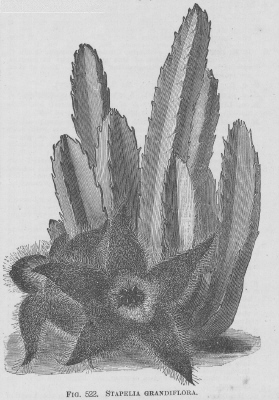
S. glabriflora (glabrous-flowered). fl., corolla deeply five-lobed; lobes lanceolate, acuminate, at first spreading, and then 3in. to 4in. in diameter, afterwards strongly reflexed, the face entirely glabrous without a fringe, dull red-purple, with numerous transverse, yellowish-white lines; corona dark purple-brown, the ligulae linear, concave, recurved at apex, obtuse, with a minute tooth; wings free to the base, divergent, oblong, obtuse; pedicels 1/2in. long, pubescent. Stems pubescent, erect, quadrangular. h. 4in. to 8in. 1862. This is known in gardens as S. grandiflora minor. (G. C. n. s., vi. p. 809.) S. grandiflora (large-flowered). fl. large, rather flat; corolla dark purple at the bottom, but the ovate-lanceolate segments are of a lighter purple, ciliated with grey hairs, and striped with white; peduncles three-flowered. September to December. Branches quadrangular, clavate, downy, with remote tubercles or teeth. h. 1ft. 1795. Plant grey from down. See Fig. 522 (R. H. 1858, p. 152.)
S. g. lineata (lined). This only differs from the type in the corolla lobes being marked across the basal half with yellow lines. 1873. (G. C. n. s., vii. p. 559.)
S. g. minor (lesser). A garden synonym of S. glabriflora.
S. Gussoniana (Gussone's). A synonym of Boucerosia europaea.
S. hamata (hooked). fl., corolla blood-coloured, 3in. across, flat, ciliated, wrinkled above, with a hairy centre; segments trans versely striped with white, acuminated, ciliated with red hairs; outer coronal segments emarginate, the inner leaflets linear-subulate hooked. July and August. Branches erect, tetragonal, shining green; young ones sulcate; adults flatter, with short, erect or incurved, pale teeth. h. 3in. 1820. (L. B. C. 242.)
S. hirsuta (hairy). fl., corolla, yellowish, with transverse, deep violet stripes, a pale red, villous bottom, and red nectaries, wrinkled; segments villously ciliated with white hairs: outer coronal segments acute, lanceolate, the inner leaflets spreading. July and August. Branches erect, slightly villous, dingy green, sulcate-tetragonal, floriferous at the base, the angles having erect teeth. h. 6in. 1710. (H. E. F. 230.) The variety atra has deep purple flowers. (B. R. 756.) S. laevis (smooth). fl. showy; corolla segments lanceolate, acute, green beneath, purple above, yellowish at apex, dotted with dark red; peduncles long, one-flowered; inner coronal leaflets carunculate. June to November. Branches stout, and, as well as the branchlets, oblong, smooth, obscurely sulcate, not toothed. h. 3in. 1790. (B. M. 793, under name of S. pedunculata.) SYN. Caruncularia pedunculata.
S. maculosa (spotted). fl. very foetid; corolla smooth, ciliated; segments dirty yellow, red at the tips and edges, almost covered by large, confluent, rufous spots, ovate, acute; orb waved, elevated, downy; peduncles three or four, aggregated at the bases of the younger branches. June to September. Branches very numerous, erect, glabrous, green; adults loosely pubescent, tetragonal, with spreading teeth. h. 1ft. 1804. (B. M. 1833.)
S. Massoni (Masson's). fl. 4in. to 4 1/2in. in diameter; corolla brownish-purple, marked with a few, narrow, yellowish lines on the glabrous lobes and the disk thickly covered with fine, short, purple hairs. July. Branches quadrangular, pubescent. An old garden plant.
S. mutabilis (changeable). fl., corolla greenish-yellow, with numerous transverse, purple stripes, ciliated with red, clavate, tremulous hairs; inner branch of the inner corona clavate; ligulae three-toothed; peduncles usually in twos or threes. June and July. Branches erect, tetragonal, narrow, with erect, obtuse teeth. h. 6in. 1823.
S. namaquensis (Namaqualand).* fl. large; corolla bright yellow, with crowded and more or less confluent, dark purplish-brown spots; lobes much wrinkled, not fringed; outer coronal lobes entire, acute. Branches thick, glabrous, beautifully mottled. h. 3in. to 4in. 1883. One of the handsomest species.
S. n. tridentata (three-toothed). fl. having the corolla lobes fringed with short hairs, and the outer coronal lobes truncately three-toothed at apex. 1883.
S. normalis (normal). fl., corolla much spreading, 2in. or more in diameter; segments yellow, with transverse stripes and spots of dark blood-colour, ovate, acute, outwardly of a pale sulphur-colour, lined; peduncles solitary, one-flowered, much spreading. July and August. Branches many, declinate or ascending, glabrous, tetragonal, with much-spreading teeth. h. 6in. 1821. (B. R. 755; B. M. 1676, under name of S. bufonis.)
S. olivacea (olive-coloured). fl. very foetid, two to six from the bases of the younger branches; corolla dull green and puberulous outside, glabrous within, with numerous crowded, brown, transverse rugae on a dark olive-green or sometimes pale olive ground, about 1 1/2in. in diameter; coronal scales dark purple-brown; peduncles two to three lines long. September. Stems erect, rather slender, branching at base, minutely puberulous, 3in. to 5in. high, 3/8in. to 1/2in. thick, with rounded edges, becoming blotched with purple on full exposure to the sun. 1874. (B. M. 6212; G. C. n. s., iii. p. 137.) SYN. S. eruciformis (of gardens).
S. orbicularis (orbicular). fl., corolla pale yellow, having approximate, brownish lines on the segments, much spreading; segments cordate, recurved at apex, acuminate, striate-wrinkled; orb yellow, dotted with brown, tumid; peduncles near the base of the branchlets, solitary, one-flowered. July to November. Branches many, erecto-patent, tetragonal, with mucronulate teeth. h. 6in. 1799. (A. B. R. 439; F. d. S. 1281; L. B. C. 811.)
S. patentirostris (spreading-beaked). fl. one to three together, on pedicels 1 1/2in. long; corolla 2 1/2in. to 3 1/2in. in diameter, the face wrinkled, rich dark purple-brown, with numerous transverse, yellowish lines on the basal part of the lanceolate, acuminate lobes, the centre densely villous with rich purplish-red hairs, the lobes fringed with long, pale purple hairs; ligulae linear-lanceolate, obtuse, with a central tooth; wings linear-oblong, horizontal; rostra subulate, horizontally recurved over the wings, reaching nearly to the sinuses of the corolla. Autumn. Stems rather slender, puberulous, toothed. h. 6in. 1870. Also cultivated under the name of S. Courcelli. (G. C. n. s., vii. p. 140l; B. M. 5963, under name of S. sororia.) S. pedunculata (long-peduncled). A synonym of S. laevis.
S. picta (painted). fl., corolla sulphur-coloured, marbled and spotted with dark blood-colour; segments ovate, acuminate; wrinkled; orb elevated, much wrinkled, depressed in the middle; peduncles from the base of the branchlets, solitary, one-flowered. June to September. Branches simple, erect, tetragonal or quadri-sulcate, slightly torulose. h. 6in. 1799.
S. pilifera (bristle-bearing). A synonym of Trichocaulon pilifera.
S. planiflora (flat-flowered). fl., corolla much spreading, half-quinquefid; segments pale sulphur-coloured, lined and spotted with dark purple, ovate, acuminate, transversely wrinkled; peduncles from the axils of the younger branchlets, solitary or twin, one-flowered. July to November. Branches many, branched, ascending or nearly erect, glabrous, sulcate-tetragonal, with much-spreading teeth. 1805. (L. B. C. 191.)
S. Plantii (Plant's). fl. on stout, pubescent peduncles; corolla 5in. in diameter, villous round the throat; lobes purplish-brown in the centre, and there transversely barred with wavy, yellow bands, broadly black-purple at apex and on the margins, 1in. to 1 1/2in. broad, ovate-lanceolate, ciliated with long hairs. November. Stem stout, creeping; branches downy, 5in. to 9in. long, erect, columnar or sub-clavate, with four thick, remotely-toothed wings. 1866. (B. M. 5692; F. d. S. 2012.)
S. pulvinata (cushion-flowered). fl., corolla deep violet, large, flat, elevated and very villous at the bottom; segments variegated with whitish, transverse wrinkles, fuscous and concave at the apex, rufous beneath, roundish, abruptly acuminate, ciliated; peduncles mostly solitary, terete, from the axis of the branchlets. June to November. Branches and branchlets many, reclinate, with erect, green teeth. 1795. A very elegant species. (B. M. 1240; L. B. C. 206.) S. revoluta (revolute-flowered). fl. sub-solitary, on very short peduncles; calyx segments acute; corolla red, with whitish blotches, smooth, very fleshy, the segments revolute, with fringed margins. July. Branches tetragonal, erect, denticulated, the sides hollowed out. 1801. (B. M. 724.)
S. rufa (rufous). fl., corolla glabrous; segments of an obscure violet, variegated with deep purple or pale red, transverse stripes, having the bottom stellate, rufous, and variegated, the margins ciliated with dark violet hairs; peduncles two or three together, short, purplish. June to November. Branches erect, tetragonal, with small, erect, obtuse teeth. h. 3in. to 6in 1795. (L. B. C. 239.)
S. Simsii (Sims'). fl., corolla ample, flat, glabrous; segments dark violet, with slender, whitish lines about the throat, without greenish or obscurely tinged with violet, ovate, acuminate, five-nerved; peduncles erect, at the tips of the branchlets. May to November. Branches glabrous, the angles obsoletely nippled, toothed; teeth having a green, deciduous acumen. h. 3in. to 6in. 1800. (B. M. 1234, under name of S. vetula.)
S. sororia (sisterly).* fl. 3in. to 4 1/2in. in diameter; corolla clothed with long hairs; lobes dark vinous-purple, ovate, acuminate, transversely wrinkled, the folds towards the base bright orange-yellow; processes of the column deep purple; peduncles solitary or twin, 3in. to 4in. long. July. Stems 6in. to 10in. high, with erect or horizontal branches 1/3in. to 2/3in. in diameter, the angles toothed at intervals of 1/3in. to 2/3in., the teeth soft and incurved. 1797. Plant pale green, glabrous, variable in size. (L. B. C. 94.)
S. spectabilis (showy). fl., corolla large, flat; segments ovate-lanceolate, furnished from the base behind the middle with dense, red hairs, and having pale stripes on the upper surface, with black tips. November to January. Branches quadrangular, clavate, toothed on the angles, the teeth remote, incurved, whitish. h. 1ft. 1802. (B. M.585, under name of S. grandiflora.) S. stricta (straight). fl. segments of corolla purple, with pale greenish margins, ovate, acuminate, nearly flat, glabrous, not ciliated; peduncles growing from the base of the branches. June to November. Branches tetragonal, smooth, simple, straight. h. 3in. 1814. (B. M. 2037.)
S. tsomoensis (Tsomo River). fl., calyx lobes 1/4in. long; corolla 3in. in diameter, the face entirely dull smoky-purple, darker at the tips of the lobes, or with some of the ridges greenish or dirty-yellowish, the disk and base of the lobes covered with purple hairs; lobes ovate-lanceolate; outer coronal segments purplish-black; pedicels 3/4in. to 1in. long; cymes sub-sessile, four to nine-flowered. Summer. Stems 4in. to 6in. high, five to eight lines thick, the angles compressed, repand-toothed, very minutely puberulous. 1882.
S. unguipetala (claw-petaled). fl. 4in. to 4 1/2in. in diameter; corolla rich purple-brown, marked two-thirds the way up the lobes with transverse, yellowish lines, the centre of the disk and five bands radiating to the sinuses, pale greenish-ochre; lobes lanceolate-attenuate, incurved-hooked at apex, fringed with long, pale purplish hairs, and the disk covered with long, silky, purplish-red hairs, the rest glabrous; ligulae lanceolate, acute, and, as well as the free, deltoid-oblong wings and the recurving rostra, dark purple-brown. h. 6in. 1877. Allied to S. patentirostris. (G. C. n. s., vii. p. 335.)
S. variegata (variegated). A synonym of S. Curtisii.
S. vetula (oldish). A synonym of S. Simsii.