Statice
(the Greek name, used by Pliny for some astringent herb; from statikos, astringent). Sea Lavender. SYN. Taxanthema. ORD. Plumbagineae. A large genus (upwards of 120 species have been described) of greenhouse, half-hardy, or hardy herbs, sub-shrubs, or shrubs, chiefly inhabiting saline districts and shores of temperate seas, most commonly found in Western Asia. Flowers one or two in the bracts, or often in few-flowered, many-bracted spikelets; calyx usually funnel-shaped, with a scarious, spreading limb; petals connate with the stamens in a ring towards the base, or free to the base; bracts subtending the spikelets, small, scale-like; peduncles or scapes leafless, often branched, cymose, corymbose, or paniculate. Leaves in the stemless species radical and rosulate, in the tufted sub-shrubs clustered, in the small shrubs somewhat scattered at the sides of the branches, alternate, flat, sometimes entire, linear, spathulate, oblong, or obovate, sometimes sinuately pinnatifid or dissected. S. auriculaefolia, S. bellidifolia, and S. Limonium, are included in the British Flora. The hardy species thrive in sandy soil, in the open border, or on rockwork. Their flowers are excellent for cutting, and for intermixing with other flowers in glasses, &c.; they are also well adapted for drying like everlastings. Annual and biennial species may be propagated from seeds, sown in early spring, in a frame, the young plants being put out into their permanent places when large enough. The perennials may also be raised from seeds when any are procurable, or increased by means of careful division. Greenhouse Statices are very useful and ornamental plants, nearly always more or less in flower. They succeed in good, turfy loam, with a little charcoal or sand intermixed, and may be increased by cuttings, inserted in small single pots, during early spring, and placed under a bell glass.
A selection of the most popular species, from a horticultural standpoint, is given below. Except where otherwise stated, the plants are herbaceous perennials.
S. aegyptiaca (Egyptian). A synonym of S. Thouini.
S. arborescens (tree-like).* fl. blue; spikelets two-flowered, few, in short, secund, rather loose spikes; floral branches very short; scape tall, branched above, ample and sub-corymbosely panicled. July. l. ample, ovate-oblong, petiolate, obtuse, mucronate, attenuated at base. Stem branched above, at length leafy. h. 2ft. Teneriffe, 1829. Greenhouse shrub. (B. 47; B. M. 3776; B. R. xxv. 6 and P. M. B. iv. 217, under name of S. arborea.)
S. Bonduelli (Bonduelle's). fl. yellow, sessile, in terminal corymbs; peduncles repeatedly dichotomous, clavate; bracts scarious. June. l. radical, lyrate, attenuated to the petioles, dilated at apex, terminating in a subulate mucro, pilose above, villous beneath. Stems tufted, branched, hairy at base. h. 1ft. North Africa, 1859. Greenhouse. (B. M. 5158; F. d. S. 2129; R. G. 318; R. H. 1885, p. 276.)
S. Bourgaei (Bourgeau's). fl. purple and white; spikelets one or two-flowered, two or three in fascicles at the extremities of the branchlets; lower bracts slightly reddish; scape compressed, 6in. to 12in. high, corymbosely paniculate above. August. l. ample, petiolate, stellate-puberulous, oblong, attenuated at base, slightly sinuate or often lyrate, the terminal lobe ovate, obtuse, mucronate. Canary Islands, 1859. Greenhouse sub-shrub. (B. M. 5153; F. d. S. 2292.)
S. brassicaefolia (Brassica-leaved). fl. purple; spikelets two-flowered, two or three in fasciculate at the tips of the branchlets; lower bracts rufous, puberulous; scape angled, paniculately corymbose above. August. l. few, slightly ciliated on the margins, petiolate, lyrate; terminal lobe large, roundish-ovate, often irregularly lobed, very obtuse, cuspidate, sub-cordate at base; lateral ones two to four, ear-like, small, alternate, often confluent at base. h. 1 1/2ft. Canary Islands, 1859. Greenhouse sub-shrub. (B. M. 5162.) S. callicoma (beautiful-haired).* fl. pink; spikelets two-flowered, in short, rather broad, distichous spikes; scape dwarf; panicle ovate-triangular, sub-secund, the branches triquetrous. July. l. oblong and oblong-lanceolate, attenuated into the petioles, mucronate, white-tubercled, puberulous or glabrous. h. 1ft. Russia, 1804. Half-hardy. (R. G. 1063; B. M. 1629, under name of S. conspicua.)
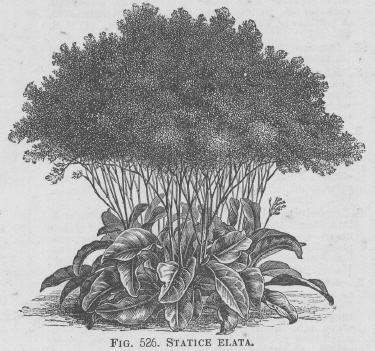
S. elata (tall).* fl. blue; spikelets two-flowered, in ovate, distichous, rather loose, imbricated spikes; bracts ovate, white-margined; scape 2ft. high, elongated-paniculate above, the branches hairy, triquetrous. July. l. obovate, very obtuse, often retuse and shortly mucronate at apex, rather long-attenuated into the petioles. Southern Russia, 1820. Hardy.
S. eximia (choice). fl. lilac, rose; spikelets about four-flowered, disposed in very dense, scorpioid-capitate, much-imbricated spikes; bracts pubescent; scape tall, paniculate or branched above, terete, pubescent; scape tall, paniculate or branched above, terete, pubescent. August. l. oblong or obovate, obtuse, shortly petiolate, narrowed, slightly crisped on the margins, long-attenuated into the petioles. h. 1ft. Songoria, 1844. Hardy. (B. R. 1847, 2.)
S. floribunda (bundle-flowered).* fl. violet-blue, produced in dense heads. 1882. A handsome plant, much resembling S. profusa.
S. Fortunei (Fortune's). A synonym of S. sinensis.
S. fruticans (shrubby). fl. blue; spikelets one or two-flowered, very few, in secund, very short, imbricated spikes; lower bracts ciliate-margined; scape 4in. to 6in. high, corymbose-paniculate or branched above, puberulous, closely compressed. Summer. l. near the base of the scape, ovate, 1 1/2in. to 2in. long, obtuse, mucronate, shortly attenuated into the petioles. Stem short, naked, terete. Canary Islands, 1847. Half-hardy shrub. (R. G. 319; F. d. S. 325, under name of S. frutescens.)
S. Halfordi (Halford's). A garden variety of, or hybrid from, S. macrophylla. S. imbricata (imbricated). fl. blue; spikelets three or four-flowered, few, in short, fascicled spikes; bracts velvety; scape tall, amply corymbose above, with undulated and broadly winged branches. Summer. l. lanceolate, lyrate-runcinate, with eight or nine lobes on each side, setose-mucronate, 9in. to 10in. long. h. 1 1/2ft. Teneriffe, 1829. A half-hardy, slightly tomentose sub-shrub. (F. d. S. 320, 321.)
S. incana (hoary), of Bieberstein. A synonym of S. tatarica angustifolia.
S. Kaufmanniana (Kaufmann's). fl. pink; scape 6in. to 16in. long, bearing several ascending spikes. Summer. l. all radical, lanceolate, acuminate, crisped, with thick margins. h. 1ft. Turkestan, 1880. A pretty, hardy perennial. (R. G. 996.)
S. latifolia (broad-leaved).* fl. blue; spikelets one (rarely two) flowered, rather remote, forming loose, very slender, slightly recurved spikes; bracts glabrous; scape tall, much-branched; panicle ample, effuse. June. l. large, oblong-elliptic, obtuse, long-attenuated into the petioles. h. 1ft. South Russia, 1791. Hardy.
S. leptoloba (slender-lobed). fl., calyx purple, stellate, funnel-shaped; corolla yellowish, small; spikes about 1/2in. long, few-flowered; scape slender, repeatedly forked. Summer. l. all radical, oblanceolate-spathulate. Turkestan, 1881. Habit tufted. Hardy. (R. G. 1045.)
S. macrophylla (large-leaved).* fl. white, twice as large as those of S. arborescens; spikelets two-flowered, twin, erect, at the tips of the branchlets; bracts velvety, the lower ones scarious-rufescent; scape tall, amply and much branched above, in a corymbose panicle. May. l. nearly glabrous, large, sessile, obovate-spathulate, very obtuse, the lower part long-attenuated, obsoletely sinuate. h. 2ft. Teneriffe, 1824. Half-hardy sub-shrub. (B. M. 4125; B. R. xxxi. 7.) S. macroptera (large-winged). fl. purple; spikelets two-flowered, in fascicles of two or three at the tips of the branchlets; wings of the floral branches very broad; scape tall, ample and spreading, very broadly paniculate-corymbose. Summer. l. slightly puberulous, at length glabrescent, ample, coriaceous, petiolate, lyrate; terminal lobe large, ovate, slightly acute, bristle-bearing at apex, sinuate-lobed; lateral ones much smaller, confluent. h. about 2ft. Canary Islands. Greenhouse. (I. H. iii. 105.)
S. pectinata incompta (comb-like, inelegant). fl. blue; spikelets three-flowered, distichous, in oblong, sub-scorpioid, spreading, densely-imbricated spikes; lower bracts rufescent; scape leafy, decumbent. September. l. rosulate at the base of the scape, or fascicled or solitary near the axils of the scales, obovate, obtuse or retuse, mucronate, attenuated into the petioles. Canary Islands, 1780. A half-hardy, calcareous-dotted sub-shrub. (B. R. xxvi. 65, under name of S. pectinata.)
S. profusa (profuse).* fl. disposed in well-branched, corymbose heads; calyx purple; corolla white. August. l. radical, 6in. to 8in. long, oval or somewhat spathulate, waved, leathery, shining, and dark green; outer ones prostrate. h. 2ft. A greenhouse hybrid between S. puberula and S. Halfordii. (F. M. 40.)
S. puberula (puberulous). fl. violet, as large as those of S. arborescens; spikelets two-flowered, few, at the tips of the branchlets, sub-distichous and rather loosely fascicled; bracts scarious-rufescent, pubescent; scape 3in. to 5in. high, paniculately corymbose. July. l. 1/2in. to 3/4in. long, ovate-rhomboid, slightly acute, bristle-bearing at apex, long-ciliated on the margins, shortly attenuated into the petioles. Graciosa, 1830. A whitish-pilose or puberulous, half-hardy sub-shrub. (B. 182; B. M. 3701; B. R. 1450.)
S. pumila alba. A mere garden name.
S. rosea (rosy).* fl. blue; spikelets one-flowered, clustered in short, terminal, horizontal spikes, with a flexuous rachis; bracts blackish, with white margins; scape terete, much-branched, paniculately corymbose above, tuberculate-scabrous. May. l. obovate-oblong, attenuated into the petioles, rough-tubercled on both sides. Stem short, leafy. h. 3ft. Port Natal, 1840. Half hardy sub-shrub. (B. M. 4055, under name of S. rytidophylla.)
S. rytidophylla (shrivelled-leaved). A synonym of S. rosea.
S. sinensis (Chinese). fl. yellow; spikelets two-flowered, in short, sub-secund, terminal spikes; lower bracts ovate, obtuse; scape tall, dichotomously branched just above the base, corymbose-fastigiate. April. l. obovate-lanceolate, obtuse, long-attenuated into the petioles. Stem acutely angled. h. 1ft. China, 1845. Plant hardy, glabrous. (B. R. 1845, 63, and F. d. S. ii. 28, under name of S. Fortunei.)
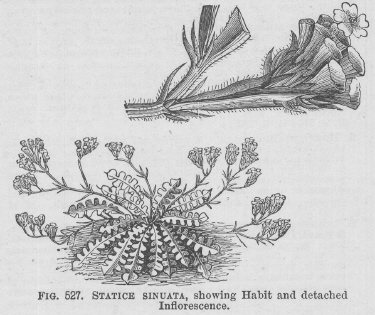
S. sinuata (sinuate-leaved).* fl. purple, yellow; spikelets three or four-flowered; spikes short, secund, nearly horizontal, the upper branchlets densely imbricated; lower bracts reddish; scape dichotomous, paniculately corymbose, three to five-winged. August. l. lyrate-pinnatifid, with rounded lobes, the terminal ones bristle-bearing. h. 1ft. Levant, 1629. Half-hardy. (B. M. 71; S. F. G. 301.)
S. spathulata (spathulate-leaved). fl., calyx white; corolla purple, obcordate, larger than the calyx; spikes in two rows; scape and branches perfectly round. August. l. radical, spathulate, obtuse, glaucous, entire. h. 1ft. Barbary, 1804. Hardy. (B. M. 1617.)
S. speciosa (showy). fl. white; spikelets three or four-flowered, in very short, scorpioid-capitate, distichous and very densely imbricated spikes; scapes densely corymbose above. July. l. nearly orbicular or oblong-obovate, abruptly attenuate-cuspidate, shortly narrowed at base. h. 1ft. South Russia, 1776. Half-hardy. (B. M. 656; L. B. C. 1336.) S. spicata (spike-flowered). fl. pink or white; corolla lobes ovate; spikelets two to four-flowered; spikes terminal, or often many, sessile, cylindrical, very dense. Summer. l. rosulate, glabrous or slightly hairy beneath, oblong-lanceolate, long-attenuated into a short petiole, obtuse, mucronate, entire or laciniate. h. 6in. Asia, 1819. Hardy annual.
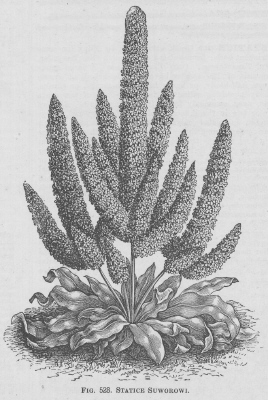
S. Suworowi (Suworow's).* fl. of a pretty lilac-colour, produced in dense, branched spikes. Summer. l. radical, oblong-lanceolate, entire or coarsely runcinate. Turkestan, 1883. A strikingly beautiful, hardy annual.G. C. n. s., xx. p. 393; R. G. 1095, f. 1-2.)
S. tatarica (Tartarian).* fl. bright ruby-red, 1/6in. long; spikelets sub-unilateral on the branches, one to three-flowered; scape stiff, erect, 2in. to 3in. long, soon giving off a long, broad, recurved panicle. June and July. l. tufted, 4in. to 6in. long, oblong, spathulate, or oblanceolate, acuminate, mucronate, rigid, glabrous, narrowed into the petioles. h. 1ft. South-east Europe, 1731. Hardy.(B. M. 6537.)
S. t. angustifolia (narrow-leaved). A variety with narrower leaves than the type. SYN. S. incana (of Bieberstein).
S. Thouini (Thouin's). fl. yellow; spikelets two or three-flowered; spikes secund, very short, angled, straight; scape corymbose above, more or less broadly three-winged, subdichotomous. May. l. sinuate or lyrate-pinnatifid, the lobes and sinuses rounded, the margins shortly ciliated. h. 1 1/2ft. Teneriffe, Greece, Palestine, North Africa, &c., 1829. A half-hardy, glaucescent annual. SYN. S. aegyptiaca (B. M. 2363).