Home › S › Sterculiaceae (This genus about sixty species)
Sterculiaceae (This genus about sixty species)
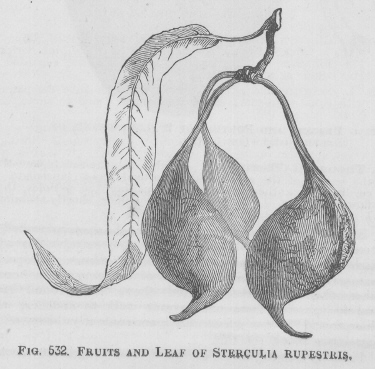
Of this genus, about sixty species have been described as such, but probably not more than fifty are really distinct; they are stove or greenhouse, evergreen trees, inhabiting the warmer regions of the globe, being most plentiful in tropical Asia. Flowers paniculate or rarely racemose, the inflorescence usually axillary; calyx five-cleft or five-parted, rarely four-parted, often coloured; petals wanting; staminal column bearing at the summit fifteen (or rarely ten) stamens. Leaves undivided, obed, or digitate. The species introduced, a selection of which is given below, succeed in a light, loamy soil, or a compost of loam and peat. Ripened cuttings, with the leaves intact, will readily root in sand, under a hand-glass; those of the stove species require a moist heat.
S. Balanghas (Balanghas). fl. purplish, panicled; calyx segments linear, five-cleft to the middle, the segments connivent. June to September. l. elliptic-oblong, rather blunt, entire, nearly smooth. h. 30ft. Malabar and East Indies, 1787. Stove.
S. Bidwilli (Bidwill's). The correct name of plant described in this work as Brachychiton Bidwilli.
S. discolor (discoloured).* fl. in terminal, contracted, spicate panicles; calyx rose-red, rusty-tomentose, 1 1/2in. long, between campanulate and funnel-shaped. l. long-petiolate, 5in. to 7in. long and broad, pale green, cordate or bilobed at base, with a broad or narrow sinus, more or less deeply five-lobed, but never beyond the middle. h. 40ft. West Australia, 1882. Greenhouse. (B. M. 6608.) S. diversifolia (variable-leaved). Bottle-tree of Victoria. The correct name of plant described in this work as Brachychiton diversifolium. S. Ivira (Ivira). fl. yellowish, with spreading segments, in panicles; carpels bristly. July. l. ovate, smooth, acuminated at the apex, entire, rarely three-lobed. h. 20ft. to 60ft. South America, 1793. Stove. S. lanceolata (lanceolate-leaved). fl. reddish-brown, stellate, in small, axillary panicles; calyx segments spreading, not cohering at base; racemes simple. Summer. l. quite entire, smooth, ovate-lanceolate. h. 20ft. China. Greenhouse. (B. R. 1256.) S. macrophylla (large-leaved). fl. yellow; calyx five-cleft, with spreading segments; panicles lateral, drooping. July. l. deeply cordate, obtuse, undivided, tomentose beneath. East Indies, 1822. A large, stove tree. S. platanifolia (Plane-leaved). Chinese Parasol. fl. panicled. l. large, highly glabrous, cordate, three to five-lobed; lobes terminating in an acute point, the sinuses rounded; petioles terete. China. A tall, greenhouse tree. S. pubescens (downy). A synonym of S. tragacanthae.
S. rupestris (rock-loving). Bottle-tree. fl., calyx campanulate, deeply lobed; panicle tomentose, usually longer than the petioles. Summer. l. glabrous, either quite entire, oblong-linear or lanceolate, 3in. to 6in. long, or digitate, of five to nine sessile leaflets, often above 6in. long. Australia, 1880. A good-sized, greenhouse tree, the trunk often swelling to a large size--hence the common name. SYN. Delabechea rupestris. S. tragacanthae (tragacanth). Tragacanth Gum-tree of Sierra Leone. fl. red-brown; calyx segments equalling the turbinate tube; panicle axillary, coarctate, tomentose. Summer. l. ovate, acute, obtuse at base, tomentose beneath. h. 20ft. Guinea, 1793. Stove (B. R. 1363.) SYN. S. pubescens. S. villosa (villous). fl., calyx downy outside, pinkish within; style recurved; panicle compound, pendulous. June. l. five to seven-lobed, acuminate, velvety-tomentose beneath. h. 15ft. East Indies, 1805. Stove.