Sternbergia
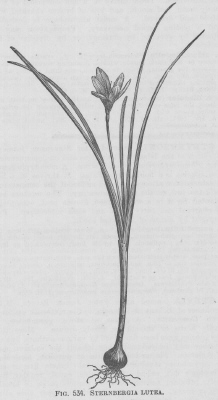
(named in honour of Count Caspar Sternberg, 1761-1838, a celebrated botanist). Mount Etna Lily. Including Oporanthus. ORD. Amaryllideae. Of this genus, about twelve species have been described, but, according to Mr. Baker, not more than four are distinct as such; they are hardy, bulbous plants, inhabiting Eastern Europe and the Mediterranean region. Flower often solitary; perianth funnel-shaped, straight, with a short or rather long tube, and linear or lanceolate, equal, erecto-patent lobes; stamens equally affixed at the throat or the bases of the lobes; bracts membranous, hyaline, tubular at base; scape short, sometimes very short, solid. Leaves late or cotemporary with the flowers. Bulb tunicated. S. lutea is a popular and valuable plant, on account of its yellow flowers being produced in autumn. The genus may be divided into two sections, viz., Sternbergia proper, having autumnal flowers, with a cylindrical tube, and leaves produced in spring; and Oporanthus, with short-tubed, funnel-shaped flowers, produced, with the leaves, in October. To the first section belong S. colchiciflora, S. macrantha, and S. Schubertii. S. lutea and its forms comprise the second section. Only a couple of species call for mention here. They succeed best in soil of a good depth, and in a sheltered position. The bulbs may be placed from 4in. to 6in. below the surface when planting.
S. colchiciflora (Colchicum-flowered). fl. sessile, erect, odorous; perianth tube yellowish-white, straight, partly subterraneous, five to nine lines long; limb yellow, erecto-patent, 1in. to 1 1/3in. long, the segments striate-nerved; scape subterraneous, one-flowered. Autumn. l. produced in spring, rarely in autumn, usually five, erect, twisted, carinate, obtusely callous, 4in. long, one line or more broad. Hungary and Roumelia, 1816. (B. R. 2008.) S. lutea (yellow).* Winter Daffodil; Yellow Star Flower. fl., perianth yellow, 1 3/4in. to 2 1/4in. long, turbinate-campanulate; tube straight, funnel-shaped; segments slightly concave, obtuse or emarginate, twelve to seventeen lines long; scape 2in. to 4in. long. Autumn. l. five, six, or more, arcuate-reflexed, linear lorate, obtusely carinate, canaliculate, obtuse, dark green, 6in. to 12in. long, four to six lines broad. Central Europe, 1596. SYN. Amaryllis lutea (B. M. 290; S. F. G. 310). This plant is supposed to be the "Lily of the Field," of Scripture. The following, often classified as species, are regarded, by Mr. Baker as mere varieties:
S. l. exigua (mean). fl. erect; perianth tube campanulate, with equal segments; scape 1in. long. l. one to three, short. North Africa, 1820.
S. l. Fischeriana (Fischer's). fl. pale yellow; perianth scarcely 1 3/8in. long; scape 9in. long, mostly underground. Spring. l. erect, loriform, quite flat. Karabagh, 1868. (R. G. 576, under name of S. Fischeriana.)
S. l. graeca (Grecian). A form with short peduncle, leaves short at flowering period, finally 4in. to 5in. long by 1/12in. broad. Greece.
S. l. sicula (Sicilian).* A variety bearing larger flowers, with more acute, narrower perianth segments. Sicily.