Strawberry
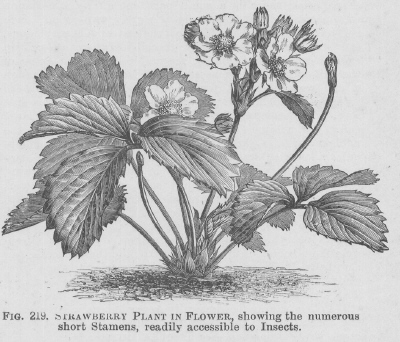
(Fragaria). Several species of Fragaria have contributed towards the production of the numerous kinds of cultivated Strawberries. There are few gardens in which some plants are not grown, the fruit being one favoured by everybody, and always held in high esteem. Forced Strawberries are generally the first new fruits of the year, and the operation of preparing and forcing plants is always one of the most important garden operations. It is well known that the fruits are used, when ripe, in various ways, principally for dessert, but also for cooking and preserving.
Propagation. This is effected by seeds, occasionally by division, but most generally by runners. The varieties are preserved true by the latter method; and, with some few exceptions, runners are produced in abundance during summer. The Alpine Strawberries, however, are best raised annually from seed, or, at least, the plants should not be kept more than two years. Seeds of these, and also of any others, if it is desired to raise plants by that method, should be saved from large, well-ripened fruits in summer. The fruits may be crushed, and dried on thick paper, or the pulp may be separated from the seeds by means of water, the seeds being afterwards dried. Only those which are firm and sink in the water should be kept; others that float on the surface are useless. Sow at once, or dry the seed and preserve it until the following spring. At the latter part of summer, a seed-bed, in a sheltered place outside, will answer well, if watering is carefully attended to. Pots and boxes are also suitable. Where a little warmth is at command, such as a gentle hotbed, the seedlings may be brought on rapidly to a size large enough for planting out where they are intended to fruit. Seedling Strawberries, sown early in the season, bear a little late fruit the same year, but a much better crop the year following. If any runners appear which are not required, they should be cut off at an early stage. Increasing by means of division is sometimes practised when runners cannot be secured, but it is not to be recommended, as divided plants are never certain to succeed. It may best be done, if requisite, in early autumn, or just before growth commences in spring.
Runners afford the best and most general method of propagation. They readily root into the ground, unless it is very hard, and may be lifted with balls and replanted; but a better way is that of layering in small pots of loamy soil, and allowing them to root into it. Runners are entirely supported by the parent until they form roots of their own; this they do readily, when coming in contact with soil that is of a proper description regarding moisture, &c. If pots cannot be spared, runners for planting-out may be procured, well rooted, and in good condition for lifting, by loosening the earth and placing some light, leafy soil beneath them, just when the roots begin forming. The method of layering on pots will be further mentioned in relation to the methods of preparing plants for forcing.
Soil, Planting, &c. Strawberries grow very well in almost any good garden ground, but succeed best in rather strong loam, of a good depth, and in a somewhat moist situation. In a dry summer, the crop frequently proves a failure on plants subjected to a light soil or gravelly sub-soil, as, if flagging is once allowed, the fruits seldom ripen properly. Previous to planting, the ground should be well trenched, and plenty of good manure intermixed. Very stiff soils are not suitable, as they are so liable to cake into hard lumps, which crack open during dry weather. Stiff soils may be much improved by adding rotten leaves, peat, or leaf mould, during the trenching process.
Planting is best performed about the middle of August, or so soon as well-rooted runners can be secured. Some persons layer Strawberries very successfully for planting purposes on small pieces of turf of square or triangular shape, 1in. or more thick: the roots do not then become twisted and interlaced, as they do in pots, and a piece of turf is admirably adapted for them to enter and permeate. The turf may be sunk a little into the ground, and kept watered; in transplanting, they should be be carefully lifted with a trowel. It is not always convenient to prepare land for Strawberries at the season above named; but it is of great importance that the young plants should be put into their permanent quarters early, and receive every encouragement to get them established before winter. That showery weather should be selected, if possible, need scarcely be remarked. Land which has been occupied by early Potatoes or Cauliflowers is not unfrequently in good order for planting with Strawberries without any preparation beyond levelling down, providing the soil is sufficiently heavy, and the situation can be spared. Strawberry-plants that have been forced are available for forming an outside plantation when the fruit has been gathered; but the balls should be thoroughly soaked in water, and the leaves dipped in a soft-soap solution if they are infested with Red Spider--which is sometimes hurtful to such plants--before being put into the ground. When planting Strawberries, the soil, which should be moderately moist, must be rendered quite firm about their roots. Should the weather be dry, watering must be attended to until the plants are thoroughly established; they will need but little further attention for the season. The distance at which to plant varies a little, according to the strength of soil and the varieties. Generally, the rows should be from 2ft. to 2 1/2ft. apart, and the plants about 1 1/2ft. asunder in the rows; but small-fruited varieties (Black Prince and the Alpines, for instance) may be planted much closer together. The soil should never be dug between Strawberry-plants, as there are so many roots near the surface, which would be destroyed. Large weeds may be pulled occasionally by the hand and carried away, to prevent seeds dropping. Strawberry plantations should be partially renewed every year, as young plants produce larger, and in every way superior, fruit to old ones. Three, or at the most four, years is a limit; when plants have been in one situation for this period, it is best to destroy them, provided others are coming on for a succession. The general treatment of Strawberries outside may be briefly summed up: To keep the fruit clean, the spaces between all fruiting plants should be mulched with short straw or light, clean litter, in May or June, just before the flowers open. For providing nourishment to the roots, a mulching of short, rotten manure may be spread over the surface first, and then the straw above. If runners are not required, they should be cut off at intervals, soon after being formed, unless the parents are disposed to grow too strongly to leaf, when some of the earliest may be left. At the latter part of summer, and early in autumn, considerable growth is made, and another mulching of good manure is generally of great advantage. A full crop must not be expected the following year from young plants; but, if they are put in early, a few nice fruits are generally produced, and also excellent runners for layering to force. Strawberries two and three years old bear the heaviest crops of good fruits. Watering is sometimes a necessity when the fruits are swelling, if droughts prevail or the soil is too light. A good soaking should be administered; a little on the surface is useless. A mulching of manure beneath the straw, as referred to above, helps to keep the ground cool in summer, and prevents, to a great extent, undue evaporation. Forcing. Before successful forcing of Strawberries can be carried out, it is necessary that strong and well-ripened plants be prepared; this latter subject may, therefore, be referred to at the commencement. So soon as any runners appear, and forcing is intended, layering should be at once commenced. Perhaps the plan most generally adopted is that of layering first on small pots, and then transferring to the sizes in which the plants are intended to bear afterwards. This system is widely practised, more generally, perhaps, than any other; but that here recommended is to layer, whenever practicable, on the fruiting pots in the first instance. This entails more labour at the outset, but the necessity for a second potting is avoided. Both methods may be referred to, as some cultivators favour one and some the other.
For layering on small pots, the size known as 60s are best adapted. They should be washed clean, and then allowed to get dry; no crocks need be used, a little rough fibre from the loam placed in the bottom will afford ample drainage, the remainder being filled with loamy soil, pressed moderately firm. Strawberries for forcing should always be raised from the strongest runners procurable; these are invariably borne earliest in the season, and by plants one or two years old. A single plant is quite sufficient for one pot; it should be placed in the centre, just as roots are forming, and made secure by a peg, the runner being then pinched off just beyond the plant that is layered. Pegs made from stems of common Brake Fern answer well, as they are not required to last long. The runners take root quickly if the soil is kept moist, and soon become sufficiently established for detaching from the parent, and taking away previous to potting on for fruiting. It is important to leave them until well rooted; the check consequent on throwing the plant on its own resources in this respect, is then but little felt; whereas, if there are only a few short roots formed, the leaves often flag, and the plants are slow in recovering strength.
The customary method of proceeding with Strawberries layered on small pots is as follows: When strong roots have fairly permeated the soil, the plants are cut off, taken away, and either stood in some open situation for a few days previous to potting, or potted on at once. The pots most generally used are of the size known as 32s, which measure about 6in. in diameter. These should be clean, dry, and well drained; a little rough turf is also recommended for placing over the drainage, and, if a sprinkling of dry soot is shaken amongst this, it will materially aid in keeping out large worms, which often enter at the bottom if they have an opportunity.
The best soil for Strawberries in pots is turfy loam, somewhat heavy rather than light, used to the extent of about two-thirds of a compost, the remainder being good, short manure, such as leaf mould, or horse-droppings which have laid for a time, or well-rotted cow-dung. Some cultivators use bone-meal or crushed bones, in preference to other manures, with excellent results. The compost should be suitably moist for ramming firmly with a hand-rammer; and it is important that none of the plants are dry at the time of potting. Stand them in a shady place for a few days, unless the weather happens to be dull, and afterwards place them in an open situation with full exposure to the sun, on a firm bottom, such as gravel or coal ashes, which allows water to pass away, and also keeps worms from entering the pots. As the plants grow, they must be stood wider apart, always allowing sufficient space between them, so that the leaves of one do not overgrow another. The crowns should be kept pointed towards the south, with a view to getting them strong and well ripened by exposure to the sun's influence. Strawberries in pots require constant attention in watering through the summer and early autumn; they need copious supplies whenever it is fine, but, in showery weather, the rain often supplies sufficient moisture for several days together, and growth made under such naturally favoured conditions is then rapid. Before there are any severe frosts, the plants should be stored away for the winter, or until they are required for forcing. They may be plunged amongst dry leaves, in cold pits or frames, where litter or some other covering can be thrown over to exclude frost. On all fine days, and during mild weather, the sashes should be removed: the plants only need protection from heavy rains and sharp frosts. Where frames or pits cannot be spared, the plan of plunging the pots in ashes, one above another, against a south wall is sometimes adopted, the pots being laid on their sides, with the crowns outwards, and all one way. Garden mats may then be laid over them at any time, if it becomes necessary. Under the system of layering on the fruiting-pot, the mode of treatment is very similar, except that no small pots are used, and, consequently, no second potting is necessary. The large pots (6in.) should be cleaned, well-drained, and filled with good soil, at the first; then taken to the Srawberry plantation, and the selected runners placed on them, in the way previously described. Watering must on no account be neglected, not giving sufficient to cause sourness in the soil, which, it is important to remember, has to serve the roots for the season. When the plants get established, they may be detached from the parents, and afterwards treated in precisely the same way as has been already described. No check consequent on repotting is experienced by plants thus treated; and the pots may, in the first place, be filled rapidly with soil. They are not so readily taken to and from the plantation as when the small size is used; but, on the other hand, when established, they may be taken direct to the place where they are to remain for the summer, and there is no fear of injury from the roots becoming starved, because of delays that often unavoidably occur in getting the work of re-potting completed. The preparation of plants for forcing has been thus fully detailed, because on it principally depends the success with them when introduced under glass for fruit-bearing; or, at least, superior forced fruit must not be expected if the crowns are not strong, plump, and well-ripened, at the outset. Strawberry forcing, and its attendant results, are matters of very great importance to most gardeners every season. Under successful management, good fruits may be secured some time during the month of April; earlier than this, the amount of natural heat and light necessary, through all stages, for attaining proper development, is seldom forthcoming. Some of the best-ripened plants of an early variety--such as Keen's Seedling or Vicomtesse H. de Thury--may be introduced under glass, for starting during December, or early in January. The temperature at first must not exceed 40 deg. to 45 deg. at night, and from 45 deg. to 50 deg. by day, with air on all favourable occasions. This will be sufficient to excite the crowns to push the embryo flower-stalks and leaves which they contain; but forcing must still be conducted very slowly, even until the time the fruits are set. By the time the plants reach the flowering stage, the days will have lengthened, and full sunlight must be admitted to them, with a free circulation of air--always avoiding a draught. When flowering, an average temperature of about 55 deg. must not be exceeded, and the admission of air from some quarter is essential for insuring fertilisation; the atmosphere at this period should be kept somewhat drier than is advisable at any other time, till the fruits are ripe, and syringing must, for a few days, be discontinued. The strongest flowers appear amongst the first that open; and if from nine to a dozen of these can be induced to set properly, it will be a good crop, and all the smaller, secondary flowers may be clipped off so soon as these are safe. During forcing operations, it is important to remember that the four parts of a Strawberry flower are formed in succession, and that the most essential of all, the pistil, arrives last at maturity to perform its allotted function. It must not, therefore, be inferred that, when the calyx appears, and the white petals expand, the other organs are similarly advanced. In early forcing particularly, great care must be taken in regard to temperature and moisture during the whole flowering period. After the crop is set, a higher temperature should be gradually applied, about an average of from 60 deg. to 65 deg.; or the plants that are sufficiently advanced may be shifted into another house, if there are others coming on for a succession.
Watering must receive special attention. Plentiful supplies are requisite, especially when the fruits are swelling, and no Strawberry-plant should ever be allowed to get quite dry at the root. The application of manure-water is of great advantage while the fruits are swelling, or the plants may be assisted more conveniently, and quite as efficiently, by placing a little artificial manure over the surface of the soil once a week, and watering it in. The effect is most marked just as the first signs of colouring are seen, and this should be the last application made. Syringing may be freely practised until the fruits begin colouring; besides supplying moisture, it materially aids in keeping down Red Spider. When the earliest fruits are nearly ripe, carefully transfer the plants to a cool, airy house for two or three days before gathering; this will often improve the flavour immensely. As the crop is taken, the plants may be turned out and thrown away, or preserved for forming a new plantation, according as they may or may not be required: others will be coming on to take their places. Where large quantities of Strawberries are forced, a Strawberry-house, specially devoted to bringing on successions, is the best arrangement. This should be fitted up with beds or shelves, near the glass, where full exposure to sun and light is at all times secured. The quantity of plants forming a successional batch must be determined by the total intended to be forced, the space available, and other conditions that are mostly of individual, and not general, application. Forced plants of Vicomtesse H. de Thury Strawberry are sometimes induced to bear a second crop in the following autumn. They are reduced a little at the root, then potted up afresh, and grown on either outside or in frames. Towards autumn, a second crop of flowers appears; and if they set well, the fruits can be ripened with fire-heat, and a fairly good crop secured, that proves invaluable for dessert, even if of second-rate quality, so far out of the natural season. The variety above named is peculiarly noted for this method of treatment; none of the others that are forced are adapted for autumn fruiting with the same degree of certainty.
Insects, &c. Few species have been recorded as noticeably injurious to the Strawberry; but this plant, like almost all other garden herbs, is liable to have the leaves and flower-buds eaten by Surface Caterpillars, and the roots devoured by larvae of Cockchafers, and species of Otiorhynchus, especially of O. sulcatus. Information in regard to the insects, and the best means of lessening the damage done by them, will be found under the headings indicated.
In Ormerod's "Report of Injurious Insects," for 1883, is an account of serious damage done near Chester, in May and June, by the larvae of a small Moth called in the Report the "Strawberry-leaf Button Moth," Peronea comparana (?). The flowers and sides of the leaflets were spun together and eaten by the larvae, and the result was that badly-infested plants died. "Young Strawberry-plants of twelve months old are never affected; two-year-old plants are affected rather badly, but three-year-old plants are invariably ruined." The larva is cylindrical and green, with a pale yellow head, and is rather bristly. The pupa is pale green, with reddish wing-cases and abdomen. The moth, which appears at the end of June, is under 3/4in. in spread of fore wings, which are pale ochreous, with a large, dark brown, triangular blotch running in from the front margin of each wing two-thirds across it; there is a dark streak inwards from the hind margin near the base of the wing. The hind wings are grey. There is probably a second brood of the insects in autumn. In the "Entomologist" for 1881 (p. 232), an attack, similar to the above, is recorded from near Blairgowrie, in Perthshire, but the moth is named Peronea aspersana. Yet it is the same species, perhaps, though apparently there is uncertainty about the correct name. Probably, the remedy suggested in the "Report" quoted above, of skimming the soil, to remove pupae with it, and with the surface rubbish, would be found useful.
The leaves of Strawberry-plants that have been forced are liable to serious harm from the Red Spider (see Tetranychus telarius). During the process of forcing, Strawberries are also invariably attacked by Green Fly, which prove very destructive if not checked at first. Fumigating with tobacco-smoke is the best and most effectual remedy, but this should not be done while the plants are in flower. At any stage before flowering, or after the fruits are set, no danger need be apprehended, provided, of course, that the method of fumigating is properly carried out.
The fruit of the Strawberry is liable to be eaten by Slugs and Snails (which see), as well as by Millipedes, such as Polydesmus and Julus (see Millipedes). Mice, too, often prove very destructive, by nibbling off the fruits before they are ripe, or by eating the seeds, when they are at all prominent, from ripe fruits.
Fungi. The Fungi parasitic on Strawberries are few in number, and, so far as experience goes, not seriously hurtful to the plants. The most conspicuous in their effects produce spots on the leaves, sometimes in very great profusion. The spots are at first brownish-red, surrounded by a brighter red margin. After a time, the centre becomes white, by separation of the epiderm from the lower tissues, and because of the presence of air below it. In the white area lie imbedded various minute, black specks, which the microscope shows to be pycnidia inclosing sporidia, or perithecia, with spores in asci. The only Fungus of this group recorded from Britain as living on the Strawberry is Leptothyrium Fragariae, which has minute, cylindrical sporidia (each with four or five dots in it) in its pycnidia. On the Continent there have also been recorded: Ascochyta Fragariae, with two-celled sporidia; Phoma fragaricola, with one-celled, small sporidia; Sphaerella Fragariae, with three-septate sporidia; and Sphoerella Fragarioe, with two-celled spores in asci. The spots produced by all these are much alike; and it is doubtful in how far the various Fungi belong to species really distinct among themselves. When very abundant, they injury the leaves, and thus weaken the plants. It has been observed that plants on clay soils are more liable to attack, and that, if transferred to more open soil, they become almost free from the Fungi. No direct remedy is known, but the plants, though weakened, are seldom killed by the disease.
The fruits, when beginning to decay, in damp places, are often overgrown with moulds. The best preventive is the freer admission of air.
Sorts. Of the hybrid or large-fruited Strawberry so largely cultivated in gardens, a selection of sorts is subjoined, which includes those generally grown for forcing, and for early, mid-season, and late crops outside. Where the object is to give only a selection, and there are so many to choose from, it is not unlikely that some of those omitted are of equal merit with others included. Alpine Strawberries (F. vesca monophylla) are represented in Red and White varieties. The Bush Alpine is a distinct Strawberry, inasmuch as the plants produce no runners. There are red and white forms of this, which may be raised from seeds or increased by means of division. The fruits of the Hautbois Strawberry (F. elatior) possess a peculiar and strong flavour, which is disagreeable to some people, but much liked by others. A few plants are generally grown in gardens, but rarely a quantity. Runners are freely produced, and afford a ready means of raising or increasing a stock.
Bicton Pine. Fruit creamy-white, sometimes tinged with red where exposed to the sun, large; flesh white, juicy, of fairly good flavour. Mid-season. Plant very productive, of compact habit.
Black Prince. Fruit dark red, shining, changing almost to black when quite ripe, small; seeds prominent. The plant is a free bearer, and forces well. It is valued, both for forcing and outdoor culture, on account of its earliness.
British Queen.* Fruit light scarlet, but not always uniform in colour, frequently very large, often flattened; flesh white, very juicy and richly flavoured. When well grown, this may justly be designated the best of all Strawberries; but the plant is tender, and does not always succeed and bear satisfactorily. It is much esteemed as a late variety for forcing.
Dr. Hogg.* Fruit light red, cockscomb-shaped, very large; flesh pale pinkish-white, solid, very rich. The plant has much the appearance of BRITISH QUEEN, but is much hardier, rather later, and more prolific than that variety. Elton. Fruit dark red or crimson, large; flesh red throughout, firm, briskly acid; plant very hardy, vigorous, and prolific. A valuable late variety, specially adapted for preserving; it is an almost certain bearer, and ripens in long succession.
Frogmore Late Pine. Fruit dark red, very large. This ripens about the same time as ELTON, and is of better flavour than that variety. Plant of free-bearing habit.
James Veitch. Fruit bright vermilion, very large and handsome; flesh solid, rich and juicy. Plant very robust. A midseason variety; it sometimes produces fruit of unusual size.
Keen's Seedling.* Fruit dark crimson next the sun, large, roundish; flesh scarlet, rich and agreeably flavoured. This is an old and well-known variety of great excellence; it is one of the best for forcing, and is invariably included amongst varieties for that purpose. It is also grown extensively outside, where it succeeds admirably.
La Constante. Fruit bright crimson, large, conical; flesh white, tinged red, juicy, briskly flavoured. Plant dwarf; a great bearer; rather late.
La Grosse Sucree. Fruit dark red, medium or large; flesh pale red; flavour slightly acid. A free-bearing variety, well adapted for forcing.
Loxford Hall Seedling.* Fruit bright crimson where exposed, large, handsome, conical or sometimes cockscomb-shaped; flesh red, solid, of excellent flavour. An invaluable variety, the latest of all, of great excellence.
Lucas. Fruit deep scarlet or crimson, large, conical or sometimes cockscomb-shaped, handsome; flesh solid, highly flavoured. Mid-season or rather early. Plant free-growing and a good bearer.
Marguerite. Fruit bright red, very large, often of an unusual size; flesh juicy and tender. A productive early variety, sometimes used for forcing. Pauline. Fruit deep red, large, with smooth neck; flesh firm, richly flavoured. A large and very early variety, and a good bearer.
Pioneer. Fruit very dark red, medium-sized; flesh solid, bright red, of rich, brisk flavour. Plant vigorous, a great cropper, one of the earliest.
President.* Fruit bright red, often very large and handsome; flesh light red, solid, highly flavoured. An excellent, free-bearing Strawberry, largely grown for forcing, and still more extensively for general crop outside.
Sir Charles Napier.* Fruit clear light scarlet, large and handsome; flesh pale, firm, briskly flavoured; seeds small, and very prominent. A most abundant bearer, and a variety very extensively grown for market; it is also well adapted for forcing. The plant is unusually tender.
Sir Harry. Fruit dark red or crimson, very large; flesh dark red, very juicy, of excellent flavour. An abundant bearer, grown extensively for market; it ripens at the same season as KEEN'S SEEDLING, which it somewhat resembles.
Sir Joseph Paxton.* Fruit bright crimson, large, even in outline; flesh solid, and richly flavoured. Mid-season or rather early. The plant is hardy, a free bearer, and forces well. This is one of the best and most useful Strawberries grown.
Vicomtesse Hericart de Thury.* Fruit bright red, medium-sized, conical; flesh pale red, solid, brisk and richly flavoured. The plant is compact, and almost evergreen; it is one of the most abundant bearers, and succeeds well forced.