Strelitzia
(named in honour of the wife of George III., Charlotte of Mecklenburgh-Strelitz). Bird of Paradise Flower; Bird's-tongue Flower. ORD. Scitamineae. A small genus (four or five species) of warm greenhouse, perennial herbs, restricted to South Africa. Flowers large and showy, few in a spathe, shortly pedicellate, with a long-exserted perianth; sepals three, ovate-lanceolate, long, free; petals unequal, the two lower or front ones united, each one lobed on the outer side towards the upper part, so that the two petals are distinctly halberd-shaped, and conceal within a fold the five perfect stamens, the third or posterior petal much smaller than the other two and somewhat hooded; bracts large and spathe-like, boat-shaped, acuminate; scape terminal or in an upper axil, shortly exserted from the leaf sheaths. Leaves in long, sessile or stalked sheaths, ample, flabellately bifarious. Rhizome sometimes hypogaeus, sometimes produced into an erect, woody stem. Strelitzias succeed in a mixture of two parts loam, and one part peat, with a little sand added. They require a liberal supply of water during summer; but very little need be given during winter. The principal methods of propagation are by suckers, and by division of old plants. Seeds, which are also sometimes procurable, should be sown in light soil, and the pots plunged in moist bottom heat.
S. augusta (majestic).* fl. whitish; calyx and corolla both pure white; the sagittate petals very short and rounded, the posterior one very small, acuminate. March. l. dark green, distichous, 2ft. or more long, 1in. to 1 1/2in. broad, oblong, sub-cordate at base; petioles 3ft. to 6ft. long, slightly glaucous, longer than the scape. h. 10ft. 1791. A noble plant. (B. M. 4167-8; F. d. S. 173-4.)
S. farinosa (mealy). fl. purple and yellow; scape free, longer than the petioles. February. l. oblong, unequal at base; petioles half as long again as the leaves. h. 4ft. 1795.
S. humilis (humble). A form of S. Reginae.
S. Nicolai (Prince Nicolajevitsch's). fl., calyx whitish; petals blue, the sagittate ones rather large, triangular-ovate, the posterior one nearly round, long and abruptly acuminate; spathes four, alternate, livid-green and purplish, at length 1 1/2ft. long; scape shorter than the petioles. May. l. oblong, obtuse at base. h. 25ft. A superb plant, considered, by the authors of the "Genera Plantarum," to be specifically identical with S. augusta. (R. G. 235.)
S. parvifolia juncea (small-leaved, Rush-like). fl. purple and yellow; scape equalling the petioles. May. l., blades absent or nearly so (in the type they are linear-lanceolate with flat margins); petioles resembling the stems of large Rushes. h. 4ft. (B. R. 516.) The variety angustifolia has lanceolate leaf blades, one-seventh the length of the petioles.
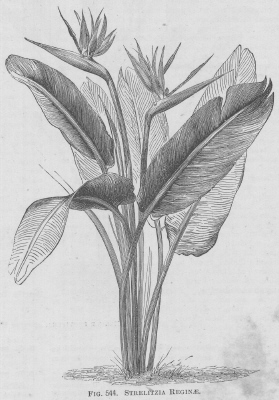
S. Reginae (queen's).* fl. orange and purple, large, abundantly produced; scape free, equalling the leaves. April. l. very fine, ovate or ovate-oblong, green, mostly equal at base, broadly undulate-crisped on the margins. h. 5ft. 1773. This is the most magniflcent species of the genus. The seeds are eaten by the Kaffirs.(A. B. R. 442; B. M. 119-20; R. G. 1877, 216.) S. humilis has been called a "reduced copy" of S. Reginae.
S. R. Lemoinierii (Lemoinier's). A variety with golden-yellow sepals. 1880. (F. d. S. 2370-1.)
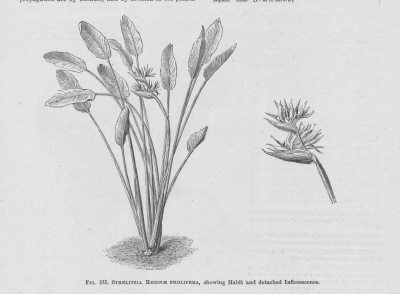
S. R. prolifera (proliferous). This only differs from the type in the longer petiole and shorter blade of the leaf, and in there being two spathes developed on the same scape.
S. R. pumila (dwarf). A dwarf, compact variety. 1879.