Strobile
(from strobilos, a Fir-cone). A scaly fruit, composed chiefly of a number of bracts that overlap one another like the slates on a roof. It is defined by Lindley as "an imbricated scaly inflorescence; a collection of hard scales, representing distinct flowers, arranged spirally but closely imbricated;" but the term is seldom employed for the inflorescences, which rather belong to the type called Catkins, and become Strobiles only when the seeds are approaching ripeness. The word Cone is employed with almost the same meaning as Strobile, though in general almost restricted to the fruits of the Coniferae, while the latter word also includes the fruits of the Hop, and of a few other plants. The Strobile is the result of the fertilisation of several flowers (there is usually one in the axil of each of the bracts of which it is composed); but the flowers are in most cases completely hidden from sight by the bracts. The latter become much enlarged as the seeds are ripening. They remain thin and membranous in some plants, e.g., Hop Among the Coniferae, they usually become woody and hard; in some, e.g., Cedrus, they remain comparatively thin; but in others, e.g., Cupressus, each bract expands towards the tip into a broad, shield-like plate. In the genus Juniperus, the bracts become soft and fleshy, and are united by their edges, so as to form a fruit which, at first sight, very much resembles a berry. This form is sometimes distinguished by the name of Galbulus. In Coniferae, the seeds are not inclosed in carpels; but, in most, they lie, as represented, in pairs, on the upper surface of scales, of which one is present in the axil of each bract. There has been much controversy about the true nature of the scales; but a widely-accepted view is that they represent two leaves, arising from an undeveloped branch in the axil of the bract, united together by one side, and that they correspond to open carpels.
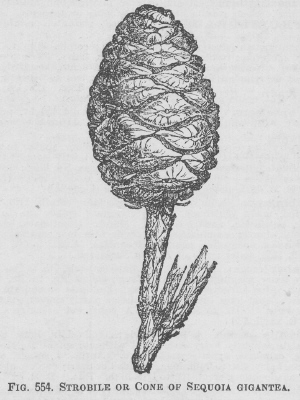
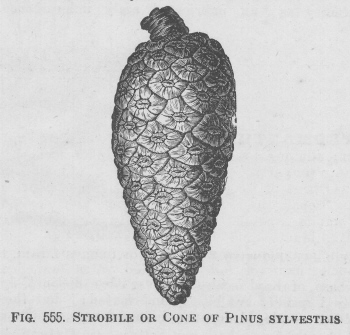
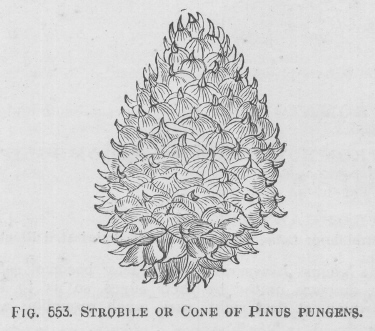
As regards their forms, Strobiles are usually elongated cones, as, indeed, is implied in the equivalent term, Cone; but frequently they are oval or globular, and occasionally they are comparatively slender. Some of the commoner forms are shown in the figures referred to above, and in those of Pinus and Sequoia.