Symphytum
(the old Greek name used by Dioscorides, and derived from symphuo, I make to grow together; from its supposed power of healing wounds). Comfrey. ORD. Boragineae. A genus comprising about seventeen species of hardy, erect, sometimes tuberous herbs, natives of Europe, North Africa, and Western Asia. Flowers yellowish, blue, or purplish, pedicellate, cymose or racemose; calyx five-cleft or five-parted, the segments linear; corolla broadly tubular, enlarged above, with five scales in the throat; lobes five, very short, erect and tooth-like or scarcely spreading; stamens five, affixed to the middle of the tube. Nutlets four, ovoid, smooth. Leaves alternate or mostly radical; cauline ones sometimes decurrent; uppermost ones sometimes closely approximate and nearly opposite. S. officinale is a well-known plant which has become rather widely naturalised along our water-course; it has much the taste and properties of Borage. The species described below are showy subjects, thriving in almost any soil or situation. They succeed under the shade of trees, and flower throughout the principal part of the summer. Propagation may be effected by divisions.
S. asperrimum (very rough). Prickly Comfrey; Trottles. fl. bluish-purple; corolla campanulate, very acute at both ends, scabrid; lower ones petiolate; uppermost ones sub-sessile. Stem branched, strigosely bristly. h. 4ft. Caucasus, 1799. See Fig. 557. The variety aureo-variegatum has the leaves bordered with yellow.
S. bohemium (Bohemian). A synonym of S. officinale bohemicum.
S. caucasicum (Caucasian).* fl. blue; corolla sometimes thrice as long as the obtusely five-toothed calyx, the limb campanulate. l. ovate-lanceolate, hairy; lower ones attenuated into long petioles; upper ones nearly opposite, shortly decurrent at the sides of the stem. h. 3ft. Caucasus, 1820. (B. M. 3188.)
S. Donii (Don's). fl. blue; calyx lobes subulate, scabrid; corolla tube equalling the calyx, the limb campanulate, with linear, obtuse appendages. l. scabrid; lower ones ovate-lanceolate, attenuated into the petioles; upper ones lanceolate, narrow, decurrent at the sides of the stem. h. 2ft. (S. B. F. G. ser. ii. 294, under name of S. caucasicum.) S. officinale (officinal). Alum; Black Root; Common Comfrey; Knitback, &c. fl. creamy-yellow, drooping, in scorpioid cymes; calyx lobes narrow-lanceolate; corolla 3/4in. long. l. ovate-lanceolate; radical ones 4in. to 8in. long, on long, winged petioles; cauline ones shortly petiolate. Stem 1ft. to 3ft. high, branched. Europe (Britain), &c. (Sy. En. B. 1115.)
S. o. bohemicum (Bohemian).* fl. red or reddish-purple; racemes twin, erect, revolute at apex. l. running into the petioles. Bohemia, 1810. (S. B. F. G. ser ii. 304.) SYN. S. bohemicum.
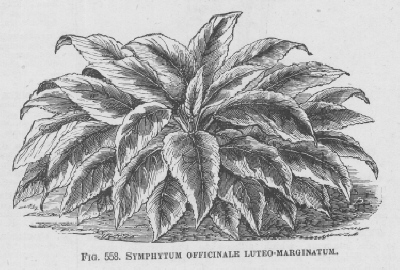
S. o. luteo-marginatum (yellow-margined). A variety having the leaves margined with yellow. 1870. See Fig. 558. SYN. S. o. variegatum.
S. o. patens (spreading). A purple-flowered form. (Sy. En. B. 1116.)
S. o. variegatum (variegated). A synonym of S. o. luteo-marginatum.
S. orientale (Oriental). fl. whitish; corolla twice as long as the five-toothed calyx, funnel-shaped above, with linear-attenuated appendages. l. oblong-ovate, acute, narrowed at base; lower ones alternate, petiolate, sub-cordate; uppermost ones nearly opposite, sessile. Stem branched. h. 3ft. Orient, 1752. Plant clustered, pubescent.
S. o. angustior (narrowed). l. oblong-or oval-lanceolate, undulated. (B. M. 1912, under name of S. orientale.)
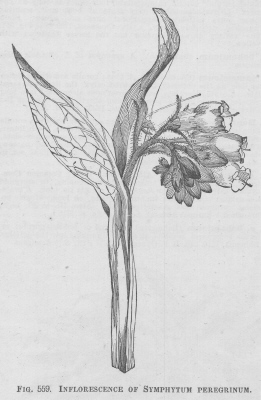
S. peregrinum (foreign). fl. reddish and purplish; calyx five parted nearly to the base, the segments acuminate; corolla three or four times longer than the calyx, sub-campanulate above the middle, shortly five-cleft. l., lower ones on long petioles, elliptic-lanceolate, acuminate; upper ones sessile. Stem tall, branched. Iberia, &c., 1816. (B. M. 6466.) This species is largely cultivated as a fodder plant, under the erroneous name of S. asperrimum. By some authors it is regarded as a hybrid between S. asperrimum and S. officinale. S. tauricum (Taurian). fl. whitish; calyx acutely lobed above the middle; corolla twice as long as the calyx, with obtuse lobes and linear appendages. l. acute, slightly undulated; lower ones alternate, petiolate, ovate-cordate; uppermost ones opposite, sessile. Stem branched. h. 3ft. Tauria, 1806. Plant pilose, hairy. (B. M. 1787.)
S. tuberosum (tuberous-rooted).* fl. ochreous. l. scarcely decurrent; radical ones on long petioles. Stem 1ft. to 2ft. high. Rootstock short, horizontal. Europe (Britain). This resembles S. officinale, but the flowers are smaller, and the radical leaves are on longer petioles. (J. F. A. 225; Sy. En. B. 1117.)