Syringa
(from syrin, syringos, a pipe; the branches are long and straight, and are filled with medulla). Lilac; Pipe-tree. Including Ligustrina. ORD. Oleaceae. A well-known genus, comprising about ten species of ornamental, hardy, deciduous, glabrous or pubescent shrubs, natives of Eastern Europe and temperate Asia. Flowers disposed in terminal, thyrsoid or trichotomous panicles, the inflorescence at first centripetal, ultimately often centrifugal; calyx campanulate, irregularly toothed; corolla tube cylindrical, rarely shortened; lobes four, shorter or longer than the tube, induplicate-valvate; stamens two, affixed nearly at the apex of the tube, the filaments short or filiform. Leaves opposite, entire or rarely pinnatisect. Nearly all the species, and many splendid varieties, have been introduced to our gardens. The common English name is said to have been derived from Lilac or Lilag, the Persian word for the flowers. The common Lilac, S. vulgaris, and its varieties, are the largest in the genus, and are also among the commonest and most beautiful of our spring-flowering shrubs.
Propagation. Lilacs may be readily increased by suckers, which are produced in abundance from the roots. Scarce or good varieties may be increased by means of shield-budding, using a pushing bud in April, or a dormant one in July. Crown-grafting or cleft-grafting in March is also practicable, either on stocks near the ground, or on others prepared as dwarf or tall standards. Seedling plants should be raised for stocks, as they are less likely to produced suckers, which would, in due course, deprive the bud or graft of its full amount of nutriment. Strong-growing varieties are usually worked near the ground, and the new shoot allowed to run up; others, of slender growth, are best united higher up on a more vigorous stock. The varieties may also be raised from cuttings.
Cultivation. Few shrubs are more universally grown and admired when in flower than the species and varieties of Syringa. They grow freely, and flower profusely outside in almost any soil and situation, but well repay any extra attention bestowed in removing suckers or giving a little good soil occasionally. They are also amongst the best of subjects for forcing in winter and early spring. One of the finest varieties for this latter purpose is Charles X. (see Fig. 560): its panicles of flowers are much larger and more compact than the so-called Persian Lilac of gardens (S. chinensis), which is, however, well adapted for treating in a similar way. In France, Lilacs are extensively forced in places where light is excluded. The flowers thus become, by blanching, pure white, and are in great request in the flower market for making bouquets, &c.; large quantities being sent annually to England, amongst other places. The common Lilac (S. vulgaris) is also amenable to blanching. It has been recently discovered that, if forced in a sufficiently heated structure, the colouring matter has no time to form in the flowers, and therefore the same results are obtained as if the plant were, according to the old recognised method, grown in a place where light was excluded.
Lilac flowers, when blanched pure white, have a very chaste and beautiful appearance. The process of blanching is best performed in a cellar or shed, from which all light can be excluded. A temperature of 55deg. or 60deg., with a moist atmosphere, should be maintained, and it should preferably be secured by fermenting material composed of stable litter and leaves. One disadvantage connected with blanching is the impossibility of obtaining any foliage to accompany the flowers. Leaves procured from other plants exposed to light may, however, be substituted.
Forcing. Lilac plants intended for forcing are best prepared by being grown purposely in pots; at any rate, they should be lifted and potted early in autumn, using any ordinary loamy soil, and afterwards standing them outside until required. Only those with plenty of flower-buds should be selected for forcing. The difference in flower and wood-buds is not always readily seen, as both are on the points of the shoots. Flower-buds are globose, and much more plump than the others, and may thus be distinguished. Light protecting material should be placed round the pots for the winter, and a few plants, as may be required, introduced to the forcing house at intervals of two or three weeks from November onwards. A moist temperature of 55 deg. will be sufficient at first, as it is important that the flowers should be induced to start a little in advance of the leaves. When Lilacs are placed direct into a high temperature, growth is unduly excited, and the flowers often remain dormant, and eventually die away instead of opening. When flowering is over, the growths may be cut back to within 2in. of the starting point of the previous year. Lilacs do not answer well for forcing two years in succession; consequently, two batches should be kept, one to remain in the ground outside while the other is being forced. Where expense is not an object, beautiful plants may be purchased annually. They are imported from the Continent in large quantities, both as dwarfs and standards, and are all invariably well set with flower buds.
Fungi. Few Fungi ever do conspicuous harm to plants of this genus, and none are known to be really dangerous to their welfare. The only ones that call for even a passing reference are those that grow on the living leaves. These organs are occasionally more or less covered with a diffused white coat of hyphae of Oidium (which see for remedies). Other plants show a dark coating of Fumago vagans, so widely diffused on almost all shrubby plants, especially when growing under trees infested by Aphides. Well syringing the leaves with clean water, or with soapsuds, will remove honeydew, which serves as the food of the Fungus, and will also clear away the Fungus itself. In the North of Scotland, the leaves of Lilacs often show brown patches, with a green, watery border. These patches are the work of a Fungus, discovered by Mr. A. S. Wilson, and named by Mr. Berkeley Ovularia Syringae (G. C., 19th Oct., 1881). Hyphae are pushed out through the stomata of the leaves, and each bears on the tip a pear-shaped spore, fixed by the broader end. Mr. W. G. Smith has described the sexual spores of this Fungus. They are formed on the decaying, fallen leaves. The best remedy is to gather and burn such leaves in autumn. The leaves of Lilacs are apt to be disfigured by dry spots, the work of various Fungi, e.g., Asteroma vagans, Cercospora Lilacis, Phyllosticta Syringae, Septoria Syringae, &c.; but it would be useless to enter into a description of these so-called species, as they are only stages in the development of others, probably Pyrenomycetes, not yet ascertained; and the effects are much alike with all of them. A few of these have not yet been recorded as British. The Lilacs seem little the worse for their presence. Probably, burning the fallen leaves would be found sufficient to prevent the disfigurement from spreading.
Insects. Insect pests are not dangerous. They are chiefly the larvae of a few Moths; e.g., the Privet Hawk-moth (see Sphingidae), one or two Noctuae and Geometers, and one of the Tineina, named Gracilaria syringella. The last-mentioned causes the most conspicuous damage, as it is very common. Its larva burrows in the leaves, and forms an irregular mine, ending in a pale blotch. After a time, it leaves the mine, and rolls up the leaf into a tube for its own protection, till full-fed, when it drops to the soil, and becomes a pupa below ground. The moth is about 1/2in. in spread of wings: these are yellowish-white, with a basal patch, a blotch on the inner margin, and three oblique bars (all brown). The leaves should be picked off while the larvae are in them, and may be crushed or burned. The larvae of the other Moths are all much larger than the Gracilaria. They may be exterminated by shaking the bushes over anything placed below, to receive the insects as they fall.
S. amurensis (Amur). A synonym of S. japonica.
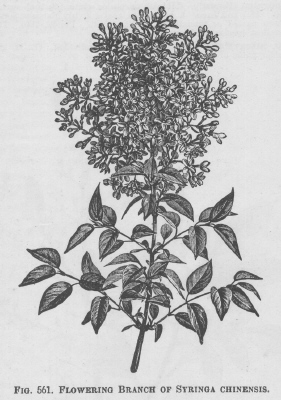
S. chinensis (Chinese). Rouen Lilac. fl. of an intense violet colour; corolla limb flat. May and June. l., including the petioles, six to seven lines long, ovate-lanceolate, slightly acute at the base, acuminate at apex, highly glabrous. h. 4ft. 1795. This plant varies somewhat in the colour of its flowers. It is regarded by some authors as a hybrid between S. persica and S. vulgaris. SYNS. S. dubia, S. rothomagensis.
S. dubia (doubtful). "Persian Lilac." Erroneously called S. persica in gardens. A synonym of S. chinensis.
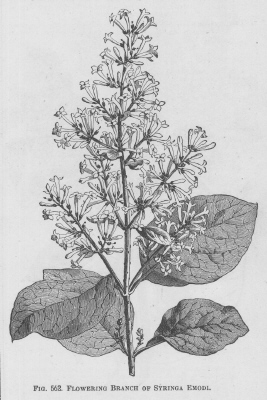
S. Emodi (Mount Emodus).* fl. purplish or white, often fascicled; corolla tube 1/4in. long, lobes 1/5in. long; panicles dense-flowered. April. l. 3 1/2in. long, 1 3/4in. broad, elliptic or ovate, acute at both ends, glabrous; secondary nerves prominently reticulated beneath; petioles 1/2in. to 3/4in. long. h. 6ft. Himalayas, 1840. (B. R. xxxi. 6.)
S. E. variegata (variegated). This differs from the type in having the leaves blotched with dull yellow.
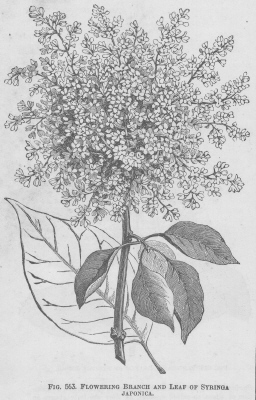
S. japonica (Japanese). fl. creamy-white, in a dense-flowered thyrse. Summer. l. broad-ovate, acuminate, with a rounded or sub-cuneate base, glabrate above; midrib and veins pubescent beneath. Japan, &c. A handsome shrub. (G. C. n. s., xxv. 561) SYNS. S. amurensis, Ligustrina amurensis.
S. Josikaea (Countess von Josika's).* fl. bluish-purple, scentless; corolla limb slightly concave; pedicel not exceeding the calyx. May. l. elliptic-lanceolate, acute, wrinkled, slightly ciliated, glabrous, intense green and shining above, whitish beneath; petioles of the upper leaves two to three lines long. h. 5ft. to 10ft. Hungary, 1835. (B. 24; B. M. 3278; B. R. 1733.)
S. oblata (oblate). fl. purple, profusely produced in very ornamental bunches; cup of the calyx more acutely four-toothed than in the common Lilac. May. l. very striking, large, rather fleshy, oblately cordate. China, 1859. About the size of the English Lilac, but more tree-like in general outline. There is a white-flowered variety.
S. persica (Persian). fl. bluish-purple or white, the limb rather flat. May and June. l. lanceolate, acute, highly glabrous, sometimes parted or pinnatifid. h. 4ft. to 5ft. Persia, 1640. The smallest species of the genus.
S. p. integrifolia (entire-leaved). l. all undivided. (B. M. 486, under name of S. persica.)
S. P. laciniata (torn). l. all, or nearly all, inciso-pinnatifid. (L. B. C. 1107.)
S. rothomagensis (Rouen). A synonym of S. dubia.
S. villosa (villous). fl. bluish-purple; corolla-tube slender, the limb with oblong, reflexed lobes. May. l. ovate or ovate-elliptic, rather obtuse, glabrous above, pilose on the principal nerves beneath. h. 3ft. to 6ft. North China, 1880.
S. vulgaris (common).* Common Lilac; Pipe-tree. fl. red, blue, or white; corolla limb slightly concave. May. l. cordate or ovate-cordate, highly glabrous. h. 8ft. to 20ft. or more. Persia, Hungary, &c., 1597. Many beautiful varieties, of which the following are a selection, are referred to this species.
S. v. alba (white).* fl. white; thyrse ample, clustered. Branches and buds greenish. h. 12ft. to 15ft. There are two sub-varieties: major, with larger, and plena, with double, flowers.
S. v. caerulea (blue). fl. slightly rosy, at length becoming blue; thyrse sparingly clustered. h. 12ft. A sub-variety has the leaves imperfectly variegated.
S. v. grandiflora (large-flowered). fl. red, large.
S. v. purpurea (purple). fl. violet-purple; thyrse ample, crowded. Branches and buds purplish.
S. v. violacea (violet). Scotch Lilac. fl. of a beautiful violet or lilac; thyrse sparingly clustered. Branches and buds purplish. h. 10ft. (B. M. 183.)
GARDEN VARIETIES. A select list of garden varieties is given below: ALBA GRANDIFLORA, flowers white, large, one of the best; ALBA MAGNA, one of the finest whites; ALBA VIRGINALIS, flowers snowy-white, trusses large, good for forcing; ALPHONSE LAVALLEE, flowers sky-blue, shaded with violet, double, in very large trusses; CHARLES X., flowers deep purplish-lilac when grown outside, white when forced, very large trusses, extra fine, one of the best for forcing; DR. LINDLEY, flowers reddish-lilac, in extremely large clusters; LE GAULOIS, flowers dark peach-colour, with light centres, very double, in large, close trusses; LEMOINEI, flowers pale ashy-lilac, double; MATHIEU DE DOMBASLE, flowers reddish-mauve, double, trusses nearly 1ft. long; MICHEL BUCHNER, flowers pale lilac, rose-margined, double, in fine, erect, pyramidal trusses; RANUNCULIFLORA, flowers dark red, becoming lilac, double; RENONCULE, flowers azure-mauve, strongly perfumed, double, very full; RUBELLA PLENA, flowers vinous-red, changing to rosy-violet, double.