Tamarix
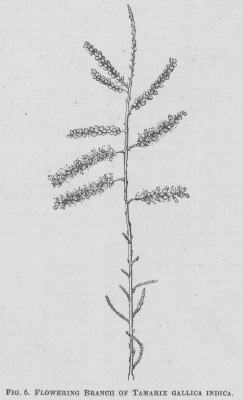
(the old Latin name used by Pliny). Tamarisk. ORD. Tamariscineae. A genus comprising about twenty species of very elegant, greenhouse or hardy bushes or small trees, distributed where the order extends. Flowers white or pink; sepals four or five, rarely six, free; petals inserted under the disk, free or lightly connate at base; stamens four, five, eight, or ten; anthers apiculate; disk more or less lobed; inflorescence of lateral or terminal spikes or dense racemes. Leaves minute, scale-like, amplexicaul or sheathing. The manna of Mount Sinai, which consists wholly of mucilaginous sugar, is produced by a variety of T. gallica. Sandy loam is most suitable to the culture of the greenhouse sorts. T. gallica will thrive under almost any conditions, and is admirably suited for ornamenting shrubberies; it is also invaluable as a seaside plant, and is very extensively employed along the South Coast. Propagation may be readily effected by cuttings, inserted in sand, under a bell glass, the greenhouse kinds in heat.
T. africana (African). A synonom of T. parviflora.
T. articulata (jointed). fl. pink, 1/8in. in diameter, sub-sessile; spikes slender, more or less interrupted, usually sessile. July. l. reduced to a very short sheath, with a minute tooth. Branches fastigiate, elongated, slender, cylindric, jointed. h. 10ft. to 25ft. India. A greenhouse bush or coniferous-looking tree. SYN. T. orientalis.
T. dioica (dioecious). fl. pink, 1/8in. in diameter, dioecious; spikes dense, panicled, 1in. to 2in. long, about equalling their peduncles. June. l. sheathing, glabrous, green, obliquely truncate and acuminate. Branches with drooping extremities; ultimate branchlets elongated, spreading-fastigiate. h. 6ft. India, 1823. A small, greenhouse tree.
T. gallica (French).* Common Tamarisk. fl. white or pink, in catkin-like, obtuse spikes 1in. long; disk acutely five-angled. July to September. l. on the branchlets extremely minute, closely imbricated, triangular, auricled, keeled; those on the older wood 1/8in. long, subulate. Branchlets excessively slender and feathery. h. 5ft. to 10ft. India to Europe. Hardy shrub or small tree.
T. g. indica (Indian). fl., lobes of the disk entire or nearly so. l. semi-amplexicaul. Branchlets divaricate. Greenhouse.
T. g. Pallasii (Pallas'). fl. rosy-pink; lobes of disk deeply emarginate. l. shortly decurrent. Branchlets erect. Thibet, &c.
T. orientalis (Eastern). A synonym of T. articulata.
T. parviflora (small-flowered).* fl. pink, small; spikes or racemes lateral, crowded, nine to ten lines long. Summer. l. small, lanceolate, subulate, a little keeled, acute. South-eastern Europe, Levant. Hardy shrub. (F. d. S. 898.) SYNS. T. africana, T. tetrandra, of gardens (R. H. 1855, 401).
T. tetrandra (four-anthered). fl. white; racemes lateral, nearly 1 1/2in. long. July. l. lanceolate, amplexicaul; adult ones diaphanous at apex. h. 6ft. to 8ft. Caucasus, 1821. Hardy shrub.
T. tetrandra (four-anthered), of gardens. A synonym of T. parviflora.