Taxus
(the old Latin name for the Yew, used by Virgil and Pliny, akin to Greek Taxos of Dioscorides). Yew. SYN. Verataxus. ORD. Coniferae. A genus comprising six or eight species (probably varieties of one) of hardy, evergreen trees, rarely shrubs, broadly dispersed over North temperate regions. Flowers dioecious; males solitary in the axils, sub-sessile; female catkins axillary, sessile, one (or very rarely two?) flowered. Fruit solitary, one-seeded. Leaves sub-spirally affixed, usually distichous-spreading, very shortly petiolate, linear, flat, often falcate. "The Yew is of geological antiquity; it formed part of the forests of Britain at a period long anterior to historic times. It is found among the buried trees on the Norfolk coast, near Cromer. It also "crops up in another forest, now beneath the Bristol Channel, in which, if there be any truth in bones, the elephant, rhinoceros, and beaver roamed" (G. C. n. s., vi., p. 99). The wood, which is hard and compact, but flexible and elastic, was in olden times in great request for the manufacture of bows. The branches are frequently tipped with galls of a Gall-midge (Cecidomyia Taxi). One of these is shown The female midge lays her eggs in the terminal bud of a twig; the larvae hatch, and the result of their operations is the formation of a gall, which bears a strong resemblance to a cone in its form, and in the overlapping of the leaves of which it is composed. Among the leaves the small larvae of the midge may be found. These galls are usually solitary; though two, or even three, may be found side by side at the tips of the twigs, the growth of which they check. They do not, however, inflict much injury on the trees. Should it be desired to get rid of the galls, they are so conspicuous that they can be readily detected and cut off. This should be done as soon as possible after their formation, while they still inclose the larvae. Yews thrive in almost any soil. They are readily propagated from seeds, which should be sown in spring; the ripe fruits, after being gathered, should be mixed with sand and treated similarly to those of the Hawthorn until sowing time. Cuttings also afford a ready means of increasing any desirable form; these should be inserted in sandy soil, in August, and kept shaded under handlights, or in cold frames, during bright sun, until rooted. The golden varieties, and those of weeping habit, are frequently grafted on tall stems of the common upright type. Layering may also be advantageously resorted to. T. baccata (berried). Common Yew. fl., male catkins 1/4in. long; females minute. March. fr. 1/3in. long, rounded, with a red, mucilaginous cup. l. linear, more or less falcate, acute, 1/3in. to 1 1/2in. long, coriaceous, shining above, paler beneath. Trunk 15ft. to 50ft. high, sometimes as much as 27ft. in girth, channelled; branches spreading. Europe (Britain), India, &c. Tree.The following varieties are enumerated by Gordon, in "The Pinetum":
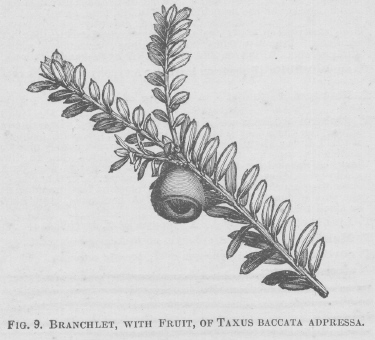
T. b. adpressa (adpressed).* fr. like that of the type, but somewhat smaller. l. oblong or bluntly oval, rounded at both ends on the lesser branchlets, but much longer and more pointed on those of the leading shoots, more or less distichous, flat, rather distant, on very short footstalks, decurrent, mostly spiny-pointed, two to four lines long, dark glossy-green above, glaucous below. Branches numerous, much divided, horizontally spreading, sometimes in whorls; lateral ones and branchlets distichous. h. 6ft. to 8ft. A dense, spreading, depressed bush, raised from seed in the nursery of Messrs. Dickson, of Chester, more than half a century ago. SYNS. T. tardiva, Cephalotaxus tardiva. There is a form, erecta, of upright habit.
T. b. argentea (silvery). l. striped with silvery-white, sometimes changing to straw-colour. A very handsome variety.
T. b. cheshuntensis (Cheshunt). This variety is intermediate between the type and T. b. fastigiata.
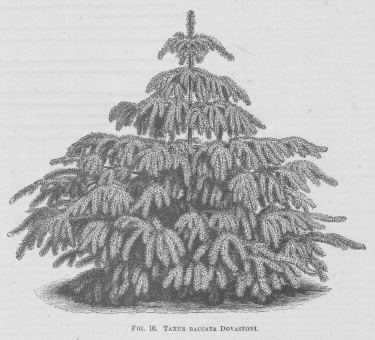
T. b. Dovastoni (Dovaston's).* Principal branches horizontal or pendent; branchlets quite drooping. A very striking variety. In the form variegata, all the leaves, when young, are broadly edged with golden-yellow, but when fully matured, they change to a bright green, edged with silvery-white.
T. b. elvastonensis (Elvaston). l. on the young parts of the plant entirely of a bright orange-colour.
T. b. epacrioides (Epacris-like). l. light green, small. A pretty, dwarf, somewhat spreading variety.
T. b. erecta (erect).* Fulham Yew; Upright Common Yew. A slender variety, with smaller foliage than the type, but with a much stiffer and more erect habit. Crowderi is a form differing very slightly from this.
T. b. ericoides (Heath-like). l. dark green, very small, Twigs short, erect, slender. A slender, slow-growing variety, 1ft. to 2ft. high. SYN. T. empetrifolia.
T. b. fastigiata (pyramidal).* Irish or Florence Court Yew. fr. oblong. l. in tufts, or scattered along the branchlets, not two-rowed as in the type. Branches erect, closely compressed, forming a pyramidal or broom-shaped head. A very distinct and singular variety, of which the following are forms: aurea variegata, with golden-variegated leaves; variegata, having a portion of the foliage striped and margined with silvery-white or pale straw-coloured blotches.
T. b. Foxii (Fox's). l. much smaller and darker than in the type. A very dwarf kind, not exceeding 2ft. in height.
T. b. fructu-luteo (yellow-fruited).* fr. of a beautiful golden yellow, very handsome.
T. b. glauca (glaucous). l. dark green above, bluish or glaucous-grey on the under part. Bark on the young shoots rusty-brown. A very vigorous kind.
T. b. Jacksoni. Jackson's Weeping Yew. l. light green, broad, all more or less incurved, falcate, and thickly covering the upper part of the branches. Branchlets reddish-brown, numerous, short, obliquely placed, and more or less curved. A nice, pendulous kind.
T. b. nana (dwarf). l. longer, and of a darker and more glossy-green, than those of the type. A very desirable variety, forming a dwarf, dense, conical bush.
T. b. nidpathensis (Nidpath Castle). A form rather columnar than pyramidal in habit, and having a tendency to spread at the top.
T. b. recurvata (recurved). l. longer and straighter than those of the species; the margins involute. Branches long and straggling, spread out and little divided, but often reflected.
T. b. sparsifolia (sparse-leaved). l. dispersed round the branches, as in the Irish Yew. Branches spreading.
T. b. variegata (variegated). l. mostly edged with golden-yellow. A very handsome variety. Barroni is a fine fruit-bearing form.
T. b. Wallichiana (Dr. Wallich's). l. deep glossy-green, much paler and not glossy below. Branches long, slender, spreading, light brown; branchlets more or less pendent. Gordon accords this specific rank.
T. brevifolia (short-leaved). Western or Californian Yew fr. resembling that of the Irish Yew. l. distichous, flat, narrow, acute-pointed, somewhat curved on the branchlets, but more or less scattered on the leading shoots and principal branches, 3/4in. to 1in. long, linear-falcate, rarely straight, glossy yellowish green, glaucous beneath, with a yellowish footstalk one line long. Branches slender, very long, pendulous, with yellowish bark. h. 30ft. to 40ft. California. A handsome tree. SYN. T. Lindleyana.
T. canadensis (Canadian). American Yew; Ground Hemlock. fr. resembling, but much smaller than, that of the common Yew. l. linear, crowded, rather narrow, mostly straight, somewhat distichous, revolute on the edges, decurrent at base, on very short footstalks, abruptly tapering at the apex, spiny-pointed, 3/4in. to 1in. long, glossy pale yellowish-green above, slightly rusty beneath. Branches slender, horizontally spreading, seldom ascending; branchlets distichous. h. 3ft. to 4ft. North America, 1800. A spreading bush.
T. c. variegata (variegated). l. at the ends of the young shoots whitish; those lower down more or less margined with white; mature ones as in the type. T. cuspidata (abrupt-pointed).* l. linear, curved upwards, alternate, stiff, scattered but somewhat distichous on the leading shoots, denser on the branchlets, 3/4in. to 1in. long, on rather long footstalks, broadly decurrent at base, abruptly spine-pointed, deep glossy-green above, pale yellowish-green beneath, but not glaucous. Branches numerous, spreading; branchlets rather stiff, angular. h. 15ft. to 20ft. Japan. A large, handsome bush.
T. empetrifolia (Empetrum-leaved). A synonym of T. baccata ericoides.
T. Fortunei (Fortune's). A synonym of Cephalotaxus pedunculata fastigiata.
T. globosa (globular-seeded). Mexican Yew. fl. lateral and solitary on the under side of the branchlets. fr. with globular seeds. l. linear, slightly curved or falcate, narrow, closely placed, distichous, tapering to both ends, spiny-pointed, 3/4in. to 1in. long, on rather long, twisted footstalks, decurrent at base, dark glossy-green above, very much paler beneath. Branches long, spreading, much divided; branchlets more or less drooping at the point, mostly forked. Mexico. A handsome, large bush or small tree.
T. Lindleyana (Lindley's). A synonym of T. brevifolia.
T. Makoya (Makoy's). A synonym of Podocarpus chinensis.
T. tardiva (tardy). A synonym of T. baccata adpressa.