The Illustrated Dictionary of Gardening

Every genus a Victorian gardener could grow — Abelia to Zygopetalum across four volumes, with each plant's history, species, and culture, by the Curator of Kew.

HomeT › Tetranema

Tetranema

Tetranema
Tetranema

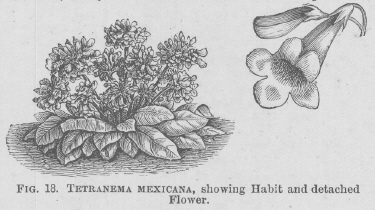
(from tetra, four, and nema, a filament; the genus is characterised by having four stamens). ORD. Scrophularineae. A monotypic genus. The species is a pretty, dwarf, perennial, greenhouse herb. In spring, it should be potted in a compost of leaf mould and sandy loam, and placed in the greenhouse, where it will bear a profusion of flowers during the greater part of the summer. The atmosphere of a warm greenhouse is necessary during winter. Propagation may be effected by seeds, or by divisions.

T. mexicana (Mexican). Mexican Foxglove. fl. shortly pedicellate, on axillary, scape-like peduncles; calyx five-parted; corolla purplish-violet, variegated with a paler colour; stamens four. l. sub-radical, opposite, obovate or oblong, loosely crenate-toothed, angled at base, glabrous. Stems very short, or in cultivation slightly elongated and ascending. Mexico, 1843.(B. H. 1879, 16; B. M. 4070; B. R. xxix. 52.) TETRANYCHUS TELARIUS, or RED SPIDER. This is not a Spider, but a true Mite. It is frequently most injurious to cultivated plants, and is peculiarly hurtful to certain fruit-trees (e.g., Plum), to Hollyhocks, and to many of the more delicate greenhouse plants. A good deal of doubt exists as to whether there is only one species of Red Spider, liable to variation in colour, and in other minor points, or whether there are several closely-related species. It matters little to gardeners whether there are more than one or no, since the habits, harm done by them, and remedies against them, are the same for all, and will be discussed here as if there were but one. The creatures are too small to be seen with the unaided eye, save as minute, moving specks on the leaves; but often their numbers render the effects produced by them conspicuous. Their colour is usually some shade between rust-red and brick-red, but some (probably immature) are greenish, with brown specks on the sides. The body is oval, without any separation between the thorax and abdomen (unlike the structure in Spiders). There are four pairs of nearly equal legs, of which two pairs are turned forwards and two backwards. On the upper part of the body, near the front, are two minute eyes, and a beak or sucker, for boring into, and sucking juices from, the leaves of plants. Near the hinder end of the body, on the lower surface, is a conical wart, which is an organ used for spinning threads.

The name Spider has probably been given to these mites because of their powers of spinning. The females lay eggs; from these emerge larvae, which differ from the adults in their size, and in having only six legs. The mites, when they establish themselves upon plants, spin webs of very fine texture on the backs of the leaves. They then, by means of their suckers, bore into the leaf-cells and suck out the sap. The leaves become yellowish or greyish-green, marbled with paler patches on the upper surface; the glistening web covering the lower surface renders it grey. A severe attack by Red Spider kills the leaves, which fall prematurely; the fruit crop is lessened; and the young branches formed the next year are stunted and weakened.

Prevention. Attacks of Red Spider are worst when the growth of plants is checked by drought and heat; hence, any measures that promote growth--such as frequent syringing--diminish the risk to some extent. Plants that show symptoms of being attacked, should be at once separated from the rest, and specially treated. Free access of air is much to be recommended. Soot, caustic lime, sand impregnated with spirits of tar, or other similar substances, may be laid round the bases of the stems of the plants to be protected, to prevent the mites from getting access to them. Poles and other supports should have their surfaces planed quite smooth, to prevent the mites from harbouring in crevices, and to allow of being thoroughly washed.

Remedies. Sulphur, in the form of Flowers of Sulphur, is almost a certain cure for Red Spider, and for some Fungi. It is sometimes dusted dry on the leaves, but is better employed in solution, e.g., 1lb. of sulphur, boiled with 2lb. of quicklime in four gallons of water; or the sulphuret of lime may be employed, in the proportion of 4oz. of sulphuret to 2oz. of soft soap and one gallon of boiling water. The sulphuret and the soap should be thoroughly mixed, and must be well stirred while the water is being poured on them. The plants may be dipped into the mixture; and it may be applied to the bark with a stiff brush. Various other washes have been found useful; e.g., Gishurst Compound, Veitch's Chelsea Blight Composition, and solutions prepared from quassia-wood. Fumigation with tobacco-smoke, or with sulphur and chalk, mixed in water and painted on the hot-water pipes, is also recommended. To cleanse infested walls, the following method may be employed with success: Add clay to a solution of soot in water till the mixture is of the consistency of thick paint; then add 1lb. of flowers of sulphur, and 2oz. of soft soap, to each gallon; well mix the whole, and carefully paint the entire surface of the walls with the preparation.

← TetramicraTetrapterys →