Teucrium
(the old Greek name used by Dioscorides, probably from Teucer, King of Troy, who is said to have first used the plant medicinally). Germander. Including Polium, Scordium, and Scorodonia. ORD. Labiatae. A large genus (nearly 100 species) of greenhouse or hardy herbs, sub-shrubs, or shrubs, of variable habit, dispersed over the temperate and warmer regions of the globe. Calyx tubular or campanulate, rarely inflated, five-toothed; corolla limb quasi-bilabiate, obliquely five-lobed, the two upper lobes very small, the two lateral larger, the lowest largest; stamens four; whorls two or rarely many-flowered, axillary, or disposed in spikes, racemes, or heads. Nutlets obovoid, reticulate-wrinkled. Leaves entire, toothed, or incised, sometimes multifid; floral ones conformed or reduced to bracts. T. Botrys, T. Scordium (Water Germander), and T. Scorodonia (Wood Sage), are British plants. T. Chamaedrys, an escape from gardens, has become naturalised. T. Pseudo-Scorodonia (Bastard Wood Sage), an inconspicuous species nearly allied to the British T. Scorodonia, is now and then met with in gardens. Few of the species have any horticultural merit, but several are of medicinal value. All thrive in any moderately good soil. The shrubs may be increased by cuttings, inserted in sandy soil, under a glass, in spring or summer; the perennials by divisions.
T. betonicum (Betony-like). fl. purplish; corolla, tube exserted, pubescent outside, the throat inflated and incurved; whorls two-flowered, secund, loosely racemose; racemes 3in. to 6in. long. May to August. l. ovate-oblong, 1in. to 1 1/2in. long, on rather shorter than the calyx. Branches cano-tomentose. h. 1 1/2ft. Madeira, 1775. Greenhouse, evergreen shrub. (B.M. 1114.)
T. bicolor (two-coloured). fl. blue; peduncles short, axillary, one-flowered, the upper ones sub-racemose. July. l. ovate, oblong, or lanceolate, nearly 1in. long, entire or cut, sometimes trifid; young ones often linear, entire or trifid; floral ones usually exceeding the flowers. Branches 1ft. to 2ft. long, acutely tetragonal. h. 1ft. Chili, 1826. Greenhouse, glabrous perennial. SYN. T. orchideum (B.R.1255).
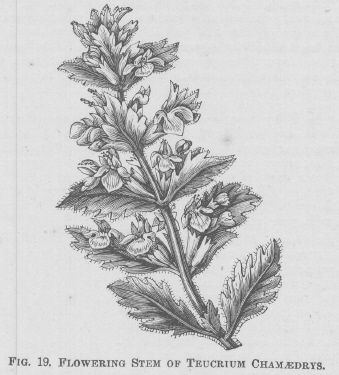
T. Chamaedrys (Chamaedrys).* Wild Germander. fl. rosy, 3/4in long, the lower lip spotted with white and red; whorls about six-flowered, in the axils of leafy bracts, or sub-secund in leafy, terminal spikes. July to September. l. petiolate, ovate, incised crenate, 1/2in. to 1 1/2in. long, gradually narrowed into the petioles. Stem 6in. to 18in. long, ascending, much branched. Rootstock creeping. Europe (naturalised in Britain). A hispidly-hairy perennial. See Fig. 19. (Sy. En. B. 1094.)
T. fruticans (shrubby)* Tree Germander. fl. blue, on one-flowered peduncles shorter than the tomentose calyx; racemes terminal or lateral on short branchlets, few-flowered. Summer. l. ovate, obtuse, entire, flat, very shortly petiolate, glabrous above, white or rufescent-tomentose beneath. Branches divaricate. h. 2ft. to 3ft. South Europe, 1869. Greenhouse or half-hardy, evergreen shrub. (Ref. B. 204; S.F.G. 527.) SYN. T. latifolium (B. M. 245).
T. hircanicum (Hyrcanian). fl. purple, on short, erect, villous pedicels; corolla villous outside; spikes simple, dense, 3in. to 8in. long. September. l. petiolate, ovate-cordate, 1in. to 3in. long, deeply crenate, obtuse, scarcely pubescent above, softly sub-canescent beneath. Stems 1ft. to 2ft. high, pubescent, scarcely branched. Persia, 1763. Hardy perennial. (B. M. 2013.)
T. latifolium (broad-leaved). A synonym of T. fruticans.
T. Marum (Marum). Cat Thyme. fl. reddish-purple, in pairs at the axils of the upper leaves, forming an oblong, generally rather crowded, nearly one-side inflorescence; corolla with the median lobe sub-orbicular; calyx hairy, with shortly acuminate, lanceolate, nearly equal teeth. Summer. l. shortly stalked, entire, oval or lanceolate, green, pubescent above, white-woolly beneath. Stems shrubby, erect. h. 1ft. Western Mediterranean region. Hardy. Cats have a strange liking for this plant.
T. orchideum (Orchid-like). A synonym of T. bicolor. T. orientale (Eastern). fl. blue, disposed in a loose, sometimes hispid-pilose panicle; pedicels or peduncles one-flowered, nearly twice as long as the acutely-toothed calyx. July. l. once or twice pinnatisect, the lower ones 1 1/2in. to 2in. long, broadly ovate in outline, the floral ones minute; segments linear, entire or incised. h. 1ft. Levant, 1725. A hardy, sometimes loosely pubescent or canescent, erect perennial. (B. M. 1279; L. B. C. 1871.)