Thalia
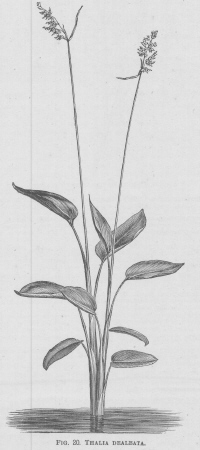
(named in honour of J. Thalius, a German physician and botanist, who died in 1588). SYN. Peronia. ORD. Scitamineae. A genus embracing about five species of stove, greenhouse, or hardy herbs, natives of tropical America, one species extending as far as the Southern United States, and one being found in tropical Africa. Flowers in pairs, pedicellate, loosely spicate; sepals three, free, equal, membranous, equalling or much shorter than the corolla; petals three, free or very shortly connate at base, equal or the dorsal one scarcely broader; androecious tube short, the lobes petaloid, very irregular; panicle terminal; bracts spreading under the branchlets, deciduous. Leaves few, ample; floral ones sometimes conformed. T. dealbata, the only species that calls for description here, is an aquatic plant, sufficiently hardy to withstand the severity of our winters, provided it be planted about 2ft. beneath the surface of the water. It is a very elegant subject for aquaria. Propagation may be effected by division of the rootstock.
T. dealbata (whitened). fl. purple, small; valves of the spathe unequal, ovate, coriaceous; spikes erect; panicle erect, dense, smooth, the branches not longer than the lanceolate, deciduous bracts at their base; scape terete, Reed-like, 3ft. to 5ft. high. June to September. l. distichous, long-petiolate, cordate-ovate, acute, 6in. to 9in. long; petioles 1ft. to 2ft. long. South Carolina, &c., 1791. Plant dusted over with a minute, white powder; otherwise smooth. See Fig. 20. (B. M. 1690.)
T. sanguinea (blood-coloured). A synonym of Stromanthe sanguinea.