Thermopsis
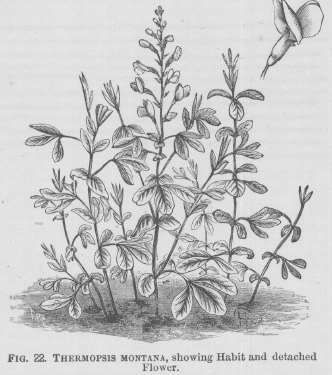
(from Thermos, a Lupine, and opsis, resemblance; the species are not unlike Lupines). SYN. Thermia. ORD. Leguminosae. This genus embraces about a dozen species of hardy, perennial herbs, natives of North America and Asia (Siberia and Himalayas). Flowers yellow or rarely purple, rather large, in terminal or leaf-opposed racemes; calyx teeth or lobes sub-equal, or the two upper ones connate in one; standard sub-orbicular; keel equalling, or slightly longer than, the wings; stamens free; pedicels solitary. Pods sub-sessile or shortly stipitate. Leaves perfectly alternate, digitately trifoliolate; stipules leafy. The following species have been introduced. They are elegant subjects, but rather difficult to preserve. They succeed best in a light, rich soil. Propagation is most safely effected by means of seeds; for when the plants are separated at the roots, they often decline.
T. barbata (bearded).* fl. six to twelve, shortly pedicellate, opposite or ternate; corolla deep purple, 1in. long. June. l. sessile, sub-glabrescent, often opposite; leaflets oblanceolate; stipules resembling the leaflets both in texture and shape. Stems 1ft. or more high, copiously dichotomously branched. Rootstock woody. Himalayas, 1854. (B. M. 4868.) T. corgonensis (Corgon). fl. yellow, twin on the racemes, nearly sessile; calyx villous. June and July. l. sessile or very shortly petiolate; leaflets ovate, acute; stipules constituting with the leaflets a kind of half-whorl. h. 1ft. to 2ft. Corgon Alps, 1820.
T. fabacea (Bean-like). A synonym of T. montana.
T. lanceolata (lance-shaped). fl. yellow, twin or somewhat whorled; calyx cleft to the middle; bracts large; racemes terminal. June and July. l. nearly sessile, the lower and the highest ones often simple; leaflets oblong-lanceolate, silky-puberulent on both sides; stipules half the length of the leaflets. h. 1ft. Kamtschatka, 1779. SYN. Podalyria lupinoides (B. M. 1389).
T. montana (mountain).* fl. yellow, alternate; racemes terminal. June and July. l. petiolate; leaflets broadly oval; stipules broadly ovate, obtuse, shorter than the petioles. h. 1ft. to 2ft. North America, 1818.(B. M. 3611; B. R. 1272; L. B. C. 1856.) SYN. T. fabacea.
T. nepalensis (Nepaul). A synonym of Piptanthus nepalensis.