Tilia
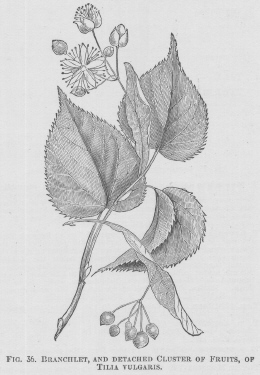
(the old Latin name for the Lime, used by Virgil and Pliny). Lime-tree; Linden. ORD. Tiliaceae. This genus includes about eight species of ornamental, lofty-growing, hardy, stellate or simply-pubescent trees, inhabiting the temperate regions of the Northern hemisphere. Flowers white or yellowish; sepals five; petals five, naked or furnished with petaloid scales on the inside; stamens numerous, free or irregularly disposed in bundles; bract of the peduncle leaf-like, adnate for half its length; cymes axillary or terminal. Fruit globose, nut-like, indehiscent, one or two-seeded. Leaves often obliquely cordate, serrated. Several species are grown in this country, one being a native. The flowers contain a quantity of honey, and are consequently haunted by bees. Russian Bass or Bast Mats, so well known to gardeners, are prepared from the inner bark of various species. The smooth, light, delicately-white, and uniform wood of T. platyphyllos and T. vulgaris is in great demand by carvers, turners, and musical instrument makers. Culture, &c. A good, loamy soil is suited to the requirements of Limes. In dry situations, the species never attain a large size, and they lose their leaves earlier than any other tree. Being a tree of the plains, rather than of the mountains, the Lime does not appear suitable for very exposed situations. Propagation is usually effected by layers, which are made in the nurseries, in autumn and winter, and become rooted, so as to admit of being taken off, in a year. Seeds are seldom ripened in this country; when obtainable, they should be sown immediately after being gathered, but the raising of plants by this means is an exceedingly slow process. Du Hamel states that "the French gardeners, when they want a supply of young Lime-trees, cut over an old one close by the surface of the ground, which soon sends up a great number of shoots; among these they throw in a quantity of soil, which they allow to remain one, two, or three years; after which they find the shoots well rooted, and of a sufficient height and strength to be planted at once where they are finally to remain." This mode is still practised in France and Belgium, both with the Lime and the Elm. The Lime-tree bears transplanting when of a considerable size; but when grown for this purpose, it should be taken up and replanted every two or three years. Trees that have stood some years without being removed should have the roots cut round, at from 3ft. to 4ft. from the stem, a year before transplanting, in order to stunt the growth, both of the head and roots, and to induce the production of smaller roots and fibres. The different cut-leaved and variegated forms are usually increased by grafting on strong plants of any of the common species.
Insects, &c. Of foes to the Lime-tree, only a few do so much injury as to call for detailed notice here. The bark and wood are liable to attacks by Beetles, though healthy trees seldom suffer thereby. The caterpillars of several kinds of Moths, most of them small, frequently disfigure the leaves by drawing them together by webs, or rolling them to form tubes, and by eating large holes in them. The more destructive species belong to the Winter Moths, the females of which either have no visible wings, or have them so small as to be useless (see Hybernia and Winter Moth). Their ravages may be lessened by shaking the branches, and collecting the caterpillars when they drop from their tubes; or, yet more effectually, by interposing an obstacle, e.g., a belt of tar, in autumn and winter, round the foot of the tree, to prevent the ascent of the female moth to lay her eggs.
Lime-trees are very liable to be injured by the growth of galls on the younger parts. A Gall-midge (Cecidomyia floricola) often makes galls on the branches or leaf stalks, in the form of swellings about the size and form of a small pea, in the centre of which the larvae may be found. The leaves are very liable to be galled by Mites of the genus Phytoptus. These Mites are extremely small, requiring a considerable magnifying power to show them; but the genus is easily recognised by having only four legs, instead of eight, as in other Mites, and by being gall-makers-a mode of life not shared by other Mites. The Mites do not in themselves afford characters by which the species can be clearly distinguished from one another; but the galls made by them are very constant in form and aspect, so that they can be readily recognised. On Lime leaves there may be found three at least, very distinct from one another. The first resembles small nails, and has received the popular name of Nail-galls. It has also received the name of Ceratoneon extensum. Frequently, many of these galls stand on almost every leaf of the tree. Another gall is in the form of small, round, hard warts, at the origin of the larger leaf-veins; while the third forms velvety patches, 1/4in. to 3/4in. across, on the lower surface of the leaves, so much resembling a Fungus that it was at one time described as such under the name Erineum tiliaceum. It consists of a patch of hairs, between which the Mites live. The hairs are at first white, but show a tendency to become brown.
Except where very numerous, these galls can hardly be regarded as doing much harm to the trees. The most likely method of limiting their attacks is to remove the affected leaves or branches, and to destroy them, as soon as possible after the first appearance of any of the galls on a plant.
T. alba (white). A synonym of T. argentea.
T. a. pendula (white weeping). A synonym of T. petiolaris.
T. americana (American). American Basswood or Whitewood. fl. yellowish-white; petals truncate and crenate at apex, equalling the style, furnished with scales. July and August. fr. yellow, the size of a large pea. l. deeply cordate, abruptly acuminate, sharply serrated, somewhat coriaceous, glabrous, turning yellowish-brown in decay. h. 60ft. to 70ft. North America, 1752.
T. a. pendula (weeping). A garden synonym of T. petiolaris.
T. a. pubescens (downy). fl. pale yellow. June. l. 3in. to 4in. in diameter, the under surface, when young, rather paler than the upper, but at length nearly the same colour; serratures broad and short. h. 50ft. to 70ft. 1726.
T. argentea (silvery).* White or Silver Lime. fl. yellowish-white, very fragrant; petals each with a scale on the inside. June to August. fr. yellow, evidently ribbed. l. cordate, somewhat acuminate, rather unequal at base, serrated, smooth above, white-downy beneath, four times the length of the petioles. h. 30ft. to 50ft. Eastern Europe, 1767. (W. D. B. 71, under name of T. alba.)
T. a. pendula (weeping). A synonym of T. petiolaris. T. cordata (heart-shaped). fl. yellowish-white; petals without a scale at their base. Summer. fr. crustaceous-pubescent, globose or ellipsoid, faintly-ribbed. l. glabrous, glaucous, and pubescent, in the axils of the nerves beneath. Europe and Siberia. A small tree, generally with leaves smaller in size than those of either T. platyphyllos or T. vulgaris. This is the last of the three to flower. It is found here and there in woods in Britain, and is regarded by some authorities as a truly indigenous species. SYNS. T. microphylla, T. parvifolia (Sy. En. B. 287), T. ulmifolia.
T. dasystyla (thick-styled).* fl., lower part of the pyramidal style tomentose and persistent as a point. Summer. l. large, obliquely truncate at base or sometimes sub-cordate, slightly hairy beneath and bearded in the axils of the nerves. Buds glabrous. h. 30ft. to 60ft. South Tauria, 1884.
T. europaea. See T. platyphyllos and T. vulgaris.
T. e. laciniata (torn). A synonym of T. platyphyllos asplenifolia.
T. grandifolia (large-leaved). A synonym of T. platyphyllos.
T. heterophylla (variable-leaved). American White Basswood. fl. greenish-yellow, few in a loose cyme; petals obtuse, crenulated. July and August. l. 4in. to 8in. in diameter, very oblique, more or less cordate, abruptly acuminate, green and somewhat shining above, very white and velvety-tomentose and conspicuously veined beneath. h. 30ft. to 50ft. North America, 1811.
T. intermedia (intermediate). A synonym of T. vulgaris.
T. microphylla (small-leaved). A synonym of T. cordata.
T. parvifolia (small-leaved). A synonym of T. cordata. T. petiolaris (petiolate).* fl. yellow-green, with five petaloid scales inserted amongst the stamens. July. fr. depressed, globose, five-lobed, warted, 1/3in. in diameter. l. pale green above, white, hoary-pubescent beneath; petiole as long as, or longer than, the blade. Branchlets pendulous, leafy. Trunk erect. h. 50ft. Crimea (?). This greatly resembles the White Lime, but is easily recognised by its much longer leafstalks and its warted fruits. (B. M. 6737.) SYNS. T. alba pendula, T. americana pendula (of gardens), T. argentea pendula.
T. platyphyllos (broad-leaved).* fl. yellowish-white; petals without a scale at their base. June. fr. obovate, globose, with from three to five prominent ribs when ripe. l. downy sometimes on both surfaces, always on the entire under surface. h. 70ft. to 90ft. Europe (Britain). This species is the earliest to flower. SYNS. T. europaea (in part), T. grandifolia (Sy. En. B. 285).
T. p. asplenifolia (Spleenwort-leaved). This has curiously laciniated leaves and is not so vigorous or tall a grower as the type. SYN. T. europaea laciniata.
T. p. aurantia (orange). In this form, the bark of the young twigs is of an orange-yellow colour.
T. p. Blechiana (Blech's). l. very large. A distinct and vigorous form of garden origin.
T. p. pyramidalis (pyramidal). A form of distinctly pyramidal habit.
T. p. vitifolia (Vine-leaved).* A pretty variety, with lobed, Vine-like leaves. SYN. T. vitifolia.
T. ulmifolia (Elm-leaved). A synonym of T. cordata.
T. vitifolia (Vine-leaved). A synonym of T. pyramidalis vitifolia. T. vulgaris (common).* Lime, Lin, Linden, or Line-tree. fl. yellowish-white; petals without a scale at their base. Summer. fr. woody, pubescent, not ribbed when ripe. l. glabrous above, pubescent in the axils of the veins beneath. Europe, Caucasus (naturalised in Britain). This species begins to flower when T. platyphyllos is nearly past. SYNS. T. europaea (in part), T. intermedia (Sy. En. B. 286).
T. v. variegata (variegated). This only differs from the type in having the leaves blotched with dull creamy-white. SYN. T. europaea variegata.