Tillandsia
(named in honour of Elias Tillands, a Swedish botanist, and Professor of Medicine in the University of Abo). SYN. Renealmia (of Linnaeus). Including Allardtia, Anoplophytum, Bonapartea, Phytarrhiza, Platystachya, Vriesia, Wallisia (of Regel). ORD. Bromeliaceae. A large genus (according to the authors of the "Genera Plantarum," nearly 120 species) of very handsome, stove, epiphytal or rock-loving, very rarely terrestrial, glabrous or often more or less furfuraceous herbs, natives of tropical America, a few extending into North America. Flowers solitary in the bracts; sepals erect, rather rigid, free, closely imbricated; petals free, deciduous, the erect claws connivent in a tube, the blades spreading; stamens free; filaments filiform; anthers oblong-linear, erect, shorter than the petals, or Sometimes exserted; bracts variable; spike terminal, simple or compound, rarely reduced to a one-flowered peduncle. Capsules oblong or linear, septicidally three-valved. Leaves narrow, entire. Most of the plants of this genus are epiphytal on trees under natural conditions; but under cultivation it is found best to treat the majority of them as pot-plants, the exceptions being such as T. bulbosa, T. Gardneri, T. ixioides, and T. usneoides (Old Man's Beard)-which last could not well be grown in a pot, and, as it makes no roots, does not require soil. These should be fastened on to blocks of cork or soft wood, and a little sphagnum placed about them to root in. Grown in pots, the strongest kinds, e.g., T. corallina, T. Itatiaiae, the gigantic T. regina, and T. splendens, require a strong soil, such as fibrous loam with rotted manure added, or loam, peat, and manure. T. Lindeni and the whole of the Vriesia section thrive best in a mixture of loam, peat, and leaf mould, with a sprinkling of crushed bones added. The small, grassy-leaved kinds, of which T. angustifolia and T. virginalis are examples, may be grown in peat and sphagnum. All the species delight in abundant sunlight, a high temperature during summer, plenty of water (though the soil must not be kept saturated), and syringing overhead twice a day. In winter, they should be kept from getting quite dry, but need not be syringed. Nothing can exceed the beauty of many of the Tillandsias, when in good health, and bearing their richly-coloured flowers. There is no more beautiful plant than T. Lindeni, whilst T. carinata, T. Morreni, T. psittacina, and T. splendens, are most richly coloured. Propagation is effected by seeds and suckers, chiefly by the latter. They should be allowed to grow large before being detached from the parent, and inserted singly in pots just large enough to hold the sucker, using a compost of loam, peat, and leaf mould. The suckers must not be confined in a close frame for propagating, but kept moderately moist and well shaded. Spring is the best season for detaching them.
T. acaulis (stemless). A synonym of Cryptanthus acaulis.
T. aloifolia (Aloe-leaved). A synonym of T. flexuosa.
T. amethystina (amethystine). fl. yellow, 2 1/2in. long, distichous, distant, sub-sessile, tubular; petals twice the length of the sepals; anthers exserted; bracts greenish-yellow, small; spike distichous, the rachis pulvinate; scape slender, erect, exceeding the leaves, bracteate. l. 12in. to 16in. long, lingulate, acuminate, shining-green above, amethystine beneath. South Brazil, 1884. SYN. Vriesia amethystina (B. H. 1884, 15-16).
T. anceps (two-edged). fl. 2in. long; sepals pale yellow, keeled, imbricated; petals white and purplish, twice as long as the sepals; bracts greenish-yellow, red-margined, cymbiform, bluntly mucrenate; spike oblong, solitary; scape nearly 1ft. long. June. l. numerous, imbricated, about 1ft. long, curved to one side, broad, sheathing, and very concave at base, becoming subulate above, dingy-green, whitish-scaly outside. West Indies and Central Mexico, 1824. SYNS. T. setacea, of Hooker (B. M. 3275), T. tricolor (B. H. 1879, 10-11), Phytarrhiza anceps (B. H. 1879, 20 D.
T. angustifolia (narrow leaved). fl. blue, sepals half as long as the erect petals; bracts imbricate-distichous; central spike 4in., lateral ones 1 1/2in. to 2in., long. August. l. linear from a subulate base, convolute, curved, about as long as, or longer than, the stem, lepidote. h. 1ft. to 2ft. West Indies, 1822.
T. argentea (silvery). A garden synonym of T. Gardneri.
T. argentea (silvery), of K. Koch. A synonym of T. tectorum. T. Balbisiana (Balbis'). fl., sepals exceeding half the petals, all distinct; petals violet, erect, convolute, spathulate-linear, 1 1/4in. long; stigmas exserted; bracts green, red, and yellow, imbricate-distichous, oblong-lanceolate, acuminate, ten lines long; spike compound, compressed; lateral spikes three to eight, 2in. to 3in. long, appressed, alternate. l. lanceolate-linear from a subulate base, convolute, recurved, exceeded by the stem, lepidote. h. 1ft. to 1 1/2ft. West Indies, 1874. (B. H. 1879, 6-7.)
T. Barilleti (Barillet-Dechamps'). fl. yellow; bracts yellowish-olive, very numerously spotted with dark blood-colour, distichous, clustered, conduplicate, navicular, equitant; spike simple, elongated, ancipitous; scape about as long as the leaves. l. green, smooth-edged, 16in. to 20in. long, shortly acuminate, with the margins rolled in at the middle. Andes of Ecuador, 1883. SYN. Vriesia Barilleti (B. H. 1883, 3).
T. Billbergiae (Billbergia-like). fl. tricoloured (green, white, and red), sessile; corolla dilated. l. resembling those of Billbergia, quite glabrous, rosulate, imbricate, dilated, amplexicaul at the base, very thin, slightly recurved, oblong-ligulate, oblique, and very shortly and abruptly apiculate, sub-coriaceous, pale green, furfuraceous at the base outside. h. 10in. Mexico.
T. brachycaulos (short-stemmed). fl. purple, about twelve in a head, which is sessile amongst the leaves. l. linear, channelled, recurved, 6in. to 9in. long, red on the upper surface, greyish-green beneath, slightly scurfy. Central Mexico, 1878. A handsome, dwarf species. (B. H. 1878, 11.)
T. brachystachys (short-spiked). A synonym of T. carinata.
T. bryoides (Moss-like). fl. three or four in a small, distichous spike; style and stamens short; scape capillary, 2in. long. l. small, lanceolate-subulate. Stems slender, branched. South Brazil, &c., 1880. A small, Moss-like plant. SYN. S. polytrichoides.
T. bulbosa (bulbous). fl., sepals distinct; petals violet, white at the point, 1 1/4in. long, recurved at the summit, convolute spathulate-linear; bracts eight to nine lines long, imbricate-distichous; spikes five to eight, sub-equal, approximate, spreading, 2in. to 3in. long. November. l. convolute-filiform, greenish, minutely lepidote; rosulate ones dilated into the roundish sheaths of the bulbous stem-base, flexuous; uppermost ones exceeding the spikes. h. 8in. to 12in. West Indies, Buenos Ayres, &c., 1823. (H. E. F. 173.) SYN. T. paucifolia. T. eminens, T. erythraea, T. inanis, and T. pumila, are mere varieties of this species.
T. Caput-Medusae (Medusa's Head). fl. six or seven to a spike; bracts green; spikes about four, forming a compound panicle; scape shorter than the leaves, clothed with elongated bracts. l. tumid at base, forming a kind of bulb, lanceolate, thick, channelled, divaricate, arched, undulated, unequal, shining, silky-grey. Mexico, 1880.
T. carinata (keeled).* fl. projecting 1/2in. beyond the bracts; sepals pale yellow, keeled; petals pale yellow, twice as long as the sepals, cohering nearly to the dark green tips; bracts green beyond the middle, scarlet below, 2in. long, closely imbricated, laterally much compressed; spike 5in. long, broadly ovate, the rachis scarlet; scape scarlet, 6in. long, stout, cylindric, the sheaths green-tipped. November. l. 4in. to 6in. long, 1in. to 1 1/2in. broad, spreading and recurved, pale green, broadly strap-shaped from a dilated, sheathing base. South Brazil, 1866. A very brilliant plant. SYNS. T. brachystachys, Vriesia brachystachys (B. M. 6014; R. G. 1866,518), V. psittacina brachystachys (B. H. 1870, 8), V. p. carinata (B. H. 1882, 10-12).
T. chrysostachys (golden-spiked). fl. yellow, regular; sepals free, lanceolate; petals longer, ligulate, obtuse; bracts yellow, conduplicate; spike simple, distichous, elliptic, elongated; scape elongated, erect, bracteate. l. numerous, rosulate, lax, arched, coriaceous, short and broad, loriform, lingulate at base, of a pleasing green, but rosy and glaucescent beneath towards the base. Stem short. Andes of Peru, 1881. (B. M. 6906.)
T. circinalis (crozier-like). A synonym of T. Duratii. T. circinata (crozier-like). A synonym of T. streptophylla.
T. complanata (complanate). A synonym of T. xiphostachys.
T. corallina (coral-red).* fl. green, distant, refracted, each subtended by a long, purplish-crimson bract, the scape and rachis being of the same brilliant colour; petals large, with two scales on the claw; spikes distichous. l. oblong-ligulate, blunt and apiculate, green. Minas Geraes, 1871. SYNS. Encholirion corallinum (F. M. n. s. 116), Vriesia corallina (R. G. 1870, 671).
T. c. rosea (rosy). This differs from the type in its rose-tinted flowers. SYN. Encholirion roseum.
T. cordobensis (Cordoba). A synonym of T. recurvata.
T. crocata (saffron-yellow). fl. of a saffron-yellow colour, about five in a short, elliptic, distichous spike; scape elongated, slender, villous, nearly naked. l. distichous, long, linear-subulate, recurved, covered with silky, white hairs. Stem undulated, branched. South Brazil, 1880. SYN. Phytarrhiza crocata.
T. cyanea (blue). fl. blue, in a branching panicle from the centre of a rosette of strap-shaped, entire leaves. h. 2 1/2ft., when in flower. Guatemala, 1852. SYNS. Allardtia cyanea, Platystachys cyanea.
T. dianthoidea (Dianthus-like). fl., corolla tubular, the tube cylindrical, the limb blue, spreading or reflexed; bracts purplish-rose, ovate-lanceolate, acute, persistent; spike loose, six to ten-flowered. l. amplexicaul, the outer ones recurved, the inner ones erect or inflexed, coriaceous, rigid, triquetrous towards the apex, acute, entire, silky-glaucous. Stem nearly terete, simple, ascending, 3in. to 5in. long. Uruguay, &c., 1810. (R. G. 85.) SYN. T. stricta, of Lindley (B. R. 1338.) T. d. rosea (rosy). fl. white, issuing from rosy-pink bracts; scape short. l. glaucous, lanceolate-subulate, recurved, channelled. 1861. SYNS. T. recurvifolia (B. M. 5246), T. rosea (B. R. 1357).
T. didisticha (twice-two-rowed). fl. white; spikes elliptic, forming a crowded, distichous panicle; scape elongated, arched, clothed with bracts. l. thick and robust, disposed in a rosette, lanceolate, channeled, acuminate, cinereous. South Brazil, 1881. SYN. Anoplophytum didistichum.
T. distachya (two-spiked). fl., sepals 3/4in. long, free to the base; corolla white, more than twice as long as the calyx, the petals oblanceolate, with a long claw; bracts green, oblong-lanceolate, about 1in. long; spikes two, distichous, six to twelve-flowered; scape erect, 6in. long, hidden by its linear, falcate leaves. l. twelve to fifteen in a sessile rosette, lanceolate, acuminate, about 1ft. long, the dilated base 1in., the middle of the lamina 1/2in., broad, the face pale green, concave, glabrous upwards, thinly lepidote towards the base, the convex back thinly lepidote throughout. h. 1ft. British Honduras, 1879.
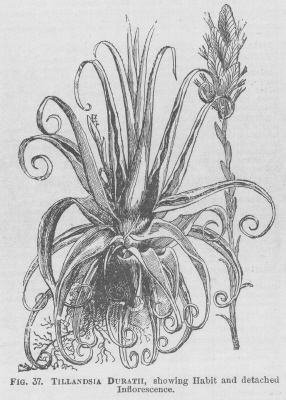
T. Duratii (Durati's). fl. violet; panicle compact, 3in. to 4in. long, composed of several dense, few-flowered spikes; scape 6in. high. l. twelve to twenty, spreading, 6in. to 9in. long, gradually tapering to a thick, subulate, channelled more or less circinate tip, everywhere densely silvery-lepidote. Uruguay, 1879. SYNS. T. circinalis, T. revoluta, Wallisia Duratii.
T. Duvaliana (Duval's). fl. yellow, green at apex; bracts scarlet below, green above, conduplicate, keeled, beaked, equitant; spike simple, elongated-elliptic, about eighteen-flowered; scape erect, about 1ft. high. l. membranous, short, lanceolate, green above, tinged with red beneath, the sheath broad. South Brazil, 1884. SYN. Vriesia Duvaliana (B. H. 1884, 7-8).
T. eminens (eminent). A form of T. bulbosa.
T. ensiformis (sword-shaped). fl. of a reddish-yellow colour. June. l. tongue-shaped, yellow-green, about 1ft. long, the edges entire. h. 1 1/2ft. Brazil.
T. erubescens (blushing). A garden synonym of T. ionantha.
T. erythraea (red). A form of T. bulbosa.
T. fenestralis (fenestrate). fl., sepals long, elliptic, convolute in a tube; petals pale yellow, longer, very broad; spike distichous, elongated; scape erect, long, robust. l. coriaceous, about 12in. long, broad, arched, concave, pale, beautifully marked with pellucid reticulations in the upper half, rounded-mucronate at apex, slightly spotted with red at base. Parana, 1875. Plant tufted. (B. M. 6898.) SYN. Vriesia fenestralis (B. H. 1884, 4-5; I. H. n. s. 215).
T. filifolia (thread-leaved). fl. pale blue, small, distichous, with reflexed petals; inflorescence paniculate, not unlike that of some of the species of Statice, with lax, drooping branches. l. subu-late, filiform, spreading. Mexico, Vera Cruz, &c., 1871. A very elegant, dwarf, densely-tufted plant. SYN. T. staticiflora (B. H. 1871, 12).
T. flexuosa (flexuous). fl. rosy, distant; sepals 1in. long; petals 2in. long, linear, spreading at the summit; bracts rosy, distichous, spreading, oblong-lanceolate, bluntish; spike with a few long, spreading branches, or simple. l. linear, acuminate, subulate at base, recurved, shorter than the stem, lepidote with minute scales or greenish, transversely zonate beneath. h. 1 1/2ft. to 3ft. West Indies, &c., 1790. (B. R. 749.) SYNS. T. aloifolia (H. E. F. 205), T. tenuifolia (of Jacquin).
T. Gardneri (Gardner's). fl., sepals glabrous; petals pale purplish, small; spikes four to eight, short, distichous, crowded; bracts lepidote; scape 2in. to 4in. high, densely sheathed with linear-subulate, lepidote leaves. l. 6in. to 8in. long, flat in the lower part, narrowed from a 1/2in.-broad base to a reflexing, subulate, convolute point, everywhere densely covered with silvery scales. South Brazil, &c., 1879. SYNS. T. argentea (of gardens), Anoplophytum incanum (B. H. 1881, 11).
T. geminiflora (twin-flowered). fl. madder-coloured; sepals shorter than the petals, the limb of which is reflexed; filaments sigmoid towards the apex; bracts red, lanceolate, mucronate, rather longer than the sepals; spike oblong, sub-compound; scape erect, clothed with red, green-tipped, acuminate sheaths. February. l. ovate-lanceolate, channelled, acuminate, the outer ones spreading-recurved. South Brazil, &c., 1840. SYNS. T. rubida (B. R. 1842, 63), Anoplophytum geminiflorum (B. H. 1880, 11).
T. gigantea (gigantic). A form of T. regina.
T. gladioliflora (Gladiolus-flowered). fl. greenish-violet; spike simple; bracts green, closely imbricated. l. broadly ligulate, abruptly acuminate, glabrous. Costa Rica, 1863.
T. glaucophylla (glaucous-leaved).* fl., sepals greenish-white; petals purple, almost white at apex, convolute, erect; filaments banded with purple: lower bracts red, the rest green tinged with yellow and red; spikes four or five, 9in. long; scape red, 1ft. or more long. August. l. imbricated round a rather tumid base, spreading, recurved, 1ft. to 1 1/2ft. long, gradually tapering from a broad and rather concave base to a slender point, sub-farinose or flocculose. Santa Marta, 1847. SYN. Vriesia glaucophylla (B. M. 4415; F. d. S. 432).
T. gracilis (slender). fl. remote, sessile, distichous; petals oblong, slightly dilated and scarcely spreading at apex; bracts reddish at base, greenish towards the apex; panicle loose, erect, the branches erecto-patent, five to eight-flowered, 6in. to 8in. long; scape 2ft. to 2 1/2ft. high. l. entire, of a pleasing green, 10in. to 12in. long, broad and semi-amplexicaul at base, attenuated towards the acute apex. Forests of Southern Brazil, 1886. SYN. Vriesia gracilis (R. G. 1886, p. 163.)
T. guttata (spotted). fl. numerous, distichous, approximate; sepals citron-coloured, with reddish marks, elliptic; petals yellow, obovate-ligulate; bracts light rose-coloured, broad, con-duplicate, nearly equalling the calyx, farinose; spike simple, very long, pendulous; scape arched. l. short, slightly acute, mucronate, olivaceous, richly spotted and blotched with dark purple. South Brazil, 1875. SYN. Vriesia guttata (B. H. 1880, 1-3; I. H. n. s. 200).
T. Hamaleana (Hamale's).* fl. sessile, bifarious, fragrant; sepals green, ovate-lanceolate; claw of petals white, linear, channelled, the limb beautiful violet, snow-white at base, rhomboiddilated, spreading-reflexed, obcordate; bracts green and purplish, lepidote, conduplicate; spike compound, the branches distichous; spike erect, longer than the leaves, with remote, reddish bracts. l. approximate, divaricate, the lower ones arcuate-deflexed, the upper ones erect, linear, concave, uncinate-revolute at apex, unarmed, not lepidote. Andes of Peru, 1870. (B. H. 1870, 5.) SYNS. Phytarrhiza Hamaleana, Wallisia Hamaleana.
T. heliconioides (Heliconia-like). fl. sessile, distant; sepals whitish, striated, lanceolate, acuminate, concave; corolla white, tripartite, the segments lanceolate-linear; bracts striated, ovate, acute, keeled, spreading, 1in. or more long; spike 4in. to 6in. long. l. linear-lanceolate, subulate at apex, nearly flat, glabrous, coriaceous, striated, recurved, 1 1/2ft. long. Stem simple, scarcely 1ft. long, leafy. Rio Magdalena Valley. SYNS. Vriesia bellula and V. Falkenbergii (of gardens), V. heliconioides (G. C. n. s., xxi., p. 140; I. H. n. s. 490).
T. hieroglyphica (hieroglyphic). fl. disposed in a lax panicle; bracts ovate, conduplicate, short; panicle branches spreading, short, naked at base, bearing seven or eight pedicellate flowers. l. forming a tuft 3ft. to 7ft. in diameter, long, loriform, broad, especially at base, glabrous, mucronate, obtuse, green, very handsomely marked above with dark green, and below with blackish-purple. South Brazil. An exceedingly handsome foliage plant. SYNS. Massangea hieroglyphica (R. H. 1878, p. 175), Vriesia hieroglyphica (B. H. 1885, 10-12; I. H. 1884, 514). For some time after it was introduced, the flowers of this species were unknown. In 1885, however, it flowered in the Brussels botanical garden, and was then found not to be a Massangea at all; therefore, this species should not be referred to Caraguata, as mentioned under Massangea.
T. inanis (uninteresting). A form of T. bulbosa.
T. incurvata (incurved). fl. yellow, tipped with green, sub-sessile, long-tubular; petals ligulate, the limb obtuse, recurved; bracts beautiful orange and red, conduplicate, keeled, oval-lanceolate; spike dense, stout, distichous. l. green, lorate, shortly acuminate, widened at base. South Brazil, 1882. SYNS. T. inflata (B. M. 6882), Vriesia incurvata (B. H. 1882, 2).
T. inflata (inflated). A synonym of T. incurvata.
T. ionantha (violet-flowered).* fl. sessile, crowded at the tips of the branches; petals pale violet, convolute by their linear, broad claws; bracts lanceolate, equalling the sepals. l. numerous, closely imbricated, 2in. to 2 1/2in. long, recurved, subulate-lanceolate, very coriaceous, concave above, sub-pungent at tip, the margins ciliated; upper ones more erect, bright rose-coloured, at length wholly green. h. 3in. to 4in. Brazil (?), 1871. Plant tufted. (B. M. 5892; F. d. S. 1006.) SYNS. T. erubescens (of gardens), Pitrophyllum ionantha.
T. ixioides (Ixia-like). fl. three to five in a spike, sub-tristichous; sepals equalling the claw of the petals; petals orange; limb only half as long as the claw; anthers included. l. imbricated, linear, acuminate, slightly dilated at the base, with silvery scales on the dorsal nerve. h. 6in. Uruguay.
T. Jonghei (Jonghe's). fl. tawny-yellow, rather remote, horizontal; sepals greenish, with fuscous margins, ovate, convex, bidentate at apex; corolla campanulate, the petals obtuse, emarginate; bracts fuscous-green, conduplicate, plicate, gibbous at base, shorter than the sepals; spike simple, ancipitous, the rachis distichous-pulvinate; scape erect, simple, longer than the leaves, with lanceolate, leafy bracts. l. lorate, recurved, fuscous-purplish beneath. Minas Geraes, 1874. (B. H. 1874, 12-13.) SYN. Vriesia Jonghei.
T. juncifolia (Rush-leaved). A synonym of T. setacea.
T. Karwinskiana (Karwinsky's). fl. one to twelve arranged in a single lax, narrow, distichous spike; sepals glossy-green, glabrous; petals violet; scape 9in. to 12in. long. Winter. l. twenty to thirty in a dense rosette, 1ft. long, narrowed from a base 1in. broad to a long point, pale green, lepidote on the back, nearly or quite naked on the face. Mexico, 1878.
T. Lindeni (Linden's).* fl. axillary, sessile; sepals green, reddish at apex, lanceolate, acuminate, channelled; petals spathulate, the claw linear, the limb of a beautiful bluish-purple, spreading, ovate, sub-acuminate; stamens included; bracts very densely distichous-imbricate, cymbiform, keeled, entire, trun-cate at apex, smooth, the included base greenish, the outer part of a beautiful carmine; spike terminal, simple, ovate, compressed, rather shorter than the leaves, about twenty-flowered. l. rosulate, 8in. to 12in. long, 1/2in. to 3/4in. broad, spreading-recurved, attenuated, acuminate, entire. Andes of Peru, 1867. A handsome species. (B. H. 1869, 18; F. M. 1872, 44; I. H. 1869, 610.) SYNS. T. Morreniana, Phytarrhiza Lindeni. T. L. intermedia (intermediate). fl., bracts green, slightly shaded with rose-colour; scape longer than in the type. 1871. An intermediate form between the type and T. L. Regeliana. (F. M. 1871, 529.)
T. L. luxurians (luxuriant). fl., scapes many, axillary, elongated. 1871. (B. H. 1871, 20-21.)
T. L. major (greater).* fl. bright azure-blue, with a white centre, much larger than in the type. 1871. (F. M. n. s. 529.)
T. L. Regeliana (Regel's). fl., bracts green; spike narrower than in the species; scape elongated. 1877. (G. C. n. s., xii., p. 461.) SYN. T. Lindeniana (R. G. 1869, 619).
T. Lindeniana (Linden's). A synonym of T. Lindeni Regeliana.
T. Malzinei (Omer de Malzine's). fl. twelve to twenty in a dense, simple, multifarious spike; petals white, lingulate, twice as long as the calyx, with a pair of white, fimbriated scales at the base; bracts yellow or red, ovate-navicular, above 1in. long. April. l. fifteen to twenty in a dense rosette, about 1ft. long, 3in. broad at the dilated base, falcate, chartaceous, deltoid-cuspidate at apex, bright green on the face, red-brown with fine vertical lines at back. Mexico, 1874. Acaulescent. (B. M. 6495.) SYN. Vriesia Malzinei (B. H. 1874, 14).
T. monadelpha (monadelphous). fl. about twenty, whitish, tinged with light purple, rather remote, sub-sessile; petals spathulate, the limb spreading; stamens monadelphous at base; bracts conduplicate, green, tinged with yellow, shining; spike simple, loose, the rachis distinctly pulvinate, green; scape erect, longer than the leaves. l. numerous, broad and green at the base, above arcuate, lanceolate, acute, purple on both sides. Guiana, 1882. SYN. Phytarrhiza monadelpha (B. H. 1882, 7).
T. Morreni (Morren's).* fl. secund, one sessile in the axil of each viscid, brown bracteole; calyx light brown, about twice the length of its bracteole; petals yellowish-green, very narrow; panicle pyramidal; bracts straw-coloured. l. two, 21/4in. broad, erect, 1 1/2ft. long, sub-coriaceous, with broken, zigzag, transverse markings; tip rounded, minutely mucronate. h. 15in. Brazil.
T. Morreniana (Morren's). A synonym of T. Lindeni.
T. muscosa (mossy). A garden synonym of Pitcairnia muscosa.
T. narthecioides (Narthecium-like). fl. yellowish-white, inconspicuous, distant, nearly horizontally spreading; bracts glabrous, as long as the calyx, oblong, striated; spike 4in. long, erect, simple; scape 6in. high, erect. l. linear, flat, 8in. long, 1/4in. broad, subulate at apex, dilated at base. Guayaquil, 1878.
T. nitida (shining). A synonym of Catopsis nitida.
T. paraibica (Parahiba). fl. in a densely-imbricated, distichous spike; bracts large, purple-red, as long as the golden-yellow calyx; petals yellow, much longer than sepals. Summer. l. green, shining, lingulate, 6in. to 9in. long, about 1in. wide, about as long as the scape. h. 6in. to 9in. Brazil, 1885.
T. paucifolia (few-leaved). A synonym of T. bulbosa.
T. Philippo-Coburgi (Prince Philip of Saxe-Coburg's). fl. distant, secund; calyx golden-yellow; petals greenish, protruding at the summit of the calyx a third longer, the included part folded into a very narrow tube; panicle pyramidal, the branches red; lower bracts large, dark red; bracteoles bright red, scarious, clasping at the base, oblong--lanceolate, very acute. l. 21/3in. broad, rigidly membranous, light green, shining, the apex reddish-brown; sheath slightly dilated, variegated with pale purplish blotches. h. 15in. Brazil. SYN. Vriesia Philippo-Coburgi.
T. picta (painted). A garden synonym of T. splendens. T. Platzmanni (Platzmann's). fl. yellow, distichous, rather remote, shortly pedunculate, tubular; sepals fuscous at base, convolute in a tube; petals also convolute; bracts purplish, navicular; spike simple, second, about ten-flowered; scape 3ft. to 4ft. high, slender, erect, bracteate. l. lingulate, bread at base, green, margined with red. South Brazil, 1875. SYN. Vriesia Platzmanni (B. H. 1875, 23).
T. polystachya (many-spiked). fl. sessile; calyx bipartite; petals blue, rarely white, linear, channelled-concave, acuminate; bracts scarlet, imbricated above; spikes numerous, the lateral ones about ten, 1ft. long, alternate. June. l. linear-subulate, acuminate, entire, channelled, broad and ventricose at base, the lower ones 2ft. long. Stem leafy, erect, 3ft. high. West Indies, &c., 1825.
T. polytrichoides (Polytrichum-like). A synonym of T. bryoides.
T. pruinosa (pruinose). fl., sepals seven to eight lines long, all distinct; petals blue, fourteen to sixteen lines long, convolute, spreading at the summit, spathulate above the claw; bracts rose-coloured, 1in. long, distichous, approximate, ovate-oblong, pointed; spike simple, 2in. to 3in. long. l. convolute-filiform from a subulate base, recurved, as long as the stem. h. 4in. to 6in. West Indies, Brazil, &c. Plant wholly covered with spreading, white scales. (B. H. 1876, 16-17.)
T. psittacina (parrot-like).* fl. large, remote, distichous; petals green at the point, rather longer than the bracts, which are bright red in the lower part, and deep yellow above; rachis red; scape 1ft. or more high. July. l. radical, 6in. to 8in. long, linear-ligulate, much inflated, recurved, acute, entire, yellow-green, thin, more or less waved. Forests near Rio Janeiro, 1828. (B. M. 2841.) SYN. Vriesia psittacina (B. H. 1882, 10-12; B. R. xxix. 10). Morren unites with this T. carinata as a variety.
T. psittacino-carinata (hybrid). A good and handsome garden hybrid, having more numerous and approximate flowers than T. psittacina. 1883. SYN. Vriesia Morreniana (B. H. 1882, 10-12, f. 2.) T. psittacino-scalaris (hybrid). fl. as in T. psittacina, ten to fifteen on a reflexed rachis; internodes short; scape arcuate, dependent. 1885. Habit stouter than T. scalaris. SYN. Vriesia retroflexa (B. H. 1884, 10.)
T. pulchella (pretty). A synonym of T. pulchra.
T. pulchra (beautiful).* fl., calyx greenish-white; petals quite white; bracts of a beautiful, delicate red, imbricated and sheathing, almost entirely concealing the flowers; scape, including the spike, about as long as the leaves. l. 4in. to 6in. long, quite subulate, hoary with a minute, scurfy pubescence, channelled, especially towards the base. South Brazil, &c., 1840. Plant tufted. SYNS. T. pulchella (B. H. ix. 322; B. M. 5229), Pourretia surinamensis (of gardens).
T. p. amoena (pleasing). fl., sepals pink; petals much longer, with a white claw and a lilac limb; spike few-flowered; scape erect, sheathed by pink bracts. l. narrow-subulate. Stem branched, flexuous. SYN. Anoplophytum amoenum (B. H. 1883, 17).
T. pumila (dwarf). A form of T. bulbosa.
T. recurvata (recurved). fl., sepals about three-fourths as long as the blue corolla; petals naked within, spreading above the calyx; peduncles axillary or terminal, sub-solitary, exserted, two to five-flowered; spike included by a sheathing bract, each flower by a smaller bract, the upper ones somewhat distant. l. 2in. to 3in. long, filiform, recurved. Stems tufted. Scaly down spreading. h. about 6in. Tropical America, 1793. SYN. T. cordobensis.
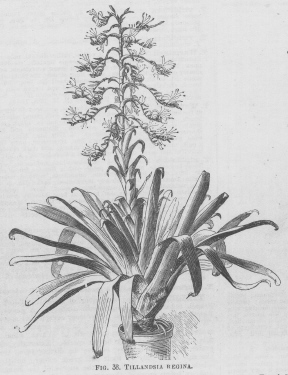
T. recurvifolia (recurved-leaved). A synonym of T. dianthoidea rosea. T. regina (queen).* fl. white, exhaling a strong. Jasmine-like perfume; bracts rose-coloured; spikes two-ranked, curved, disposed in a branched panicle; scape developing very rapidly, eventually attaining a height of about 7ft. l. about 4ft. long, recurved at apex, broadly sheathing at base. South Brazil, 1867. A magnificent plant. SYNS. Vriesia gigantea, V. Glaziovana, V. regina (G. C. n. s., iii., p. 235). T. gigantea is merely a form of this species.
T. reticulata (netted-leaved). fl. in a paniculate inflorescence, 1ft. or more long; calyx greenish, 11/4in. long; petals milk-white, 1/4in. longer than the calyx; stamens longer than petals. Spring. l. lorate-lanceolate, 1 1/2in. to 2ft. long, in a dense rosette, 3in. above the dilated base, moderately firm in texture, nearly naked on both sides, copiously reticulated with fine transverse lines of dark green on a pale green ground. h. 1 1/2ft. to 2ft. Rio Grande do Sul, 1870. SYNS. Guzmannia reticulata, Vriesia reticulata.
T. revoluta (revolute). A synonym of T. Duratii.
T. Rodigasiana (Rodigas'). fl. citron--yellow, distichous, remote, sub-sessile, spreading, tubular; sepals obtuse; petals thrice as long as the sepals, ligulate, the lamb arcuate; bracts tinged with red, striated, ovate, short; panicle loose, elongated, elliptic, the branches spreading, few-flowered, nearly sessile, springing from a short, scarlet spathe; scape elongated, erect, slender, with narrow bracts. l. short, arcuate-spreading, broadly sheathing and fuscous at base, the blade loriform, slightly channelled, rounded-cuspidate, green, with a few dark blood-coloured markings. South Brazil. Closely allied to T. gracilis. SYN. Vriesia Rodigasiana (I. H. n. s. 467.)
T. Roezlii (Roezl's). fl. rosy; spikes distichous, ancipitous, elliptic, forming a tall panicle. l. large, linear, acute, dark green, with large, black blotches on the upper part, the margins incurved. Andes of Northern Peru, 1877. A plant of bold habit. (B. H. 1877, 15.)
T. rosea (rosy). A synonym of T. dianthoidea rosea.
T. rubida (reddish). A synonym of T. geminiflora.
T. sanguinolenta (blood-red). l. deflexed at the apex, with numerous irregular blotches of dark blood-red on both surfaces. h. 9in. to 12in. New Granada, 1875. As the flowers of this species are unknown, it has been impossible to place it in the key, or even to state with certainty whether it is really a Tillandsia or no. SYN. Encholirion sanguinolenta (I. H. 1875, 200).
T. Saundersii (Saunders').* fl. sulphur-yellow; sepals equitant, oblong, concave; panicle loose, the primary raceme few-flowered, divaricate, bracteate; scape erect, shining, angled, yellowish-white. l. rosulate, short, deeply and broadly sheathing at base, linear, obtuse, decurved, coriaceous, above greyish green, slightly dotted with white, below striated and spotted with blood-colour. h. 1 1/2ft. Brazil, 1872. SYN. Encholirion Saundersii (I. H. n. s. 132).
T. scalaris (ladder-like). fl. very long and pretty; calyx yellow; corolla green; bracts of a deep rose-colour; scape 1 1/2ft. to 2ft. long, hanging from the plant like a rope ladder. l. ligulate, about 10in. long, green, ciliated. South Brazil, 1879. SYN. Vriesia scalaris.
T. setacea (bristly). fl., sepals half as long as the corolla; petals bluish-purple, spathulate, 1in. long, spreading at the summit; bracts lepidote, imbricate-distichous, ovate-oblong, pointed, as long as the sepals; spike 2in. to 3in. long, compressed, simple, or with a few short, appressed branches at the base. l. convolute-filiform, little or gradually dilated at base, sub-erect, equalling or exceeding the scape. h. 8in. to 18in. West Indies to Brazil, 1825. (Ref. B. 288.) SYNS. T. juncifolia (R. G. 811), T. tenuifolia (of Linnaeus), in part (B. H. 1876, 14).
T. setacea (bristly), of Hooker. A synonym of T. anceps.
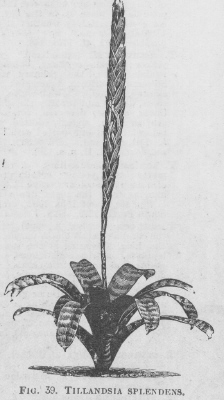
T. speciosa (showy). A garden synonym of T. splendens. T. splendens (splendid).* fl., calyx free, the sepals oblong-lanceolate; petals yellow, free, linear or linear-oblong, slightly dilated-spathulate at apex, thrice the length of the calyx; bracts fiery-purple, lanceolate, acute, keeled, oblique, closely imbricated; spike simple, distichous, compressed, ancipitous, linear-lanceolate, longer than the scape; scape erect, simple, longer than the leaves, the closely--appressed scales green, fuscuous-spotted. l. eight to twelve, linear-oblong, concave at base, nearly 2ft. long, 3in. broad, flat and abruptly narrowed towards the recurved apex, of a pleasing green above, lighter beneath, with transverse, dark fuscous zones. French Guiana.(F. d. S. May, 1846, 4.) SYNS T. picta, T. speciosa, and T. zebrina (of gardens), Vriesia splendens.
T. staticiflora (Statice-flowered). A synonym of T. filifolia.
T. streptophylla (twisted-leaved). fl., calyx 1/2in. long, hidden; corolla bright lilac, cylindrical, 1 1/2in. long; bracts densely lepidote, much imbricated; spikes four to eight in a short panicle; peduncle short, hidden by its numerous red-tinted, lepidote, imbricated, bract-like leaves. l. in a dense, basal rosette, the erect, dilated base 3in. long and broad; blade 6in. to 9in. long, 1in. broad at base, gradually tapering to a long point, much twisted spirally from low down, densely lepidote. Jamaica, &c., 1878. (B. M. 6757.) SYN. T. circinata.
T. stricta (erect). fl. narrow-cylindrical, about 3/4in. long; calyx pale reddish-brown; corolla deep violet-blue above the calyx, finally deep red; bracts white, red-tinged, slightly pellucid; scape about 7in. high. November. l. springing from a short, fleshy rootstock about 6in. long, nearly 1/2in. broad at the base. coated with hoary pubescence. Brazil, &c., 1810. (B. M. 1529.) SYN. Anoplophytum strictum (B. H. 1878,13).
T. s. caulescens (caulescent). This only differs from the type in its stem being decidedly developed, and, consequently, in the greater stature of the plant.
T. stricta (erect), of Lindley. A synonym of T. dianthoidea. T. tectorum (growing on roofs). fl., sepals free, lanceolate, conduplicate; petals white, blue in the middle, convolute in a tube which broadens towards the apex; bracts light green, tinged with rose, lanceolate, conduplicate, rather shorter than the sepals; spikes distichous, ancipitous, short, forming a short, contracted panicle; scape erect, tall, its bracts rosy at base. l. very numerous, imbricated, lanceolate-linear, spreading, arched, scarious-pilose; sheath very broad, gradually attenuated into the limb. Stem elongated, ascending, leafy. Andes of Peru, 1865. (B. H. 1877, 18.) SYNS. T. argentea (of K. Koch), Pourretia nivosa (of gardens).
T. tenuifolia (slender-leaved), of Jacquin. A synonym of T. flexuosa.
T. tenuifolia (slender-leaved), of Linnaeus. A synonym of T. setacea.
T. tessellata (tessellated). fl., sepals green, glutinous; petals yellow, forming a campanulate corolla; bracts green; panicle tall, erect, loose, the branches erect, arcuate, each bearing nine to twelve sub-sessile flowers; scape equalling the leaves, furnished with navicular bracts. l. coriaceous, rigid, channelled, tessellated in green and yellow, sub-glaucescent, acuminate at apex, the sheath broad, dark fuscous. South Brazil, 1882. SYN. Vriesia tessellata (B. H. 1882, 14-16).
T. tricolor (three-coloured). A synonym of T. anceps.
T. umbellata (umbellate).* fl. sapphire-blue, white in the centre, five or six opening simultaneously; calyx green; bracts light green, as large as the sepals; inflorescence a very short, ancipitous spike. Winter. l. l. 9in. to 12in. long, 1/3in. broad, light green, shortly sheathing at the base, ascending, spreading. filiform, acute at the tips, smooth and glossy. h. 1ft. Ecuador, 1882. (R. H. 1886, p. 60.) A near ally of T. Lindeni. T. usneoides (Usnea-like). Long Moss; Old Man's Beard; Spanish Moss, of the West Indies. fl. green, solitary, terminal, about 1/3in. long; sepals tinged with red. July. l. alternate, bifarious, uniform throughout, spreading, 1in. to 3in. long, filiform, grooved above; sheaths 1/2in. to 2in. long, cylindric. Tropical America, 1877. Plant forming loose, pendulous tufts, sometimes many feet long, clothed everywhere with a spreading, silvery scurf. (B. H. 1877, 17; B. M. 6309.)
T. utriculata (bladder-like). fl., sepals green, reddish-margined, half as long as the corolla; petals greenish-white, spreading at the summit; bracts green, reddish-margined, distichous, erect, oblong, blunt, longer than the internodes; spike compound, the blanches long and distant. l. linear, acuminate, gradually tapering from an ovate base, spreading recurved at the top, shorter than the stem. West Indies, &c., 1793.
T. vernicosa (polished). fl. white; spikes panicled; distichous; peduncle under 6in. long. l. few, ensiform, polished. Parana, 1887.
T. vestita (clothed). fl. yellow, forming a long, cylindrical tube, exserted about 1in. from the red calyx; spike simple, few-flowered. May. l. linear-subulate. h. 6in. Mexico, 1886.
T. viminalis (twiggy). fl. white, 1 1/2in. long, 1/2in. in diameter; petals oblong, obtuse, forming a campanulate corolla; bracts green; spike simple, distichous, dense, fusiform; scape twiggy, 2ft. high, covered with scarious bracts. l. in a large, open rosette, membranous, shining, ligulate, acute, recurved, entire, 1ft. long, 1 1/2in. to 2in. broad. Costa Rica, 1878. SYNS. T. viridiflora (of gardens), Vriesia viminalis (B. H. 1878, 14-15).
T. virginalis (fragile).* fl. sessile; sepals green, included; corolla claviform, ample, the petals white, obovate; bracts green, conduplicate, ample, farinaceous; spike simple, distichous, elliptic, ancipitous. l., primordial ones filiform; the rest lorate, with a broad sheath, pale green, farinaceous. Mexico. 1873.
T. viridiflora (green-flowered). fl., petals green, fugacious; spike simple, dense, 12in. long; bracts 2in. to 2 1/2in. long; peduncle 1 1/2ft. to 2ft. long. Summer. l. twelve or more, about 1ft. long, lorate. Mexico, 1887.
T. viridiflora (green-flowered), of gardens. A synonym of T. viminalis.
T. Warmingii (Warming's ). fl. yellow, rather distant, numerous, distichous, erecto-patent, tubular; petals ligulate, revolute at apex; bracts golden-yellow, tipped with green, coriaceous, ovate, closely covering the flowers; spike long, simple, the rachis rigid; scape 3ft. to 4ft. high. l. coriaceous, about 3ft. long and 2in. broad, slightly spreading, green, marbled and tinged with dark rose-colour, especially in the lower part, the sheath broad. South Brazil, 1884. SYN. Vriesia Warmingii (B. H. 1884, 12-13).
T. Wawranea (Wawra's). fl. ten to twelve, arranged distichously at the summit of a scape, which is clothed with green, adpressed bracts, and is somewhat shorter than the leaves; calyx green; petals waxy-yellow, pointed, recurved; filaments and pistil shorter than the petals. Summer. l. 18in. long, 2 1/2in. to 3in. wide, glaucous, bluish-green, with fine, transverse, wavy lines, a dark brown blotch just under the mucro, and dark chestnut-brown at the base; rosette with about a score leaves. h. 1 1/2ft.
T. xiphioides (Xiphion-like).* fl. snow-white, numerous; sepals linear-lanceolate, acuminate; petals with a slender, linear claw, 1in. long, and a broadly obovate, acuminate, reflexed, crisped blade; bracts 2in. long, closely imbricated; spike 3in. to 4in. long, reflexed, distichous; scape long or short. May. l. crowded, rosulate, 4in. to 6in. long, 1/2in. broad at base, broadly subulate, with recurved margins that are involute at the tip. Argentine Republic and Uruguay, 1810. Plant covered with silvery-grey tomentum, deliciously scented, and remarkably pretty. (B. M. 5562; B. R. 105.) T. xiphostachys (dagger-spiked).* fl. deep rich purple, only one opening at a time; bracts green, becoming tinged with bright yellow, and bright red towards the base, closely placed, sharply cymbiform; spike singularly flattened, solitary, 6in. long, 1in. broad. August. l. 9in. to 12in. long, from a broad, convex base, gradually tapering to a subulate point, entire, dark glaucous-green; lower ones purplish at base. Mexico and Venezuela 1861. SYNS. T. complanata (B. H. 1872, 23), Vriesia xiphostachys (B. M. 4287).
T. zebrina (zebra-striped). A garden synonym of T. splendens.