Trevesia
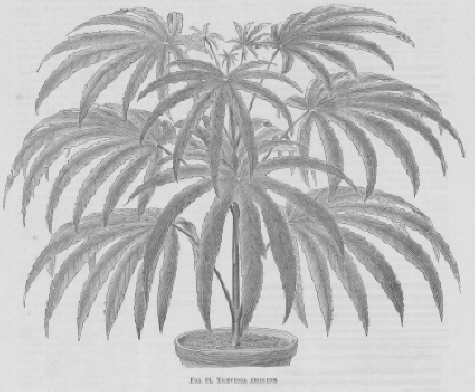
(called after the family Treves de Bonfigli at Padua, who were supporters of botanical research). ORD. Araliaceae. A genus embracing eight or nine species of prickly or unarmed, stove shrubs or small trees, inhabiting tropical Asia, Malaya, and the Pacific Islands. Flowers polygamous, in panicled umbels; petals eight to twelve, often cohering as a cap in the fertile flowers; stamens as many as the petals; pedicels not jointed; bracts small or wanting. Leaves ample, palmatifid, or digitately or pinnately compound. T. eminens and T. palmata require a mixture of sand, loam, and leaf mould. Cuttings will readily root in sand, under a glass, in heat. T. eminens (eminent). l. long-stalked, roundish in outline, palmatifidly divided about two-thirds of their depth into nine lanceolate segments, which have each a prominent rib and both edges serrated, the teeth distinct, small, but sharp-pointed. Philippines, 1882. Probably a mere form of T. palmata. (for which we are indebted to Mr. Wm. Bull).
T. palmata (palmate-leaved). fl. greenish-white; panicles 1 1/2ft. long, straggling, clothed, when young, with red-brown tomentum. March. l. very large, sometimes 2ft. long, palmate or digitate, nearly glabrous; segments lobed or sub-pinnatifid. Shoots covered with reddish hair and many prickles. h. 10ft. to 15ft. India, 1818. Tree. SYNS. T. sundaica, Gastonia palmata (B. R. 894).
T. sundaica (Sunda Isles). A synonym of T. palmata.