Trillium
(from trilix, triple; alluding to the triple parts of the flowers and leaves). American Wood Lily; Indian Shamrock; Three-leaved Nightshade. ORD. Liliaceae. A genus comprising about a dozen species of hardy, perennial herbs, with short, thick rhizomes, natives of North America and extra-tropical Asia, from the Himalayas, as far as Japan. Flowers solitary, erect, drooping or reflexed, sessile or pedicellate within the leaves; perianth violet, lurid, white, or greenish, persistent; segments distinct, spreading, the three outer ones slender and herbaceous, green or rarely coloured, the three inner ones petaloid, often larger, less spreading, or sometimes recurved; stamens six; style deeply trifid, or three-parted from the base. Berry globose or ovoid, indehiscent. Leaves three, whorled at the apex of the stem, broad, sub-sessile or rather long-petiolate, three to five-nerved and reticulate-penniveined. Stem simple, erect, with a few short, scarious sheaths at base. The species best known to cultivation are here described. All are North American, and have violently emetic roots. A deep, well-drained bed of peaty soil, in a somewhat shady position, is the most suitable for these plants. During summer, a plentiful supply of water is essential. They may be increased, rather slowly, by dividing the roots, or by seeds. T. grandiflorum is the best species, and is one of the most desirable hardy plants for all collections.
T. Catesbaei (Catesby's). A synonym of T. stylosum.
T. cernuum (drooping). fl. small; inner perianth segments white, eight to twelve lines long, oblong-ovate, wavy, recurved, rather longer than the lanceolate outer ones; peduncle usually shorter than the flower. April and May. l. broadly rhomboidal, 2in. to 6in. long, abruptly acuminate, shortly petiolate. Stems two or three together, 1 1/2ft. high. 1758. (B. M. 954.)
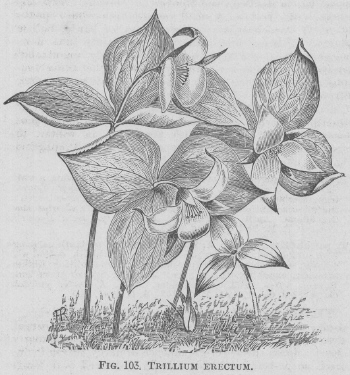
T. discolor (two-coloured). fl., inner perianth segments dark purple, varying into green, 1 1/2in. to 2in. long, erect, oblong, obtuse, narrowed below; outer ones shorter, lanceolate, spreading. February and March. l. sessile, 3in. to 5in. long, ovate-lanceolate to broadly ovate, tapering from near the base to the apex, variegated above with green and brown, or dark purple. Stem stout, solitary, 6in. to 12in. high. 1831. (B. M. 3097.) According to Sereno Watson, the correct name of this plant is T. sessile Wrayi. T. erectum (erect).* Beth-root; Birth-root; Lamb's Quarters. fl. 1in. to 1 1/2in. long, spreading, fetid; inner perianth segments dark purple, oval or oblong, rather longer than the lanceolate-ovate outer ones; peduncles 1 1/2in. to 3in. long, at length declined. May. l. sessile, broadly rhomboidal, abruptly acuminate, acute at base. Stem solitary, 1ft. high. 1759. See Fig. 103. (B. M. 470; F. d. S. 990; L. B. C. 1838.) SYNS. T. faetidum (G. C. n. s., xix., p. 605), T. pendulum (R. G. 656), T. rhomboideum (B. 138).
T. e. album (white). fl., inner perianth segments greenish-white, or rarely yellowish. (B. M. 1027; L. B. C. 1850.)
T. e. ochroleucum (yellowish-white). fl., inner perianth segments yellowish-white. (B. M. 3250, under name of T. e. viridiflorum.)
T. erythrocarpum (red-fruited).* Painted Wood Lily. fl. 3/4in. to 1in. long; inner perianth segments white, striped with purple at the base, oblong, wavy, much longer than the lanceolate outer ones; peduncle 1in. to 2in. long, erect. April and May. fr. red. l. ovate, 3in. to 5in. long, long-acuminate, rounded at base, shortly petiolate. Stem solitary, 1ft. high. 1811. (B. M. 3002; L. B. C. 1232; S. B. F. G. 212.)
T. foetidum (fetid). A synonym of T. erectum.
T. grandiflorum (large-flowered).* Wake Robin. fl. 2in. long; inner perianth segments white, changing to rose-colour, obovate, much longer and broader than the lanceolate outer ones; peduncle longer than the flower, erect or slightly declined. May. l. 3in. to 5in. long, rhombic-ovate, abruptly acuminate, nearly sessile. Stem solitary, 1ft. to 1 1/2ft. high. 1799. A fine plant. (F. d. S. 991; L. B. C. 1349; R. G. 575; B. M. 855, under name of T. erythrocarpum.)
T. nervosum (nerved). A synonym of T. stylosum.
T. nivale (snowy).* fl., inner perianth segments, white, oblong, obtuse, 1in. long, scarcely wavy, spreading from an erect base, equalling the peduncle; outer ones lanceolate, obtuse. April. l. 1in. to 2in. long, oval or ovate, obtuse, rounded at base, distinctly petiolate. Stem 2ft. to 4ft. high. 1879. (B. M. 6449.)
T. obovatum (obovate). fl., inner perianth segments pink, above 1in. long, elliptic-ovate, obtuse; inner ones shorter, oblong; peduncle erect, 1in. long. April. l. sessile, roundish-rhomboid, abruptly acuminate, green above, scarcely paler beneath, glabrous, 2 1/2in. long. Stem erect, 8in. to 10in. high. 1810. This is regarded by Sereno Watson as probably identical with T. erectum.
T. pendulum (pendulous). A synonym of T. erectum.
T. rhomboideum (rhomboid). A synonym of T. erectum.
T. sessile (sessile). fl. ten to fifteen lines long, sessile, erect; inner perianth segments dark purple, lanceolate, erect, much longer than the lanceolate, spreading sepals. March and April. l. sessile, 1in. to 3in. long, broadly oval, widest in the middle, abruptly pointed, narrowed at base, variegated above with paler and deeper green. Stems slender, 6in. to 12in. high, commonly two or more in a cluster. 1759. (B. M. 40; F. d. S. 2311; L. B. C. 875.)
T. s. Wrayi. See T. discolor.
T. stylosum (large-styled). fl. 1 1/2in. to 2in. long; inner perianth segments tinged with rose-colour, oblong, much longer and broader than the sepals; styles united below the middle; peduncle 1 1/2in. to 2in. long. April and May. l. oval or oblong, 4in. long, acute, shortly petiolate. Stem solitary, slender, 1ft. to 1 1/2ft. high. 1823. SYNS. T. Catesbaei, T. nervosum.