The Illustrated Dictionary of Gardening

Every genus a Victorian gardener could grow — Abelia to Zygopetalum across four volumes, with each plant's history, species, and culture, by the Curator of Kew.

HomeT › Tritonia (Species is a very handsome)

Tritonia (Species is a very handsome)

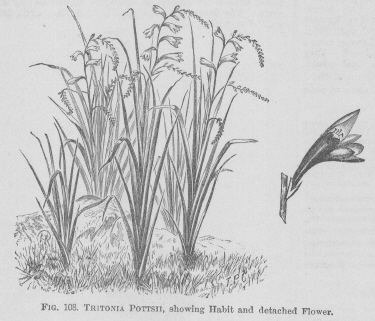
The species is a very handsome hardy, or nearly hardy, bulbous perennial, and thrives best in a light, rich, sandy soil. It is often grown in pots for the greenhouse; but, with a little care, it will be found to thrive remarkably well in the open. In cold, northerly situations, the better plan will be to lift the roots in November, and store in frost-proof quarters until the following spring; but they must not be kept so dry as to cause them to shrivel. Propagated by offsets, or by seeds; the latter should be sown in pans, in a cold house, as soon as possible after maturity; but where the Crocosmia does well, the corms increase pretty freely. C. aurea (golden).* fl. brilliant orange-red, few; perianth with a longish curved slender tube, and a nearly regular six-parted limb of oblong segments spreading in a star-like form; spike terminal, branched. Summer and autumn. l. narrowly sword-shaped, 1ft. long, 1/3in. broad, sheathing at the base of the stem for about 1ft. Stem slightly winged. h. 2ft. South Africa, 1846. SYN. Tritonia aurea. (B. M. 4335.) CROCUS (a Chaldean name, applied by Theophrastus). ORD. Irideae. A well-known genus of hardy bulbous plants. Scapes enveloped in a thin tubular sheath; perianth regular, consisting of six (generally) nearly equal segments, and with a long slender tube. Leaves slender, narrow, linear, channelled, with recurved margins; developing after the blossoms have faded, or simultaneously with them. Corms fleshy, with sheathing fibrous coats. This genus contains about seventy species, and is confined to Europe, North Africa, and North and West Asia. It is generally represented in our gardens by about a dozen species, and the innumerable varieties of C. vernus. As a great many that enjoy undisputed claims to specific rank are by no means distinct enough in general appearance to arrest the attention of any but specialists, the enumeration of species is confined to those which are in more general cultivation. For full account and descriptions of all the known species, the reader should consult Mr. Maw's "Synopsis," published in the "Gardeners' Chronicle," n. s., vol. xvi.

Some of the species flower in the autumn as freely as, and in a similar way to what, the majority of other species and nearly all the numerous cultivated varieties flower in spring. C. speciosus may be mentioned as one of the best. Those, however, which flower from December to January, are so very liable to be injured by severe frosts, that it is better to afford them the shelter of a cold frame.

PROPAGATION. This is effected by seed, for raising new varieties; and the increase of the corms perpetuates established species and forms. Each year, one, or in some cases, several young corms are formed, either on the top or by the side of the old one, the latter annually dying away. For increasing stock, these may be lifted and replanted singly, allowing sufficient room for each in its turn to develop new corms the following year. More would be obtained of varieties that increase rapidly, by this method, than if they were left crowded together. Some species increase very slowly, and these, with many that are scarce and valuable, are best left undisturbed, so long as they grow satisfactorily.

Seed. The seed of the Crocus should be sown as soon as ripe, or early in spring, the choicer strains in pots or boxes, using a light sandy soil, and afterwards placing them in a cold pit or frame, while the commoner varieties may be placed in a warm position outside, in a seed-bed. The seed germinates freely, and must be sown thinly, so as to allow the plants space to grow for two seasons in the seed-pan or bed, without lifting. They will need but little attention beyond being occasionally weeded and watered. After the second year, when the corms die down, they should be shaken out, and replanted. In the third or fourth year, most of them will flower, and any good ones may then be selected. It is an excellent plan to top-dress the seed-beds or pans, after the first season, with an inch or two of rich compost. CULTIVATION. Many of the species thrive on rock-work, in soil that has a good proportion of small stones intermixed, thereby insuring thorough drainage. If planted deeply and permanently in such a position, dwarf-growing plants, such as mossy Saxifrages, may be placed above, and the Crocuses allowed to grow through, when flowering. It is difficult to keep a collection separate and distinct, if planted near each other. The corms, by their mode of propagation underground, gradually become removed to a considerable distance from where they were first placed; and, if other species are near, the whole soon become mixed. The remedy is to lift and replant, or make a limited inclosure for each with slates, placed on edge in the ground. It is not necessary to lift often for any other purpose. As soon as the leaves are ripened, and die away, is the best time for lifting, if it is required. Sandy loam, with the addition of some leaf soil and sharp grit or crushed stones, is a good compost; and it is preferable to prepare this and replant at once. The ordinary varieties of spring-flowering Crocuses, so much cultivated, will grow and flower freely in almost any soil or position. They are very largely imported from Holland, in the autumn of each year; and the quicker planting is taken in hand, after their arrival, the better. The margins of flower-beds, planted with other bulbs, or of borders running parallel with a walk, are positions, among innumerable others, that may be rendered attractive by a mass of differently-coloured Crocuses. The corms can be inserted most regularly in a small trench, about 3in. deep, placing them a similar distance apart. The leaves should be left alone after flowering is over until they ripen, and the corms need not be lifted unless the place is required for other plants in summer. In this case, they may be transplanted, and allowed to ripen elsewhere.

Cultivation in Pots. Spring Crocuses are useful and very ornamental when flowering in pots. The imported roots may be bought cheaply in autumn, and their cultivation is within the reach of all. Place five or six corms in a 5in. pot, or four in a smaller one, and bury them in ashes outside for a time until filled with roots, when they should be very gradually brought on in a cool pit or house. The Crocus will not flower if exposed to fire heat, nor must severe forcing be attempted. If placed in a light position, with a little higher temperature than that outside, each corm will produce several flowers earlier than those planted in the open. The individual flowers do not last long, but there is a succession which extends the season over a considerable period. The stronger-growing sorts succeed well in water if treated like Hyacinths.

C. alatavicus (Alatavian). fl. white, small, with a yellow glabrous throat, and without a basal spathe; outer surface of the three outer segments obscurely feathered and freckled with purple. February. l. 1ft. long at maturity, 1/16in. broad, slightly ciliated at margins of keel and blade. Ala Tau Mountains, 1877. There is a white-flowered variety, in which the outsides of the outer segments are coated with pale buff.

C. aureus (golden).* fl. bright orange. Spring. l. linear; sheaths wide. Corm, coat membranous, with vertical, narrow, fibroid divisions. South-east Europe. This "was one of the first species introduced to cultivation, and is the parent of our yellow garden, or 'Dutch Yellow,' Crocus, and a number of old horticultural varieties--lacteus, sulphureus, sulphureus pallidus, sulphureus striatus, &c.--the history of which is unknown; they are not known to occur in a wild state, and all are sterile." SYNS. C. lagenaeflorus, C. maesiacus, &c. C. biflorus (two-flowered).* fl., segments of perianth varying from white to a pale lavender; outer surface of the outer segments distinctly feathered with purple markings; yellow within. Spring. l. short, erect, narrow, with distinct white midrib. This species has a wider range than any other (extending from Tuscany into Georgia), and none exhibits greater variation in the size and colouring of the flowers. (B. M. 845.) C. Adami (B. M. 3868), C. estriatus, C. minimus (B. M. 2991), C. nubigenus, and C. Weldeni (B. M. 6211), among many others, are forms of this species.

C. Boryi (Bory's).* fl. creamy-white; throat orange-yellow; base of segments marked externally with dull purple lines. Late autumn. l. narrow, smooth, produced a little before the flowers. h. 3in. to 4in. Greek Isles. (B. R. 1847, 16.) C. byzantinus (Byzantine). A synonym of C. iridiflorus. C. Cartwrightianus (Cartwright's). A miniature form of C. sativus. SYN. C. graecus.

C. chrysanthus (golden-flowered). fl. rich orange-yellow; perianth segments obovate. Very early spring. South-eastern Europe. There are four varieties of this species: albidus, caerulescens, fusco-tinctus, and fusco-lineatus. C. fimbriatus (fimbriated). A synonym of C. nudiflorus. C. fragrans (fragrant). A synonym of C. versicolor.

C. graecus (Greek). A synonym of C. Cartwrightianus. C. Imperati (Imperato's).* fl. of a lilac-purple on the inside, sweet-scented; "external divisions 1 3/4in. long and 3/4in. broad, marked with three longitudinal dark purple lines, of which the two outer ones and the end of the middle one are feathered with short lines of the same colour." Very early spring. l. preceding the flowers, linear, thick, recurved, with a distinct white line in the middle, sheathed for 2in. or 3in. at base. h. 3in. to 6in. Italy. (B. R. 1993.) C. iridiflorus (Iris-flowered).* fl., perianth throat unbearded; outer segments clear, rich purple, much larger than the inner ones, which are pale lilac; anthers orange, shorter than the stigmata; filaments lilac; stigmata purple, multifid. September and October. l., proper ones glabrous, 3/8in. wide, wider than in any other strains; sheathing leaves falling short of proper spathe; proper spathe monophyllous, foliaceous. Corm small, oblate; tunic fibro-membranous, tending to a reticulated structure. Banat and Transylvania. SYN. C. byzantinus. (B. M. 6141.) C. lagenaeflorus (bottle-flowered). A synonym of C. aureus. C. maesiacus (Maesian). A synonym of C. aureus.

C. multifidus (much-cut). A synonym of C. nudiflorus. C. nudiflorus (naked-flowered).* fl. pale bright purple or violet; tube 3in. to 10in. long, and segments 1 1/2in. to 2in. long; throat not hairy. Autumn. l. about 1/8in. broad, appearing in spring. The corms produce long stolon-like shoots, which form independent corms at the death of the parent. South-west Europe; naturalised in meadows about Nottingham and elsewhere in England. SYNS. C. fimbriatus, C. multifidus, and C. pyrenaeus. (Sy. En. B. 1500.) C. Orphanidis (Orphanides'). A synonym of C. Tournefortii. C. pulchellus (beautiful). fl. pale bluish-pearl colour, with darker veins, large; throat orange-yellow. Autumn. l. 3/16in. broad, smooth, with a prominent narrow keel. h. 4in. to 5in. Shores of the Bosphorus, &c. (B. R. 30, 3.) C. pyrenaeus (Pyrenean). A synonym of C. nudiflorus. C. reticulatus (netted). fl. varying from white to deep lilac, the outer face of the outer segments feathered with purple; throat glabrous. l. 1/16in. broad, the lateral channels containing one or two ribs. C. revolutus (revolute). A synonym of C. susianus.

C. sativus (cultivated). Saffron Crocus. fl. violet, variously striped and marked with deeper or lighter tints, fragrant; throat hairy. Autumn. l. 1/8in. broad, ciliated; margins of blade and keel ciliated. Corm rather large, globular, depressed. From Italy to Kurdistan. This species furnishes the saffron of commerce. It appears to have been cultivated in Palestine at the time of Solomon. (B. M. Pl. 274.) The following plants, which have been accorded specific rank, are all referable to C. sativus as mere forms: C. Cartwrightianus, C. Elwesii, C. Haussknechtii, C. Orsinii, C. Pallasii (SYNS. C. Thomasii and C. hybernus).

C. Sieberi (Sieber's). fl., throat orange, unbearded; perianth a uniform bright lilac, with a rich golden base; anthers orange; stigmata orange-scarlet. February and March. l. glabrous, 4in. broad, with open, unribbed, lateral channels. h. 2in. to 3in. Greece, &c. C. S. versicolor (various-coloured). fl. varying from white to purple, and with white and purple stripings and featherings, but always with a rich golden base. Crete and the Cyclades.

C. speciosus (showy).* fl. bright lilac, internally striped with deep purple lines, large; stigmata orange, conspicuously fringed. Autumn. l. 1/4in to 1/3in. broad, with prominent keel, erect, appearing almost with the flowers. Corms nearly round. East Europe and West Asia. Probably the handsomest of autumnal-flowering kinds. (B. M. 3861.) C. susianus (Susian).* Cloth of Gold Crocus. fl., perianth throat glabrous; segments about 1 1/2in. long and 1/2in. broad, reflexed, deep orange, the outer face of outer segments variously feathered with deep brown, occasionally self-coloured orange, or evenly suffused with dull brown; anthers orange, about twice the length of the orange filament; the style dividing at the base of the anthers, and produced into long, spreading, entire, orange-scarlet stigmata, which much exceed the anthers. February. l., proper ones reaching to the flowers, the margins of keel and blade ciliated; sheathing leaves falling short of the proper spathe; proper spathe diphyllous. Corm about 3/4in. broad; tunic of strong reticulated fibre, with long interspaces produced upwards into sharp, wiry points. h. 3in. Crimea and Caucasus, 1605. This is one of the earliest spring-flowering species. SYN. C. revolutus. C. Tournefortii (Tournefort's). fl. lilac, uniform, bright, with a few purple veins, 2 1/2in. in diameter; throat orange. Autumn. closely covered with a soft brown membrane. The Cyclades and the Morea. SYN. C. Orphanidis. (B. M. 5776.) C. Vernus (spring).* fl. lilac, violet, white (never yellow), or streaked with white and violet; inside of the throat always hairy. Spring. l. 1/4in. broad, rarely glabrous; lateral channels wide and open, without ribs, appearing with the flowers. Corm invested with slender anastomosing fibres. Europe. This species was one of the earliest introduced to cultivation, and has become naturalised in several localities in Britain. It is remarkable for the great range of the colouring of its flowers; the endless varieties, from pure white to deep purple, being generally intermixed in its native habitats, and corresponding with the multitude of horticultural varieties which decorate our gardens.

C. versicolor (various-coloured).* fl., perianth throat glabrous; segments about 1 1/2in. long, varying from purple to white, self-coloured, or externally feathered or veined with purple; the inner and outer segments are nearly similar in their markings; anthers yellow, twice the length of the white, slightly glandular filament; style dividing near the summit of the anthers, and produced into entire orange stigmata, which are not divergent. Spring. l., proper ones glabrous, reaching to the throat at the flowering time, about 1/8in. broad, and 8in. or 9in. long at maturity, the lateral channels containing two or three ribs; sheathing leaves falling short of the proper spathe; proper spathe monophyllous. Corm pyriform, 3/4in. wide; tunic of parallel fibres. Maritime Alps. This was one of the earliest species introduced, and, from its tendency to vary in colour and markings, has given rise to a host of horticultural varieties. SYN. C. fragrans. (B. M. 1110.) VARIETIES. The following are amongst the best to be obtained, either for pots, or for flower garden decoration in spring:

ALBION STRIPED, white, striped mauve, large and early; ARGUS, blue and white; CAROLINE CHISHOLM, pure white, dwarf; CLOTH OF SILVER, white, striped purple; DAVID RIZZIO, purple, very fine; GENERAL GARIBALDI, dark purple, large and good; GOLDEN YELLOW, extra large and good; MONT BLANC, large, pure white, one of the best; PRINCE ALBERT, fine dark blue; QUEEN VICTORIA, white; SIR JOHN FRANKLIN, dark purple, large; SIR WALTER SCOTT, white, striped lilac, fine.

← Tower of GlammisTribe I →