Turnip
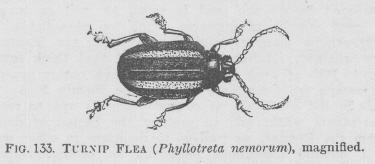
(Brassica Rapa). A hardy biennial, native of Europe (Britain), &c.; cultivated from a remote period, for the use of the fleshy roots, which are boiled and served as a vegetable in various ways. The tender growing tops are also gathered in spring, and cooked as a green vegetable; and they are sometimes blanched at the same season as a substitute for Seakale. Cultivation. The Turnip is chiefly an autumn and winter crop, as it succeeds best in cool, moist weather; but early and successional supplies may be procured by commencing to sow early in spring, and keeping on at intervals until July. In summer, Turnips not unfrequently run to seed without forming roots of a useful size; and during dry weather they are, if procurable, often stringy, and of inferior quality. The destructive Turnip Flea has also to be contended against; all through early summer especially, its attacks are commenced on the seedlings so soon as they appear above ground. It is of little use attempting to force Turnips too early in spring: they should not be sown under glass until the weather is favourable for admitting plenty of air. The first supply may be obtained by sowing some seed broadcast in a frame, during February or early in March. The least bottom heat from fermenting material may be allowed, but a spent hotbed or cold frame, with from 3in. to 6in. of rather fine, light soil in it, will do; an early variety should be selected--Early Munich is one of the best. The seedlings require thinning out so soon as they are large enough to handle. Plenty of air must be allowed, to insure a sturdy growth, and when the leaves get strong the frame may be removed. The season will by this time be advanced and the weather warmer than at the period of seed-sowing. Attention to watering is the principal point in after-cultivation. A valuable supply may be thus obtained in advance of any that could be grown entirely in the open air; a two-light frame at least should be allowed, as it could scarcely be more profitably utilised. By the middle of March, the first sowing may be made on a south border, and successional sowings according to requirements will be necessary until the end of June or early in July, when the seed for the main crop should be put in. In favoured districts, any time in July will do, and sowings may even be made up till the end of August with successful results. Turnip seed usually grows very freely, and the young plants appear above ground in a very short time. Some cultivators sow broadcast, but the ground is more readily kept free from weeds and the plants thinned out when the plan of having drills is adopted: the latter is therefore recommended. Drills 1ft. apart will suffice; they should be drawn with a hoe not more than 2in. deep, and the plants may be thinned to about 9in. apart, though this distance may vary somewhat according to the strength of the variety and the season. During summer a cool situation is preferable, and in dry weather it is often necessary to keep Turnips watered. If this is not done, growth becomes checked, and either the plants run to seed or the roots lose their succulent nature and become pithy. The main crop may be left in the ground, to be pulled when required, but for the purpose of having a supply in very severe weather it is advisable to lift a portion, cut off their tops--not too closely--and store them in sand or soil ready for use. The crops at all seasons are much benefited by keeping the soil between hoed and loose on the surface. Damp, dull weather is most favourable for Turnip cultivation; but as the crop is of much importance throughout the season, all that can be done during the summer to counteract the evil influences of drought should receive full attention. If two or three varieties are sown at the same time, sometimes one will thrive if another fails. Turnips succeed best in rich, rather light, loamy soils; ground which is stiff and retentive is not well adapted, as the roots do not attain a good flavour, and in the summer are more apt to run to seed; light, gravelly soils are also unsuitable. Animal Pests. The animal foes of this valuable plant are both numerous and varied. A large proportion of them attack the roots. Ants are said to carry off the seed, and to endanger the crop at times; and sparrows and other seed-eating birds assist in such depredations. The germinating plants, so soon as they appear above the soil, are too often wholly destroyed by the Turnip Flea or Fly (which see), and by small Weevils, such as Otiorhynchus (which see), and Ceuthorhynchus contractus, which is nearly related to the Turnip-gall Weevil (see Turnip Galls) and Turnip-seed Weevil (which see). The best treatment for the destruction of these insects is mentioned under the above headings.
When the plants are somewhat larger, the leaves are often so eaten by numerous larvae, that merely the larger veins remain, or, at least, large holes are gnawed in the leaves and other green parts, to the injury of the plants, and the consequent diminution of the root-crop. The larvae (see Cabbage Caterpillars) of the White Butterflies (Pieris Brassicae, P. Napi, and P. Rapae) feed on the leaves of Turnips, as they do also on Cabbages; and they are assisted in this by the larvae of various Night-moths, e.g., of Mamestra (which see), and of Plusia gamma (which see) and others noted under the headings Potherb Moths and Surface Caterpillars. The larvae of a small Moth, Plutella cruciferarum (which see), are very numerous in some localities, living under webs on the lower surfaces of, and eating holes in, the leaves.
Still more dangerous than the Butterflies and Moths is Athalia spinarum, the Turnip Sawfly (which see), the larvae of which at times devastate entire fields. An allied species (A. ancilla) also proves destructive occasionally, though to a less extent.
Various Beetles assist in destroying the leaves of Turnips, chief among them being the Turnip Flea (which see); though Curtis accuses Phaedon Betulae (which see) and Otiorhynchus of aiding in the harm done. Besides the holes eaten through them, the leaves are often marked with white, wavy tracks, or mines, burrowed between the surface-membranes. These mines are the work of larvae of small Flies (Drosophila and Phytomyza), and of the Turnip Flea (which see). The flowers inclosing the young ovaries are favourite resorts of numerous Beetles, some of which gnaw the various organs, devouring the ovaries, or rendering them unfertile. The flowers and flower-stalks, and, to a less extent, the leaves, are sometimes injured by more than one kind of plant-louse (see Aphides). The seeds are devoured in the seed-vessels, while soft, by larvae of certain small Midges belonging to the group of Gall-midges (Cecidomyidae), but these scarcely alter the form of the fruit. The larvae of the Turnip-seed Weevil (which see) also devour the seeds in the fruit. From their concealed mode of life, little, if anything, can be done against those insects that feed on the seeds. But, while the green parts, the flowers, and the seeds, are all liable to serious injury from animals, and the roots thus suffer indirectly, the latter parts suffer from direct attacks even more seriously than do the other organs. All herbivorous quadrupeds eat them; and hares and rabbits are peculiarly hurtful where Turnips are grown in an insufficiently inclosed area. Rooks also greatly injure Turnips, by scooping out holes in them to obtain food during snowy weather. In localities near the sea-coast, a similar habit is frequently indulged in by sea-gulls. Among the most effectual protections against birds are threads stretched in zigzags near the soil, and decked with rags, or other fluttering objects, suitable to act as scarecrows.
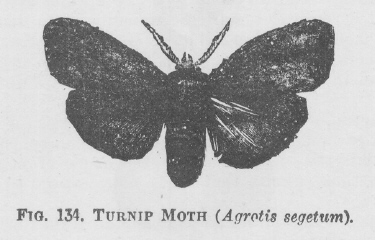
Some account of the more destructive parasites of Turnip roots is given, along with the most successful remedies against each, under the headings Slugs, Snails, Surface Caterpillars, Turnip Galls, Turnip Moths, and Wireworms; and it would occupy unnecessary space to repeat what is contained in those articles. When the roots have begun to decay, the change is hastened by numbers of Millipedes (which see) and insects (chiefly larvae of small Beetles and Midges) that feed in them, and soon reduce them to the condition of putrescent masses.
In Germany, it has been observed that Turnips and other Crucifers are liable to have the smaller side-roots more or less injured by the production of small, round galls on them, the work of a minute worm (Heterodera Schachtii), of which an account is given, and appropriate remedies are discussed, under Nematoid Worms.
Fungi. Turnips are liable to serious injury from the attacks of several species of Fungi, most of which have been already discussed in this work under headings quoted below. Almost all of them also infest Cabbages and cruciferous weeds--a circumstance that must be kept in mind in the means employed for preventing or curing diseases caused by them in Turnips. Of those that have proved peculiarly injurious in Great Britain, the more hurtful are the following:
Plasmodiophora Brassicae (which see), producing "Clubroot," or "Finger-and-Toe," in the roots, of which they cause the early death and decay, so that the crop is largely, if not entirely, destroyed in severe attacks.
The leaves are frequently "mildewed." One form of "Mildew" is caused by the growth of the superficial mycelium of Oidium Balsamii (see Oidium), which is itself a young stage of an Erisyphe of some kind, of which the perfect condition is uncertain. The threadlike cells of the Fungus spread in a thin, whitish coat over the whole of both surfaces of the leaf, from which they draw their nourishment, without, however, traversing its tissues; and they injure it both by the nourishment they absorb from it, and by hindering free interchange of gases and fluid between the cells of its interior and the air. The leaves wither and dry up, and the plants are insufficiently nourished, with evil effects to the roots. For a remedy, see Oidium. Peronospora parasitica gives rise to another form of "Mildew" on the leaves. This shows itself in whitish patches, which consist of erect stalks, much branched above, and bearing on the tips of the branches the nearly globose conidia or reproductive cells. The mycelium of the Fungus burrows among the inner cells of the leaf, and only the stalks just spoken of are seen on the surface, passing out through the stomata. The sexual reproduction of the Fungus is also provided for by the mycelium in the leaves, as described under Peronospora. The upper surface of the leaves is mildewed by this Fungus far less frequently than the lower; but the presence of the parasite is shown by yellowish-green or yellow patches on the surface. P. parasitica frequently grows in the flower-stalks and in the flowers, which, under its influence, become much distorted and swollen, and fail to produce seeds. All parts in which it grows are liable to premature death and rapid putrefactive decay in moist air. For treatment, see Peronospora.
White Rust is very often associateu with P. parasitica, growing on the same spots of the plant, and actually intermingled with it; but frequently, also, they grow apart from one another. The White Rust resembles splashes of whitewash, when the conidia are matured on the diseased spots, which latter are usually swollen and distorted. It occurs on stems, leaves, and flowers. The Fungus (Cystopus candidus) is nearly related, in a good many points, to Peronospora. For an account of its structure, and of the treatment to be employed against it, see Rust.
The leaves frequently show spots or patches, often 1in. or more in breadth, at first yellowish, but soon becoming withered and dry. On these spots, the microscope shows minute Fungi. On some, there may be found slender conidia (with many septa, or cross-walls), on the tips of short threads, pushed through the stomata. This form of Fungus has been named Cercospora Bloxami by Messrs. Berkeley and Broome. On other spots occur small dark Pycnidia (which see), in which are produced small, oval, pale sporidia, one-celled (Phyllosticta Brassicae), or two-celled (Ascochyta Brassicae). The relations between the Fungi found on such patches are still very uncertain. Turnips do not suffer very seriously from the presence of these Fungi, as the latter seldom affect the young, vigorous leaves, but prefer the lower leaves when already half-dead. It is, therefore, unnecessary to dwell upon treatment, further than to mention that it is a wise precaution to destroy--if possible, by fire--all leaves overgrown with parasites.
Two other Fungi have been described as occasionally very injurious to Turnips in Germany, and a brief notice of them will not be out of place here. Polydesmus exitiosus is the name given by Dr. J. Kuhn to a Fungus described by him as extremely injurious to Turnips, destroying both the leaves and the unripe seed-vessels. Very dark spots appear on the diseased organs; the spots spread, and the tissues become discoloured, and dry up. If the seed-vessels are attacked while young, the seeds do not ripen; but if the disease is late in its appearance, they may ripen, but are soon destroyed, the valves of the fruit shrivelling, and bursting away prematurely. In the diseased tissues, the mycelium of a Fungus is present in abundance, absorbing the nourishment in the cells, and destroying the cell contents and cell walls. From this mycelium rise erect branches, which project through the epidermis of the leaf, and bear, on their tips, conidia that vary much in form, but that, when mature, are clavate, being fixed by the broader end, and having the other prolonged as a slender filament; or there may be a series of from five to ten such conidia, end to end, forming a chain. The conidia are dull or brown-violet, and are divided into cells, by numerous cross-walls, and a few longitudinal ones. The conidia readily fall off the erect branches, and germinate speedily, in damp, warm weather, spreading the disease if they fall on green parts of Turnip-plants, under suitable conditions. This Fungus produces brown, withered spots in the parts affected, often surrounded by a yellow or reddish border. On these spots develop Pycnidia (which see) of Phyllosticta Brassicae, and perithecia of a Pleospora (which see), perhaps P. herbarum. The only treatment possible is to endeavour to prevent future attacks, by destroying diseased parts of plants without delay.
Peziza sclerotiorum is blamed by Dr. Frank as the cause of a peculiar disease of Turnips, which was prevalent, near Leipzig, in 1879. The plants became yellow during July. The cause of this was a diseased state of the stems, commonly near the base, which manifested itself in a pale colour, and in a separation between the epidermis and the tissues below it. On breaking the stem, the pith is found occupied by a black, oval body, the sclerotium, from which the above Peziza grows out in the following spring. For an account of the structure of the Fungus, and of the treatment advised against it, see Peziza.
Sorts. These are very numerous, but it is unnecessary to grow many varieties if attention is given to include those which are adapted for early use, and others for main crops. The shapes and outside colours vary in the different sorts; but this is of little importance, provided the inner flesh is of good quality. The flesh is either white or yellow: white-fleshed varieties are generally preferred in the southern division of the country, while yellow ones are more largely cultivated in the north.
CHIRK CASTLE BLACK STONE, skin black; very fine and hardy EARLY PARIS MARKET, white, oblong in shape; early, a much-esteemed French variety. EARLY PURPLE-TOP MUNICH, distinct and very early; one of the most valuable for frame culture and for early crops, the produce is at its best when about half or three-parts grown. EARLY RED AMERICAN STRAP-LEAVED STONE flesh white and firm; very early. EARLY SNOWBALL, one of the best whites, sweet and tender; early, largely grown for the London markets. EARLY STRAP-LEAVED WHITE STONE, fine quality; suitable for very early and for late sowing (see Fig. 130). EARLY WHITE DUTCH, an old and well-known sort, of excellent quality. EXTRA EARLY MILAN, bulb flattened, with purple top; very early, and compact in habit. ORANGE JELLY, or GOLDEN BALL, an excellent yellow variety (see Fig. 131); much favoured in the north of England and in Scotland. VEITCH'S RED GLOBE, of handsome shape and fine flavour; one of the best for main crop, and for use in winter. YELLOW MALTA, a handsome yellow variety, of good quality, but sometimes rather strong-flavoured (see Fig. 132).