Ulmus
(the old Latin name used by Virgil, &c.). Elm. ORD. Urticaceae. A genus comprising about sixteen species of hardy, unarmed trees, broadly dispersed over north temperate regions, extending in Asia to tropical mountains. Flowers polygamous, mostly hermaphrodite, fascicled; perianth loosely campanulate, four to nine (often five) cleft, the lobes imbricated; stamens four to eight (often five); filaments erect, at length exserted. Fruit a one-seeded samara. Leaves alternate, distichous, serrated, penniveined, deciduous or sub-perennial; stipules lateral, scarious, very caducous. Elm wood is rather hard, and reddish; it is used specially for wheelwrights' work, shafts, axletrees, screws for presses, &c. Exotoses or wens are often developed on Elm trunks, which acquire great hardness, and are much sought for by cabinet-makers, from the different patterns exhibited by the twisted arrangement of their wood fibres. Elm-trees arrive at perfection in 150 years, but they will live for more than four times that period. They were held in high estimation by the ancients, not only on account of their leaves, which were dried and used as fodder, but also on account of their being used as props for Vines. The common Elm (U. campestris) grows very rapidly in light, rich land; but its wood is proportionately light and porous, and of little value compared with that grown on strong land, which is of a closer and stronger texture, and at the heart will have the colour, and almost the hardness and weight, of iron. Propagation is effected by layers, suckers, grafting, and budding. Layers are usually made in autumn, or in the course of the winter, and become rooted, or fit for removal, in the course of a year. Suckers are produced in abundance by some of the species and varieties, and afford a ready means of increase. Whip or splice-grafting is best performed, close to the root, in spring; the plants thus treated make shoots of 3ft. or 4ft. in the same year, and never throw up suckers, unless the graft is buried in the soil. The Scotch Elm (U. montana) luxuriates in a deep, rich loam; but it becomes most valuable in a sandy loam lying on rubble-stone or on dry rock. It is most readily propagated by seeds; these may be sown as soon as ripe (about the middle of June), in which case many plants will be obtained in the same season; or they may be dried in the shade, and stored in bags or boxes, in a dry place, until the following March or April. U. americana delights in a low, humid situation. Its wood is inferior to that of the common Elm. The species best-known to cultivation are here described; all have brownish flowers, appearing from March to May.
U. alata (winged). Wahoo or Winged Elm. fl. on slender, drooping, jointed pedicels or peduncles; perianth segments obovate. fr. ovate or oval, downy on the face, at least when young, fringed-ciliated. l. ovate-oblong and oblong-lanceolate, acute, rather thick, 1in. to 2 1/2in. long, smooth or nearly so above, downy beneath. Branches (at least some of them) corky-winged; branchlets and bud-scales nearly glabrous. h. 30ft. to 40ft. North America, 1820.
U. americana (American).* American or White Elm. fl. in close fascicles, on slender, drooping peduncles or pedicels, which are jointed above the middle; perianth seven to nine-lobed; fascicles close. fr. oval or ovate, glabrous, except on the margins, 1/2in. long. l. obovate-oblong or oval, abruptly acute, sharply and often doubly serrated, 2in. to 4in. long, smooth or nearly so above, softly pubescent or soon glabrous beneath. Branches not corky; branchlets and buds glabrous. h. 80ft. to 100ft. North America, 1752. An ornamental tree. (T. S. M. p. 322.)
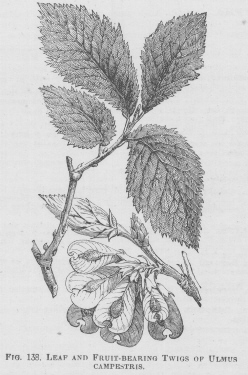
U. campestris (field-loving).* Alme; Aume-tree; common Elm. fl., perianth smaller than in U. montana; stamens often four. fr. usually obovate. l. 2in. to 3in. long, less cuspidate than in U. montana, often narrow at base, scabrid above and pubescent beneath, or nearly glabrous. Trunk attaining 20ft. in girth, with rugged bark; root sending up abundant suckers. h. 125ft. Europe (Britain). See Fig. 138. (B. M. Pl. 232.) SYN. U. carpinifolia. U. glabra and U. suberosa are regarded, by Hooker, as mere varieties of this species; but for gardening purposes they are kept distinct in this work.
U. c. acutifolia (acute-leaved). l., in old specimens, more tapering, and branches more pendulous, than in U. c. alba, which this variety otherwise resembles.
U. c. antarctica (Antarctic). A graceful, small-leaved form, somewhat resembling U. c. viminalis. The name of this form is very inappropriate, as there are no Elms in the Southern hemisphere.
U. c. aurea (golden). This is one of the most distinct and desirable of all the ornamental Elms; it has foliage like that of U. c. antarctica, but of a uniform golden-bronze colour. (B. H. 1866, 19; I. H. 513.) SYN. U. Roseelsii.
U. c. Berardi (Berard's). A distinct and pretty form, of somewhat erect habit, with small, rather rigid leaves. This originated as a seedling in the nurseries of Simon-Louis Bros., near Metz.
U. c. betulaefolia (Birch-leaved). l. somewhat resembling those of the common Birch.
U. c. chinensis (Chinese). A low and rather tender bush. China.
U. c. concavaefolia (concave-leaved). This is scarcely distinct from U. c. cucullata.
U. c. cornubiensis. Cornish Elm. l. small, strongly veined, coriaceous. Branches bright brown, smooth and somewhat flexuous when young, and very compact, becoming upright with age. "This variety, in the climate of London, is a week or a fortnight later in coming into leaf than the common Elm, from which, and from all other varieties, it is readily distinguished by the bark of old trees, which never scales off, but tears asunder, exhibiting its fibrous construction, in the manner of the bark of the Sweet Chestnut. There are many fine trees of this variety in Kensington Gardens." (Loudon.)
U. c. cucullata (hooded). l. curiously curved, something like a hood.
U. c. foliis-variegatis (variegated-leaved). l. striped with white, very ornamental in spring.
U. c. latifolia (broad-leaved). l. broader than in the species, and expanding very early in spring.
U. c. nana (dwarf). This very distinct variety is said not to grow above 2ft. high in ten or twelve years.
U. c. parvifolia (small-leaved). A very common variety in all the woods of the South of Russia, and varying in height from that of a medium-sized tree to that of a diminutive shrub, according to soil and climate.
U. c. planifolia (flat-leaved). A handsome, small tree, closely resembling U. c. parvifolia.
U. c. rotundifolia (round-leaved). This form is characterised by its roundish-oval or sub-orbicular leaves. See Fig. 139.
U. c. sarniensis. Jersey Elm. A free-growing variety, differing very little from the type.
U. c. stricta (upright). Red English Elm. One of the most valuable timber-trees of the small-leaved kinds; growth very rigid. The timber is of excellent quality, and the tree forms poles of equal diameter throughout.
U. c. tortuosa. Twisted Elm. This is the only Elm that grows freely from cuttings. The wood of the tortuous parts of the trunk is valuable for the naves of wheels.
U. c. umbraculifera (umbrella-bearing). A compact-growing form, with a dense, umbrella-like head.
U. c. viminalis (twiggy). l. small. Branches numerous, slender, twig-like. A very distinct and elegant variety.
U. c. virens (green). Kidbrook Elm. "Almost evergreen in a mild winter; and, as such, is the most ornamental tree of the genus. It must not, however, be depended upon as a timber-tree, because, in some autumns, the frost kills the shoots. The bark is red, and the tree of spreading habit. This, like U. c. stricta, grows well upon chalk." (Loudon.)
U. carpinifolia (Hornbeam-leaved). A synonym of U. campestris. U. effusa (effuse). A synonym of U. pedunculata.
U. fulva (fulvous). Slippery or Red Elm. fl. nearly sessile; perianth segments and stamens seven to nine. fr. orbicular, eight to nine lines wide, not ciliated, the cell pubescent. l. ovate-oblong, acuminate, doubly serrated, 4in. to 8in. long, very rough above, softly downy beneath, and slightly rough downwards, sweet-scented in drying. Branchlets downy; buds before expansion, softly downy with rusty hairs. North America. A small or medium-sized tree, with tough, reddish wood, and a very mucilaginous inner bark. (B. M. Pl. 233; T. S. M. p. 334.)
U. glabra (smooth). Wych Elm. fl. nearly sessile, five-cleft. fr., samaras obovate, naked, deeply cloven, smaller than those of most other kinds. l. elliptic-oblong, doubly serrated, smooth, very unequal at base, not elongated at the extremity. h. 60ft. to 80ft. Europe (Britain). See Fig. 140. (Sy. En. B. 1286, under name of U. suberosa glabra.) Hooker regards this as merely a form of U. campestris.
U. g. glandulosa (glandular). l. very glandular beneath.
U. g. latifolia (broad-leaved). l. oblong, acute, very broad.
U. g. major (greater). Canterbury Seedling. Of more vigorous growth than the type.
U. g. microphylla (small-leaved). l. small.
U. g. pendula (pendulous). Downton Elm. A "weeping" variety.
U. g. variegata (variegated). l. variegated.
U. g. vegeta (vigorous).* Chichester or Huntingdon Elm. The most vigorous kind of Elm propagated in British nurseries, often making shoots from 6ft. to 10ft. in length in one season. The tree attains a height of 30ft. in ten years from the graft.
U. major (greater). A form of U. montana.
U. montana (mountain-loving).* Scotch or Wych Elm. fl. shortly pedicellate, five to seven-parted. fr., samaras oblong or nearly round, glabrous, slightly cloven. l. 3in. to 6in. long, often 3in. in diameter, doubly and trebly serrated, cuspidate, unequally rounded or cordate at base, rough above, pubescent or nearly glabrous beneath. Branches long, spreading. h. 80ft. to 120ft. Europe (Britain), Siberia. (Sy. En. B. 1287.) Most of the following varieties are distinct and handsome trees, and are well worth cultivating, either for use or for ornament:
U. m. cebennensis (Cevennes). A variety of spreading habit, but of much less vigorous growth than the normal form.
U. m. crispa (curled). l. crisped, thickly plicate-rugose, irregularly incised-pinnatifid. Habit slender and stunted. SYN. U. urticaefolia.
U. m. fastigiata (pyramidal). Exeter or Ford's Elm. l. peculiarly twisted, very harsh, feather-nerved, enfolding one side of the shoots, retaining their deep green until they fall off. A very remarkable, pyramidal form.
U. m. major (greater). l. falling almost a month sooner than those of U. m. minor. This tree is of upright and rapid growth, with few branches; in some stages, it approaches the habit of the type, but is of a more tapering form.
U. m. minor (lesser). Compared with U. m. major, this is of a more branching and spreading habit, of lower growth, with more twiggy shoots, which are more densely clothed with leaves.
U. m. nigra (black). Black Irish Elm. A spreading tree, with the habit of the normal form, but with more spreading leaves.
U. m. pendula (pendulous). "A beautiful and highly characteristic tree, generally growing to one side, spreading its branches in a fan-like manner, and stretching them out sometimes horizontally, and at other times almost perpendicularly downwards, so that the head of the tree exhibits great variety of shape." (Loudon.)
U. m. rugosa (wrinkled). Bark reddish-brown, cracking into short, regular pieces, very like that of Acer campestre.
U. parvifolia (small-leaved). fl. shortly pedicellate; perianth four or five-cleft. fr.small, ciliated, l. small, narrow-lanceolate, oblique at base, slightly acute or scarcely acuminate at apex, simply serrated; adults coriaceous, highly glabrous, or the middle nerve and under side sparsely puberulous. Branches twiggy, often arcuate-deflexed. China and Japan. A medium-sized or diminutive shrub, according to the soil in which it grows.
U. pedunculata (pedunculate). fl., perianth oblique; stamens six to nine, often eight, shortly exserted; pedicels slender, elongated, jointed; inflorescence pendulous. fr. glabrous, except the densely-ciliated margin. l. ovate or obovate, acuminate, deeply and doubly serrated, slenderly membranous, softly pubescent beneath. h. 50ft. to 60ft. Europe, 1800. SYN. U. effusa.
U. Roseelsii (Roseels'). A synonym of U. campestris aurea.
U. suberosa (slightly erose). Cork-barked Elm. fl. stalked, four or five-cleft. fr., samaras almost orbicular, deeply cloven, glabrous. l. pointed, rough, doubly and sharply serrated. Branches spreading, their bark corky. h. 60ft. to 100ft. Europe (Britain). According to Hooker, this is merely a form of U. campestris. (Sy. En. B. 1285.)
U. s. erecta (erect). This tree has a tall, narrow head, resembling that of the Cornish Elm (U. campestris cornubiensis); but it differs from that variety in having much broader leaves and a corky bark.
U. s. foliis-variegatis (variegated-leaved). This is only distinguished from the type by its variegated leaves.
U. urticaefolia (Nettle-leaved). A synonym of U. montana crispa.