Valeriana
(a mediaeval name, said to be derived from valere, to be healthy; in allusion to its powerful medicinal qualities). Valerian. ORD. Valerianeae. A large genus (nearly 150 species) of mostly hardy, perennial herbs, sub-shrubs, or shrubs, mostly inhabiting North temperate regions and extra-tropical South America; a few are natives of Brazil or the East Indies. Flowers white or pink; calyx at first entire, but forming a feathery crown at fruiting time; corolla with a short or rarely elongated tube and a five-cleft, spreading limb; stamens three, rarely one or two by abortion. Fruit compressed. Leaves, especially the radical ones, entire or toothed, or the cauline ones (or all) pinnatifid, or once, twice, or thrice pinnatisect. Few of the species have any horticultural merit. The medicinal qualities of V. officinalis are, however, extensive. Those described below are hardy perennials; they thrive in common soil, and may be readily increased by divisions.
V. angustifolia (narrow-leaved). A synonym of Centranthus angustifolius.
V. Calcitrapa (Calcitrapa). A synonym of Centranthus Calcitrapa.
V. Cornucopiae (Cornucopia). A synonym of Fedia Cornucopiae.
V. dioica (dioecious). Marsh Valerian. fl. pale rose-coloured, mostly unisexual, in terminal corymbs; corolla tube short. Early summer. l., radical ones and those of the runners long-stalked, ovate, entire, 1/2in. to 1in. long; cauline ones few, mostly pinnate, with one terminal segment and several pairs of smaller ones, all entire. Flowering stems 6in. to 8in. high. Europe (Britain). (Sy. En. B. 668.)
V. montana (mountain-loving). fl. pink; corymbs at length paniculate. July. l., lower ones oblong or obovate, obtuse, slightly toothed; upper ones lanceolate, acute. h. 9in. Mountains of Europe, 1748. Plant glabrous or slightly pilose, erect. (J. F. A. 269; L. B. C. 317.)
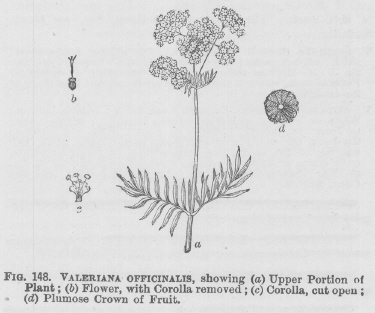
V. m. rotundifolia (round-leaved). l. lower ones nearly round. Stems dwarfer than in the type. (B. M. 1825.) V. officinalis (officinal). All-heal; Common Valerian; St. George's Herb, &c. fl. pink; corymb contracted or loose, at length sub-paniculate. June. l. all, or nearly all, pinnatisect; segments seven or eight pairs, lanceolate, serrated. Stems sulcate. h. 3ft. Europe. A very variable species. See Fig. 148. (B. M. Pl. 146; F. D. 570; Sy. En. B. 666.)
V. Phu. fl. white, in a paniculate corymb. August. l., radical ones oblong or elliptic, undivided; cauline ones pinnately lobed, the lobes oblong. Stem terete, smooth. h. 2ft. Caucasus (an escape from cultivation in Europe). Plant glabrous, erect.
V. P. aurea (golden).* This only differs from the type in the bright golden-yellow colour of the young growths in spring.
V. ruthenica (Russian). A synonym of Patrinia sibirica.
V. sibirica (Siberian). A synonym of Patrinia sibirica.