Vanda
(the Indian name of the original species). ORD. Orchideae. A genus embracing about thirty species of very beautiful, stove, epiphytal Orchids, natives of the East Indies and the Malayan Archipelago, one being also found in tropical Australia. Flowers showy or rarely mediocre, shortly pedicellate, usually fragrant; sepals and petals free, sub-equal, much spreading, often narrowed or nearly clawed at base; lip continuous with the column, spreading, saccate or obtusely spurred at base, the lateral lobes erect, rounded or reduced to auricles, the middle one spreading; column short, thick, wingless; pollen masses two; bracts short; racemes simple, loose; peduncles lateral. Capsules often on rather long pedicels. Leaves distichous, spreading, coriaceous or slightly fleshy, often emarginate or shortly bilobed at apex, flat or (in V. Hookeriana and V. teres) terete. Stem leafy, not pseudo-bulbous. The Vandas require more light than most other Orchids; indeed, many successful growers do not use shading for them at all. During the period of growth, say from March or April until about October, a high temperature and abundance of moisture are essential; the thermometer should not fall below 70deg. or 75deg. during the day, and may be allowed to rise to 85deg. or even higher in sunny weather. The night temperature during the growing season should not fall more than about 10deg. below that maintained during the day. In the winter months, 60deg. or 65deg. at night will be sufficient, and less water will be required--none being allowed to lodge in the axils of the leaves. The most rational method of growing the plants is to fix them in baskets, filled three-fourths of their depth with broken potsherds, and the rest with clean, fresh sphagnum. If rafts or blocks of wood are employed, more care is necessary in watering, for, if an insufficient supply is given, the leaves are apt to shrivel and the lower ones to fall off. As pots are more readily moved, they are frequently employed by exhibitors; the directions as to cultivation in baskets should be followed if pots are used. V. caerulea requires less heat than the other kinds; indeed, it succeeds sometimes better under almost cool treatment. V.teres should be placed close to the glass, in a warm, sunny house, and supplied with abundance of water when growing; when at rest, less will suffice. Should the plants of any of the tall-growing species become too high, the tops may be cut off and potted in potsherds and sphagnum. New growths often spring from the base of the old plants, and from the stems of those which have been cut back; these allow the species to be readily propagated.
V. alpina (alpine). fl. pale green, small; sepals and petals oblong; lip yellowish, streaked with dull purple, gibbous below the apex, emarginate; basal hollow deep purple; raceme subsessile, erect, two or three-flowered. l. channelled, recurved, obliquely (sometimes acutely) bilobed. Khasya, 1837. SYN. Luisia alpina.
V. Batemanni (Bateman's). A synonym of Stauropsis Batemanni.
V. Bensoni (Benson's). fl. white outside, about 2in. in diameter; sepals and petals yellowish-green, dotted with reddish-brown on the inside, obovate, obtuse; lip pink, with a violet, reniform apex, ovate in front, convex, trilamellate on the disk, the small basal auricles and conical spur white; scapes rigid, 1 1/2ft. high. l. coriaceous, lorate, channelled, toothed at apex. Rangoon, 1866. (B. M. 5611; F. d. S. 2329; G. C. 1867, 180.)
V. bicolor (two-coloured). fl. white externally, yellowish-brown inside, with obscure, livid tessellations, less than 2in. across; sepals and petals falcate; lip lilac, with large, white auricles, giving the base a broad, cordate appearance, dotted with lilac and tinged with yellow; raceme erect, rigid, few-flowered, longer than the leaves. l. lorate, coriaceous, half-twisted in the middle, very oblique and somewhat three-toothed at apex. Bhotan, 1875.
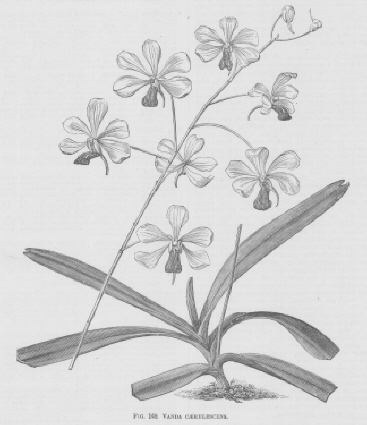
V. caerulea (blue).* fl. sometimes as much as 5in. across; sepals and petals pale blue, membranous, oblong, obtuse, shortly stalked; lip deep blue, small, coriaceous, oblong-linear, the point obtuse, with two diverging lobes; racemes ten or more-flowered; scapes erect, much longer than the leaves. Autumn. l. loriform, channelled, coriaceous, unequally truncate, with acute lateral lobes. Stem erect, 2ft. to 3ft. high. Khasya, 1849. A very handsome plant. (F. d. S. 609; I. H. 246; L. J. F. 102; L. & P. F. G. i. 36; R. X. O. i. 5; W. S. O. 18) V. c. grandiflora is a fine, large-flowered variety. (R. H. 1881, p.290.) V. caerulescens (bluish) fl. ten to twenty on a slender, erect, axillary scape; sepals and petals pale mauve-blue, cuneate-ovate, twisted at the clawed base; lip violet, obcuneate, dilated, emarginate, with lilac-purple auricles, the spur tipped with green. Spring. l. coriaceous, ligulate, dark green, 5in. to 7in. long, truncately bilobed. Stems elongated. Burmah, 1869. A pretty little species.(for which we are indebted to Messrs. Veitch and Sons). (B. M. 5834; F. M. ser. ii. 256; G. C. 1870, p.529; W. O. A. i. 48.)
V. c. Boxallii (Boxall's).* fl., sepals and petals white, tinged with lilac; front lobe of the lip dilated, deep violet, bordered with white; disk dark blue-striped; racem rather close, on a short scape. l. obliquely erose at apex. 1877. (B. M. 6328.)
V. c. Lowiana (Low's). Similar to Boxallii, but having an amethyst-coloured middle lobe of lip and a dot of amethyst at each end of the sepals. 1877.
V. Cathcarti (Cathcart's).* fl. 3in. across; sepals and petals white outside, yellow with reddish-brown bands internally, sessile, concave, roundish-oblong; lip three-lobed, the lateral lobes white, red-streaked at base, small, the middle lobe whitish, with a yellow, crenate, incurved border; disk with two erect calli; scape erect, leaf-opposed, four or five-flowered. l. 6in. to 7in. long, linear-oblong, unequally bilobed, pale green. Sikkim Himalayas, 1864. A tall, scrambling species. (B. M. 5845; C. H. P. 23; F. d. S. 1251 2; F. M. ser. ii. 66; G. C. 1870, 1409; I. H. 187; W. O. A. iv. 168). Arachnanthe Cathcarti is now the correct name of this species.
V. concolor (one-coloured). fl. rather distant, numerous, in elongated, lateral racemes; sepals and petals white outside, cinnamon-brown within, oblong-obovate, wavy; lip three-lobed, downy at base, the side lobes white with rosy dots, the middle one cinnamon-brown, cuneate and bilobed at apex; spur attenuated. l. membranous, evergreen, lax, obliquely three-toothed at apex. Stems erect, 5ft. to 6ft. high. China, 1850. (B. M. 3416, under name of V. Roxburghii unicolor.) V. cristata (crested). fl., sepals and petals yellow-green, oblong, obtuse, the petals incurved; lip buff, striped with rich purple, divided at the end into two or three narrow, acute, diverging, unequal lobes; racemes erect, three to six-flowered, shorter than the leaves. March to July. l. channelled, recurved, truncate and three-toothed at apex. Stems erect. Nepaul, 1818. (B. M. 4304; B. R. 1842, 48; R. G. 680.)
V. Denisoniana (Denison's). fl. thick and fleshy, medium-sized; sepals and petals white, slightly tinged with green, the dorsal sepal and petals spathulate; lip white, pandurate; the apex two-lobed, the base with two nearly quadrate auricles; spur short, conical; racemes axillary, five or six-flowered, on stout, ascending peduncles. April. l. lorate, rigid, recurved, sharply bilobed at apex, dark green. Stems erect. Arracan Mountains, 1869. (B. M. 5811; F. & P. 1869, p.250; G. C. n. s., xxiv., p. 105; I. H. ser. iii. 105.)
V. D. hebraica (Hebrew-marked). fl., sepals and petals sulphur-coloured on both sides, but darker within and with spots and bars resembling Hebrew letters; anterior part of the blade of the lip olive-green; spur orange inside. July. Burmah, 1885. (W. O. A. 248.)
V. D. punctata (dotted). fl. sulphur-coloured, with some brown spots on the petals and odd sepal, the middle and base of the lip white.
V. densiflora (dense-flowered). A synonym of Saccolabium giganteum.
V. fuscoviridis (fuscous-green). fl. about 1 1/2in. across, having a slightly fishy smell; sepals and petals dull brown, with a little greenish-yellow at the edge, the petals clawed, falcate, broader than the sepals; lip pure greenish-yellow, tomentose at base, five-furrowed, bilobed; spur cylindrical; racemes short, few-flowered. Spring. h. 1ft. Java, 1848. (G. C. 1848, p. 351; L. & P. F. G. ii. p. 20.)
V. gigantea (gigantic). A synonym of Stauropsis gigantea. V. Gowerae (Gower's). A garden name for V. undulata.
V. Griffithii (Griffith's). fl. yellow, brown, and lilac, much smaller than those of V. cristata (which this species resembles); sepals linear-oblong, recurved; petals acuminate; lip ovate, elongated, furrowed. concave at base. l. channelled, recurved, sharply and unequally three-lobed. Bhotan.
V. hastifera (halbert-bearing). fl. many in a loose raceme; sepals and petals light yellow, blotched with red inside; lip white, marked with brown and mauve, the lateral lobes semi-oblong, triangular, the front lobe halbert-shaped, covered with hairs at its base. l. linear-ligulate, erose at apex. Sondaic Archipelago, 1884. A rare, tall-growing Orchid.
V. helvola (pale red). fl. wine-red, shading into pale purple; lateral sepals connivent under the lip; lateral lobes of the lip bright purple, short, the middle lobe triangular-hastate, tumid inside and a little furrowed, concave beneath, the little sac having a pair of small callosities on the side opposite the column; raceme erect, shorter than the leaves, about three-flowered. March and April. l. rigid, slightly undulated, carinate at base, oblique and obtuse at apex. Java, 1850.
V. Hookeriana (Hooker's).* fl. 2 1/2in. across, membranous; sepals white, tinted with rose; petals larger, white, spotted with magenta, undulated, spathulate-oblong; lip cuneate at base, three-lobed, 1 1/2in. broad, white, lined and spotted with magenta-purple; a large, deep purple auricle on each side of the column; raceme two to five-flowered; peduncle leaf-opposed. September. l. erect, 2in. to 3in. long, terete, pale green, subulate-pointed. Stems rooting, elongated, terete. Borneo. (I. H. ser. iii. 484; W. O. A. ii. 73.) V. insignis (remarkable).* fl. 2 1/2in. across; sepals and petals light brown, spotted with chocolate-brown internally, yellowish-white outside, obovate-spathulate; lip large, almost fiddle-shaped, the side lobes white, short, the front one white, suddenly expanding into a concave, semi-lunar limb of light purplish-rose; racemes about as long as the leaves, five to seven-flowered. May and June. l. channelled, rigid, linear-ligulate, curving, unequally cut or denticulate at apex. Stems sub-erect. Moluccas, 1846. (B. M. 5759; L. & P. F. G. ii., p. 19; W. O. A. iv. 172; W. S. O. 3.)
V. i. Schroderiana (Baron Schroder's). fl., sepals and petals light yellow; lip pure white, with a large, concave, anterior limb. Autumn. Malay Islands, 1883. A very chaste and distinct novelty.
V. lamellata (plated). fl. pale yellow, streaked with dull, pale red, in long, loose, erect racemes; sepals and petals obovate, undulated, the lower ones larger and slightly incurved; lip with two diverging, elevated lines, acute, obcuneate, retuse; auricles small, rounded; spur short, cylindrical-conical, hairy within. August. l. coriaceous, obliquely and acutely bidentate. Philippines, 1837.
V. l. Boxallii (Boxall's).* fl., dorsal sepal creamy-white, the inner part of the lateral ones reddish-brown tinged with purple; petals white; limb of the lip rich magenta-rose towards the front, the disk with six reddish-purple stripes running back to the mouth of the tube; racemes fourteen to twenty-flowered. November and December. l. much recurved. Stems erect. 1880. (G. C. n. s., xv., p. 87; Gn. xix. 287.)
V. limbata (bordered). fl. 2in. across; sepals and petals cinnamon-brown, blotched and tessellated with darker reddish-brown, evenly bordered with yellow, tinged with lilac outside; lip rosy-lilac, margined with white, quadrate, slightly pandurate, the disk tumid, with five to seven parallel furrows; racemes loose, erect, about twelve-flowered. June. l. 8in. to 10in. long, channelled, coriaceous, obliquely retuse at apex. Stems stout, with long, thick roots. Java, 1875. (B. M. 6173; W. S. O. ser. iii. 9.) V. Lindeni (Linden's). fl. disposed in a handsome raceme; sepals and petals light yellow, with red dots on the disk, cuneate-oblong, wavy; lip whitish-yellow, with nearly square side lobes and a triangular, two-edged middle lobe produced into a sharp angle under two tumours at the apex, sulcate beneath, with a linear, velvety, ascending auricle on each side at the base, and three furrows over the disk, the tumours and side-lobes purple-spotted, the disk marked with four purple lines, the tip under the tumours brownish; spur conical, hairy inside. Sunda Isles, 1886.
V. Parishii (Parish's).* fl. large; sepals and petals greenish-yellow, dotted with reddish-brown, cuneate-oblong, acute; lip strongly and peculiarly scented, the front lobe pale magenta, narrowly margined with white, rhomboid, gibbous below the apex, with a median keel and a violet, conical callus at base; spur short, gibbous; auricles white, orange-striped; scape erect, several-flowered. Summer. l. broadly ligulate, obtuse, unequally bilobed, fleshy, bright green. Moulmein, 1870. A handsome, dwarf species. (W. O. A. i. 15.)
V. P. Marriottiana (Sir W. H. S. Marriott's). fl. not scented; sepals and petals bronzy-brown, suffused with magenta; lip having a rich magenta, rhomboid front lobe and white basal auricles; raceme about six-flowered. l. slightly emarginate. Stems closely leafy. 1880. (W. O. A. ii. 61.)
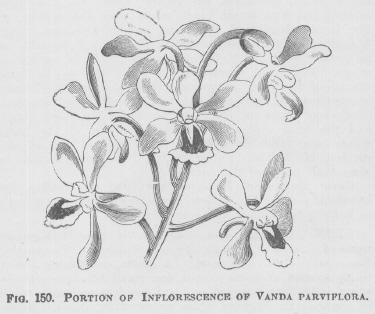
V. parviflora (small-flowered). fl., sepals and petals pale yellow, oval; lip funnel-shaped, the broadly oblong, rounded front lobe white, with purple crests on the fleshy disk, and dotted with lilac; spur short, conical; racemes short, erect, many-flowered. Summer. l. lorate, obliquely and obtusely bilobed at apex, with an intermediate cusp. India. A beautiful little plant. SYNS. V. testacea, Aerides testaceum, A. Wightianum (B. M. 5138; F. d. S. 1452.) V. Roxburghii (Roxburgh's).* fl., sepals and petals pale green, with chequered lines of olive-brown, oblong-obovate, the outer surface white; lip violet-purple and convex in the front part, deeper purple towards the apex, the lateral lobes white, lanceolate; spur pinkish, short; racemes six to twelve-flowered, on erect peduncles. Summer. l. ligulate, recurved, channelled, coriaceous, obliquely three-toothed at apex. Stems erect, dwarfish, stout. Bengal, 1850. (B. M. 2245; B. R. 506; F. d. S. Feb. 1846, 641, f. 2; L. & P. F. G. ii. 42, f. 2; W. O. A. 59.) Of this species there are several varieties, one having a dark blue lip, and another, V. tessellata (P. M. B. vii. 265; I. H. n. s. 579, V. R. rubra) a pink lip.
V. Sanderiana (Sander's).* fl. flat, about 4in. across; dorsal sepal and the smaller petals pink, slightly stained with buffyellow, the lateral sepals 2in. across, pale nankeen outside, within greenish-yellow, reticulated with dull crimson; lip small, concave, pale purplish-red at base, the tip chocolate-purple, strongly recurved, three prominent keels extending from base to apex; racemes axillary, many-flowered. September and October. l. broadly ligulate, coriaceous, recurved, 9in. to 12in. long, deeply channelled. Philippine Islands, 1881. (G. C. n. s., xx., pp. 440-1; I. H. ser. iii. 532; W. O. A. iii. 124.)
V. S. labello-viride (green-lipped). A distinct variety, having a green lip. Mindanad, 1886.
V. Stangeana (Stange's). fl. four or five in a raceme; sepals and petals internally at first greenish, afterwards ochre, tessellated with dark purple-brown; auricles of the lip blunt, white with yellow and some mauve-blue spots, the middle lobe white with mauve-blue or wholly mauve-blue, cordate-triangular. Assam, 1885. (R. X. O. ii. 102.) V. suavis (sweet).* fl. large and handsome, freely produced, fragrant; sepals and petals pure white outside, spotted and barred with blood-purple within, the dorsal sepal and two petals sub-lobate; lip convex, three-lobed, the front lobe pale rosy-purple, narrow, deeply bifid, the lateral ones deeper rosy-purple, ovate, flat; racemes bold, elongated, on axillary peduncles. l. lorate, flaccid, recurved, dark green, obliquely toothed at apex. Java, 1847. A noble plant for exhibition purposes. (B. M. 5174; F. d. S. 641, f. 3, (Hrubyana) 1604-5; G. C. n. s. xxii., p. 237, Wingate's var.; L. & P. F. G. ii. 42, f. 3; R. X. O. i. 12; W. O. A. iv. 180.)
V. s. flava (yellow). fl. yellow, with broad, oblong, rich brown spots. (B. M. 4432, under name of V. tricolor.)
V. s. Gottschalckei (Gottschalcke's). fl. deliciously scented, larger and stouter than in the type; sepals and petals more densely spotted; lip bright rosy-purple, tipped with white; pedicels deeply tinged with rose. l. (and stem) stouter than in the type. 1869.
V. s. Lindeni (Linden's). fl., sepals, petals, and base of lip white, spotted with purple, the rest of the lip purple. 1886.
V. teres (terete).* fl. large; sepals oblong, the dorsal one white, slightly tinged with rose, the lateral ones creamy-white, twisted, parallel with the lip; petals rose-magenta, lighter towards the margins, larger, sub-orbicular, undulated; lip bright rose-magenta, cucullate, large, strongly veined, the throat orange, striped and spotted with crimson, the apex dilated and emarginate; spur conical; racemes leaf-opposed, mostly two-flowered. June to August. l. (and stems) terete, dark green. Burmah, &c., 1828. A handsome, straggling or climbing species, several feet long. (B. M. 4114; B. R. 1809; P. M. B. v. 193; R. H. 1856, 22.)
V. t. Andersoni (Anderson's). fl. richer and deeper in colour, freely produced; racemes 10in. long, five or six-flowered. (W. S. O. ser. iii. 2.) V. t. aurorea (rosy). fl., sepals white; petals white, slightly rose-tinted; throat light ochre, with rosy lobes, which are furnished with two rows of small, purple dots; column light rose-purple. 1884.
V. t. candida (white). fl. white. A distinct and beautiful form.
V. teretifolia (terete-leaved). A synonym of Sarcanthus teretifolius.
V. tessellata (tessellated). A form of V. Roxburghii.
V. testacea (tile-coloured). A synonym of V. parviflora.
V. tricolor (three-coloured).* fl. white outside, handsome, fragrant; sepals and petals pale yellow spotted with brownish-red within, oblong-obovate, obtuse; lip three-lobed, the middle lobe rose-magenta, paler at the tip, convex, cuneate, deeply emarginate, the disk marked with five white lines, the basal lobes white, erect, rounded; spur white, short, compressed; column white, short, thick; racemes short, dense, on axillary peduncles. l. lorate, channelled, recurved, obliquely bilobed and somewhat erose at apex. Stems erect, tall. Java, 1846. (F. d. S. 641; L. J. F. 136; L. & P. F. G. ii. 42; W. O. A. ii. 77.) The following varieties of this superb species are enumerated by B. S. Williams, in the sixth edition of the "Orchid Grower's Manual": DALKEITH, a very highly-coloured form; DOWNSIDE, flowers large, and very rich in colour and markings.
V. t. Corningii (Corning's). fl., sepals and petals rich yellow, spotted and streaked with deep crimson, margined on both surfaces with rosy-purple; lip dark plum-colour, softened off to pale rose towards the base. l. very broad, dark green, stout.
V. t. Dodgsoni (Dodgson's). fl. very highly scented, borne in great numbers on the racemes; sepals and petals light amber, streaked and blotched with reddish-brown, and margined with violet; lip rich violet-purple, with a few white blotches near the base.
V. t. insignis (remarkable). fl., sepals and petals light yellow, spotted with crimson; lip pale lilac. Generally spring and autumn. This handsome variety was formerly known in gardens as V. insignis.
V. t. Patersoni (Paterson's). fl. about 2in. in diameter, appearing on very small plants; sepals and petals creamy-white, densely spotted with cinnamon-brown, broad; lip bright magenta. (G. C. n. s., xxii., p. 236.)
V. t. planilabris (flat-lipped). fl. larger and brighter-coloured than in the type; sepals and petals citron-yellow, thickly spotted with rich brown, very broad, clawed or narrowed to the base: lip rose-coloured, margined with purplish-mauve, and striped with chocolate-purple on the disk, large and flat. (W. O. A. ii. 87.)
V. t. Russeliana (Russel's). fl. very bright-coloured, in long racemes. A beautiful variety, having a peculiar, pendulous style of growth; it is very robust.
V. t. Warneri (Warner's). fl., sepals and petals distinctly margined with deep rose; lip deep rosy-purple. l. linear, lorate, peculiarly ribbed. (W. S. O. ser. ii. 39.)
V. undulata (waved). fl. white, very freely produced in racemes; sepals and petals lanceolate, much undulated; lip having the lateral lobes greenish, and marked with orange lines on the disk. l. coriaceous, ligulate, unequally bilobed. India, 1875. This has been sold under the name-of V. Gowerae.
V. violacea (violet). A synonym of Saccolabium violaceum.
V. Vipani (Vipan's). fl., sepals and petals blunt, rhomboid, white externally, within pale at the base, marked with short, brownish-purple lines, the rest of the sepals brownish-olive, and of the petals inclining to ochre, all striped with dark brown-purple; middle lobe of the lip olive-green, the side auricles yellow. l. very long and narrow. Burmah, 1882.