Veltheimia
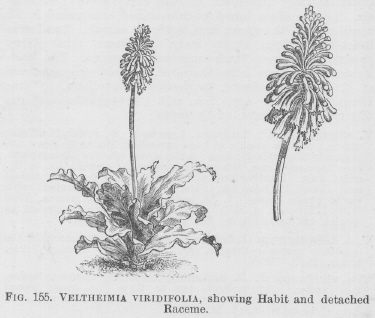
(named in honour of Aug. Ferd., Count Veltheim, 1741-1801, a German supporter of botanical studies). ORD. Liliaceae. A small genus (three species) of greenhouse or half-hardy, bulbous plants, confined to South Africa. Flowers showy, densely clustered in a terminal spike or raceme, shortly pedicellate or sub-sessile, pendulous or nodding; perianth tubular, cylindrical, equal or slightly enlarged above, persistent, the six lobes equal, very short, tooth-like; stamens six, equally affixed above the middle of the tube, included; scape simple, leafless; bracts scarious, short. Leaves radical, numerous, oblong or loriform, fleshy-herbaceous. The two species known to cultivation thrive in a light, loamy soil. Propagation may be readily effected by offsets; or leaves, pulled off close to the bulb, and inserted in pots of soil, will produce bulbs at their base.
V. glauca (glaucous). fl., perianth red-spotted or yellowish, 1/2in. to 3/4in. long; pedicels scarcely above one line long; raceme 2in. to 6in. long, 1 1/2in. to 2in. thick; scape 1ft. or more high; bracts linear, three to four lines long. March. l. narrower than in V. viridifolia, glaucous, much undulated. 1781. (B. M. 1091.) A variety rubescens (reddish-flowered) is figured in B. M. 3456.
V. viridifolia (green-leaved). fl., perianth reddish or yellowish, spotted, 1 1/4in. to 1 1/2in. long; pedicels two to three lines long; raceme 3in. to 4in. long, 3in. thick, forty to sixty-flowered; scapes 1ft. to 1 1/2ft. long; bracts lanceolate, four to six lines long. August. l. ten to twelve, lorate, 8in. to 12in. long, 2 1/2in. to 3in. broad, green, the margins undulated. 1768. See Fig. 155. (L. B. C. 1245.) SYN. Aletris capensis (B. M. 501).