Veronica
(a mediaeval name of doubtful derivation, probably from hiera eicon, sacred image; in allusion to the legend of the sacred handkerchief of S. Veronica). Cancerwort; Speedwell. Including Diplophyllum and Leptandra. ORD. Scrophularineoe. A genus comprising about 160 species of greenhouse or hardy herbs, shrubs, or rarely trees, broadly dispersed over temperate and frigid regions. Flowers often varying in colour in the same species, blue, purple, flesh-coloured, or white, disposed in bracteate, terminal or axillary racemes, rarely solitary in the axils of alternate leaves; calyx four, five, or very rarely three-parted, the segments scarcely imbricated; corolla tube rarely exceeding the calyx; limb spreading, four or five-cleft, the lateral lobes exterior (or one exterior), the upper and lower ones usually narrowest; stamens two, exserted; pedicels ebracteolate. Leaves opposite, rarely whorled or somewhat scattered, the cauline ones very rarely alternate; floral ones always alternate, similar to the cauline ones or often reduced to bracts. Sixteen species are indigenous in Britain; among them the following may be mentioned; V. Beccabunga (Brooklime), with rather fleshy, blunt leaves, which are considered to be anti-scorbutic; V. Chamaedrys, one of the loveliest of our wild flowers; and V. spicata, often grown in gardens. The best-known cultivated species are here described. Except where otherwise stated, they are hardy, and of perennial duration, thriving in any fairly good soil, and being increased by divisions. The shrubby kinds may be readily multiplied by cuttings, and the annuals by seeds.
V. alpina (alpine). fl. blue or violet; corolla two to three lines across; raceme spiciform or somewhat capitate, dense, or interrupted below. May. l. mostly shorter than internodes of the simple stem (1/2in. to 12in. long), ovate to oblong, crenulate-serrate or entire. h. 9in. to 12in. Europe (Britain), Asia, North America. (F. D. 16; Sy. En. B. 980.)
V. a. Wormskioldii(Wormskiold's). A villous-pubescent form, with larger leaves. 1819. (B. M. 2975.)
V.amethystina (amethystine-blue). A synonym of V. paniculata. V. amplexicaulis (stem-clasping). fl. in short, conical, dense spikes 3/4in. to 1in. long, on hairy peduncles 1in. to 1 1/4in. long, crowded together near the ends of the branchlets; corolla white, the tube 1/4in. long, the limb 1/4in. across. l. loosely imbricated, amplexicaul, oblong, obtuse, 1/2in. long, 1/3in. broad, glaucous, coriaceous, entire, slightly concave. h. 1ft. to 2ft. New Zealand. Decumbent or sub-erect shrub.
V. Andersonii (Anderson's).* fl. bluish-violet, sometimes whitish towards the base of the raceme; racemes shortly pedunculate, narrow-oblong, rather longer than the leaves. July. l. oblong, 3in. to 4in. long, somewhat obtuse, entire, puberulous on the margins, rather thick. h. 1 1/2ft. Half-hardy shrub. Garden hybrid. (F. d. S. 658; L. J. F. 103; L. & P. F. G. 38.)
V. A. variegata (variegated). This differs from the type in having finely variegated leaves.
V. anomala (anomalous). fl. white, very shortly pedicellate or sessile; corolla tube 1/4in. to 1/2in. broad, the lobes nearly equal, three or two unequal, spreading, narrow; racemes crowded together, five to ten-flowered, sub-terminal. l. decussate, 1/2in.to 1in. long, 1/5in. to 1/4in. wide, linear or linear-oblong, patent, often reddish-coloured, coriaceous, quite glabrous on the upper surface, sometimes ciliated on the margin, concave, entire, shortly petiolate. Branches long, slender, purplish or reddish towards the tips. h. 3ft. to 6ft. New Zealand. A densegrowing shrub.
V. Buxbaumii (Buxbaum's). fl. bright blue; corolla 1/2in. across; peduncles solitary, axillary in alternate, leaf-like bracts. April to September. l. shortly petiolate, oblong or ovate-cordate, 1/3in. to 1 1/3in. long coarsely serrated; floral ones similar, shorter than the decurved pedicels. Branches 6in. to 12in. long. Europe (naturalised in Britain). A prostrate annual. (F. D. 1982; Sy. En. B. 973.) V. buxifolia (Box-leaved). fl. white; corolla tube short, the limb 1/4in. to 1/3in. across; racemes very short, dense-flowered, crowded at the ends of the branches and sub-capitate, puberulous or glabrous; pedicels short; bracts as large as the sepals. l. 1/4in. to 1/3in. long, 1/5in. to 1/4in. broad, broadly oblong-obovate, obtuse, suddenly truncate or cordate at the very short, thick petiole, excessively thick and coriaceous, concave. h. 2ft. to 3ft. New Zealand. A small, stout, glabrous shrub.
V. carnosula (slightly fleshy).* fl. white, with reddish-yellow anthers; corolla tube very short, the limb 1/4in. to 1/3in. across; spikes short, pilose and pubescent, crowded and forming heads at the ends of the branches, very dense-flowered. Summer. l. closely imbricated, sub-erect, 1/3in. to 2/3in. long, broadly obovate or oblong or orbicular, round at tip, entire, very thick and coriaceous, almost sessile or on broad petioles. New Zealand. A stout, often prostrate shrub.
V. cataractae (waterfall). fl. white or pinkish, 1/2in. to 3/4in. in diameter; pedicels very slender, 1/2in. to 1in. long; racemes axillary, slender, 3in. to 8in. long, very many flowered; bracts linear, subulate l. sessile or petiolate, 1/2in. to 5in. long, ovate-oblong or narrow-lanceolate, acuminate, deeply and acutely serrate, coriaceous. Stems sub-erect or prostrate at the base and ascending, 10in. to 2ft. long, branched, rather slender. New Zealand. Shrub.
V. caucasica (Caucasian). fl. pale red; pedicels filiform; racemes loose, many-flowered, on slender peduncles. June. l. sub-sessile, once or twice pinnatisect; segments oblong or linear-cuneate, narrowed at base, entire or incised. Stems ascending or erect, pilose. Caucasus, 1816. (L.B.C. 1369.)
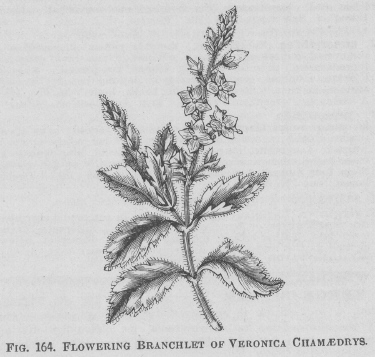
V. Chamaedrys (Chamaedrys). Angels' Eyes; Birds' Eyes; Germander Speedwell; God's Eye. fl. bright blue; corolla 13in. to 1/2in. across; raceme loose, 2in. to 5in. long, including the slender peduncle. May and June. l. all opposite, sub-sessile, ovate-cordate, 1/2in. to 1 1/2in. long, deeply serrated. Branches 8in. to 2ft. long, slender, ascending. Europe (Britain). Plant hairy. (F. D. 448; L. B. C. 53; Sy. En. B. 986.) V. chathamica (Chatham Island). fl. dark purple, large, numerous, closely set; peduncles 1/2in. long, pubescent; racemes 1in. to 1 1/2in. long, sub-terminal at the ends of the branches and axillary to the uppermost leaves. l. spreading, sessile, 1/3in. to 1 1/2in. long, 1/5in. to 1/2in. broad, obovate-oblong or ovate-oblong, acuminate, entire, flat, scarcely coriaceous. Branches wiry, pubescent. Chatham Island. A small, prostrate, rambling shrub, adapted to the ornamentation of rockwork or earth-banks.
V. Colensoi (Colenso's). fl. white, pink, or bluish; corolla tube short, the limb 1/8in. to 1/4in. across; racemes sub-terminal, often compound, pedunculate, hardly longer than the leaves, puberulous. Summer. l. spreading or erecto-patent, almost sessile, 1/2in. to 1in. long, very coriaceous, linear-oblong or narrowly oblong-obovate, acute, entire, sometimes glaucous. New Zealand. A small, glabrous, half-hardy shrub.
V. cupressiodes (Cypress-like). fl. violet, 1/16in. in diameter, three or four at the end of the slender branchlets; bracts larger than the sepals, both broadly oblong, obtuse, not ciliated. l. 1/16in. long, ovate-oblong, obtuse, not broader than the branch, opposite pairs connate at the base, erect or adpressed, glabrous, fleshy. New Zealand, Middle Island, &c. A dense, much-branched bush, 6in. to 3ft. or 4ft. high. This is known in gardens under name of V. salicornioides.
V. decussata (decussate). A synonym of V. elliptica.
V. Derwentia (River Derwent). fl. light blue or white, rather crowded in racemes often 6in. to 8in. long, in the upper axils; corolla lobes broad, acute, 1/4in. long, obscurely arranged in two lips. June. l. sessile, broadly lanceolate, acuminate, 3in. to 4in. long, serrated. Stems 2ft. to 3ft. high. Australia. 1802. Greenhouse. (A.B.R.531.) SYN. V. cabiata (B. M. 1660,3461). V. diosmaefolia (Diosma-leaved). fl. lilac, 1/6in. to 1/4in. across; pedicels slender; corymbs terminal, depressed, many-flowered. July. l. petiolate, close-set, spreading, rigidly coriaceous, 1/2in. to 2/3in. long, 1/6in. broad, linear-oblong, acute at both ends, entire, not shining, sharply keeled by the midrib below. Branches rather slender. h. 3ft. to 12ft. New Zealand, 1835. Greenhouse shrub
V. elliptica (elliptic).* fl. white, large; corolla limb 1/3in. to 2/3in. broad; racemes very short, few-flowered, forming together a loose, sub-corymbose head at the tips of the branchlets. July. l. close-set, spreading, uniform, petiolate, 1/3in. to 2/3in. long, linear or obovate-oblong, truncate at base, entire, flat, not shining. h. 5ft. to 20ft. New Zealand, Chili, Fuegia, and Falkland Islands, 1776. Half-hardy shrub or tree. (L. & P. F. G. iii., p. 101.) SYN. V. decussata (B.M.242).
V. epacridea (Epacris-like). fl. white, collected into terminal, ovoid, leafy heads; corolla with a long tube, the limb 1/12in. in diameter. l. sessile, 4in. in diameter, densely imbricate, spreading and recurved, 1/8in. to 1/6in. long, very broadly obovate-oblong, concave, rigid, glabrous, round or sub-acute at the tip. Stem much branched, rigid, tortuous. New Zealand. Half-hardy shrub.
V.formosa (beautiful). fl. pale blue, in short, loose racemes in the upper axils, forming terminal, leafy corymbs; corolla lobes 1/4in. or more long. July. l. rather crowded, oval-oblong or lanceolate, entire or rarely obscurely toothed, thick, often recurved, 1/4in. to 1/2in. long. h. 2ft. to 4ft. Australia, 1835. A beautiful, corymbosely-branched, greenhouse shrub (B. M. 4512; L. J. F. 3; L. & P. F. G. 95.)
V. gentianoides (Gentian-like). fl. blue, rather large; pedicels at length 1/3in. to 1/2in. long; racemes elongated, loose, many flowered, pubescent. June. l. rather thick, entire or with a few crenatures, lin. to 3in. long, the lower ones rosulate, obovate or oblong, the rest remote, oblong or lanceolate. Stems tufted, erect, simple, 6in. to 12in. or more high. Caucasus, 1748. (B.M. 1002; S. F. G. 5.) There is a very pretty variety, alba, with white flowers. V. glauco-caerulea (glaucous-blue).* fl. deep blue, changing to purple, in short, few-flowered spikes, crowded together near the tips of the branchlets; corolla limb 1/4in. to 1/2in. in diameter; peduncles covered with soft, white hairs. l. closely imbricated, 1/3in. long, obovate-oblong, acute, rather concave, on short, broad petioles. New Zealand. A small, stout, decumbent or suberect shrub, much branched, intensely glaucous throughout, with slightly hairy branches.
V. Grievei (Grieve's). A garden hybrid near V. saxatilis, resembling that species, but with brighter coloured-flowers. It is more suitable for flower borders.
V. Guthrieana (Guthrie's). A garden hybrid of which one of the parents is V. saxatilis.
V. Hulkeana (Hulke's).* fl. lilac, sessile; corolla 1/4in. broad; spikes spreading, puberulous and glandular, forming long, terminal, opposite-branched panicles, 4in. to 10in. long. Summer. l. in distant pairs, 1in. to 1 1/2in. long, oblong-ovate, obtuse or acute, coarsely serrated, rather coriaceous; petioles 1/4in. to 3/4in. long. Stem nearly simple, terete. h. 1ft. to 3ft. New Zealand, 1865. Half-hardy shrub. (B. M. 5484.)
V. incana (hoary).* fl. blue; pedicels much shorter than the woolly calyx; racemes often solitary. July. l. petiolate, oblong or lanceolate, narrowed at base, the lower ones obtuse and crenate, the upper ones acute and serrated or entire at apex, both sides (as well as the stem) hoary-tomentose. h. 2ft. Russia, 1759. SYN. V. neglecta (S.B.F.G. 55).
V. incisa (cut-leaved). fl. blue, on pedicels rather longer than the calyx; racemes solitary or paniculate, slender. July. l. scattered, pinnatifid to the middle or rather deeper; lobes lanceolate, acute. Stems glabrous or canescent-pubescent. h. 2ft. Siberia, 1739. (L.B.C. 1397.) V. Kirkii (Kirk's). fl. pure white, shortly pedicellate, disposed in slender racemes in the axils of the upper most leaves; corolla tube 1/5in. long, the limb 1/4in. in diameter; racemes 4in. to 8in. long, dense-flowered. l. 1in. to 1 1/2in. long by 1/3in. wide, lanceolate, decussate or loosely imbricate, entire, smooth, acute, sessile by a broad base, slightly concave, recurved. h. 6ft. to 12ft. New Zealand. A tall, handsome shrub, with dark brown, polished branches.
V. labiata (lipped). A synonym of V. Derwentia.
V. laevis (smooth). fl. white, 1/4in. across; racemes twice as long as the leaves, usually crowded at the ends of the branches, puberulous. l. erect and adpressed, imbricating, rarely spreading, 1/4in. to 1/2in. long, 1/4in. to 1/3in. broad, broadly obovate-oblong, obtuse or acute, extremely coriaceous, entire, concave, sharply keeled by the stout, prominent midrib; petioles short, very stout. h. 2ft. to 4ft. New Zealand. A glabrous shrub.
V. latifolia (broad-leaved). A form of V. Teucrium.
V. ligustrifolia (Ligustrum-leaved). fl. white, rather large; pedicels slender; racemes about twice as long as the leaves, rather slender, loose-flowered, puberulous. l. 1 1/4in. to 3in. long, usually very narrow, linear-lanceolate, acuminate, 1 1/6in. to 1/4in. broad, flat or concave and keeled at the back, quite entire, sometimes 1/2in. to 3/4in. broad and obtuse. New Zealand. A large, glabrous, diffusely-branched, greenhouse shrub.
V. Lindleyana (Lindley's). A form of V. salicifolia.
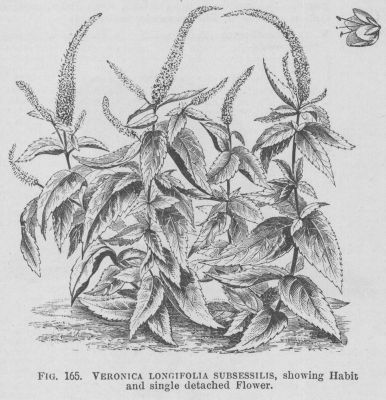
V. longifolia (long-leaved). fl. lilac; pedicels often shorter than the calyx; racemes solitary or few, dense-flowered. August. l. shortly petiolate, opposite or ternately whorled, ovate or cordate at base, ovate-or oblong-lanceolate, acuminate, argutely serrated. Stems glabrous or puberulous. h. 2ft. Central Europe, 1731.
V. l. subsessilis (nearly sessile). fl. of a beautiful amethystine blue; rachis of the raceme adpressedly-pubescent. l. very shortly petiolate, 2in. to 4in. long, simply serrated, adpressedly puberulous beneath. h. 2ft. to 4ft. Japan, 1878. (B. M. 6407; G. C. n.s. xvi., p. 789; R. H. 1881, p. 270.)
V. Lyallii (Lyall's).* fl. white, the veins pink near the throat; corolla nearly 1/2in. across; pedicels slender, the lower ones 1/2in. long, peduncles axillary, slender, 3in. to 8in. long, glabrous, many-flowered. Summer. l. shortly petiolate, 1/4in. to 1/2in. long, ovate to ovate-lanceolate, obtuse or acute, glabrous, with a few coarse serratures. Stems slender, prostrate and rooting, diffusely branched, 5in. to 15in. long. New Zealand, 1879. Shrub. (B. M. 6456.)
V. lycopodioides (Lycopodium-like). fl. white, sessile, disposed in small, dense, oblong heads at the ends of the branches; sepals linear-oblong, obtuse, ciliated; corolla tube very short, the limb 1/5in. diameter. l. very densely and closely imbricate, thickly coriaceous, very broadly reniform-ovate, much broader than long, abruptly narrowed into an acute tip, about 1/10in. broad; opposite pairs connate at the base. New Zealand. An erect, much-branched, stout shrub.
V. multifida (much-cleft). fl. light blue; pedicels scarcely exceeding the calyx; racemes dense-flowered. June. l. rarely more than 1/2in. long, once or twice pinnatisect; segments linear or subulate, rarely oblong, narrowed at base. Stems decumbent or diffuse, woody at base, cano-pubescent, 6in. long. Central and Eastern Asia, 1748. (B. M. 1679; J. F. A. 329.)
V. neglecta (neglected). A synonym of V. incana.
V. officinalis (officinal). Common Medicinal-tea Speedwell; Fluellen; Ground-hele. fl. pale blue or lilac, on very short pedicels; corolla 1/6in. across; racemes slender, many-flowered. May to July. l. all opposite, shortly petiolate, obovate-oblong or orbicular, 1/4in. to 1in. long, serrated. Stem hairy, decumbent; branches 2in. to 18in. long, ascending. Europe (Britain). (F.D. 248; Sy. En. B. 984-5.) V. orchidea (Orchis-like). A form of V. spicata.
V.orientalis (Eastern). fl. flesh-coloured, small, and shortly pedicellate, or blue, larger, and longer pedicellate; raceme loose. July. l. linear, lanceolate, or cuneate-oblong, entire, toothed, or with a few pinnatifid laciniae, narrowed at base. Stems decumbent or diffuse, woody at base, cano-pubescent or glabrous. Levant, 1748. (L. B. C. 419.) SYN. V. taurica (L.B.C. 911).
V. paniculata (panicled). fl. blue; pedicels longer than the calyx: racemes numerous, loose, many-flowered, paniculate. June. l. mostly opposite or ternately whorled, lanceolate, acute, crenate-serrate, narrowed at base, petiolate or rarely sub-sessile, rather thick, pale, glabrous or scarcely puberulous. Stems 1ft. to 3ft. high, glabrous or canescent-puberulous. South-Eastern Europe, 1797. SYN. V. amethystina.
V. parviflora (small-flowered). fl. blue, small; corolla 1/8in. to 1/6in. across; racemes generally straight, about twice as long as the leaves, dense-flowered, pubescent. May. l. erect or spreading, 1in. to 3in. long, lanceolate to linear-lanceolate, flat or concave and keeled, quite entire, acute or acuminate. h. 4ft. to 6ft. New Zealand, 1822. Half-hardy shrub. V. p. augustifolia (B. M. 5965) is a narrow-leaved form, with lilac flowers.
V. pectinata (comb-like). fl. blue; corolla ample; pedicels scarcely longer than the calyx; racemes at length as much as 1ft. long. May. l. often small, obovate to oblong-linear, crenate or scarcely incised, narrowed at base. Stems prostrate, canopubescent or villous. Syria, &c., 1819.
V. p. rubra (red). A fine variety, with reddish-pink flowers. V. perfoliata (perfoliate). Digger's Speedwell. fl. bluish-violet, streaked with purple, in long, slender racemes in the upper axils; corolla lobes nearly rotate, but obscurely bilabiate. August. l. amplexicaul and often more or less connate by their broad bases, ovate or ovate-lanceolate, acuminate or acute, entire or few-toothed, 1in. to 3in. long. Stems simple or slightly branched. h. about 3ft. Australia, 1815. Greenhouse perennial or undershrub. (B. M. 1936; B. R. 1930; L. B. C. 781.)
V. pimeleoides (Pimelea-like). fl. deep purple, opposite, in the axils of large, leafy, ciliated bracts; spikes short, very pubescent or tomentose, sub-distichous. l. sessile, imbricated, erectopatent, 1/6in. to 1/4in. long, broadly obovate oblong, obtuse, rather concave, obtusely keeled, slightly glaucous. Branches erect, transversely scarred. h. 4in. to 10in. New Zealand. A sub-erect, greenhouse shrub.
V. pinguifolia (fat-leaved).* fl. white; sepals obtuse, ciliated; spikes very short, pilose and pubescent, crowded in heads at the tips of the branches, very dense-flowered. June. l. sessile, imbricated, 1/6in. to 1/2in. long, obovate-oblong, obtuse, entire, very thick and coriaceous, concave, not keeled. Branches pubescent above, transversely scarred. h. 4ft. New Zealand, 1870. An erect or decumbent, robust shrub. (B. M. 6147; B. M. 6587, under name of V. carnosula.)
V. prostrata (prostrate). A form of V. Teucrium.
V. salicifolia (Willow-leaved). fl. bluish-purple or white, very variable in size and length of corolla tube; pedicels slender; racemes much longer than the leaves, simple, very many flowered, pubescent or glabrate. June. l. sessile, 2in. to 6in. long, linear or oblong-lanceolate, acuminate, entire, glabrous. Branches terete, as thick as a crow-quill. New Zealand. A large, half hardy, glabrous shrub. V. Lindleyana (P. M. B. xii. 247) is a form of this.
V. salicornioides (Salicornia-like). The plant grown under this name in English gardens is V. cupressoides; the true V. salicornioides has apparently not yet been introduced.
V. satureioides (Satureia-like). fl. blue; calyx unequally five-partite; corolla limb sub-bilabiate; raceme spicate, 1/2in. long. May. l. opposite, decussate, crowded, oblong or obovate, 1/3in. long; tip slightly toothed. Stems caespitose; base woody. h. 3in. Dalmatia, 1885. (R. G. 1192, fig. 3.)
V. saxatilis (rock-loving). Rock Speedwell. fl. bright blue, very beautiful; corolla 1/2in. across; raceme sub-corymbose, terminal, few-flowered. July to September. l. 1/4in. to 1/3in. long, the lower ones obovate, the upper oblong, coriaceous; teeth very few or none. Stem woody; branches many, 2in. to 4in. long, with leafy barren shoots. Europe (Britain). Plant decumbent. (L. B. C. 704; Sy. En. B. 981.)
V. speciosa (show). fl. deep blue-purple; corolla 1/3in. broad; racemes dense-flowered, 1in. in diameter, not longer than the leaves, stout, erect. May. l. sessile or on very short, thick petioles, 2in. to 4in. long, obovate-oblong, rounded at apex, very coriaceous, shining, entire, downy on the midrib above. Branches angled. h. 1 1/2ft. New Zealand, 1835. Half-hardy shrub. (B. M. 4057; P. M. B. x. 247.)
V. s. imperialis (Imperial). A very handsome and free-flowering garden variety, producing its purple flowers in large, dense spikes. 1878. (F.d.S. 2317.)
V. s. rubra (red). This differs from the type in having rose-coloured flowers. (F.d.S. 196.) V. spicata (spike-flowered).* fl. bright blue; corolla tube shorter than the calyx; stamens very long, purple; spike dense, 1 1/2in. to 3in. long. July and August. l. opposite or whorled, 1in. to 1 1/2in. long, sub-sessile, narrow-oblong or oblong-lanceolate, serrated above the middle. Stem 6in. to 18in. long, stout, erect from a decumbent base, leafy. Europe (Britain), &c. (F.D. 52; Sy. En. B. 982) V. orchidea (B. M. 2210) is a form of this species, with narrow, tortuous corolla segments.
V. syriaca (Syrian). fl. blue; corolla rather large; pedicels filiform, several times longer than the calyx; racemes slender, bundle-flowered. June. l., lower ones petiolate, upper ones sessile, ovate or ovate-lanceolate, with a few incised teeth; lower floral ones somewhat conformed, the rest small, entire. Stems ascending or diffuse, branched. Syria, 1857. Half-hardy annual. (B. H. vii. 42; F. d. S. 1259.)
V. taurica (Taurian). A synonym of V. orientalis.
V. Teucrium (Teucrium). Hungarian or Saw-leaved Speedwell. fl. light blue; calyx segments very unequal; racemes many-flowered. July. l. sessile or the lower ones shortly petiolate, ovate to linear, rounded or cordate at base, more or less toothed or sub-pinnatifid. Sterile stems prostrate; floral ones ascending from a decumbent base, or erect, cano-pubescent or villous. South Europe, 1596. A variable species. (B. H. xxx. 7; L. B. C. 425.) There is a prostrate, small-leaved form with bright blue flowers. (B.M. 3683, under name of V. prostrata.)
V. T. latifolia (broad-leaved). A tall form, with broader leaves than the type. (S. B. F. G. 23, under name of V. latifolia.)
V. Traversii (Travers').* fl. white; corolla lobes 1/4in. across; racemes longer than the leaves, sub-terminal, 1in to 2in. long, puberulous, many-flowered. Summer. l. spreading, sessile, 3/4in. to 1in. long, obovate or linear-oblong, acute or obtuse, entire, coriaceous, flat. Branches terete. h. 2 1/2ft. New Zealand, 1873 Shrub. (B. M. 6390.) V. vernicosa (varnished). fl. white; racemes crowded at the ends of the branches, puberulous, 1in. to 1 1/2in. long, often peduncled, tapering or caudate; bracts very small. l. close-set, spreading, petiolate, 1/3in. to 1/2in. long, 1/4in. to 1/3in. broad, obovate-oblong, obtuse or apiculate, varnished on the upper surface, entire, flat or a little concave. New Zealand. A small, stout, glabrous shrub.
V. virginica (Virginian).* Culver's Physic; Great Virginian Speedwell. fl. white, sometimes bluish; corolla salver-shaped; terminal spike 6in. to 10in. long, with usually several shorter ones from the upper axils. July. l. in whorls of three to nine, lanceolate, slenderly acuminate, sometimes oblong, very closely and sharply serrated, 3in. to 5in. long. Stems simple, 2ft. to 6ft. high. North America, 1714 (B.M.Pl. 196.) SYN. Leptandra virginica.