Victoria
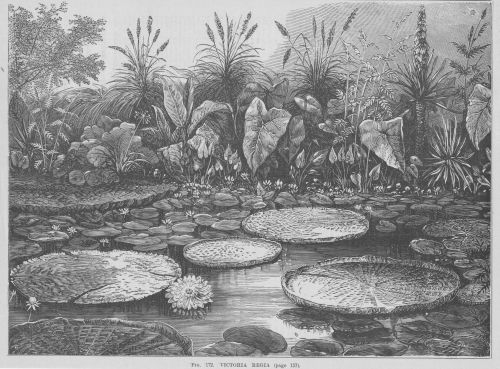
(named after Her Majesty Queen Victoria). ORD. Nymphaeaceae. A monotypic genus. The species-a gigantic, handsome, prickly, aquatic, stove herb, with a thick rhizome-is one of the most remarkable productions of the vegetable kingdom. It is found, growing in still water of about 4ft. to 6ft. in depth, in equinoctial America. The peculiar formation of the under surface of the leaves imparts to them great buoyancy-sufficient, for instance, to withstand the weight of a good-sized child sitting in a chair, provided, by means of a flat board, the pressure be equally distributed over the whole of the leaf. In this country, at any rate, it is best to treat the Victoria as an annual, as it is difficult to keep alive during dull, sunless weather in winter. The seeds-which should be kept in a vessel of water until ready for sowing-should be placed in loamy soil, and the pot containing them submerged a couple of inches in a "nursery" tank of water, the temperature of which should not be allowed to fall below 85 deg. The tank, too, should be in as light a position, and as near the glass, as possible. It is desirable to sow the seeds in January, and as soon as the seedlings appear, prick them singly into small pots, gradually shifting into larger pots as the plants grow stronger. About the beginning of May, the best plant will probably be ready to place out in the large tank. Two or three cartloads of good, strong loam, with a good proportion of rotted cowdung, will be necessary to enable the plant to attain its full size. After it is fairly established, the temperature of the water may be allowed to fall to 80 deg., but not below. All the sunlight possible is needed to keep the plant in robust health, so the house in which it is grown should not be artificially shaded in any way. Where it is practicable to maintain the water of a large tank at the temperature above mentioned, the Victoria may be grown in the open air in places sheltered from the wind, which has-except under such conditions-too much power on the upturned edges of the huge leaves. The illustration represents a plant in the open, surrounded by hardy subjects.
V. regia (royal).* Queen Victoria's Water Lily; Royal Water Lily; Water Maize; Water Platter. fl. 1ft. or more in diameter; calyx deeply quadrifid, the tube tawny, very prickly, turbinate, adnate with the ovary, the segments purple-brown, concave, deciduous, rather shorter than the petals; torus annular; petals very numerous, the outer ones white, spreading, oblong, concave, obtuse, the inner ones gradually passing into filaments and becoming deeply coloured with purple or full rose; perfect stamens in about two series, large, fleshy, subulate, gracefully incurved below, the rest erect; peduncles or scapes radical, longer than the petiole, and rising above the surface of the water when in flower, terete, prickly, sometimes 1in. in diameter, single-flowered. Summer. fr. a large, cyathiform, truncate, fleshy, green, prickly berry, bearing many oval, very dark brown seeds. l. usually floating, 4ft. to 6 1/2ft. in diameter, at first oval with a deep, narrow cleft or sinus at one end, at last almost exactly orbicular, peltate, flat, but having a turned-up margin 2in. to 5in. broad; upper side full green, reticulated; under side deep purple, sometimes green, spongy-pubescent, copiously veined, more or less beset with sharp and horny, subulate prickles; petioles terete, radical, copiously prickly. Rhizome thick. 1838.(B. M. 4275-4278.)