Vinca
(Vinca, or Pervinca, was the old Latin name used by Pliny). Periwinkle. Including Catharanthus. ORD. Apocynaceae. A genus comprising ten broadly-distributed species of pretty, stove, greenhouse, or hardy, erect, or procumbent herbs or sub-shrubs. Flowers rather large, axillary, solitary; calyx five-parted, without glands, the lobes narrow; corolla salver-shaped, the tube cylindrical, the five lobes ample; stamens above the middle of the tube, included. Leaves opposite. The best-known species are here described. V. rosea, which requires stove or greenhouse treatment, may readily be propagated from cuttings of young shoots, taken off soon after new growth is commenced in spring, and inserted in sandy loam, in a close frame. The points should be taken out as the young plants become established, to make them bushy; the flowers are borne on the new shoots as they lengthen. A compost of fibrous loam and a little decayed manure intermixed is well suited to the requirements of this species. It is not necessary to propagate every year, except for increasing stock: the old plants can be kept through the winter. The hardy Vincas are excellent trailing plants for furnishing banks, rockwork, rooteries, &c., in wild gardens, pleasure-grounds, and woods. They grow in almost any kind of soil, and spread rapidly when once established. Propagated by division: any of the single pieces with roots attached may be dibbled in from autumn until early spring.
V. acutiflora (acute-flowered).* A synonym of V. media.
V. herbacea (herbaceous). fl. purplish-blue; corolla eight to eleven lines long, bearded in the middle and at the throat. June and July. l. elliptic or lanceolate, somewhat obtuse, 1in. long, the margins revolute and slightly ciliated. Stems all fertile, herbaceous, glabrous, declinate, simple. Eastern Europe, 1816. Hardy. (B. M. 2002; B. R. 301.)
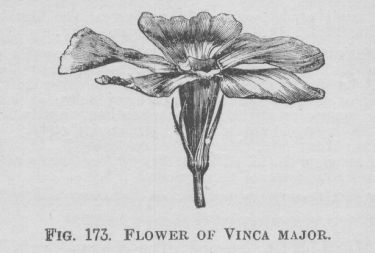
V. major (greater).* Band-plant; Cut-finger. fl. blue-purple; calyx lobes ciliated, equalling the corolla tube. April and May. l. ovate, or cordate at base, ciliated. Flowerless stems rooting at the tip only; fertile ones erect in flower, elongated afterwards. Europe (Britain), &c. Larger in all its parts than V. minor.(Sy. En. B. 905.)
V. m. elegantissima (very elegant).* A form with foliage beautifully margined or blotched with creamy-white.
V. media (intermediate). fl. blue; corolla 1in. long, the lobes obliquely ovate, acuminate. August. l. ovate, narrowed at both ends, highly glabrous, 1in. to 2in. long, 1/2in. to 3/4in. broad. Sterile stems reclinate; fertile ones nearly erect, 1ft. or more high. Mediterranean region. Hardy perennial. SYN. V. acutiflora.
V. minor (lesser).* fl. 1in. in diameter; calyx lobes glabrous, one-third the length of the corolla tube; corolla blue-purple. April and May. l. 1in. to 1 1/2in. long, elliptic-ovate, with glabrous margins, on very short petioles. Stems tough; flowerless ones 1ft. to 2ft. long, prostrate, rooting; flowering ones short, erect. Europe (Britain), &c. (F. D. 1813; Sy. En. B. 906.) Of this pretty plant there are a variegated form, a white-flowered variety, and others with double white and double blue flowers.
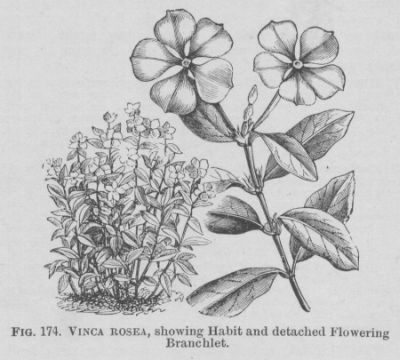
V. rosea (rosy).* Madagascar Periwinkle; Old Maid. fl. almost sessile; corolla tube 1in. long; throat with a hairy ring over the tips of the stamens, and a slighter one at the narrow orifice; lobes white, with a pink eye, sometimes all rose-coloured or white, showy, obovate. March to October. l. long, on short petioles. South Florida, Tropics, 1758. Plant low, erect, puberulent. Greenhouse or stove.(B. M. 248.)