Vitis
(the old Latin name used by Virgil, &c., perhaps from vieo, to bind; in allusion to its clinging character). Vine. Ampelopsis and Cissus are here included by Bentham and Hooker, but for garden purposes these are kept distinct in this work. ORD. Ampelideae. A vast genus (about 230 species) of stove, greenhouse, or hardy, tendrilled, sarmentose, often tall-climbing shrubs, mostly found in tropical and sub-tropical regions, but rare in tropical America. Flowers small, umbellate, cymose, paniculate, racemose or spicate, ebracteate, sometimes polygamous; calyx four or five-toothed or lobed; petals and stamens four or five; peduncles leaf-opposed or very rarely axillary, often near the tips of the branchlets. Berries ovoid or globose, one or two-celled; cells one or two-seeded. Leaves simple or compound, very rarely bipinnate; leaflets entire, serrated or dentate, sometimes pellucid-dotted. The Grape Vine (V.vinifera) has been cultivated since the days of Noah, and is supposed to have been introduced into this country by the Romans. Its principal products are: Wine, vinegar, brandy, raisins, and currants. The hardy species of Vitis are admirably grow up trees, or over strong-growing shrubs; also for trailing over massive rockwork, or along on the ground. They usually grow strong in good, loamy soil, and, consequently, require considerable space. The foliage is very ornamental at all times, particularly when changing colour in autumn. Vines requiring indoor treatment may be planted out, or grown in large pots, and trained to rafters, or a trellis. Propagation is easily effected by cuttings, inserted in pots, and placed in a close propagating-frame. Ripened wood, of the previous year's growth, will, in most, if not all, cases, root in a similar way to the Grape Vine; and, as the plants are gross feeders, they do best in a rich, loamy soil, with some manure intermixed. See also Vine.
V. aestivalis (summer).* American Summer Grape. fl. with a Mignonette-like scent. May and June. fr. black, with a bloom, small, pleasant, ripe in October; fertile panicles long and slender, compound. l. simple, rounded and cordate, often variously lobed, woolly beneath, smoothish when old. h. 20ft North America, 1656. Hardy climber.
V.albo-nitens(shining white). l. oval-oblong, acuminate, cordiform at the base, shining on the upper side and suffused with a brilliant, silvery-white tone of colour. Brazil, 1871. Stove climber. SYN. Cissus albo-nitens.
V.amazonica (Amazon). l. large, oval, acuminate, smooth, glaucous, red beneath, with the veins silvery above; young ones almost linear, their veins very strongly marked. Amazon, 1866. A pretty, stove climber. SYN. Cissus amazonica.
V. antarctica (Antarctic). Kangaroo Vine. fl. tomentose pubescent; cymes dense, broadly corymbose, shorter than the petioles. July. fr. globular. l. simple, petiolate, ovate or oblong, mostly acuminate and slightly cordate, 3in. to 4in. by 1 1/2in. to 2in., entire, sinuate or irregularly toothed, rather firm or almost coriaceous. Australia, 1790. Tall, greenhouse climber. SYN. Cissus antarctica (B.M.2488).
V. Bainesii (Baines'). fl. on glandular pedicels, cymose; peduncles terminal, as long as the stem. July. l. ternate, rather shortly petiolate (the lower ones sometimes simple); leaflets ovate or oblong, unequally serrated, penniveined; stipules twin. Trunk turnip-like, 1 1/2ft. in circumference. h. 4 1/2ft. Western tropical Africa, 1864. A dwarf, glaucous, succulent, stove tree. (B.M.5472.) V. capriolata (tendrilled). fl. on pedicles 1/4in. to 1/3in. long; cymes axillary or terminating in short, lateral branches, pedunculate; peduncles conspicuously bracteate. fr. black, globose, two to four-seeded, the size of a currant. l. five-foliolate; petioles 1 1/2in. to 2 1/2in. long; leaflets 1 1/2in. to 3in. by 1/2in. to 1 1/4in., lanceolate or narrowly ovate or sub-ovate, acute or sub-acuminate, bristly-serrate in the notches. Temperate Himalayas. Hardy, with the protection of a wall, in the South of England.
V. chontalensis (Chontales). fl. scarlet, disposed in compound cymes. December. l. trifoliolate, of a lovely green; lateral leaflets obliquely ovate, acuminate, terminal one elliptic, all toothed. Branchlets angular. Chontales Mountains, Nicaragua, 1869. An elegant, glabrous, stove climber. SYN. Cissus chontalensis.
V. cirrhosa (tendrilled). fl. minute, in dense cymes. l. digitately three to seven-foliolate; leaflets succulent, sub-sessile, obovate, remotely dentate-serrate, quite glabrous in cultivation. Stems long, weak, brittle, fleshy, furnished with long, bifid tendrills. South Africa, 1866. A straggling, glabrescent or pilose, greenhouse shrub.
V. cordifolia (cordate-leaved). Chicken, Frost, or Winter Grape. fl. very sweet-scented. May and June. fr. blue or black, with a bloom, small, very acerb, ripening after frosts; panicles compound, long and loose. l. thin, not shining, cordate, acuminate, sharply and coarsely toothed, obscurely three-lobed, smooth or nearly so, and bright green on both sides. h. 12ft. North America, 1806. Hardy climber. V. riparia (B.M. 2429) is a mere form of this, with broader, cut-lobed leaves.
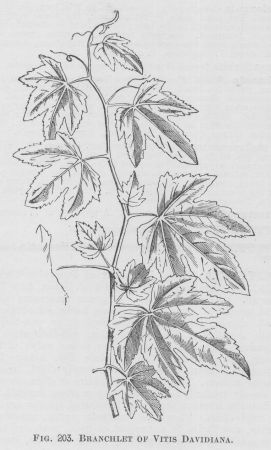
V. Davidiana (David's). fl. small. fr. violet, not edible. l. palmately lobed, the margins of the broad lobes toothed; petioles red, long. China. A vigorous-growing, hardy climber, speedily covering a large surface. SYNS. Cissus Davidiana (R.H.1868, p. 29, f. 2), C. platanifolia, C. rubricaulis.
V. Endresii (Endres'). l. cordate, deep velvety-green, the veins being of a deep purplish-brown. Costa Rica, 1875. A strong growing, stove climber. V. gongylodes (rounded). A synonym of V. pterophora.
V. heterophylla humulifolia (variable-leaved Hop-leaved). Turquoise-berried Vine. fl. minute, sub-umbellate; cymes on slender peduncles, sparingly divided. fr. of a fine, pale, china blue colour, dotted with black, globular. l. on slender, red petioles, three to five-lobed, with a broad sinus at base; lobes acutely serrated, dark green and rugose above, pale beneath, with pubescent veins. Stems 2ft. to 5ft. long. North China and Japan, 1868. Hardy Climber. (B.M.5682.)
V. hypoglauca (glaucous beneath). fl. yellow, minute, but pretty, freely produced in axillary cymes. l. digitately five foliolate, oval or oblong, light green above, beautifully glaucous beneath when young. Tendrils wanting. Australia. Greenhouse or conservatory shrub.
V. japonica (Japanese). fl. green, disposed in panicles. l. compound; leaflets five, petiolate, the four lower ones bijugate, glabrous, roundish-oval, denticulate, the odd or terminal one larger, oval-elliptic, acuminate. Japan, 1875. A half-hardy climber, of vigorous, quick-growing habit. SYN. Cissus japonica. A variety called marmorata, with broad, yellow blotches on the leaves, has sported from this.
V. javalensis (Javali Mine). fl. bright scarlet, in compound cymes. l. much handsomer than those of V. chontalensis, simple, cordate, acuminate, mucronate-toothed, above green and beautifully velvety-pubescent, the midrib and veins purplish, below glabrous and purplish. Chontales Mountains, Nicaragua, 1869. A highly ornamental plant. SYN. Cissus javalensis.
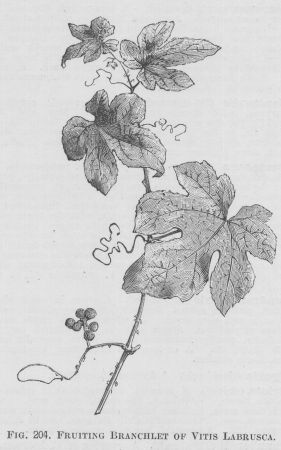
V. Labrusca (classical name).* American Plum Grape; Isabella Grape; Northern Fox Grape. fl. Mignonette-scented. June. fr. dark purple or amber-coloured, large, with a tough, musky pulp, ripe in September or October; fertile panicles compact. l. simple, rounded and cordate, variably lobed, rusty-woolly beneath. Branchlets (and young leaves) very woolly. h. 12ft. North America, 1656. Hardy climber. (R. G. 765, 1.) SYN. V. Thunbergii (R. G. 424). V. lanata (woolly).* fl. green, small, forming a thyrsoid, paniculate cyme. May. fr. purple, four-seeded, round, the size of a large pea. l. cordate-ovate, shortly acuminate, usually 3in. to 6in. by 1 3/4in. to 3in., sometimes larger, usually softly pubescent, but occasionally felted beneath or nearly glabrous. Himalayas, 1824. Hardy. The leaves of this species assume a beautiful scarlet colour in autumn.
V. Lindeni (Linden's). l. bright green, freely mottled with white between the veins. Branches terete, tendrilled. United States of Colombia, 1871. A smooth shrubby, greenhouse climber. SYN. Cissus Lindeni (I. H. ser. iii. 2).
V. macropus (gouty-stemmed). fl. four-parted, disposed in a rather broad corymb. April and May. fr. reddish-violet, the size of a pea. l. (at first plicate and white-tomentose), long-petiolate, the lowest one on the branch tri-, the rest five-foliolate; leaflets ovate-elliptic or obovate, shortly stalked, toothed, cobwebby-pubescent. Trunk forming a large bulb, bi-tribrachiate, covered with smooth, green bark. h. 1ft. to 2 1/2ft. South Benguela, 1864. A dwarf, stove tree, more curious than beautiful. (B. M. 5479.)
V. planicaulis (flat-stemmed). fl. four-parted; cymes subcorymbose, with divaricating branches. May and June. fr. red (?), the size of a cherry. l. on petioles 4in. to 7in. long; leaflets 5in. to 8in. long, on stalks 3/4in. to 1 1/2in. long, oblong-lanceolate, slightly acuminate, obtusely serrated. India, &c. A vast, stove, glabrous climber. (B. M. 5685.) V. pterophora (wing-bearing).* fl., cymes pedunculate, with thick, divaricate branchelets. Autumn. l. long-petiolate, trifoliolate; leaflets ample, sessile, rugose-undulated, trapezoid-or rhomboid-obovate, acuminate, serrated, with impressed, reticulated nerves, the terminal one somewhat three-lobed, the lateral ones oblique or dimidiate-ovate, with the lower margin produced in a lobe; stipules fuscous-purple, ample. Each branch bears at its extremity (after ceasing to grow for the season) an elongated, fleshy tuber, 5in. to 6in. long, which finally drops off, and, on reaching the ground, under favourable circumstances, forms a new plant. Brazil. A unique, tall-climbing, villous, stove plant (B. M. 6803.) SYN. V. gongylodes (G. C. n. s., xix., p. 53).
V. quadrangularis (four-angled). fl. green, in small, shortly-stalked, glabrous cymes. Summer. fr., berry globose, red, the size of a pea, very acrid. l., when present, small, broadly-cordate or reniform. Stems glabrous, four-winged, very thick and fleshy, greatly contracted at the nodes, generally leafless. India, Java, &c. A curious and interesting, quick-growing, warm house climber.
V. riparia (river-bank). A form of V. cordifolia.
V. striata (striped). fl. greenish, inconspicuous, in cymes opposite the leaves. fr. reddish, the size of small peas. l. rather thick, dark green, digitate; leaflets sessile, oblanceolate, serrated, cuneate at base. Stems and tendrils glabrous. South Brazil and Uruguay, 1881. A beautiful, hardy, evergreen climber.
V. Thunbergii (Thunberg's). A synonym of V. Labrusca.
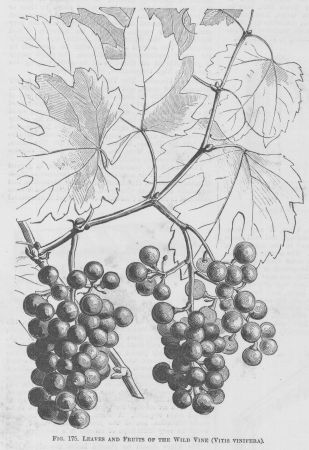
V. vinifera (wine-bearing). Common Grape Vine. fl. in loose or crowded, ovate or cylindrical racemes. June and July. fr. purple varying to white and green, watery or fleshy, sweet musky, or sour. l. lobed, sinuately toothed, naked or downy. South of the Caspian. Hardy climber. (B. M. Pl. 66; S. F. G. 242.) See also Vine.
V. v. amurensis (Amur). l. entire or three to five-lobed; young leaves woolly on both sides. (R. G. 339.)
V. vulpina (Fox Grape). Bullace; Muscadine. fl. densely disposed in small panicles. May. fr. purplish, without bloom, musky, 1/2in. to 3/4in. in diameter, with a thick and tough skin, ripening early in autumn. l. shining on both sides, small, rounded, cordate at base, coarsely broad and blunt-toothed, seldom lobed. Branchlets minutely warty. North America. Hardy climber.