Wigandia
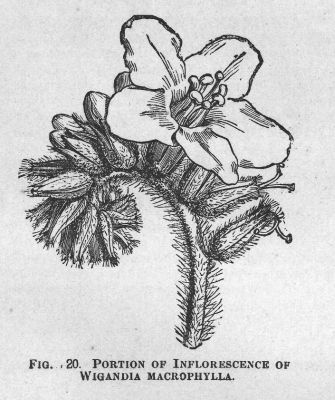
(named in honour of John Wigand, 1523-1587, a Bishop of Pomerania). ORD. Hydrophyllaceae. A small genus (three or four closely-related species) of tall, hispid, stove or greenhouse herbs, broadly dispersed over the mountainous regions of tropical America. Flowers sessile at the sides of scorpioid branches, in terminal, amply dichotomous cymes; calyx segments linear; corolla tube short, broadly campanulate, not scaly, the limb ample, spreading, of five imbricated lobes; stamens five, nearly equally affixed, often exserted; filaments hispid with reflexed pili below the middle. Leaves alternate, ample, wrinkled, generally doubly-toothed. The species are frequently, on account of their fine foliage and bold habit, used for sub-tropical bedding. Seeds should be sown in early spring, in heat; and the seedlings grown on in light, loamy soil, hardened off, and planted out in the open in June. The plants may also be propagated by means of cuttings, inserted in sandy soil, in bottom heat, and carefully shaded until rooted.
W. caracasana (Caraccas). A synonym of W. macrophylla.
W. macrophylla (large-leaved).* fl. lilac; sepals acute, hoary-tomentose, shorter than the corolla; spikes revolute at apex, second, the rachis villous-pubescent. April. l. elliptic-cordate, slightly acute, hairy-tomentose, ferruginous above. h. 10ft. Caraceas, 1836. SYN. W. caracasana (B. M. 4575; B. R. 1966; F. d. S. 755; L. J. F. 132).
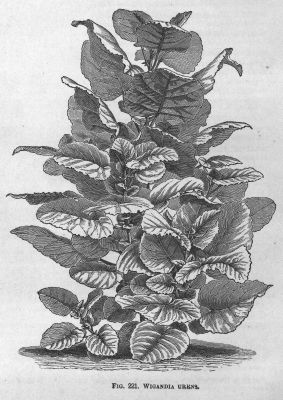
W. urens (stinging). fl. disposed in scorpiold panicles; calyx woolly, with linear, acute sepals; corolla violet-blue, the margins of the lobes somewhat revolute. Autumn. h. 6ft. Mexico (?), 1830. This species differs from W. macrophylla in its looser habit, and in its longer-stalked, more spreading leaves of a deeper ashy-green, shaded with red on the petioles.
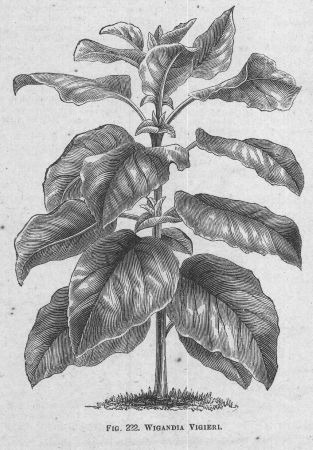
W. Vigieri (Vigier's).* fl., calyx green, exceeding the corolla tube, with five linear, acute sepals; corolla lilac-blue, passing through vinous-red to fawn-colour before fading, rotate-infundibular, woolly outside, glabrous; inflorescence very large, paniculate, divaricate. Autumn. l. alternate, oval-elliptic, cordate at the base, irregularly and sparsely toothed, channelled; petioles 9in. long. h. 6ft. Mexico (?), 1868.