Zinnia
(named in honour of John Godfrey Zinn, 1727-1759, Professor of Botany at Gottingen). Youth and Old Age. SYNS. Crassina, Lejica. ORD. Compositae. A genus embracing about a dozen species of half-hardy, Mexican, annual or perennial herbs or sub-shrubs. Flower-heads variously coloured, heterogamous, radiate, mediocre or large, pedunculate, at the tips or forks of the branches; involucre campanulate or sub-cylindrical, the bracts in three or several series, the outer ones gradually shorter; receptacle conical or at length cylindrical; ray florets ligulate, spreading, in one series; disk florets tubular, shortly five-cleft at apex; achenes narrow, striated, glabrous or ciliated at the angles. Leaves opposite, entire. The best-known species (all annuals) are here described. They flower during the summer months. Z. elegans and Z. multiflora last a long time in beauty. Zinnias succeed best in a rich, deep, loamy soil, and in a sunny situation. Seeds should be sown on a gentle hotbed at the end of March or in April, and the young plants thrive best if pricked off in frames when large enough. They should be transferred to the situations in which they are intended to flower early in or about the middle of June. If sown too early, and allowed to become starved previous to the final planting, they never succeed so well afterwards. From Z. elegans most of the garden varieties have descended; there are numerous single and double forms, all of which are fine, free-flowering subjects when well grown.
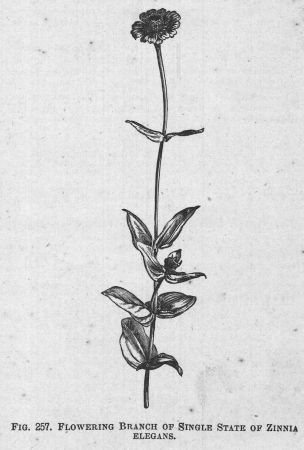
Z. elegans (elegant).* fl.-heads scarlet, crimson, rose-coloured, buff, or white; involucral bracts ovate, obtuse, the upper ones margined with black; pales of the receptacle serrate-crested; peduncles cylindrical, solitary, longer than the leaves. l. sessile, amplexicaul, cordate-ovate. Stem erect, hairy. h. 2ft. 1796. See Fig. 257. The following are varieties: coccinea, upper ray florets of a beautiful scarlet (B. R. 1294; P. M. B. i. 223, under name of Z. violacea coccinea); Darwini, a splendid hybrid; flore-pleno, a fine, double-flowered variety (B. H. 1861, p. 201, and 1862, p. 193); violacea, upper ray florets purplish-violet (A. B. R. 55, under name of Z. violacea; B. M. 527, under name of Z. elegans).
Z. Haageana (Haage's). fl.-heads similar in size to those of Z. elegans; ray florets brilliant golden-yellow or orange. Summer. l. sub-sessile or sessile, and, as well as the stems, hairypubescent. h. 1ft. to 1 1/2ft. Central America (?), 1862. (R. G. 1863, 390.)
Z. hybrida (hybrid). fl.-heads scarlet; involucral scales adpressed; pales entire; peduncles terminal, solitary, short. l. cordate, somewhat lanceolate, sessile, amplexicaul. Stems erect, pubescent. h. 2ft. 1818. Probably a hybrid between Z. elegans and Z. pauciflora. (B. M. 2123.)
Z. multiflora (many-flowered). fl.-heads, involucre campanulate, with adpressed scales; pales obtuse; ray florets scarlet or red; disk yellow; peduncles exceeding the leaves. l. scarcely petiolate, ovate-lanceolate. Stems erect, branched, very slightly hairy. h. 2ft. 1770. Allied to Z. pauciflora. (B. M. 149.)
Z. pauciflora (few-flowered). fl.-heads yellow; involucral scales adpressed; pales entire; ray florets obovate, obtuse or one or two-toothed at apex; terminal peduncles striated, obconical, the lateral ones slenderer. l. sessile, cordate-lanceolate, somewhat amplexicaul. Stem erect, hairy. h. 2ft. 1753.
Z. tenuiflora (slender-flowered). fl.-heads on very long, cylindrical peduncles; involucre oblong, the scales adpressed, scarcely margined; ray florets scarlet, seven to eight lines long, entire or bidentate and revolute at apex. l. very shortly petiolate, cordate-lanceolate. Stems erect, scarcely pubescent. h. 2ft. 1799. (B. M. 555.)
Z. verticillata (whorled). fl.-heads red; involucre campanulate, with adpressed scales; ray florets obovate, emarginate at apex, often in two or three series; peduncles short, obconical. l. oblong-lanceolate, sometimes crowded in irregular whorls, sometimes spirally disposed. Stems erect, sparsely hairy. h. 2ft. 1789. (A. B. R. 189.) "Probably a robust cultivated state of Z. elegans" (Hemsley).