Zizyphus
(Zizouf is the Arabic name of the Lotus). ORD. Rhamneae. A genus comprising about fifty species of stove, greenhouse, or hardy trees or shrubs, often decumbent or sarmentose, and frequently prickly; they inhabit tropical Asia and America, and the temperate regions of both hemispheres. Flowers greenish, small, fascicled or in sessile or pedunculate cymes; calyx with five spreading lobes; petals five, cucullate, deflexed, rarely absent; stamens five. Fruit fleshy or dry, with a woody or bony, one to four-seeded and one to four-celled stone. Leaves sub-bifarious, alternate, usually coriaceous. A selection of the introduced species is here given. The fruits of Z. vulgaris are commonly eaten, both fresh and in a dried state, in the Mediterranean region, and afford the jujubes of the shops. Z. Lotus is supposed to have yielded the seductive, sweet fruits from which the ancient Lotophagi took their name. An excellent dessert fruit is obtained from Z. Jujuba, a species largely cultivated by the Chinese. Z. spina-Christi is supposed by some persons to have furnished the crown of thorns placed on our Saviour's head at His Crucifixion. The stove and greenhouse species thrive in a compost of sand, loam and peat; and ripened cuttings of them root readily in sand, under a glass, those of the stove species requiring heat. The hardy kinds are admirably adapted for planting in shrubberies: they may be propagated by ripened cuttings, inserted in soil, under a glass; or by pieces of the roots.
Z. incurva (incurved). fl. in pedunculate, axillary cymes 3/4in. long. June. fr. 3/8in. long, ellipsoid, two-celled. l. 2 3/4in. long, ovate or ovate-oblong, acute or slightly acuminate, crenateserrated, glabrous. h. 6ft. and upwards. Nepaul, 1823. Hardy, unarmed tree.
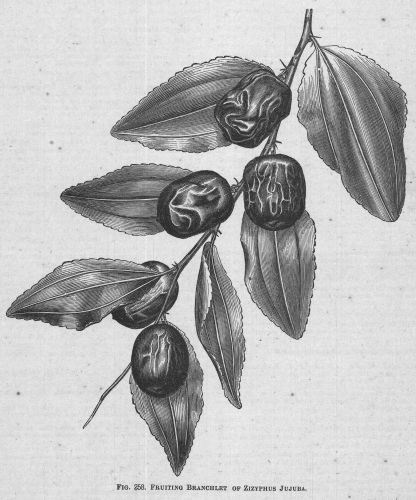
Z. Jujuba (Jujube). Jujube-tree. fl. in cymes 3/4in. long. April. fr. 1/2in. to 3/4in. in diameter, globose, fleshy and mealy. l. 1in. to 2 1/2in. long, elliptic-ovate to sub-orbicular, dark green and glabrous above, densely woolly-tomentose beneath. Young branches and flowers densely fuscous-tomentose. h. 30ft. to 50ft. North Africa, India, Australia, 1759. Greenhouse tree, usually armed. See Fig. 258. (B. F. F. 17; B. F. S. cxlix.; J. B. i. 140.) Z. Lotus. African or Jujube Lotus. fr. yellow, roundish-ovate, small, farinaceous. l. ovate-oblong, obsoletely crenated, and, as well as the branchlets, glabrous. Prickles twin, one recurved, the other straight, longer than the petioles. h. 2ft. to 4f. South Europe, North Africa, 1731. Half-hardy shrub.
Z. mucronata (mucronate-leaved). fl., cymes axillary, about as long as the petioles. June. fr. red, scarcely the size of a cherry. l. petiolate, ovate or cordate-ovate, obtusely acuminate, mucronulate, 1 1/2in. to 2in. long, crenate-serrated, sometimes hairy on the nerves beneath. Branches greyish, flexuous, prickly. h. 25ft. South Africa, 1810. Greenhouse tree.
Z. Paliurus (Paliurus). A synonym of Paliurus aculeatus.
Z. spina-Christi. Christ's-Thorn. fl. on villous-tomentose, corymbose peduncles. August. fr. ovate-globose. l. ovate. obtuse, toothed, glabrous or pubescent beneath. Branchlets white; prickles twin, spreading, one straight, the other slightly incurved. h. 6ft. West Asia, North Africa, Egypt. Hardy shrub.
Z. vulgaris (common). fl. few, fascicled in the axils of the leaves. August. fr. red or black, succulent, 1/2in. in diameter. l. 3/4in. to 2 1/2in. long, sub-obliquely ovate, obtuse or sub-acute, crenate-serrated, glabrous. Prickles usually twin. h 6ft. and upwards. South Europe, &c., 1640. Hardy shrub or small tree. (S. F. G. 241.)