Zygopetalum
(from zygos, a yoke, and petalon, a petal; in the original species the sepals and petals adhere by their bases). Including Bollea, Galeottia, Huntleya, Kefersteinia, Pescatorea, Promenoea, and Warscewizella. ORD. Orchideae. A genus comprising about fifty species of very handsome, stove or greenhouse, epiphytal Orchids, inhabiting the warmer parts of America. Flowers large and showy; sepals and petals sub-equal, free or very shortly connected at base; lip affixed to the foot of the column, slightly incumbent, forming a short chin, the lateral lobes spreading or erect, clothing the column, the middle one flat and spreading; lip bearing a transverse crest, which, from being ribbed or plaited, has the appearance of a ruff or frill; column incurved, semi-terete, wingless or shortly two-winged at apex, produced in a short foot at base; pollen masses four; floriferous scapes leafless, many-sheathed, one-flowered or terminated by a loose raceme; bracts small or rather broad. Leaves distichous, membranous or rather rigid, slightly plaited or with elevated veins. Stem leafy, short, at length thickening into a pseudo-bulb. The flowers are generally produced during winter-a circumstance which greatly enhances the value of Zygopetalums as decorative objects. The robust species, such as Z. Mackayi, may be grown along with Cattleya Mossiae. They should be potted in rough peat and sphagnum, and watered freely when making their growth. During winter, they require only sufficient moisture to keep them from shrivelling. The Pescatorea section are much more difficult to manage. The large-leaved kinds may be grown in pans or baskets, using a mixture of peat-fibre, sphagnum, and lumps of charcoal. Some growers place these kinds on flat, dish-like saucers, with several large holes in the bottom, and simply place nodules of peat and charcoal about the roots as they multiply. Others fasten them on to large blocks of birch, placing the plants on the bark side of the block. The small, delicate kinds, such as Z. gramineum, thrive best in teak baskets. All the species like plenty of moisture when in full growth, and none should ever be allowed to get quite dry.
Z. africanum (African). A synonym of Odontoglossum bictonense.
Z. aromaticum (aromatic). fl. solitary, strongly perfumed, 3in. to 4in. across; sepals and petals white, lanceolate, acute; lip azure-blue, darkening to purple at the base, obreniform, many-lobuled, slightly crisped; disk smooth; a many-furrowed callus at the contracted base; scape erect. l. cuneate-oblong, acute. Chiriqui. Stove. (G. C. 1868, p. 75; R. X. O. i. 73.) SYNS. Huntleya aromatica, Warscewiczella aromatica.
Z. Backhousianum (Backhouse's). fl., sepals and petals creamy-white, tipped with bright purplish-violet; lip deeply three-lobed, creamy-white, having a deep yellow callus of nineteen ribs, with brownish lines to the keels, the anterior portion yellowish, with small, purplish warts. Summer. Ecuador, 1877. Allied to Z. Klabochorum. Stove. SYN. Pescatorea Backhousiana.
Z. Beaumontii (Beaumont's). fl. 2in. across; sepals and petals light green, longitudinally striped with pale olive-brown; lip white, dotted and streaked with pale lilac-purple, trifid, the side lobes toothed, incurved, bearing on the disk between them about seven long, parallel, acute crests; scapes erect, one or two-flowered. l. plicate, cuneate-oblong, light green. Pseudo-bulbs pyriform, tetragonal. Brazil, 1850. Stove. SYNS. Batemannia Beaumontii (R.X.O. iii. 215), Galeottia Beaumontii.
Z. bellum (pretty). fl. more than 3in. across; sepals and petals light violet, banded near the tip with dark purplish-violet; lip whitish-yellow, somewhat hooded, with a large callus of twenty-one ribs, the keels of which are purplish on their back line, the tip of the lip blotched with purplish-violet; column purplish, with a yellowish-white, triangular space at base, purplish-spotted. Spring. New Grenada, 1878. Intermediate. SYN. Pescatorea bella.
Z. brachypetalum (short-petaled).* fl., sepals and petals brown, marbled with green, short, stiff, convex, oblong, obtuse; lip white, veined with deep bluish-violet, transverse, roundish, emarginate, the crest or frill closely striped with blue; scape tall, many-flowered. l. lanceolate-ensiform, shorter than the scape. Brazil. Intermediate. (J. H. S. iv. [Proc.], p. 11.)
Z. Burkei (Burke's). fl. curiously marked, four or five on a radical scape; sepals and petals green, with thick bands of brown, which here and there break up into spots; lip white, with a ruff of about thirteen crimson plaits or folds. l. twin, elongated-lanceolate, acuminate. Pseudo-bulbs clustered, narrow-oblong, furrowed, about 2in. long. Guiana, 1883. Intermediate. (W.O.A. iii. 142.)
Z. candidum (white).* fl. 2 1/2in. across; sepals white, lanceolate, acute; petals white, broader, reflexed; lip rosy-purple in the centre, with a broad, bluish margin, quadrate-hastate; disk bearing a large, obtriangular, ivory-white callus, with a retuse, five-toothed apex, and marked with five bluish-purple bars. l. few, oblong-ligulate, forming a loose, distichous tuft. h. 8in. to 9in. Bahia. Stove. SYNS. Huntleya candida, Warrea candida (F. d. S. vii., p. 123; L. & P. F. G. i., p. 32), Warscewiczella candida.
Z. cerinum (waxy). fl. about 3in. across; sepals and petals pale waxy straw-colour, fleshy, concave, the lateral ones rather darker; lip yellow-clawed, convex, retuse, with a thick, semicircular ruff of numerous truncate plaits, within which is sometimes a band of deep purple, surrounding the base of the short, clavate, hoodless column; peduncles axillary, one-flowered, much shorter than the leaves. l. tufted, cuneate-oblong, acuminate, 1ft. long. Chiriqui, 1851. Intermediate. (F. d. S. 1815; R. G. 838.) SYNS. Huntleya cerina (B. M. 5598; L. & P. F. G. iii., p. 62), Pescatorea cerina (F. M. ser. ii. 93; R. X. O. i. 65). Z. citrinum (citron-coloured).* fl. of a deep rich yellow, with a dark crimson blotch at the base of the lip, which is obovate in the front, with two oblong, obtuse, erect basal lobes spotted with crimson; scapes deflexed, 2in. to 3in. long, one-flowered. Late summer. l. oblong-ligulate, pale green. Pseudo-bulbs clustered. small, ovate, tetragonal, two-leaved. Brazil, 1838. Intermediate. SYN. Maxillaria citrina, Promenaea citrina (W. O. A. i. 7).
Z. Clayi (Clay's).* fl. freely produced; sepals and petals deep purplish-brown, margined, banded, and sometimes blotched, with green; lip deep violet-purple, with darker purple lines, paler at the edges, 1 1/2in. wide, the ruff whitish, with bluish-violet plaits; scapes radical. 1876. A beautiful hybrid between Z. crinitum and Z. maxillare. Intermediate. (F. M. n. s. 267; W. O. A. 50.)
Z. cochleare (spoon-like). fl. white, about 1in. long; sepals and petals ovate, pointed; lip blue-variegated, somewhat quadrate-cordate, emarginate at the broadly rounded summit, crested at the base by a broadly reniform, longitudinally many, plaited callus; peduncles 3in. long, one-flowered. l. oblong, acute, tapering at the base, 6in. to 10in. long. West Indies. Stove. (B. M. 3585; B. R. 1857.)
Z. coeleste (sky-blue).* fl. 3in. to 4in. across; sepals and the shorter petals light blue at base, deeper mauve in the middle, the marginal tips white; lip deep violet in front, the prominent basal callus yellowish-white; column deep purple-blue, yellow at base; scapes 1 1/4ft. high. June and July. l. close-set, cuneate-oblong. Columbia, 1878. Closely allied to Z. Lalindei. Greenhouse. SYN. Bollea coelestis (B. H. 1879, 9; B. M. 6458; R. G. 1075). Z. crinitum (hairy).* fl. large, beautifully variegated; sepals and petals green, barred with brown, oblong-lanceolate; lip white or cream-coloured, streaked with coloured, densely hairy veins, broad-obovate, emarginate; callus yellow, small, incurved; spikes sometimes two from a pseudo-bulb. l. lorate-lanceolate, plicate, shorter than the scapes. Pseudo-bulbs ovate. Brazil, 1829. Greenhouse. (L. B. C. 1687.) SYNS. Z. Mackayi crinitum (B. M. 3402), Z. stenochilum (L. B. C. 1923). "The best variety is that called coeruleum, which has the veins of a deep, bright blue. There is another form with the veins pink" (B. S. Williams).
Z. Dayanum (Day's).* fl. similar in shape to those of Z. cerinum; sepals and petals milky-white, the former tipped with green, oblong-obovate, the latter roundish-rhomboidal; lip white, clawed, emarginate, with a purplish-violet ruff, the base, as well as the rays in front of the callus, purplish-violet; column yellow, with a broad, reddish band at base. New Grenada, 1873. Stove. SYN. Pescatorea Dayana. The following varieties are described by B. S. Williams, in the "Orchid Grower's Manual":
Z. D. candidulum (whitish). fl., sepals and petals pure white, lip tinted with purplish-crimson. (G. C. n. s., iii., p. 343, under name of Pescatorea Dayana candidula.)
Z. D. rhodacrum (red-tipped). fl., sepals and petals tipped with purplish-rose. (B. M. 6214, under name of Pescatorea Dayana rhodacra.)
Z. D. splendens (splendid). fl., sepals and petals blotched at the tips with dark violet; lip deep violet, which colour extends to the base of the column. Z. discolor (discoloured). fl., sepals and petals straw-coloured, tinged with purple, 1 1/4in. to 1 1/2in. long, the lower sepals straight, deflexed, the upper erect, forming with the petals an arch over the column and lip; lip deep velvety-purple, white at base, concave, slightly trilobed, with a yellow, roundish-oblong appendage divided at the edge into strong, diverging teeth, five of which terminate so many distinct ribs. Central America. SYNS. Warrea discolor (B. M. 4830; L. & P. F. G. i., p. 73), Warscewiczella discolor (R. X. O. 93).
Z. Dormanianum (Dorman's). fl. white, with some light sulphur on the crest, narrower than in Z. Klabochorum and Z. Lehmanni (which this plant resembles); lip with a continuous row of angles on the hind margin of the side lobes, and three prolonged, connate, median keels; column sagittate at base. Columbia (?), 1881. Intermediate. SYN. Pescatorea Dormaniana.
Z. euglossa (beautiful-lipped). fl. of a beautiful lilac colour, similar to those of Z. Roezlii, but with a shorter lip and a broader callus, the tip of the lip bent underneath, ending in two diverging lobes. Ecuador, 1877. SYN. Pescatorea euglossa.
Z. expansum (expanded). fl. sepals green, acute; petals brown in the upper part, blotched with brown in the lower, broader than the sepals; lip green, with five interrupted, brown stripes on the basal half, and similar-coloured blotches at the base of the front part, which is fringed. l. Grass-like, cuneate-oblong-ligulate, acute. Ecuador (?), 1878.
Z. fimbriatum (fringed). fl. about 2in. across; sepals and petals white in the lower and purple in the apical half, elliptic-oblong, acute; lip yellowish-white, with rosy dots, revolute and irregularly fringed on the margins; crest semicircular, composed of seventeen to nineteen dark purple ridges; peduncles short, one-flowered. Columbia, 1880. Intermediate. SYN. Pescatorea fimbriata (R. G. 1008).
Z. Gairianum (Gair's).* fl. large; sepals and petals deep violet, oblong-ligulate, the anterior part deep black-purple within; lip purplish-rose or light purple-mauve, the front part reflexed on the limb, so as to be nearly hood-shaped, marked by obscure, longitudinal keels, with numerous warts between; ruff of fifteen to seventeen radiating keels, in some forms orange with purple ridges; column dark violet above, whitish-yellow with some purple spots at the base. Ecuador, 1879. Stove. SYN. Pescatorea Gairiana.
Z. Gautieri (Gautier's).* fl. large; sepals and petals green, blotched and barred with brown, oblong, acute; lip deep purplish-blue, lighter at the edge, the ruff around the column large, and of a deep velvety-purple; racemes drooping, on scapes springing up in the midst of the young leaf-tufts. l. elongated-oblong, dark green, plaited. Pseudo-bulbs oblong, deeply furrowed. Brazil, 1868. Greenhouse (W. O. A. i. 28) The colour of the lip varies in several varieties from pale mauve (I. H. 1867, 535) to deep bluish-purple.
Z. gemma (gem). fl. of a very pale colour, not much exceeding in size those of Z. sanguinolentum; lip marked with numerous dark blotches, denticulate and crisped. New Grenada, 1874. A small species. Intermediate. SYN. Kefersteinia gemma.
Z. gramineum (grass-like). fl. dirty yellow, copiously brown-spotted; petals rather narrower than the sepals; lip broadly oval, gibbous at base beneath, concave in the centre above, the upper half suddenly bending downwards and emarginate at apex, the edge minutely denticulate; scapes three to five, clustered. l. about 9in. long, erect or spreading, lanceolate. Pseudo-bulbs none. Popayan, 1857. Intermediate. SYN. Kefersteinia graminea (B. M. 5046; R. X. O. 25, ii.)
Z. intermedium (intermediate), of Loddiges. fl., sepals and petals green, tinged with brown, oblong, acute; lip blue, streaked with deep purple, downy-pubescent, large, flat, roundish, bilobed, undulated. Autumn. l. ensiform, shorter than the raceme. Brazil, 1844. Reichenbach regards this as a variety of Z. Mackayi. Greenhouse. SYN. Z. velutinum. Z. Klabochorum (Klaboch's).* fl. 3in. to 3 1/2in. across; sepals oblong, obtuse; petals shorter, cuneate; both white, deeply tipped with chocolate-purple; lip ochre or white, covered with lines of purple-tipped papillae, trowel-shaped, three-lobed; ruff of nineteen lamellae, sulphur-coloured, with brown keels; column yellowish, washed with brown and purple. Ecuador, 1879. Intermediate. SYN. Pescatorea Klabochorum (I. H. ser. iii. 431; L. & P. F. G., re-issue, 21; W. O. A. i. 17). Of this free-flowering species several varieties have been observed.
Z. K. burfordiensis (Burford).* fl. with broader and darker lamellae on the callus, the broad, middle line of the front part of the lip dark reddish-violet, the whole surface covered with styliform processes. 1879.
Z. K. ornatissimum (very ornamental). A fine variety, with very dark mauve-purple tips, and numerous similar spots at the base, of the petals, and a single spot at the base of the odd sepal. 1884.
Z. lacteum (milk-white). fl. white, with a few brownish dots and streaks at the base, small; sepals and petals oblong, acute; lip very broad, cuneate-oblong, retuse; callus depressed, bifid at apex; column dilated in the middle, sometimes angled; peduncles one-flowered. l. exceedingly stout, cuneate-oblong, acute. Chiriqui, 1872. Intermediate. SYN. Kefersteinia lactea.
Z. Lalindei (Lalind's). fl. about 3in. across; sepals and petals lilac at base, pale rose above, or the flowers sometimes bright violet, the upper sepal tipped with green, and the lower part of the lateral ones brownish-purple; lip golden or orange-yellow, with about thirteen close-set lamellae; column rose-coloured, arched, broader than the lamellate disk; scapes solitary. l. elliptic-lanceolate, narrowing to the base, 1ft. long, distichous, five-nerved. New Grenada, 1874. Intermediate. SYN. Bollea Lalindei (B. M. 6331).
Z. lamellosum (lamellate). fl. 2 1/2in. across, on stout, solitary peduncles 3in. long; sepals and petals yellowish-green, the dorsal sepal elliptic, acute, the lateral one larger, oblong, the petals spathulate; lip yellowish-white, nearly orbicular, cordate at base, the crest orange and brown, much raised, formed of close-set, concentric plates. August. l. 1ft. long, narrow-lanceolate, acuminate, narrowed to the base, five-ribbed. Pseudo-bulbs none. Columbia, 1875. Plant densely tufted. Stove. SYN. Pescatorea lamellosa (B. M. 6240).
Z. Lawrenceanum (Lawrence's). fl. white, solitary, on axillary scapes, 3 1/2in. to 4in. across; sepals and petals blotched with violet or mauve at the tips; lip much shorter than the other parts, nearly square, the sides revolute, the apex of an intense, rich, velvety purple, the basal callus bright yellow, white on each side, large; column white, conspicuous, hooded. l. distichous, broadly ligulate, acuminate, keeled. Columbia, 1878. Intermediate. (R. X. O. iii. 221.) SYN. Bollea Lawrenceana.
Z. Lehmanni (Lehmann's). fl. solitary, axillary, 3in. to 3 1/2in. across, very showy; sepals and petals white, closely lined with reddish-purple, broadly cuneate-oblong; lip deep mauve-purple, the anterior part oblong, revolute, retuse, covered with long, bristle-like, purplish papillae, the callus of about eleven chestnut-brown ridges. l. linear-lorate, acute, 1ft. to 1 1/2ft. high, about 1in. across. Ecuador. Stove. SYN. Pescatorea Lehmanni (G. C. n. s., xvii., p. 45; I. H. ser. iii. 471; W. O. A. ii. 57.)
Z. leopardinum (leopard-spotted). fl., sepals and petals light greenish-yellow, spotted with brown; lip with a transverse, obtuse-angled, cordate blade of a beautiful mauve-purple, and an ochreous callus with thirteen teeth. 1886. Garden hybrid. Intermediate.
Z. Mackayi (Mackay's).* fl. large, five or six in a raceme; sepals and petals yellowish-green, blotched with brownish-purple, lanceolate; lip white, lined and spotted with purplish-blue, large, roundish, undulated, emarginate, horizontally spreading, the ruff white, striped with blue, large and convex; scape radical, 1 1/2ft. long. l. distichous, linear-lanceolate. Pseudo-bulbs large, ovate, scarred, bearing numerous leaves. Brazil, 1825. Greenhouse. (B. M. 2748; l. B. C. 1664; P. M. B. iii. 97.) SYN. Eulophia Mackaiana (B. R. 1433). Of this species there are several varieties.
Z. M. crinitum (hairy). A synonym of Z. crinitum.
Z. M. intermedium (intermediate), of gardens. fl. of a paler colour than in the type, with a fine, large, expanded lip. l. longer. A very distinct plant.
Z. marginatum (margined). fl. clear straw-colour, with some purple markings on the nearly square appendix to the lip; lateral sepals abruptly bent back, the upper one erect, all tipped with green; petals rolled back above the middle; lip circular, retuse, the edges bent downwards, the claw yellow, with a slight tubercle; column pure white. l. pale green, oblong, acute, flat, 6in. long. Columbia. Allied to Z. discolor. Intermediate. SYNS. Warrea quadrata (B. M. 4766), Warscewiczella marginata (R. X. O. 23, f. 2).
Z. maxillare (jaw-shaped).* fl. large and showy; sepals and petals green, transversely blotched and barred with chocolate-brown, ovate-oblong, acute; lip rich bluish-purple, with a large, roundish front lobe and a blunt spur; ruff large, deeper purple, shaped like a horse's hoof, and united to the small, erect lateral lobes of the lip; spikes drooping, on radical scapes. l. lanceolate, attenuated at base, nerved. Pseudo-bulbs oblong, furrowed. As many as seventy flowers have been produced by one plant. Greenhouse. (B. iii.; B. M. 3686; L. B. C. 1776; P. M. B. iv. 271; R. G. 1879, 345.) Z. Meleagris (Meleagris). fl. 3in. to 4in. across; sepals and petals tessellated, pale yellow on the basal half and purplish-brown upwards, broad at base, the two lateral sepals folded inwards on the inner margin at base; lip about half as large as the petals, similar but clawed, white, tipped with purplish-brown, and having at the base of the claw a crescent-shaped plate, fringed with long, yellowish hairs; peduncles axillary, one-flowered. June and July. l. broadly lanceolate, 1ft. long, distichous. Stem short, erect. Brazil. Stove. SYNS. Batemannia Meleagris (R. X. O. 66, figs. i., ii.), Huntleya Meleagris (B. iii. 146; B. R. 1839, 14).
Z. M. albido-fulvum (whitish-fulvous). fl., upper half of the sepals and petals fulvous, the lower part white; lip and column white, the former tipped with rosy-carmine, the latter with yellowish-green. l. light shining green. Stem none. Roots numerous. Brazil, 1868. Intermediate. SYN. Huntleya albidofulva (I. H. 1868, 556).
Z. micropterum (small-winged). fl., sepals and petals creamy-white or ochre; lip white, with three transverse bars of dull crimson on the disk, and small, purple spots at the base, the front lobes elongated, lanceolate, the two lateral ones minute. Summer. Related to Z. xanthinum. Intermediate. SYN. Promenaea microptera.
Z. Murrayanum (Murray's). fl. many in a raceme; sepals and petals greenish, ovate-lanceolate, acute; lip white, the lateral lobes erect, the middle one reflexed, four times as large, purple-spotted at base, the prominent callus yellow, with five straight, violet-brown lines. l. lanceolate, striated. Pseudo bulbs ovate, deeply furrowed. Organ Mountains, 1837. (B. M. 3674.)
Z. mystacinum (moustached). fl., sepals, petals, and blade of the lip yellowish-green; callus and stalk of the lip, and column, white, with purple dots, the blade of the lip broken up into numerous fringes. Otherwise closely resembling Z. gramineum. Columbia, 1881. SYN. Kefersteinia mystacina. Z. obtusatum (obtuse). fl. disposed in a long raceme; sepals and petals green, with narrow, transverse brown bars, narrow, long, obtuse; lip of a very light violet, with a more purplish, retuse lower callus; bracts obtuse. 1878. This plant is very near Z. maxillare.
Z. pallens (pale). fl., sepals and petals light mauve, with greenish-yellow tips, the basal inner borders of the lateral sepals cinnamon-coloured, their lower halves being light yellow; lip light ochre, the orange-coloured callus painted with brownish-purple. 1881. Intermediate. SYN. Bollea pallens.
Z. Patinii (Patin's). fl. solitary, upwards of 3in. across; dorsal sepal and the oblong, undulated petals rosy-pink, the two lower sepals pink along the upper half, and deep rose along the lower side; lip yellow, short, the disk with a frill of about thirteen lamellae; column pink, large, convex, arching over the lip; scapes axillary, decurved. l. distichous, broadly oblong-ligulate, narrow at base, acute at apex, nerved. New Grenada, 1874. Stove. SYN. Bollea Patinii (F. M. ser. ii. 147; G. C. n. s., iii., p. 9).
Z. pentachromum (five-coloured). fl., sepals and petals green, marbled with dark brown; lip white, blotched and lined with mauve, cuneate-obovate; callus or ruff like that of Z. mackayi, with adhering, acute, falcate side lobes. 1885. A hybrid between Z. mackayi and Z. maxillare. Greenhouse.
Z. pictum (painted). Much like Z. discolor, differing chiefly in the lip, which is rhomboid and crisped, yellowish-white, with numerous, broad, marginal, dark purple lines, brownish basal borders, and a greenish, tablet-like, basal callus, with two teeth in front, and a few parallel ones on the sides; sepals pale greenish or yellowish-white. 1883. SYN. Warscewiczella picta.
Z. Rivieri (Riviere's). fl. very large, disposed in racemes; sepals and petals green, blotched with light brown; lip white, flabel lately veined with lilac-rose, and exhaling a perfume similar to that of the Hyacinth. l. ensiform, above 1 1/2ft. long. Brazil, 1873. Possibly this may be a large-flowered form of Z. mackayi. (R. H. 1873, 191.) Z. Roezlii (Roezl's). fl. variable; sepals and petals usually white, beautifully tipped with violet-lilac or purplish-rose, the former oblong, the latter cuneate-obovate; blade of the lip, excepting the callus, of the same showy colours. Ecuador, 1874. Allied to Z. Dayanum. Stove. SYN. Pescatorea Roezlii.
Z. Rollissoni (Rollisson's). fl., sepals and petals pale yellow; lip whitish, spotted with crimson, the middle lobe oblong, apiculate,the lateral ones narrow-ovate, acute, resembling two erect bars standing up from the base; scapes deflexed, from the lower axils. Autumn. l. oblong-lanceolate, venose. Pseudo-bulbs roundish, compressed, bearing about two leaves at the top and other accessory ones from the base. Brazil, 1843. Intermediate. SYNS. Maxillaria Rollissoni (B. R. 1838, 40), Promenaea Rollissoni.
Z. rostratum (beaked).* fl. 6in. deep; dorsal sepals and two petals whitish at base, then green, marked in the centre with dull brownish-purple, linear-lanceolate, 3in. long; lip nearly 3in. long, ovate, recurved, white, yellowish behind the disk, which bears a small, pale lilac-purple frill or ruff, about ten lines of the same colour radiating from it towards the front; scapes radical, one or two-flowered. l. lanceolate, acute, plaited. Rhizome creeping, forming compressed pseudo-bulbs at intervals. This species requires more heat and moisture than any other. Stove. (B. M. 2819; W. O. A. ii. 78.) SYN. Zygosepalum rostratum (Ref. B. 106).
Z. Russelianum (Russel's). fl. large, freely produced; sepals and petals cream-coloured, tipped with reddish-purple; lip of the same reddish-purple tint, the yellow ruff or callus having fifteen lamellae with deep crimson-purple angles; column yellowish in front, with a lemon-yellow area at base. Ecuador, 1878. Allied to Z. Dayanum. Stove. SYN. Pescatorea Russeliana. Z. sanguinolentum (dark bloody). fl. pale straw-coloured or greenish, with dark bloody spots; sepals broadly lanceolate, petals oblong-ovate, both acute; lip cuneate-flabellate, lobulate at apex, undulated, denticulated, the basilar callus dark purple at base, bidentate at apex. l. distichous, cuneate-lanceolate, acute, glaucous. Roots adventitious, cylindrical. Caraccas. Intermediate. SYN. Kefersteinia sanguinolenta (R. X. O. i. 25, i.).
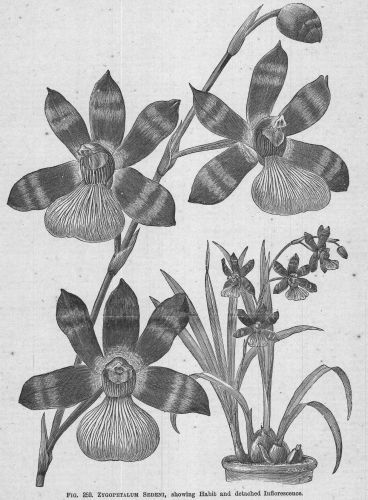
Z.Sedeni (Seden's).* fl. large, in bold racemes; sepals and petals deep purplish brown, evenly bordered with pale green; lip rich bluish-purple, deeper coloured towards the base, and breaking out into forked veins near the margin, broad, emarginate, the ruff bluish-purple, bold. l. narrow-lanceolate, plaited. 1874. A hybrid between Z. Mackayi and Z. maxillare, and much resembling the latter. See Fig. 259, for which we are indebted to Mr. Wm. Bull. (F. M. ser. ii. 417; R. G. 1883, 280.)
Z. stapelioides (Stapelia-like). fl., sepals and petals greenish yellow, transversely barred and spotted with dark purple, roundish-ovate, acute; lip deep purple, oblong, three-lobed, the lateral lobes linear, erect, the terminal one ovate-oblong, hooded at base, the margins paler and cross-barred; peduncles deflexed, two-flowered. July to September. l. thin, lanceolate, light green. Pseudo-bulbs small, ovate, tetragonal, one or two-leaved. Brazil, 1843. Intermediate. SYNS. Maxillaria stapelioides (B. M. 3877; B. R. 1839, 17), Promenaea stapelioides.
Z. stenochilum (narrow-lipped). A synonym of Z. crinitum.
Z. triumphans (triumphant).* fl. fleshy; sepals and petals snowy-white, blue at apex, the former elliptic, apiculate, the latter narrower, cuneate at base; lip blue-black, with a ligulate claw, oblong-rhomboid, emarginate, minutely papillose in the anterior portion; peduncles thick, terete, 4in. to 6in. long. l. few, distichous, Grass-like, lanceolate, acute. New Grenada. Stove. SYN. Pescatorea triumphans (R. X. O. i. 11).
Z. velatum (veiled). fl. yellowish-white, solitary, fragrant; dorsal sepal and petals broadly ovate, acute, the lateral sepals narrow, all spreading upwards; lip margined with crimson, broad, flat, five-lobed, the disk radiately striated with numerous purple-crimson bars; at the base is a stout callus resembling a semicircular row of five to seven teeth; scape rather stout, shorter than the leaves. l. few, oblong-ligulate, acute, 9in. long. New Grenada, 1866. Intermediate. SYN. Warscewiczella velata (B. H. 1878, 10, f. 4; B. M. 5582; R. X. O. i. 23, f. 1).
Z. velutinum (velvety). A synonym of Z. intermedium.
Z. violaceum (violet). fl. of a deep rich violet, tipped with greenish-yellow, melting downwards into white, 2in. to 3in. across; sepals and petals curved in at the points, crisped; lip united to the pouch of the lateral sepals by a short, narrow foot; column large, fleshy, curved at apex. l. 8in. to 9in. long, erect, acute, tufted. British Guiana, 1835. Stove. SYNS. Bollea violacea (R. X. O. 66, iii), Huntleya sessiliflora, H. violacea.
Z. Wailesianum (Wailes'). fl. of moderate size, scented like Sweet Peas; sepals and petals white or cream-coloured; lip white, stained along the centre with violet, having at the base a crest of five radiating, violet, finger-like bars, which are free except at their origin. Autumn. l. dark, evergreen. Brazil. Stove. (B. H. 1878, 10, f. 1; L. & P. F. G. i., p. 73.) SYNS. Warrea Wailesiana, Warscewiczella Wailesiana.
Z. Wallisii (Wallis').* fl. 3in. across; sepals and petals creamy-white, tipped with bluish-violet, the former oblong, apiculate, the latter rhomboid; lip deeper violet, margined with white, oblong, retuse, furrowed, the ruff of seventeen keels white, tinted in front with purple; column white, banded with dark violet at base; scapes short, axillary, one-flowered. l. lorate, acuminate. Ecuador, 1869. Greenhouse. SYN. Pescatorea Wallisii (F. d. S. 1828).
Z. Wendlandii (Wendland's). fl. 4in. to 5in. across; sepals and petals white, lanceolate, somewhat twisted; lip white, blotched and lined with violet-purple, ovate-cordate, many-lobuled, much undulated at the margins, the ruff of seven to nine violet-purple ribs; peduncles stout, axillary. August and September. l. tufted, distichous, oblong-ligulate. Costa Rica. A handsome, bulbless species. Stove. SYN. Warscewiczella Wendlandii.
Z. W. discolor (discoloured). fl. solitary, deliciously scented; sepals and petals yellowish-green; lip white, with a large, bright violet blotch in the centre, much crisped and minutely lobed at the margin, 1 1/2in. broad; peduncles axillary. l. light green. Costa Rica. SYN. Warscewiczella Wendlandii discolor (W. O. A. iii. 126).
Z. xanthinum (yellow). fl. yellow, deeper-coloured towards the centre; sepals and petals oblong, acute, spreading; lip oblong, three-lobed, the lateral lobes profusely spotted, erect, linear, entire, the middle one bilabiate with the upper lip fleshy and five-toothed; bracts cucullate; scapes ascending, one-flowered. l. narrow-lanceolate. Pseudo-bulbs oval, tetragonal. Brazil, 1843. Intermediate. SYNS. Maxillaria xanthina, Promenaea xanthina.