Important: Safety Warning
This page states that certain wild plants are safe to eat. Its identifications and edibility claims are more than a century old and in some cases simply wrong, and deadly look-alikes exist for many edible species. Never eat a wild plant on the strength of this text.
This information has been left in for historical purposes but should not be acted upon.
Home › B › Bot (Mag History Use Propagation) (VII)
Bot (Mag History Use Propagation) (VII)
mag. 1457 6804 6800 6805 6808 6803 History, Use, Propagation, Culture, 6809 Many of the stove species of this genus are succulents, and will thrive the better if a little lime rubbish be added to their sandy loam. They are somewhat difficult to strike. Sweet says, "The way I have succeeded best, is to stick them in the tan amongst the pots in a good heat, and not cover them with any glass." (Bot.. Cult. 55.) The inflorescence of this genus is not now considered to consist of twelve stamens surrounding an ovary; but almost as in Reseda, of a number of monandrous naked male florets surrounding a naked female floret. This manner of understanding Euphorbia was first indicated by Jussieu, and afterwards correctly explained by Mr. Brown. 1104. Pedilanthus. From πεδiλov, a slipper, and avθoς, a flower, in allusion to the form of the involucre. A genus resembling Euphorbia in properties and appearance. 1105. Visnea. This seems to be a blunder of the younger Linnæus for Vismea, which now is the name of a distinct genus, which see. Ripened cuttings root freely in sand. ORDER III.
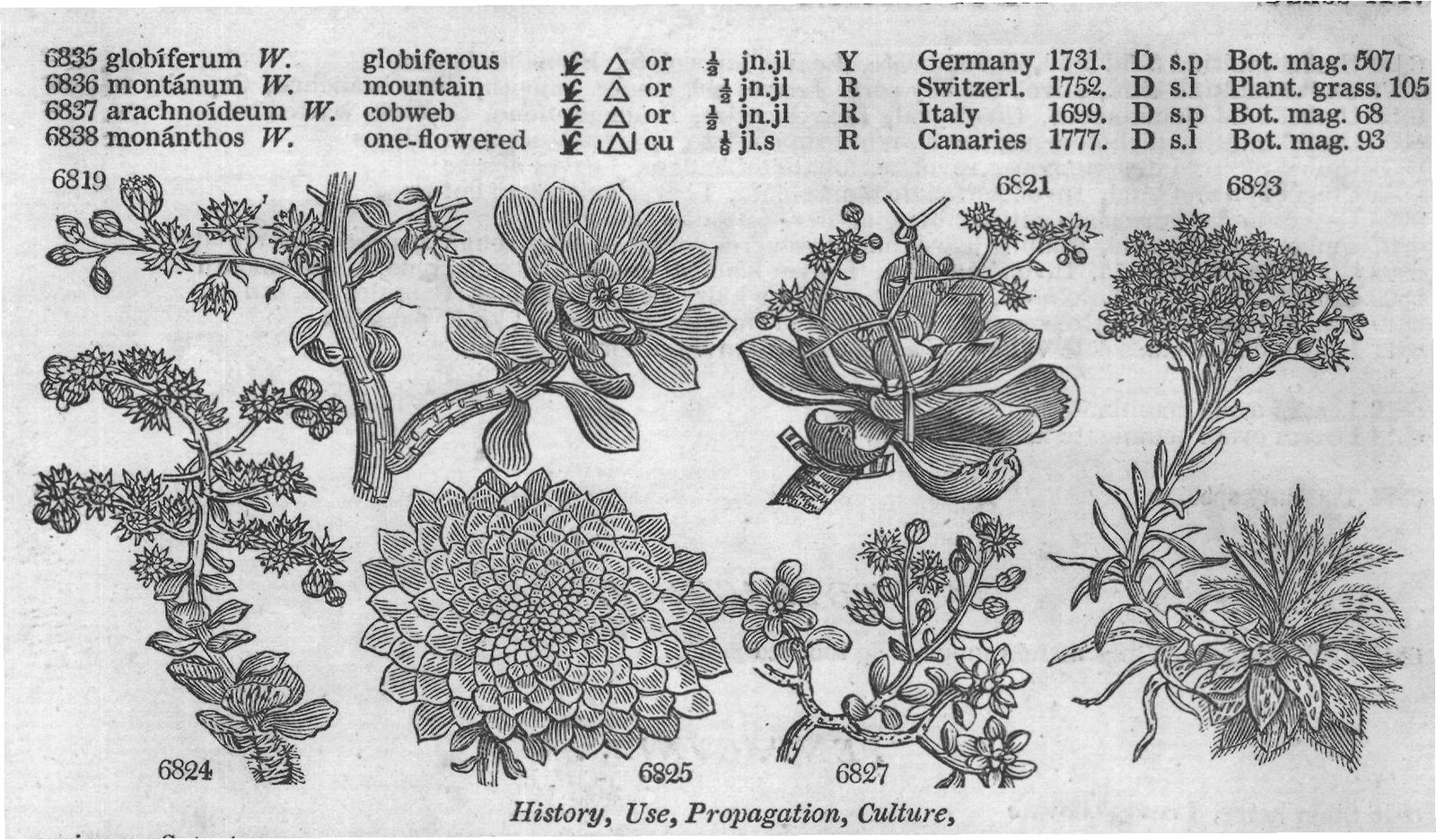
DODECANDRIA TRIGYNIA. 6800 Umbel multifid 3-fid bifid, Invol. ovate, Leaves lanceolate, Branches barren 6801 Umbel multifid bifid, Invol. broadly cord. Leaves obl. emarg. smooth, Stem branched, Capsules warted 6802 Umbel 6-fid dichotomous, Invol. oval, Leaves entire, Branches none, Capsules warted 6803 Umbel multifid dichotomous, Invol. reniform cordate, Leaves lanceolate villous 6804 Umbel multifid dichotomous, Invol. perfoliate orbiculate, Leaves obtuse 6805 Umbel multifid bifid, Invol. perfoliate emarginate, Leaves lanceolate entire 6806 Leaves linear lanceolate entire close together, Capsules smooth 6807 Umbel multifid bifid, Cauline leaves and involucres cordate oblong rough at edge subserrulate 6808 Umbel multifid trifid, Invol. roundish, Leaves lanc. attenuated, Stem simple, Caps. smooth 6809 Umb. 5-fid 3-fid dichotomous, Leaves lanceolate hairy serrulate at end, Capsules smooth 6810 Leaves lanceolate entire smooth, Caps. warted smooth, otherwise like E. palustris 6811 Leaves entire lanceolate villous, Umb. multifid, Inv. reniform cordate 6812 Leaves ovate acuminate 6813 Leaves ovate acuminate keeled beneath 6814 The only species TETRAGYNIA. 6815 Fruit winged, Wings membranous crisp toothed 6816 Stem hairy, Leaves obovate PENTAGYNIA. 6817 Leaves ovate obtuse usually entire, FL terminal panicled 6818 Leaves palmate, Stem aculeate DODECAGYNIA. 6819 Stem arborescent smooth branched, Leaves cuneiform smoothish ciliated, Ciliæ spreading smooth 6820 Stem shrubby, Leaves orbicular-spatulate villous, Nectaries nearly square truncate 6821 Stem shrubby, Leaves cuneiform viscid ciliated, Ciliæ cartilaginous appressed 6822 Stem shrubby, Leaves orbicular-spatul. glutinous at edge with globose glands and cuneiform trunc, nects. 6823 Leaves obovate acute smooth with a cartilaginous edge, Cymes clustered 6824 Stem with dense spreading bristles, Leaves curved with longitudinal green spots beneath 6825 Leaves closely packed together in a broad flat disk 6826 Suckers spreading lateral, Leaves ovate mucronate warted, Branches of cyme bifid 6827 Leaves obovate gibbous beneath villous, Nects. 2-lobed 6828 Leaves spatulate cuneiform obtuse villous, Nects. palmate 6829 Stem pubescent, Leaves spatulate scattered 6830 Leaves ciliated, Suckers spreading, Nects. cuneiform with a swelling 6831 Margins of leaves serrate toothed, Offsets spreading 6832 Leaves entire oblong ovate smooth stalked, Cymes spreading, Pedunc. and calyx hairy 6833 Leaves stem and petals hairy at end 6834 Leaves ciliated, Offsets short round nearly sessile, Petals 6 fringed 6812 6813 6817 6814 6818 and Miscellaneous Particulars. 6815 6816 1106. Calligonum. From κaλoς, beautiful, and you, a knee or joint. This plant produces, instead of leaves, curious greenish excrescences disposed in joints, which give it a remarkable appearance. 1107. Glinus. A name employed by Theophrastus to designate a kind of maple. This plant is, however, more like a purslane. 1108. Blackwellia. Named after Elizabeth Blackwell, who published an Herbal in 1735, containing figures of between two and three hundred plants, drawn and engraved by herself. Curious stove plants with pretty foliage, but inconspicuous spikes of whitish green flowers. 1109. Gastonia. Named by Commerson after Gaston de Bourbon, son of Henry IV. In the Isle de Bourbon it is called Bois d'éponge. 1110. Sempervivum. From semper vivere, to live for ever, in allusion to the tenacity of life common to plants of the genus. This is a succulent genus, some species of which are ornamental or singular, and others Dd 4 DODECANDRIA DODECAGYNIA. globiferous mountain one-flowered or or Aor cu jn.jl Y jn.jl R jn.jl R jl.s R Germany 1731. D s.p Switzerl. 1752. D s.1 Italy 1699. D s.p Canaries 1777. D s.I CLASS XI.