Home › C › Carcioffo or Kharchiof
Carcioffo or Kharchiof
C. scolymus is a well known garden esculent. In some parts of France and Italy it is eaten raw in its wild state by the common people. According to Gerarde, it was introduced into this country from Italy, but is become, "by reason of the great moisture which our country is subject unto," greater and better than those of Italy; a circumstance not to be doubted, and applicable to many other plants of culture; for it is a fact, that art can in many cases surpass nature; always, however, working upon nature's principles. The artichoke is one of those plants the most patient of drought, and in this unusually dry and hot season (1825) was almost the only vegetable procurable in the neighbourhood of Paris, during three or four weeks in July and August. Once in the seventeenth century, and again about 1739, most of the artichokes in England were destroyed by frost, but replaced from France. There are three varieties in cultivation, the conical, French, or oval; the globe, which has a large dusky purplish head; and the dwarf globe, a prolific variety, which is smaller. The parts used are the lower part of the leaves of the calyx; the fleshy receptacles of the flower, freed from the bristles and seed down, vulgarly called the choke; and some- ORDER I.
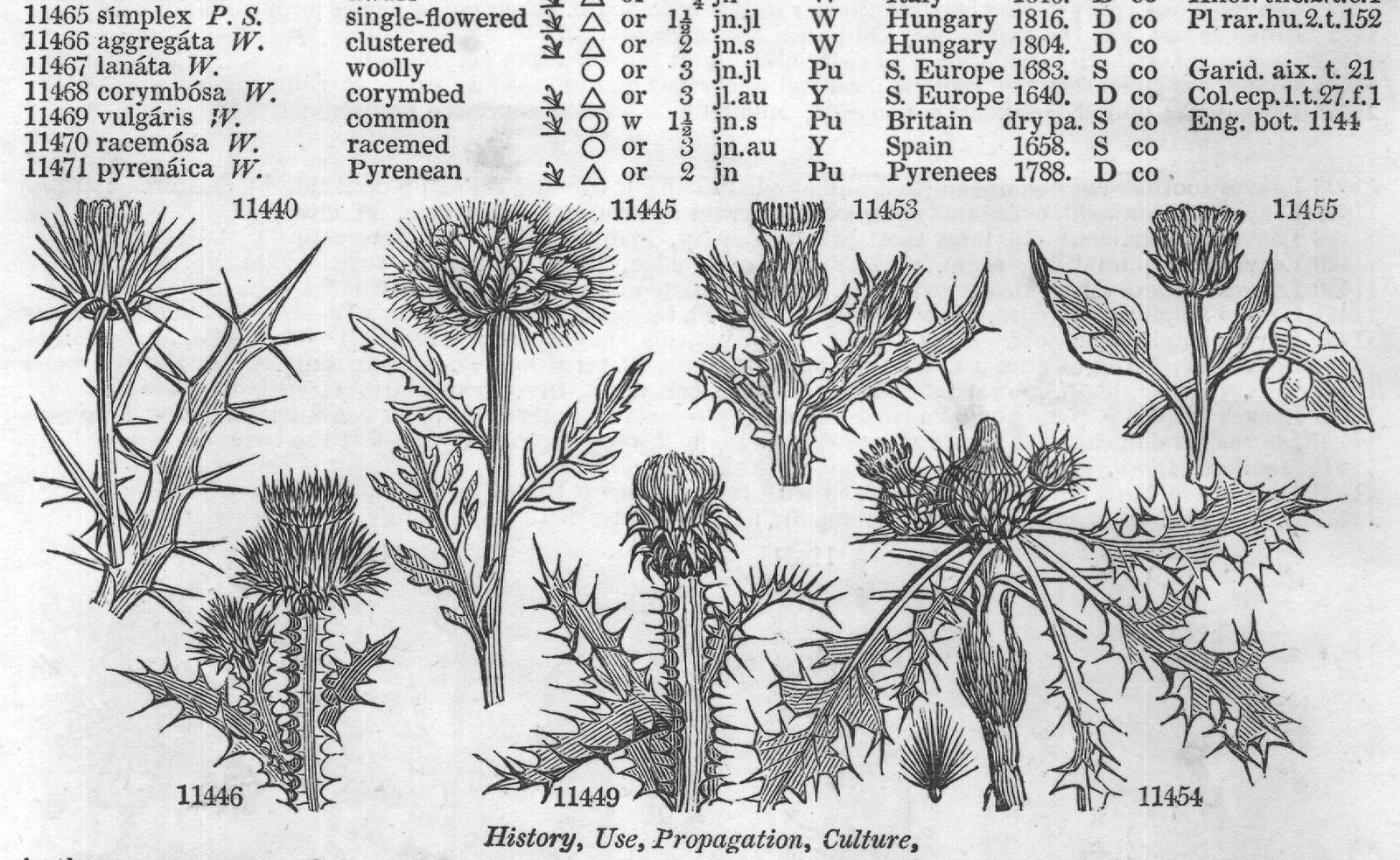
SYNGENESIA ÆQUALIS. 11440 Leaves narr. pinnatifid downy beneath with strong spines, Fl. large solitary, Lvs. of invol. spiny recurved 11441 Leaves sess. lanc. entire unarmed downy beneath, Spines axill. branched at base, Fl. axill. sessile 11442 Leaves amplexicaul. obl. toothed spiny with white veins, Fl. subsess, bracteate, Scales of invol. appressed 11443 Leaves amplexicaul. pinnatifid toothed spiny pubescent, Stem simple, Fl. terminal clustered 11444 Leaves pinnatifid, Invol. scarious: scales acuminate 11445 Leaves pinnatifid, Invol. scarious villous 11446 Scales of invol. spreading subulate, Lvs. ov.-obl. sinuated and spin. decurrent woolly on both sides 11447 Scales of invol. much spreading, Lvs. decurrent smooth on each side sinuated toothed spiny 11448 Scales of invol. much spreading as long as invol. Lvs. decurr. downy sinuated toothed spiny: radic. pinnate 11449 Lower scales reflexed: upper much spreading, Lvs. decurrent downy sinuated toothed spiny 11450 Invol, squarrose with cobwebbed down, Leaves stalked ovate angular downy beneath 11451 Scales of invol. ovate-lanc. mucronate spreading, Lvs. decurrent downy subsinuate toothed spiny 11452 Stem and leaves tomentose: radical pinnatifid; cauline obl. adnate decurrent toothed spiny 11453 Scales of invol. ovate mucronate appressed, Lvs. decurrent somewhat downy sinuate toothed spiny 11454 Steml. Invol. glob. subsess. Scales of invol. lanc. spiny spreading, Lvs. stalked pinnatif. toothed spiny downy 11455 Stemless, Invol. obl. subsess. Scales of invol. obl. lanc. downy unarmed, Lvs. stalked roundish ovate 11456 Leaves somewhat spiny pinnate and undivided, Scales of invol. ovate 11457 Leaves pinnatifid downy beneath spiny, Spines of the base of leaves and pinnæ connate at base 11458 Leaves spiny: all pinnatifid, Scales of invol. ovate 11459 Leaves spiny pinnatifid downy beneath, Scales of invol. subulate 11460 Stemless, Leaves unarmed downy beneath pinnatifid: segm. cut-toothed, Scales of invol. lanc. 11461 Stemless, Leaves pinnatifid spiny 11462 Stemless, Leaves pinnated smoothish: segm. toothed spiny, Inner scales of invol. scarious at end 11463 Stemless, Leaves pinnatifid downy beneath: segm. toothed angular spiny 11464 Stem simple 1-fl. Lvs. pinnatifid naked: segm. cut-toothed spiny 11465 Stem simple 1-fl. longer than flower, Leaves deeply pinnatifid squarrose 11466 Stem simple 1-fi. numerous aggregate, Leaves pinnatifid smooth: segm. pinnatifid spreading spiny 11467 Stem subbifid, Middle flower sessile, Lvs. hoary lanc. toothed spiny 11468 Stem many-fl. corymbose smoothish, Lvs. lanc. pinnatifid toothed smooth 11469 Stem many-fl. corymb. pubesc. Leaves lanc. unequally spin. and sinuated downy beneath 11470 Stem somewhat divided, Fl. axill. sess. Leaves lanc. toothed downy spiny pubescent 11471 Stem many-fl. Leaves decurrent 11465 11468 11458 11459 11460 11463 11469 and Miscellaneous Particulars. times the tender central leafstalk in a blanched state like the Cardoon. Medicinally, the plant is reputed to be aperient, stomachic, and somewhat heating. It is said to dye a good yellow, and the flowers curdle milk. The plant is propagated by suckers in March and April, and requires a light rich soil, well dunged, and pulverised to a good depth. The leaves being large, the plants are placed in rows at four feet distance, and two feet apart in the row. They will produce some heads the first season, a full crop the next, and, if well manured, will last for five or six years. The plants require to be covered a foot thick with litter during winter, which is removed, and the ground dressed in March and April. The heads will appear in the beginning of June. When the artichoke is to be cultivated as Cardoon, the plants are to be cut over by the surface about midsummer; in September they will have produced leaves about two feet high; they are then bound close with a wreath of hay or straw, and earth drawn round them. The blanching will be perfected in a month or six weeks. Bauhin thought the Cardoon a hybrid from the common artichoke, to which it bears a great resemblance. The tender stalks of the inner leaves, rendered white and crisp by earthing up, are used for stewing, and for soups and salads during winter, like celery. It requires the same soil as the artichoke, to be planted at three or four feet apart in May, or sown where it is to remain in March. In September the leaves may be tied together and earthed up, and in October and November they will be blanched from one to three feet in length.
With the florets of Cynara Cardunculus, which the Portuguese call Cardo do coalho, milk was formerly coagulated by the people of Portugal, as it is by rennet in England. 1669. Carlina. Olivier de Serres says, this plant was named after the famous Charlemagne, whose army was cured of the plague by means of this plant. Linnæus ascribes the name to the Emperor Charles V., whose army was relieved from the plague in Barbary in the same way. C. acaulis has black woody roots an inch thick, the upper part of which, with the receptacle of the flower, when tender, may be eaten, but the root of the adult plant becomes acrimonious, and is recommended as an alexipharmic. It contains an acrid resinous principle, by which it stimulates the solids, dissolves the humours, and promotes perspiration. C. vulgaris is found all over Europe in dry barren soils. The flowers expand in dry, and close in moist weather, retaining this property a long time.
Upon this and a few other genera M. Cassini has founded a tribe, which he denominates Carlineæ, which although possessing no very precise characters of difference, is, he believes, distinct from both his Centaurieæ and Carduineæ, from which it may always be distinguished by the perfect smoothness of the filaments. The species of Carlineæ are found in every part of the world. SYNGENESIA ÆQUALIS.
CLASS XIX. 1670. ATRACTYLIS. W. ATRACTYLIS.