Compositæ
Sp. 1-11. 11476 pinnáta Th.
Carthamus-like or 2 ja.d Y C. G. H. 1812. C co Bot. mag. 1788 1674. ONOBRO'MA. Gærtn. ONOBROMA. 11477 cærúleum Gærtn. blue-flowered or 1 jn.jl B Composite. Sp. 2.
Spain 1640. D co Bot. mag. 2293 Carthamus cæruleus W. 11478 salicifólium Link. Willow-leaved or 3 au W Madeira 1784. C s.p 1675. CAR'THAMUS. W. CARTHAMUS.
Composite.
Sp.7-20. 11479 tinctórius W. officinal or 3 jn.jl 0 11480 lanátus W. woolly or 3 jl.au Y 11481 créticus W.
Cretan or 2 jn.jl W Egypt 1551. S s.1 S. Europe 1596. S co Candia 1731. S co Bot. reg. 170 Bot. mag. 2142 11482 tingitánus W.
Tangier or 2 jn.jl B Barbary 1759. D co Cav. ic. 2. t. 128 11483 mitíssimus W. small or 11484 Carduncéllus W. mountain or jn.jl B my.jn B France 1776. D co 11485 arboréscens W. tree or 6 jl.au Y France Spain 1734. D co 1731. C s.p 11486 corymbósum Pers. corymbose 1676. CARDOPA'TUM. Pers. CARDOPATUM.
Compositæ. un 3 jl.au B Sp. 1.
Levant 1821. D co M.h. s.7.t.33.f.17 1677. STÆHELI'NA. W. STÆHELINA.
Compositæ. 11487 dúbia W.
Rosemary-lvd. ft 3 jn.jl Pu 11488 arboréscens W.
Storax-leaved ☐ pr 6 jl.s 11489 chamæpéuce W.
Pine-leaved pr 2 jl.n Sp. 3-13.
S. Europe 1640. C p.1 Candia 1739. C p.1 Candia 1640. C p.1 Lam.ill. t.666.f.4 Schreb.dec. 1. t.1 Plu. alm. t.94.f.3 11490 lineáris Lag. 1678. PALAFOX'IA. Lag. PALAFOXIA. linear-leaved pr 2 jn.jl Compositæ.
Sp. 1.
W Mexico 1821. S co Bot. mag. 2132 1679. PTERONIA. W. PTERONIA.
Compositæ.
Sp. 5-33. 11491 camphoráta W. aromatic or 3 jn.jl Y C. G. H. 1774. C p.l Pl.man. t.345.f.2 11492 strícta W. cluster-flower'd or 3 ap.jn Y C. G. H. 1774. C p.1 11493 flexicaúlis W. bending-stalk'd or 3 jn.au Y C. G. H. 1812. C co 11494 oppositifólia W. opposite-leaved or jl Y C. G. H. 1774. C p.1 Bre.prod.t.17.f.3 11495 scariósa W.
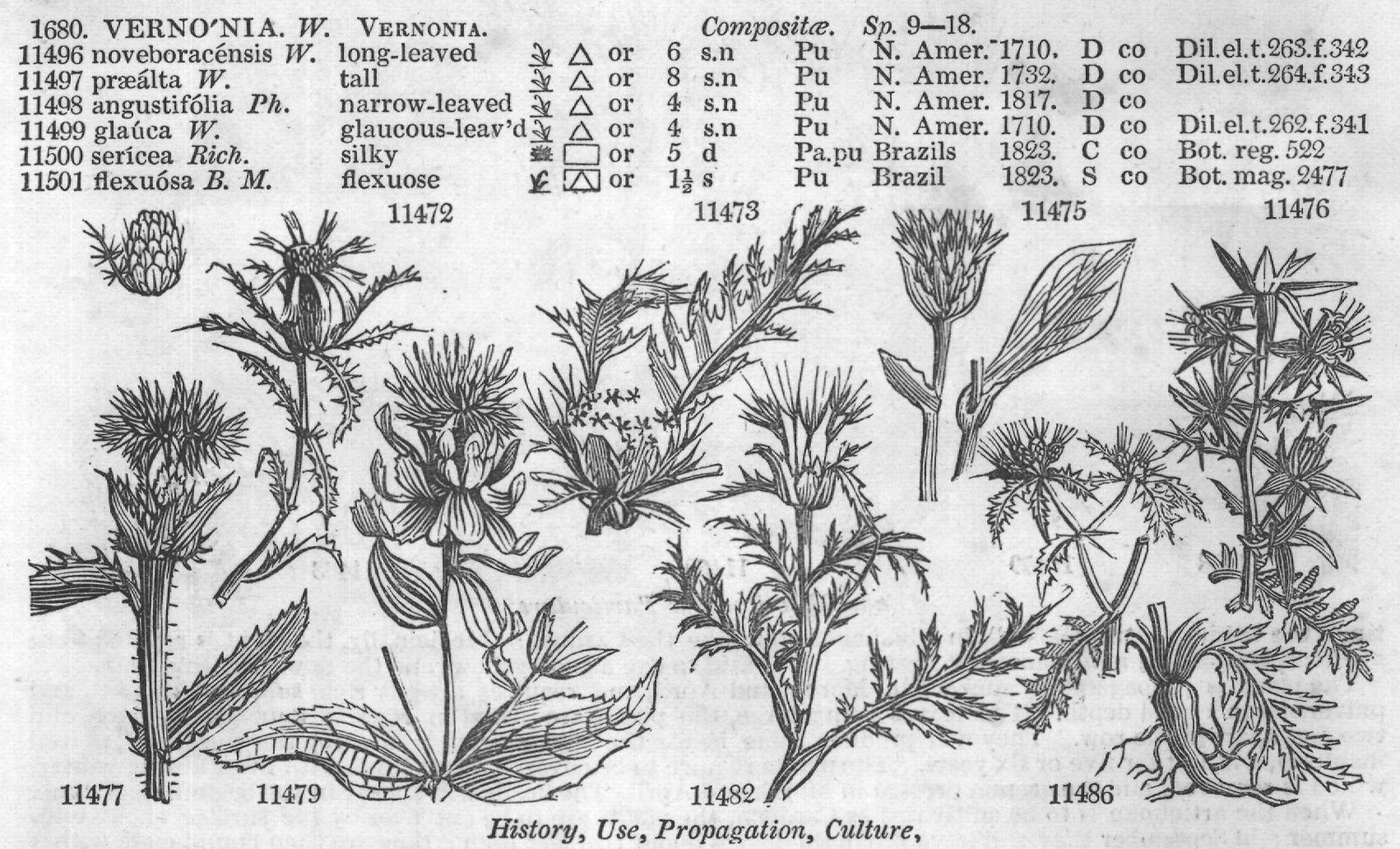
Window-calyx. or 2 jn.au Y C. G. H. 1815. C co 1680. VERNO'NIA. W. VERNONIA. 11496 noveboracénsis W. long-leaved Composite.
Sp. 9-18. or 6 s.n Pu N. Amer. 1710, D co Dil.el.t.263.f.342 11497 præálta W. tall or 8 s.n Pu N. Amer. 1732. D co Dil.el.t.264.f.343 11498 angustifólia Ph. narrow-leaved or 4 s.n Pu N. Amer. 1817. D co 11499 glaúca W. glaucous-leav'd or 4 s.n Pu N. Amer. 1710.
D co Dil.el.t.262.f.341 11500 serícea Rich. silky or 5 d 11501 flexuósa B. M. flexuose or 1 s Pu Pa.pu Brazils Brazil 1823. C co 1823. S co Bot. reg. 522 Bot. mag. 2477 11472 11473 11475 11476 11477 11479 11482 11486 History, Use, Propagation, Culture, 1670. Atractylis. Vaillant (Mem. Acad. Sc. 1718.) derives this from aτρaκτoς, a distaff, because the light stems were very fit to make spindles. 1671. Acarna. A name under which Theophrastus describes a plant resembling a thistle. Willdenow applied it to the present genus, which consists of thistle-like plants. 1672. Stokesia. Named in honor of Jonathan Stokes, M.D., well known as the coadjutor of Dr. Withering in his botanical arrangement of British plants. A perennial plant, with large handsome blue flowers. 1673. Stobœa. Named after Dr. Stobæus, of Lund, one of Linnæus's earliest patrons, and said to have been a practical naturalist. 1674. Onobroma. From ovos, an ass, and βρωμη, food, in allusion to the worthlessness of its herbage. Thistlelike plants of little beauty. 1675. Carthamus. From its Arabic name qortom, a word which signifies to paint, on account of the fine color yielded by the flowers. Tournefort, with little reason, derives it from the Greek κaτaρεiv, to purge. The flowers of Carthamus tinctorius are used by the Chinese to give some of the fine rose, scarlet, purple, and violet colors to their silks. For this purpose, the flowers are thrown into an infusion of some alkali, and left to macerate; the colors are afterwards drawn out by the addition of lemon juice in various proportions, or of any other vegetable acid.
It is cultivated at present in many parts of Europe, and in the Levant, whence great quantities are annually imported into England for dyeing and painting. In Spain it is grown in gardens, as Marygolds are in England, to color soups, olives, and other dishes. The Jews in Poland are remarkably fond of it, and mix it with their bread, and most of their viands. According to Houghton, it was formerly cultivated in Gloucestershire, both for the flowers and seed. The common people took it for saffron, and used it in their puddings, cakes, and ORDER I. 11472 Stem and leaves smooth SYNGENESIA ÆQUALIS. 11473 Stemless, Leaves pinnatifid, Outer leaves of invol. tricuspidate 11474 Stem branched, Leaves lanc. ciliate toothed downy, Outer leaves of invol. setaceous pinnatifid conniving 11475 The only species 11476 Leaves downy pinnatifid: pinnæ linear terminated by a spine 11477 Stem about 1-fl. Leaves ovate lanc. spiny-toothed [larger than flower 11478 Stem shrubby, Leaves sessile lanceolate downy beneath spiny-toothed, Branches 1-flowered 11479 Stem quite smooth, Leaves ovate entire spiny toothed, Fruit naked 11480 Stem woolly, Lower leaves pinnatifid toothed: upper amplexicaul. pinnatifid toothed spiny 11481 Stem smoothish, Invol. somewhat woolly, Lower leaves lyrate: upper hal 11482 Radic. leaves pinnated: cauline pinnatifid, Stem 1-flowered 11483 Leaves unarmed: radical toothed; cauline pinnate 11484 Cauline leaves linear pinnated as long as plant 11485 Leaves ensiform sinuate toothed 11486 Spiny much branched with small blue flowers half-amplexicaul. 11487 Leaves sessile linear toothletted downy beneath, Inner scales of invol. lanc. long 11488 Leaves stalked ellipt. blunt entire silky silky with down beneath 11489 Leaves lin. clustered very long revolute at edge hoary beneath, Branches downy 11490. The only species 11491 Leaves scattered and fascicled filiform ciliated, Leaves of invol. ciliated, Hairs of recept. clustered 11492 Lvs. scattered and fascicled filiform subciliate at base, Lvs. of invol. entire, Holes of recept. multipartite 11493 Leaves connate linear filiform glabrous, Scales of invol. ovate, Stem wavy, Fl. terminal in threes stalked 11404 Leaves ovate powdery downy, Scales of invol. ovate entire 11495 Leaves ovate smooth, Scales of invol. ovate mucronate membranous 11496 Leaves lanc. scabr. serrulate, Corymb fastigiate, Scales of invol. filiform at end 「mucronate 11497 Leaves ovate-lanc. serrate downy beneath, Corymb fastigiate, Scales of invol. ovate acuminate 11498 Stem simple, Lvs. many long and narrow lin. nearly entire, Corymb somewhat umbell. Scales of inv. stiff 11499 Leaves oblong acuminate serrate, Corymb fastigiate, Scales of invol. ovate acute 11500 Leaves linear-lanc. silky beneath downy on each side nearly entire, Flowers alternate 1-sided sessile 11501 Stem straight dichotomous upwards: branches flexuose, Heads in the forks of the branches sessile 11487 11490 11497 11496 11500 11491 11499 11501 and Miscellaneous Particulars. bread; but by putting in too great a quantity they found it communicate a purgative quality, and gave up its use.
It is still, however, used in this way by some pastrycooks. In Germany it is cultivated on light land well pulverised; it is sown in rows about eighteen inches distance, and afterwards thinned to three or four inches apart in the row: in September the plants begin to flower, and the field is then gone over once a week, for six or seven weeks, to gather the expanded florets, which are dried in a kiln in the same manner as true saffron. Turkeys and geese are said to feed greedily on the seed, and in a short time become very fat. C. lanatus is used by the women of the south of France and Spain for distaffs, and hence it had the name of distaff thistle. The root of C. carduncellus is eaten in Africa. 1676. Cardopatum. A name of unknown meaning. A spiny branched plant with little blue flowers, formerly referred to Carthamus. 1677. Stæhelina. One Benoit Stæhelin, a Swiss botanist, published, in 1730, an academical dissertation upon the Filicula saxatilis corniculata and the Equisetum. These are pretty half-shrubby thread-leaved plants, mostly deserving cultivation. 1678. Palafoxia. Named by Lagasca, after the Spanish General Palafox, of whose merits as a botanist we are uninformed. A small perennial plant with the habit of Stevia. 1679. Pteronia. From ATEGOV, a wing altered by Linnæus from the Pterophorus of Vaillant, a word which seems to allude to the feathery scales of the receptacle. A genus of humble rigid shrubs. 1680. Vernonia. Named after Mr. William Vernon, fellow of St. Peter's College, Cambridge, who travelled in North America in search of plants, and left behind him an Herbarium, which came into the hands of Sir Hans Sloane, and contributed to enrich the third volume of Ray's Historia Plantarum. Vernonieæ constitutes the twentieth of M. Cassini's subdivisions of Compositæ. They are distinguished from Lactuceæ by SYNGENESIA ÆQUALIS.
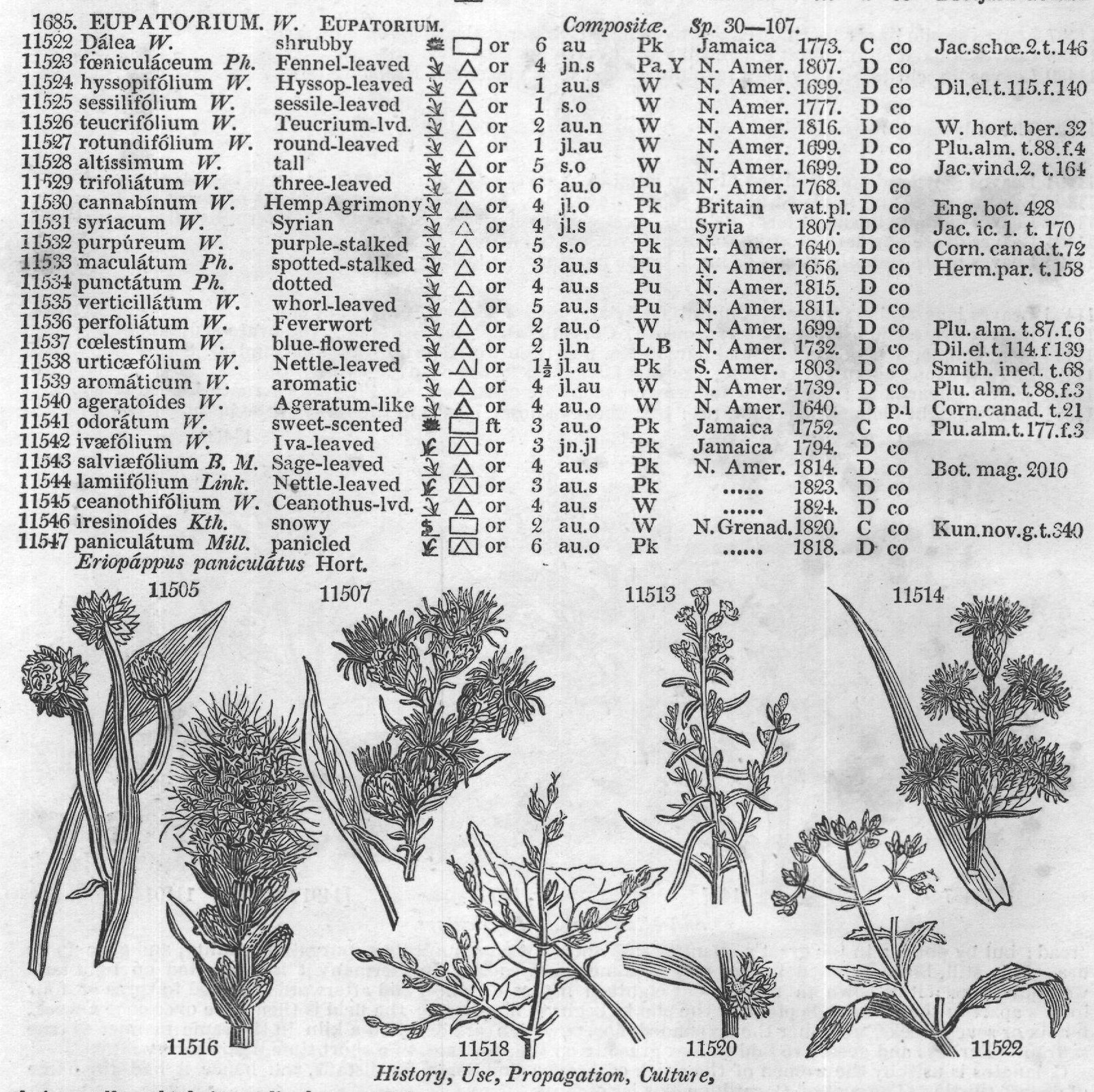
CLASS XIX. 11502 panduráta Jacq. fiddle-leaved or 4 s.n 11503 arborescens Cass. tree or 5 n.d Pu Pu Jamaica 1825. D co Jamaica 1733. C co Pl.sp.10.t.130.f.2 11504 anthelmíntica W. purple or 1½ au.s Pu E. Indies 1770. S co Rhee.mal.2. t.24 1681. AMMO'BIUM. R. Br. AMMOBIUM.
Compositæ.
Sp. 1. 11505 alátum R. Br. winged pr 2 mr.s W N. Holl. 1822. S co Bot. mag. 2459 1682. LIA'TRIS. W.
LIATRIS.
Compositæ.
Sp. 11-18. 11506 squarrósa W. rough-cupped el 3 au Pu N. Amer. 1732.
D p.l Sweet fl. gard.44 11507 scariósa W. scarious-cupped el 4 s.o Pu N. Amer. 1739.
D p.l Bot. mag. 1709- 11508 sphæroídea Ph. globular-cupp'del 3 au.o Pu N. Amer. 1817.
D co Sweet fl. gard.87 11509 élegans W. hairy-cupped el 4 s.o Pu N. Amer. 1787.
D p.l Bot. reg. 267 11510 pilósa W. hairy-leaved el 1 s.o Pu N. Amer. 1783.
D p.l Bot. reg. 595 11511 cylindrácea Ph. cylindrical-cup.el 4 au.o Pk N. Amer. 1811.
D co 11512 heterophýlla Ph. various-leavedel 3 jl.au Pu N. Amer. 1790.
D p.l 11513 pycnostáchya Ph. 11514 spicáta W. pubescent-lvd. long-spiked el 3 au.o Pu N. Amer. 1732.
D co