Important: Safety Warning
This page prescribes plants as medicine according to pre-modern medical theory. Several of the plants named are toxic, correct identification is difficult, and the doses given have no scientific basis. Do not ingest or apply any preparation described here.
This information has been left in for historical purposes but should not be acted upon.
Home › C › Cav (Ic t Mor hi t f Lam ill t f)
Cav (Ic t Mor hi t f Lam ill t f)
ic. 1. t. 37 Mor.hi. 2.t.11.f.3 Lam. ill.t.631.f.2 10517 muricáta W. two-flowered pr 2 jn.jl Y 10518 sulcáta W. three-flowered pr 2 jn.jl Y 10519 subvillósa W. four-flowered pr 2 jn.jl Y S. Europe 1640. S co S. Europe 1596. S s.l S. Europe 1731. S co Mor.hi.2.t. 11.f.4 Mor.hi.2. t.11.f.2 1580. SMITHIA. Salisb. SMITHIA.
Leguminosæ.
Sp. 1-2. 10520 sensitíva Sal. annual un jl.s Y E. Indies 1785. S s.l Par. lond. 92 10495 10490 10493 10488 10494 10500 10498 10502 History, Use, Propagation, Culture, so called. Shrubs with membranaceous inflated pods, free-growers and flowerers, well adapted to introduce in extensive shrubberies.
C. arborescens grows on Mount Vesuvius, even in the ascent to the crater, where there are scarcely any other plants. The leaves are recommended as answering all the purposes of senna, and Allioni has given particular directions for the preparation of them. A larger dose seems to be required to produce the same effect. The seeds, in a quantity of a drachm or two, excite vomiting. It is said by Haller and Ray to afford food grateful to cattle. 1574. Glycyrrhiza. From γλuκuς, sweet, and ῥiζa, a root; the sweet taste of the liquorice root is well known. But the species from which the name is derived now constitutes a different genus. See Liquiritia. 1575. Liquoritia. A Latinized appearance of our common English word Liquorice, which in its turn is said to be an alteration or corruption of the French word Reglisse, itself a corruption of Glycyrrhiza. So, at least, says De Theis. To others, however, it is appears more probable that the name alludes to the quantity of liquor or liquid which the roots contain, and which constitutes their great value. L. officinalis is a deep-rooting perennial, which has long been much cultivated in Spain; and since Elizabeth's time has been grown in different parts of England. The soil should be a deep sandy loam, trenched by the spade or plough, or with the aid of both, to two and a half or three feet in depth, and manured, if necessary. The plants are procured from old plantations, and consist of the side-roots, which have eyes or buds. These may be taken off, either in autumn, when a crop of liquorice is taken up for use, and laid in earth till spring; or taken from a growing plantation, as wanted for planting. The planting season may be either October, or February and March. In general the latter is preferred. The plants are dibbled in, in rows three feet apart, and from eighteen inches to two feet in the row, according to the richness of the soil. The after-culture consists in horse-hoeing and deep stirring, in weeding, and in cutting over and carrying away the haulm every autumn, after it is completely withered. As the plants do not rise above a foot the first season, a crop of onions or beans is sometimes taken in the intervals. The plants must have three summers' growth, at the ORDER IV.
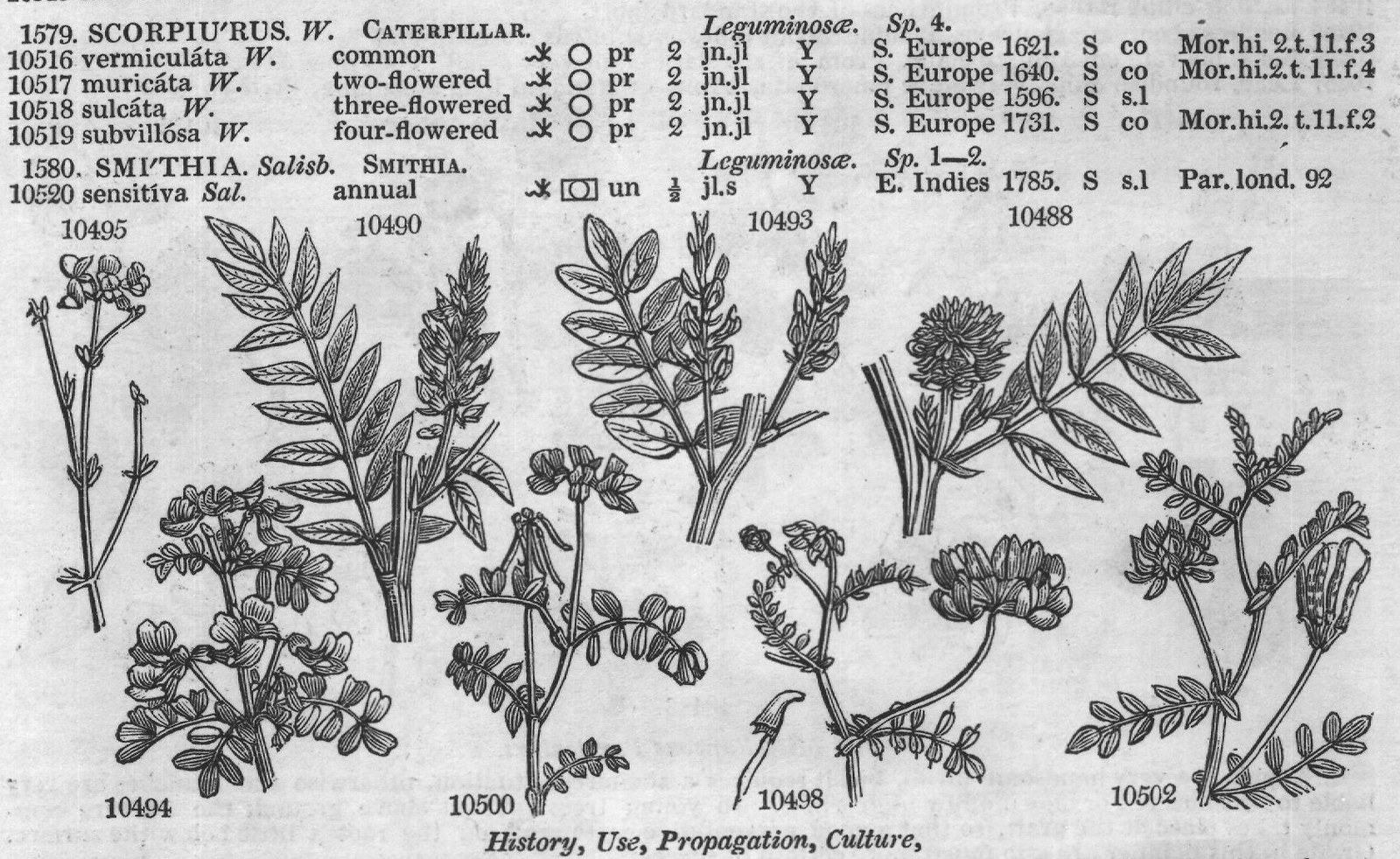
DIADELPHIA DECANDRIA. 10488 Pods echinate, Fl. capitate, Stipules lanc. Leaflets smooth oblong mucronate 10489 Pods glandular echinate, Fl. racemose, Stipules withering, Leafl. oblong lanc. emarg. clammy beneath 10490 Leaflets oblong acute silky, Pods racemose oblong hispid 10491 Pods smooth moniliform, Raceme term. Stipules lanc. Leafl. obovate emarg. rough beneath 10492 Pods hirsute, Leafl. obl. lanc. Flowers racemose 10493 Pods smooth, Stipules O, Leaflets ovate retuse clammy beneath 10494 Pedunc. about 3-fl. Claws of cor. three times as long as calyx, Stem angular 10495 Leaves 5-nate and 3-nate linear lanceolate fleshy blunt 10496 Leaflets about 9, Stipules nearly round 10497 Leaflets 7 very blunt, Stipules lanceolate 10498 Leaflets 6-10 pair more or less obovate and retuse, Pods very long curved upwards 10499 Leaflets 9 ellipt.: inner close to stem, Stipules opp. the leaves lanceolate 10500 Procumbent, Leafl. 9 ovate, Stipule opp. the leaf emarg. Pods angular knotty 10501 Leaflets 11 silky: the outer the largest 10502 Leaflets several lanceolate smooth, Pods rounded erect 10503 Leaflets 15 cuneate retuse, Pods rounded erect 5 together 10504 Leaflets several obl, cuneate, Pods compressed ensiform 10505 Leaflets 9 very blunt somewhat emarginate, Stipules round toothletted 10506 Pods sessile solitary erect 10507 Pods stalked clustered circular: lobed on one edge 10508 Pods stalked clustered smooth lobed on the outer edge, Leaves and cal. hairy 10509 Pods stalked clustered arcuate rough sinuated on one side 10510 Leaves pinnated, Flowers capitate with a bractea, Pods roundish incurved 10511 Leaves pinnated, Flowers capitate without a bractea, Pods round incurved 10512 Leaves pinnated, Flowers capitate with a bractea, Pods compressed recurved rugose 10513 Leaves ternate subsessile: the odd one very large 10514 Leaves ternate or quinate: the odd one largest, Stipules large membranous 2-toothed 10515 Leaves pinnated, Pods rugose pendulous scarcely bowed, Joints compressed roundish 10516 Pedunc. 1-fl. Pods covered over with blunt scales 10517 Pedunc. 2-fl. Pods bluntly aculeate outwardly 10518 Pedunc. about 3-fl. Pods bearing outwardly distinct acute spines 10519 Pedunc. about 4-fl. Pods bearing outwardly clustered acute spines 10520 Lips of calyx entire, Racemes stalked few-flowered 10510 10506 10513 10509 10520 10511 10518 and Miscellaneous Particulars. end of which the roots may be taken up by trenching over the ground. The roots are either immediately sold to the brewers' druggists, or to common druggists, or preserved, like carrots or potatoes, in sand, till wanted for use. They are used in medicine and porter-brewing. 1576. Coronilla. From corona, a crown. Its pretty flowers are disposed in little tufts like coronets. Handsome free-flowering shrubs, of easy culture. C. valentina, glauca, and viminalis are valuable as flowering in winter, and often all the summer. C. argentea bears a profusion of flowers, which have a strong sweet scent. The silvery color of this plant is occasioned by its growing on a poor dry soil; and if it is removed into better ground, it will take a glaucous color; and the contrary. C. emerus is a popular shrub of much beauty. C. varia is a strong coarse-growing plant, and has been grown as an adjunct to clover, lucern, &c. Curtis says, it is bitter; but others have found horses and cows to eat it greedily. 1577. Hippocrepis. From ἰππoς, an horse, and κρεπiς, a shoe; in allusion to the form of its pod. Pretty little annual plants, with bright yellow flowers. 1578. Ornithopus. From ogvis, a bird, and 785, a foot. The pods are twisted and curved in such a manner as to resemble the claws of a small bird. Curious on account of their jointed pods, but not worth culture as plants of ornament. O. sativus is a most valuable agricultural plant. It was introduced for purposes of field culture about the year 1818, from Portugal, under the name of Serradilla. Sown upon the barren, light, sandy downs of Thetford, in Norfolk, it produced an abundant crop of most excellent fodder, where nothing else would grow. It is exceedingly like O. scorpioides, except that it arrives at the height of two feet instead of as many inches. 1579. Scorpiurus. From σκoρπioς, a scorpion, and 8ça, a tail; on account of the twisted pod, which is very like the tail of some reptile. 1580. Smithia. In memory of Sir James Edward Smith, M. D., F. R. S., knight, president of the Linnean Society, possessor of the Linnean herbarium, and author of various elementary and other useful botanical works. These are inconspicuous worthless weeds, possessing little interest beyond their irritable foliage. Ss 3 DIADELPHIA DECANDRIA.
CLASS XVII. 1581. SESBAʼNIA. H.K. SESBA'NIA.
Leguminosæ. Sp. 5-9. 10521 grandiflóra H. K. great-flowered 10522 ægyptíaca H. K.
Egyptian or 4 jl.au or 10 jl.au Or Y 10523 aculeáta H. K. 10524 cannabína P. S. prickly Hemp or 4 jl.au Y or 4 jl.au Y E. Indies 1768. C l.p Rhee.mal.1.t.51 Egypt 1680. S co Al.ægypt.81.t.82 E. Indies 1690. S co Jac. ic. 3. t. 564 E. Indies 1800. S co 10525 pícta Cav. painted or 6 jl.au Y W. Indies 1823. C co Bot. reg. 873 1582. ESCHYNO'MENE H. K.
ÆSCHYNOMENE. Leguminosæ. Sp. 5-27. 10526 sensitíva W. shrubby or 3 ...
Y W. Indies 1733. C s.1 Plum. ic. t. 149 10527 áspera W. rough-stemmedor 2 jn.jl Y 10528 híspida W. hispid O or 2 au Y 10529 americána W. hairy or 2. jl.au Y 10530 índica W.
Indian or 2 jn.jl Y E. Indies 1759. S s.l N. Amer. 1803. S s.l Jamaica 1732. S s.1 E. Indies 1799. S s.1 Breyn.cent.t.52 Sloa.h.1.t.118.f.3 Rhee. mal.9.t.18 1583. STYLOSAN'THES. Swz. 10531 procúmbens Swz.
STYLOSANTHES. procumbent un 1584. HAL/LIA. Th. HALLIA.
Leguminosæ. Sp. 1-7. 1 jl.au Y W. Indies 1821. S co Slo. jam.t.110.f.2 Leguminosæ. Sp. 3-10. 10532 fláccida W. long-leaved un 1½ au.s Pu C. G. H. 10533 cordáta W. heart-leaved un 2 au Pu C. G. H.
C 1.p 1787. D 1.p Jac.schœ.3. t.296 10534 imbricáta W. imbricated un 1 au Pu C. G. H. 1812. C s.l Bot. mag. 1850 1585. LESPEDE'ZA. Mich. LESPEDEZA.
Leguminosæ. Sp. 7-14. 10535 fruticosa P. S. shrubby pr 4 jl.au Pu Virginia 1739. C 1.p Jac. vind. 3. t. 89 10536 sessiliflóra Ph. sessile-flowered pr 3 jl Pu N. Amer. ...
D 1.p 10537 júncea P. S. slender-branch. ☑ pr 2 jl.au W India 1776. D.l.p Lin. fil. dec.1.t.4 10538 capitáta Ph. headed Apr 2 jn.jl W N. Amer. 1789.
D l.p 10539 polystáchia Ph. hairy Apr 3 jn.au W N. Amer. 1789.
D 1.p Mic.amer. 2.t.40 10540 violácea Ph. violet-flowered pr 2 jl.au Pu N. Amer. 1789.
D s.l 10541 lagopodioides P. S. Hare's foot-like Apr 2 my.jn Pa China 1790.
D s.l Bur. ind. t.53.f.2 1586. FLEMINGIA. Rox. FLEMINGIA.
Leguminosæ. Sp. 6-10. 10542 strícta H. K. straight un 2 jl.s Pu India 1798. D s.p 10543 semialáta H. K. many-spiked un 3 jl.au Pu Nepaul 1805. S p.l 10544 congésta H. K. crowded-spiked un 3 jl.s Pu India 1802. C l.p 10545 nána H. K. dwarf 姓 un 1 au Pu India 1804. C l.p 10546 lineáta H. K. branch-spiked un 2 jl.au Pu India 1793. C l.p Bur. ind. t.53.f.1 10547 strobilífera H. K.
Beech-leaved un 3 jl.au Pu E. Indies 1787. C p.1 Bot. reg. 617 1587. ZORNIA. Mich. ZORNIA.
Leguminosæ.
Sp. 2-7. 10548 pulchella P. S. neat-Indian 业 un 1 jl.au Pu 10549 diphýlla P. S. two-leaved un 1 jl.au Pu 1588. HEDY'SARUM.
W. HEDYSARUM.
Ieguminosa. 10550 Alhági W. prickly-stem. 10551 bupleurifolium W Hare's-ear-lv. un 2 jl.au R un 1 jl.au Pu 10552 nummularifólium W. Money-wort Iv. un 1 jl.s Pu 10553 styracifólium W.
Storax-leaved ☐ un 2 Pu ... 10554 gangéticum W. 10555 tríquetrum W. oval-leaved un 1 jl.au triangul.-stalk. or 1 jl.au 10556 maculátum W. spotted 10557 vaginále W. sheathed un 10558 sagittátum P. S. 10559 vespertiliónis W. arrow-leaved bat-winged un 35403 jl.au R R ... un 1 jl.au W E. Indies 1799. C l.p India 1733. S l.p Sp. 56-220.
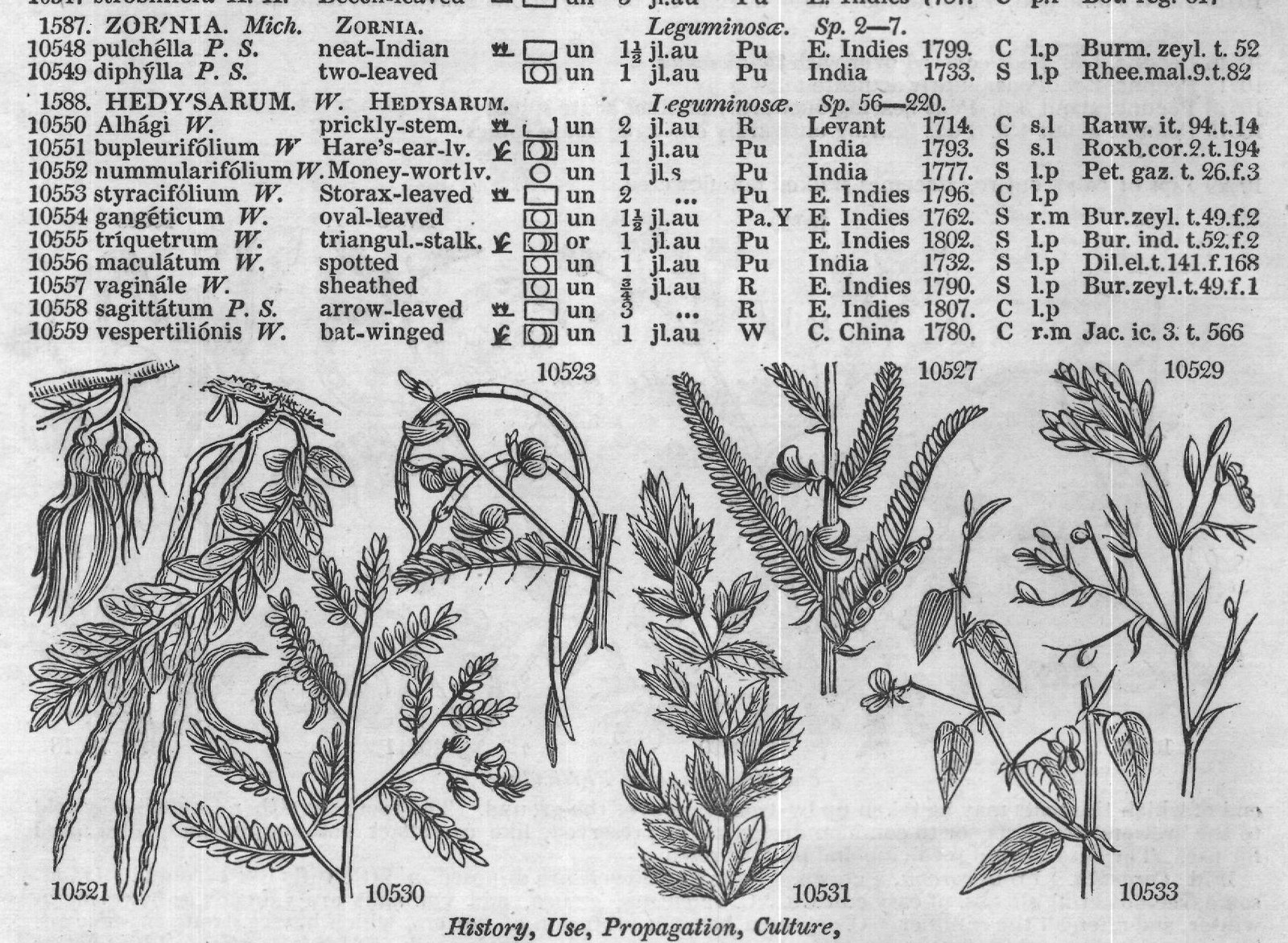
Levant 1714. C s.l India 1793. S s.1 India 1777. S l.p E. Indies 1796. C l.p Pa.Y E. Indies 1762. Sr.m Pu un 1 jl.au Pu Rauw. it. 94.t.14 Roxb.cor.2.t.194 Pet. gaz. t. 26.f.3 Bur.zeyl. t.49.f.2 E. Indies 1802. S l.p Bur. ind. t.52.f.2 India 1732. S l.p Dil.el.t.141.f.168 E. Indies 1790. S l.p Bur.zeyl.t.49.f.1 E. Indies 1807. C 1.p C. China 1780. Cr.m Jac. ic. 3. t. 566 Burm. zeyl. t. 52 Rhee.mal.9.t.82 10523 10527 10529 10521 10530 10531 10533 History, Use, Propagation, Culture, 1581. Sesbania. The Arabic name Sesban, a little Latinized. Most of these plants are ornamental. S. grandiflora is a beautiful plant; it grows in peat and loam, and cuttings root in sand under a hand-glass. 1582. Æschynomene. A name given by Pliny to a plant which withdrew its leaves from the contact of the hand. It is derived from aiσχύvoμai, to be modest. One of the species of Æschynomene is sensitive, but it is not the plant of Pliny. 1583. Stylosanthes. From 5uλoς, a style, and avθoς, a flower: a flower with a very long style. Worthless tropical weeds. 1.584. Hallia. Named after Birger Martin Hale, a pupil of Linnæus, and the student under whose name the thesis called Nectaria florum stands in the Amœnitates Academicæ. 1585. Lespedeza. Named by Michaux, in honor of Lespedez, a governor of Florida, who protected that botanist in his botanical researches. Herbaceous, chiefly North American plants with little merit. 1586. Flemingia. Named after Dr. John Fleming, president of the East India Company's Medical Board at Bengal. 1587. Zornia. Supposed to have been named after Mr. John Zorn, an apothecary at Kempten, in Bavaria, author of a work called Icones Plantarum Medicinalium, in five volumes, octavo, between the years 1779 and 1784. There was also a Dr. Bartholomew Zorn, of Berlin, author of Botanologia Medica, 1714, 1588. Hedysarum. From ήδuς, sweet, and aξωμa, smell; some the species have fragrant flowers. A ORDER IV.
DIADELPHIA DECANDRIA. 10521 Racemes about 3-fl. Leafl. obl. emarg. smooth, Pods filiform straight compressed 10522 Racemes many-fl. Leafl. lin. blunt mucronate, Rachis of leaves smooth, Pods filiform round 10523 Racemes few-fl. Leafl. linear blunt mucronate, Rachis of leaves prickly, Pods filiform round 10524 Pedunc. 1-fl. Leafl. lin. blunt mucronate, Rachis of leaves smooth 10525 Racemes many-fl. pendulous, Leafl. lin. blunt, Pods filiform round moniliform 10526 Stem smooth, Leafl. lin. blunt, Racemes few-flowered, Pods smooth 10527 Stem rough below, Leafl. lin. blunt, Racemes comp. hispid, Joints of pod rough in middle 10528 Stem hispid, Leafl. lin. blunt, Racemes simple, Pods hispid 10529 Stem hispid, Leafl. lin. falcate acuminate, Racemes simple, Joints of pods roundish distinct smooth 10530 Stem smooth, Pods smooth torose on one side and blunt, Leaflets blunt 10531 Leaves ovate lanc. smooth, Spikes many-fl. Bractes smooth mucronate, Stem downy 10532 Leaves lanc. mucronate smooth, Pedunc. 1-fl. the length of leaves 10533 Leaves cordate obl. acute smooth, Pedunc. the length of leaves 10534 Leaves cordate ovate convolute imbricated, Flowers axillary sessile 10535 Leafl. subovate villous beneath, Flowers in sessile fasicles, Stem shrubby 10536 Leafl. oblong, Fasicles of flowers sessile numerous, Pods nearly naked acute 10537 Leafl. somewhat lin. hairy beneath, Racemes axillary, Pods smooth length of calyx 10538 Simple, Leafl. ellipt. Spikes capitate on short stalks axillary and terminal, Cal. vill. length of cor. 10539 Branched villous, Leafl. round oval, Spikes axillary on long stalks, Cor. as long as calyx 10540 Branched diffuse, Leafl. ellipt. blunt hairy beneath, Racemes short umbelled 10541 Leaves ternate ovate, Racemes oblong, Pods inflexed, Calyx hairy 10542 Stem subsimple upright, Leafl. broad lanc, smooth, Racemes axill. sol. length of petiole 10543 Branched nearly upright, Leafl. ellipt. smooth, Petioles winged, Racemes panicled term, and axillary 10544 Nearly erect, Leafl. broad-lanc. Racemes axillary clustered 10545 Somewhat branched, Leafl. obovate, Petioles winged, Racemes clustered, Pods gland. viscid 10546 Erect branched, Leafl. obovate cuneate, Racemes axill. on long stalks dichotomous 10547 Leaves simple, Spikes like cones, Bractes cucullate foliaceous netted 10548 Leaves ternate large, Bractes numerous orbicular lined 10549 Leaves binate ovate-lanc. Bractes ovate acute 10550 Leaves simple lanc. blunt, Stem spiny 10551 Leaves simple lanc. acute, Stem unarmed, Stipules scarious 10552 Leaves simple obovate roundish, Stipules scarious shorter than petiole, Pods smooth netted 10553 Leaves simple cordate-roundish blunt smooth above downy beneath 10554 Leaves simple ovate acute with stipules 10555 Leaves simple cordate oblong stalked winged, Branches 3-cornered 10556 Leaves simple ovate blunt 10557 Leaves simple cordate oblong, Petioles simple, Stipules sheathing 10558 Leaves simple cordate lanc. sagittate, Flowers solitary, Pedunc: capillary very long 10559 Leaves simple and ternate intermediate 2-lobed: lobes spreading lanc. Joints of pod wavy plaited 10535 10551 10557 10541 10554 00000 10547 10559 10549 and Miscellaneous Particulars. numerous genus, not remarkable for beauty, but containing two curious species, the manna plant, and the turning Hedysarum; and one of considerable importance in European agriculture, the Saint-foin. H. Alhagi is a thorny shrub, with lanceolate leaves, and coriaceous, subcylindric, and scarcely jointed pods. It is on this plant that Manna Trungebeen is found in Mesopotamia (Russ. Alepp.) and other eastern countries. It is chiefly gathered about Tauris, where the shrub grows plentifully. Sir George Wheeler found it growing in Tinos; Tournefort also found it in many plains of Armenia and Georgia, and made a distinct genus of it, under the name of Alhagi, from the Arabic Aghul or Al-gul. H. gyrans is a native of Bengal near the Ganges; and is called there Buram Chadali, or Burram Chandali. This is a wonderful plant, Linnæus observes, on account of its voluntary motion, which is not occasioned by any touch, irritation, or movement in the air, as in Mimosa, Oxalis, and Dionæa; nor is it so evanescent as in Amorpha. No sooner had the plants raised from seed acquired their ternate leaves, than they began to be in motion this way and that; this movement did not cease during the whole course of their vegetation, nor were they observant of any time, order or direction; one leaflet frequently revolved, whilst the other on the same petiole was quiescent; sometimes a few leaflets only were in motion, then almost all of them would be in movement at once: the whole plant was very seldom agitated, and that only during the first year. It continued to move in the stove during the second year of its growth, and was not at rest even in winter. (Supp. Linn.) Swartz observes, that the motion is irregular, and that it sometimes ceases entirely; that in a very hot day it is immoveable, being agitated only in the evening, and that slowly. In our climate, the leaves, in Ss 4 un 3 pr 2 au un 2 un 2 jl un 2 jn.jl 10567 malacophýllum Link. soft-leaved ☑ un 2 jn.jl 10568 gýrans W.
Moving-plant cu 3 jl.au 10569 trigónum W. three-sided un 1 jl.au 10570 canadénse W.
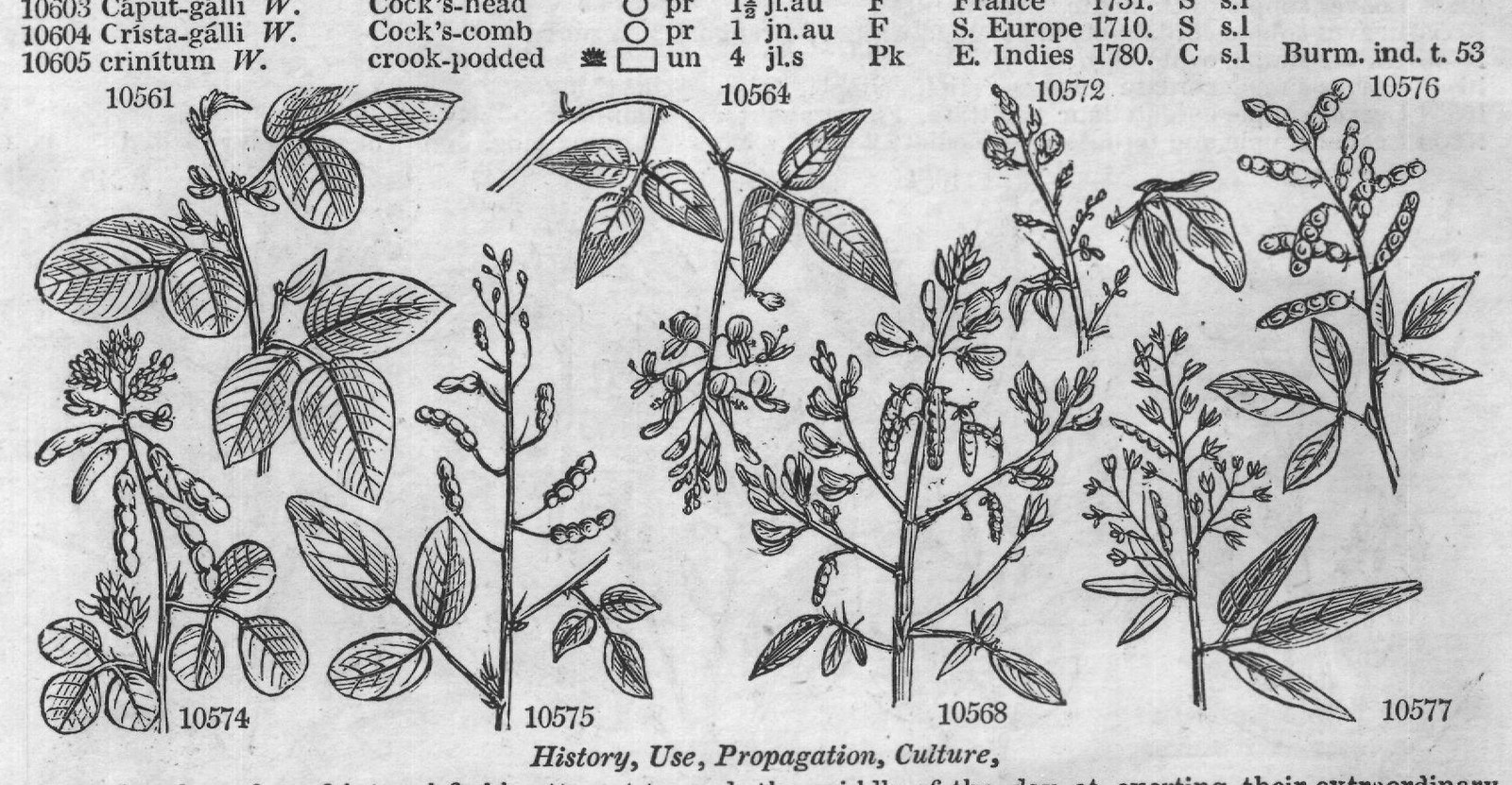
Canadian ✓ un 6 jl.au woolly DIADELPHIA DECANDRIA. un 1 jn.jl Pu umbel-flowered ☐ un 3 10560 tomentósum W. 10561 umbellátum W. 10562 biarticulátum W. 10563 latifólium Roxb. two-jointed broad-leaved hooked 10564 uncinátum Jacq. 10565 lagocéphalum Link. woolly-headed 10566 aparínes Link. Bedstraw China 1782. C l.p E. Indies 1801. Cl.p E. Indies 1808. C 1.p China 1818. Cl.p Caraccas 1823. C co Brazil 1824. C co Mexico 1823. C p.1 Manilla 1822. C p.l E. Indies 1775. S p.1 Jamaica 1733. D s.1 N. Amer. 1640. D s.l CLASS XVII.
Jac.schœ.3.t.297 Bur. zeyl.t.50.f.2 Bot. reg. 355 Jac. schön. t.298 Jac. ic. 3. t. 565 Corn.canad.t. 45 W Pu Pu Pu Y Pu Pu Pu Pu Pu 10571 canéscens W. hoary ✓ un 2 jl.au W.pu N. Amer. 1733. D s.l 10572 marilándicum W. Maryland Aun 1 jl.o Pu 10573 obtúsum W. obtuse ✓ un 2 jl.au V 10574 capitátum W. headed un 3 jl Pu 10575 tortuósum W. twisted-podded un 3 jl.au Pu 10576 viridiflórum W. green-flowered un 3 jl.s G 10577 paniculátum W. panicled Apr 2 jl Pu 10578 tuberósum W. tuberous un 3 ...
Pu 10579 cuspidátum W. 10580 glutinósum W. 10581 serotínum W. en. 10582 triflórum W. sharp-pointed Aun 1 jl.au V glutinous Aun 1 jl.au Pu late-flowering Aun 1 jl.s V three-flowered un 2 jn.jl Pu 10583 volúbile W. 10584 píctum W. 10585 argénteum L. 10586 fruticósum W. 10587 sennoídes W. 10588 alpínum W. 10589 obscúrum W. 10590 taúricum W. alpine twining Aun 3 jl.s Pu painted-leaved un 6 Pu ... silver-leaved A un jl.au Siberian-shrub. el jn.jl Senna-like un 3 jl.au Pu ...... el 4 jn.jl Pu creeping-rooted el jl.au Pu Taurian pr 12 jl 10591 róseum H. K.
Rose-colored pr jl.au Pk 10592 coronárium W.
Fr. Honeysuckle 10593 flexuósum W. wave-podded O un 1 jl.au sp 4 jn.jl Sc Pu 10594 húmile W. dwarf Pu 10595 muricátum W. prickly-podded Y 10596 spinosíssimum W. thorny 10597 Onobrýchis W.
Saint-foin 10598 saxátile W. rock 10599 álbum W. 10600 ascéndens Swz. white ascending Pu ẞ cæruleum Lindl. 10601 grandiflórum Bieb. 10602 cándidum Bieb. 10603 Cáput-gálli W. 10604 Crista-gálli W. blue large-flowered white Cock's-head Aor 1 jn.au Apr my.jn Pu pr 1½ jl.au F unjl.au un 1 jn.jl un 1 jl.au ag 1 jn.jl or 1 jn.au Apr 1 jn.au ...
Jamaica 1781. C s.l N. Amer. 1787. D s.l N. Amer. 1781. C s.l E. Indies 1806. D s.l N. Amer. 1806. D s.l N. Amer. 1805. D s.l • India 1796. S s.l N. Amer. 1727. C s.l E. Indies 1788, C p.l Pa.pu Siberia 1796. D s.l Pu Siberia 1782. C s.l 1823. C co Siberia 1798. D s.l Alps of Eu. 1640. D s.l Pa.pu Tauria 1804. D s.l Caucasus 1803. S s.l Italy 1596. S co Asia 1680. S s.1 Spain 1640. D s.l Patagonia 1793. D s.l Pa.pu Spain 1731. S s.l Britain ch.pa. D s.l S. Europe 1790. D s.l Hungary 1804. D s.1 Jamaica 1818. C s.l W. Indies 1818. C s.l Tauria 1821. D co Tauria 1824. D co France 1731. S s.l Pk L.Y W un 1 jn.au un 2 jn.au B Pu Bur.ind.t.54.f.1 Slo. ja.1.t.116.f.2 Plu.alm.t.308.f.5 Pl. man. t. 432. f.6 Bur. ind. t. 54.f.2