Com
hort.2.t.82 Al.ped.1.t.10.f.2 Vent. cels. t. 32 Barr. ic. 1239 Cav. ic. 2. t. 192 Bot. mag. 329 Bot. mag. 2450 Cav. ic. 2. t. 152 Magn.mons.t.17 Bot. mag. 317 Bot. mag. 335 ...
D co D co D co ... 1542. ANTHYL/LIS. W. KIDNEYVETCH.
Leguminosæ.
Sp. 14-35. four-leaved common or or 1 jl.au W red-flowered or A my.au Y my.au R ...... 10174 10175 S. Europe 1640. S co Britain ch.pas. D s.l 10178 Bot. mag. 108 Eng. bot. 104 ... 10179 10183 10185 10186 History, Use, Propagation, Culture, has proved serviceable in dropsical cases. A salt prepared from the ashes is recommended in the same disorder.
G. triquetra is the handsomest hardy species: it is evergreen, and produces a vast profusion of bloom. 1539. Lebeckia. Named by Thunberg: possibly in honor of some forgotten botanist. Young cuttings root freely in sand under close cover. 1540. Ulex. A word of very obscure meaning. De Theis derives it from ac, a point in Celtic. U. europæus, Jonc-marin, Fr., is a beautiful evergreen shrub, which flowers freely, both when wild and cultivated, the greater part of the year. It abounds in some places, and there it is despised by the common people; but the greatest botanists have admired its deep green shoots and leaves, brilliant yellow flowers, and tufted picturesque shape. About Petersburg, it forms one of their most valuable greenhouse plants, flowering in winter. Linnæus lamented that he could hardly preserve it alive in a greenhouse. Many parts of Germany are wholly destitute of the furze bush, insomuch that Dillenius was in 'a perfect extasy when he first saw our commons covered with its golden flowers. And Gerarde relates, that about Dantzic, Brunswick, and in Poland, there was not a branch of it growing, except some few plants and seeds that he sent, which were most curiously kept in their fairest gardens. As an agricultural plant the furze has been sown in several parts of the island as hedges; but excepting where it occupies a breadth of ten or twelve feet on a raised mound, it does not last long, getting naked below. Sown on a mound the sides may be out, and the prunings used as fuel or as green food, and the fence thus rendered close at bottom and durable. It is sown in fields, and ORDER IV.
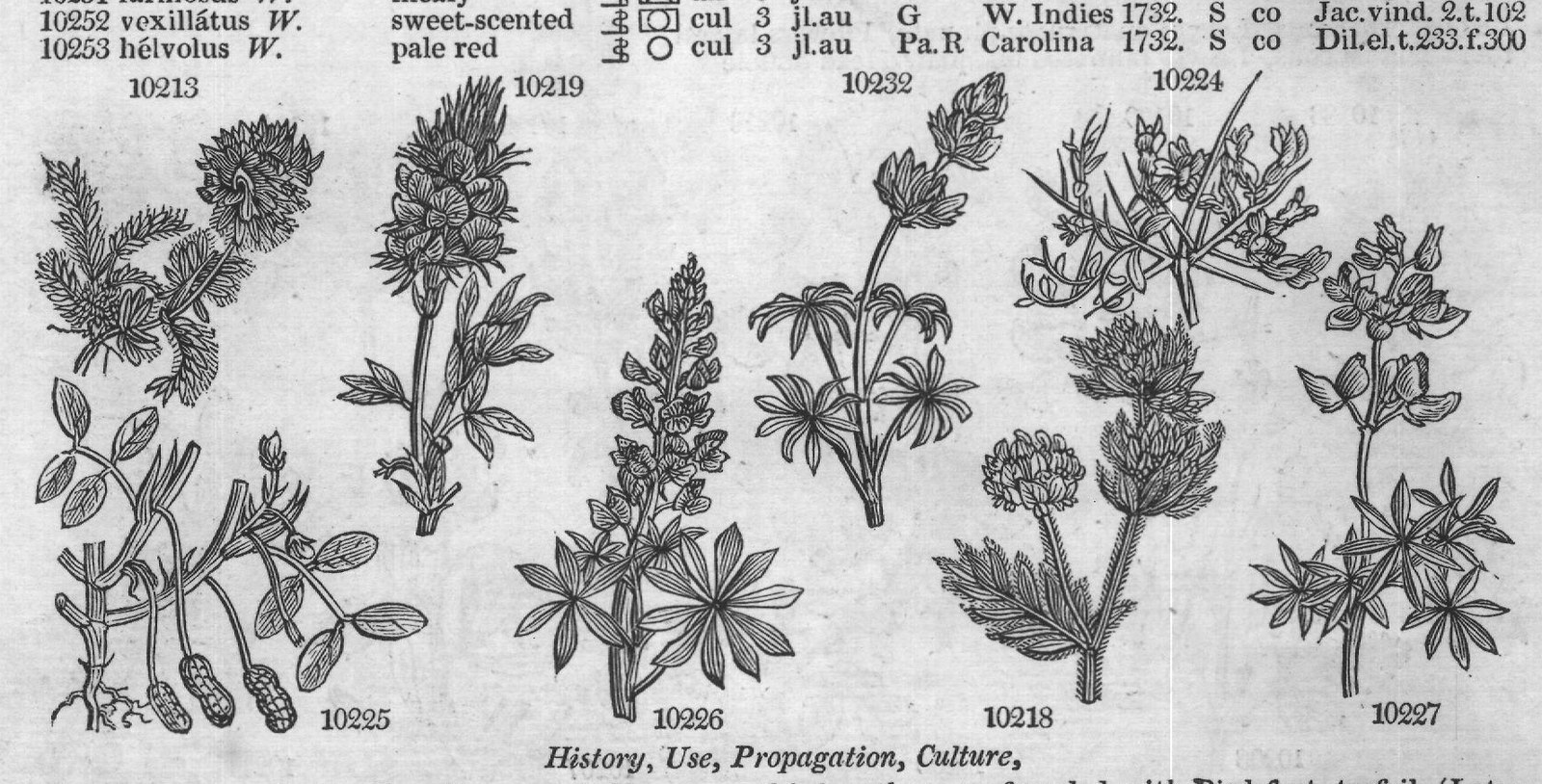
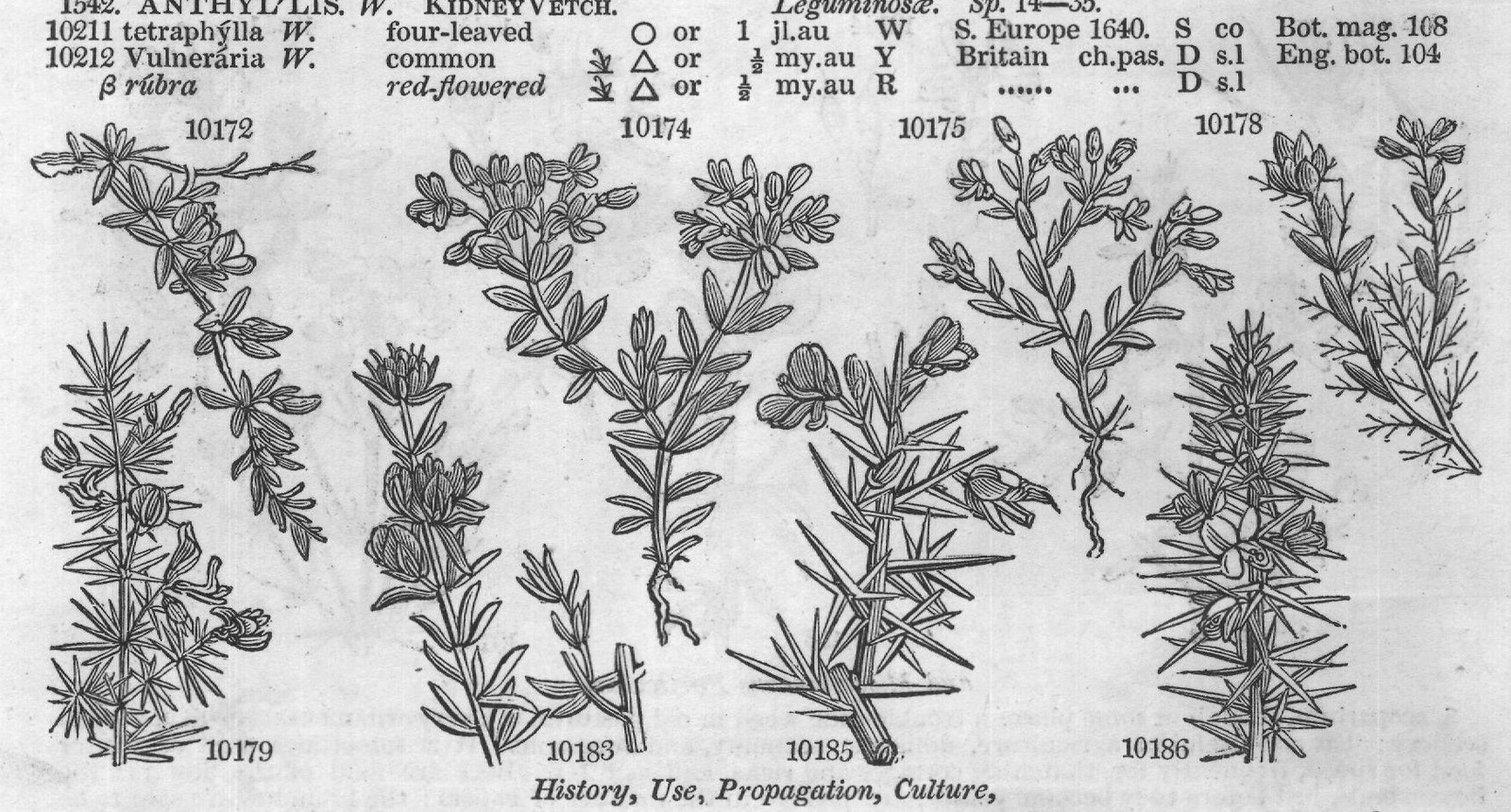
DIADELPHIA DECANDRIA. 10170 Leaves lanceolate silky, Branches striated round, Racemes 1-sided 10171 Leaves lanceolate acute, Pedunc. axill. 3 longer than leaves, Cor. smooth, Branches striated round 10172 Leaves lanceolate blunt silky beneath, Pedunc. axillary as long as leaf, Cor. silky, Branches angular 10173 Leaves lanceolate complicate, Pedunc. axill. very short, Cor. hairy, Stem warted striated procumbent 10174 Leaves lanceolate smooth subciliate, Pedunc. axillary, Cor. smooth, Branches 3-cornered procumbent 10175 Leaves lanceolate silky beneath, Fl. terminal somewhat racemose, Cor. silky, Branches erect round 10176 Spines simple or compound, Flowering branches unarmed, Leaves oblong smooth, Racemes leafy term. 10177 Spines warted compound, Fl. branches unarmed, Lvs. lanc. hairy, Racemes term. naked, Keel pubesc. 10178 Spines compound pungent, Leaves lanceolate villous, Racemes terminal subcapitate 10179 Stem leafless, Spines crossing each other 10180 Leaflets ternate obovate, Racemes short, Bractes linear under the flower 10181 Leaves simple linear filiform smooth, Flowers umbelled 10182 Leaves ternate silky, Leaves linear, Flowers racemose 10183 Leaves ternate villous, Raceme long terminal 10184 Leaves simple binate or ternate sessile lanceolate acute rough 10185 Teeth of cal. conniving, Bractes ovate loose 10186 Teeth of cal. distant, Bractes minute appressed 10187 Fl. solitary larger than leaflet, Lower leaves ternate lanceolate toothed at end, Branches spiny smooth 10188 Fl. twin axillary, Lower leaves ternate lanc, serrate, Branches spiny villous 10189 Fl. twin, Lower leaves ternate ellipt. serrate pubescent, Stem unarmed villous viscid 10190 Fl. solitary axill. Lower leaves ternate roundish serrate, Branches ascending spiny villous 10191 Fl. subsess. lateral, Leaves ternate obl. pubesc. Stipules lanc. toothletted, Cal. scarious longer than cor. 10192 Fl. sessile spiked, Bractes stipular ovate ventricose scarious imbricated 10193 Fl. subsess. lateral spiked, Leaves simple ovate blunt, Stipules dilated, Cal. larger than smooth corolla 10194 Fl. somewhat stalked axill. Lvs. simple obov. striated serrated, Stipules ovate toothed, Stem procumbent 10195 Pedunc. unarmed very short, Upper leaves simple, Stipules ovate lanc. entire 10196 Racemes straight, Leaves cuneiform, Pods nodding linear recurved 10197 Leaves ternate obovate, Pedunc. lateral 2-flowered 10198 Pedunc. unarmed 1-fl. Leaves ternate roundish crenate, Pods cernuous 10199 Pedunc. unarmed 1-fl. Leaves ternate cuneate, Stipules-serrate, Stems prostrate 10200 Pedunc. 1-fl. awned, Leaves sessile ternate, Stipules sheathing toothed 10201 Pedunc. 1-fl. awned, Leaves tern. cuneate toothed at end villous viscid, Cal. larger than corolla 10202 Pedunc. 1-fl. awned length of leaves, Leaves simple oblong serrated viscid: lower ternate 10203 Pedunc. 2-fl. awned shorter than petiole, Leaves tern. oblong, Pods linear cernuous 10204 Pedunc. 1-fl. awned longer than leaf, Awns length of cor. Leaves ternate lanc. serrated at end 10225 Pedunc. 1-fl. awned longer than leaf, Leaves ternate viscid obl. toothed at end 10206 Pedunc. awned about 1-fl. Leaves all ternate channelled recurved wholly serrated 10207 Shrubby, Leaves tern. linear fleshy 3-toothed, Pedunc. 2-flowered 10208 Shrubby, Leaves tern. roundish wavy toothed viscid, Pedunc. 1-flower unarmed 10209 Shrubby, Leaves sessile ternate lanceolate serrated, Stipules sheathing, Pedunc. 3-flowered 10210 Shrubby, Leaves tern. ovate toothed, Cal. with 3 bractes, Pedunc. 3-flowered 10211 Herbaceous, Leaves quaternate-pinnate, Flowers lateral 10212 Herbaceous, Leaves pinnated unequal, Head double 10188 10203 10190 10206 10210 10207 10192 10194 10211 and Miscellaneous Particulars. allowed to grow three or four years, and then it is cut down for fuel or for heating ovens; but the most profitable application of furze, whether sown or grown wild, is that of using it as green food for cattle. For this purpose, the shoots should not be more than two years old, and they require to be passed between rollers to bruise the ligneous parts and the thorns. It has been tried in this way by a number of agriculturists, and found a highly nutritive food for horses, oxen, and kine. Though a hardy plant and enduring the sea breeze, yet it is frequently killed by severe winters. It is never found on wet-bottomed clays, but generally on dry it is frequently killed by severe winters. It is never found on wet-bottomed clays, but generally on dry rocky or stony soils. There is a very luxuriant variety called the Irish whin, and one with double flowers found a few years ago in Devonshire, and now in propagation by cuttings in the nurseries. U. nanus greatly resembles the common species, but is smaller in all its parts. It flowers from August to January, which renders it valuable in shrubberies as a successor to the other. 1541. Ononis. From ovos, an ass, because asses only feed upon so prickly a plant. O. spinosa, Arrète boeuf, Fr., Rest harrow, Eng., was formerly very troublesome in corn fields, on account of its long ligneous roots obstructing the progress of the plough, and its thorny branches the harrow: but in all properly cultivated lands the plant has disappeared. It is frequent in aboriginal pastures on dry soils, and is eaten by cows, sheep, and goats, but not freely by horses. All the species are of easy culture, and the greenhouse kinds are readily increased by young cuttings under a bell-glass in sand. 1542. Anthyllis. From avθoς, a flower, and iouλoς, a beard. So called from the silky appearance of its heads of flowers; whence also one species is called Barba Jovis. A. Vulneraria is recommended as a herbage Rr3 10213 montána W. 10214 serícea W. 10215 cornicína W. 10216 lotoídes W. mountain jn.jl Pu wing-leaved or jl.au W horny or 1 jl.au W Lotus-like or jn.jl Y 10217 Gerárdi W.
Gerard's or jn.au W DIADELPHIA DECANDRIA. or S. Europe 1759. D s.l Barbary 1786. C p.l Spain 1759. S p.l Spain 1739. S co Provence 1806. S co CLASS XVII.
Bot. cab. 578 Desf.ac.par.1.t.3 Cav.ic.1. t.39. f.2 Cav. ic. 1. t. 40 Ger. prov. t. 18 10218 Bárba-jóvis W.
Jupiter's Beard or 3 mr.my Pa.Y 10219 crética W.
Cretan or 1½ jn.jl Pk 10220 heterophýlla W. various-leaved ☐ or 1 jn.jl Pk 10221 cytisoídes W. downy-leaved or 2 ap.jn W 10222 Hermánniæ W.
Lavender-lvd. 姓 or 1½ ap.jl Y 10223 tragacanthoides P.s. Goat's-thorn-like or 1 jn.jl W Barbary S. Europe 1640. C p.l Candia 1737. C p.1 S. Europe 1768. C p.1 Spain 1731. C p.l Levant 1739. C p.l Cp.l Bot. mag. 1927 Bot. mag. 1092 Barr. ic. 1182 Alp. exot. t. 26 ... 10224 erinácea W. prickly or 1 ap.my Pu Spain 1759. C s.p