Home › C › Cruciferæ (Sp sat vus L common a rad cula)
Cruciferæ (Sp sat vus L common a rad cula)
Sp. 5-9. 9301 satívus L. common a radícula Dec. long B oblon'gus Dec. oleìfera Dec.
Turnip Oil-seed & niger Dec.
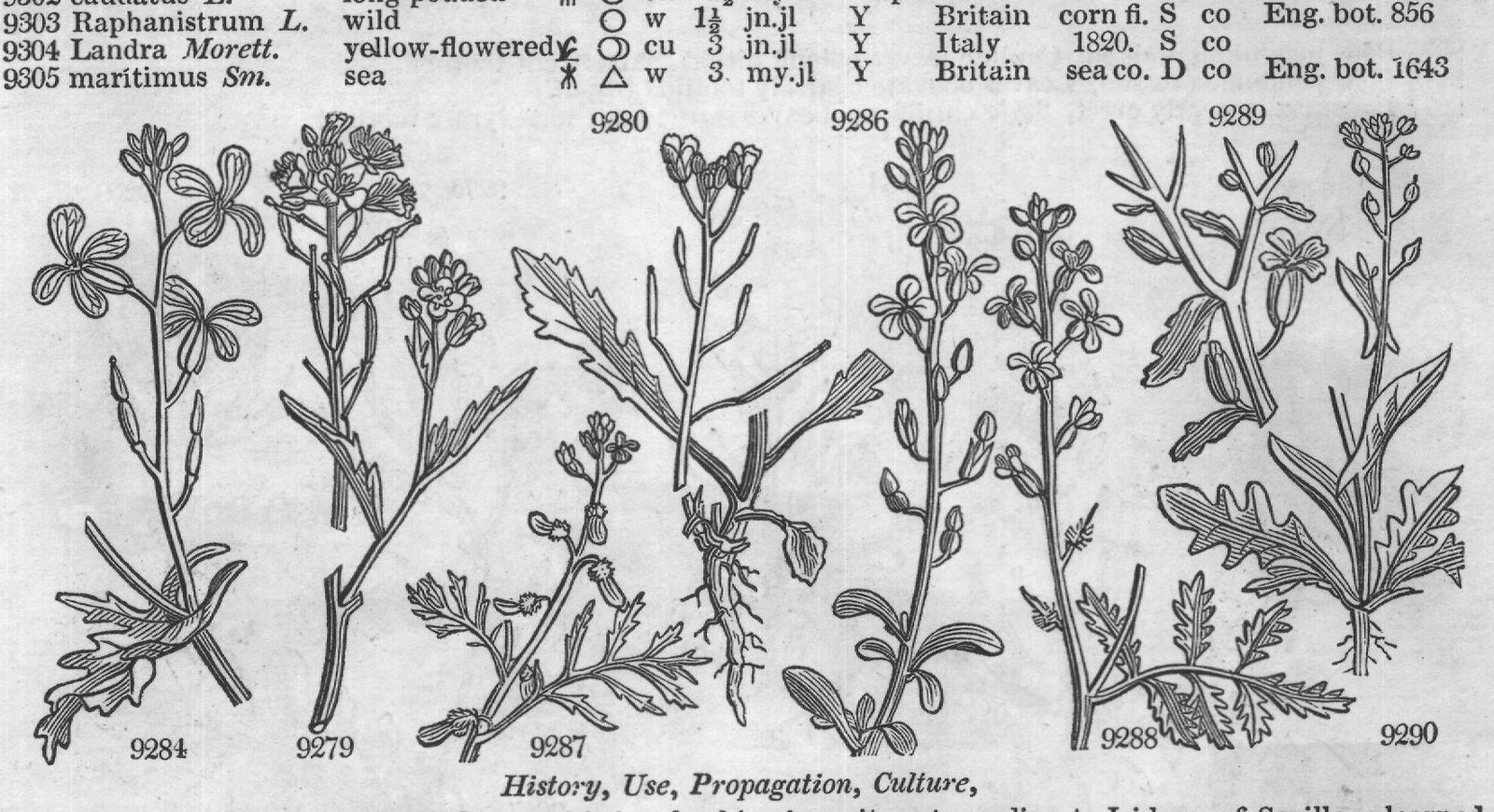
Black Spanish * 9302 caudátus L. 9303 Raphanistrum L. 9304 Landra Morett. long-podded ***** O cu 3 my.jn W.pu China 1548. Sr.m Lam, ill. t. 566 cu 3 my.jn W.pu China 1548. Sr.m cul 3 my.jn W.pu China 1548. Sr.m ec 3 my.jn W.pu China 1548. Sr.m cul 3 my.jn W.pu China 1548. Sr.m * cu 1 my.au Pa.pu Java 1815. S co wild Ow1 jn.jl Y Britain corn fi. S co Linn. dec. 3. t.10 Eng. bot. 856 yellow-flowered cu 3 jn.jl Y 9305 marítimus Sm. sea W 3. my.jl Y Italy Britain 1820. S co sea co. D co Eng. bot. 1643 9280 9286 9289 9284 9279 9287 9288 9290 History, Use, Propagation, Culture, 1436. Eruca. The meaning of this word is involved in obscurity. According to Isidore, of Seville, a learned Spaniard, who died in 636, and left a book of etymologies, eruca is an alteration of urica, derived from uro, to burn. From eruca, the Italians formed ruchetta, the French roquetta, and the English rocket. E. sativa is very pungent in the foliage, and is used as a salad in the South of Europe for its aphrodisiacal powers: "Excitat ad venerem tardos Eruca maritos." 1437. Vella. Latinized from valer, the Gallic name of the cress. A pretty low shrub, with beautiful yellow flowers appearing in the early spring. It is hardy enough to live through the winter in a dry warm south border. 1438. Carrichtera. An unexplained name, first used by Adanson. A small annual plant, with pinnated leaves, and long erect racemes opposite to the leaves. Flowers small, pale yellow. 1439. Succowia. In honor of Professor Suckow, a learned botanist of Heidelberg. An annual, with the habit of the last, from which it differs in its subulate style and solitary seeds. 1440. Zilla. The Egyptian name of the plant, which is a large glabrous herb, with round white branches and oblong toothed leaves, which are boiled and eaten by the Arabs like those of cabbage. 1441. Calepina. A name used by Adanson, the meaning of which is unknown. This plant has been transferred by one author or another to almost every genus of Siliculosæ, but appears to be really akin to Crambe only, from which it differs in its sessile and purely unilocular silicle, in its stamens having no teeth, and in the outer petals being larger than the others. 1442. Crambe. One of the names applied by the Greeks to the cabbage, and especially to the marine cabbage. C. maritima grows on sandy shores in the west of England, and there the common people have from time immemorial been in the practice of watching when the shoots and leafstalks begin to push up the sand CLASS XV.
TETRADYNAMIA. 9278 Pods sess, nearly erect, Style roundish 1-2-seed. Lvs. pinnatif. with cut lobes and lin. sinuate toothed segm. 9279 Pods somewhat stalked erect, Style filif. short without seeds, Upper lvs. entire lower pinnatifid compound 9280 Pods sess. erect, Style short somew. filif. Rad. Ivs. toothed or lyrate smooth, Stems nearly naked ascending 9281 Pods sess. erect, Style short somew. filif. Rad. lvs. runcinate toothed hispid, Stems naked erect 9282 Pods sess. erect, Style short somew. filif. Rad. lvs. lyrate very blunt smooth, Stems naked decumbent 9283 Pods sess. erect narrowed at base, Style short conical, Rad. Ivs. pinnatifid thickish with entire lobes 9284 Lvs. lyrate pinnated with toothed acute lobes, Stem hirsute, Pedicels shorter than deciduous calyx 9285 Lvs. pinnatifid, Lobes acute nearly entire, Stem hirsute, Calyx persistent somewhat bladdery 9286 The only species 9287 The only species 9288 The only species 9289 The only species 9290 The only species 9291 Long filaments forked, Pod blunt, Leaves roundish sinuated wavy toothed glauc. and stem quite smooth 9292 Long filaments forked, Pod blunt, Leaves pinnatifid with obl. acute toothed lobes, Stern smooth 9293 Long filaments forked, Pod blunt smooth, Leaves pinnatifid toothed rough, Stem smooth [smoothish 9294 Long filam. forked, Pod blunt, Rad. lvs. decompound, Pinnæ cut toothed: younger rough; old and stem 9295 Long filam. forked, Pod blunt rugose, Lvs. pinnated with obl. lin. toothed lobes and stem rough 9296 Long filam, forked, Pod nearly blunt, Lvs. stalked toothed: lower cord.; upper ov. and stem nearly smooth 9297 Long filam. toothed, Pod blunt, Lvs. lyrate rough, Terminal lobe cord. orbicular 9298 Long filam. scarcely toothed, Pod blunt, Lvs. pinnate-lyrate hairy, Terminal lobe ovate 9299 Long filam. toothed on one side, Pod mucronate, Lvs. lyrate pinnatifid toothed hoary 9300 Filam. not toothed, Pod mucronate, Lvs. ov. toothed unequal and somew. auricled at base and stem hispid 9301 Pods round torose acuminate scarcely longer than stalk 9302 Pods depressed acuminate decumbent longer than the whole plant 9303 Pods 1-celled jointed striated 3-8-seeded longer than the style, Lvs. simply lyrate 9304 Pods 1-celled jointed substriated 2-6-seeded longer than the subulate style, Lvs. interruptedly interruptedly lyrate 9305 Pods 1-celled jointed striated 2-6-seeded, Style conical shorter than the last joint, Lvs. interrupted . lyrate 9291 9292 9300 9294 9298 9305 9303 and Miscellaneous Particulars. and gravel, in March and April; when they cut them off under ground, as is done in gathering asparagus, and boil them as greens. About the middle of the last century the plant was first introduced into gardens, grown on deep sandy soil, and blanched either by sand, ashes, litter, or by covering with flower pots, earthen pots made on purpose, or any opaque cover. It is now almost as universal in good gardens as asparagus, and like it is forced either by taking up the roots and planting them on a hotbed, or in the border of a forcing house, or by covering or surrounding them with litter in the open garden. Before covering a bed with warm litter, each plant or stool of plants is covered with an earthenware blanching pot, or a wicker case, to keep off the dung from the young shoots, and to ensure their being blanched. No plant is so easily forced; and, unlike asparagus, it yields produce the first spring after raising from seed. C. tataria is called by the Hungarians Tatar-Kenyer or Tartarian bread, and its root, stripped of the bark and sliced, is eaten with oil, vinegar, and salt. The boiled root is sweet, and eaten by children. The young shoots are boiled like those of sea kail, and have an excellent taste, but are stringy, which they would not be if well cultivated, which the plant appears to deserve. 1443. Raphanus. From pa, quickly, and φaivoμai, to appear, on account of the rapidity of its germination and arriving at perfection. R. sativus is a well known salad root, requiring a deep sandy soil to attain a large size. There are several varieties both of the spindle-shaped and globular rooted kinds, and a very distinct sort known as the black or Spanish radish. In the Horticultural Transactions, sixteen varieties are mentioned besides subvarieties, arranged as spring, summer, turnip, autumn, and winter radishes. They are all of easy culture, and the spring, summer, and turnip sorts force well on hot-beds, or on dung-beds covered with mats.
R. caudatus, or tree radish, is remarkable for the length of its pod, which is greater than the whole height of the plant. The young leaves of R. Landra are eaten by the inhabitants of Insubria as salad. TETRADYNAMIA.
CLASS XV. 1444. BUNIAS. L.
BUNIAS.
Cruciferæ.
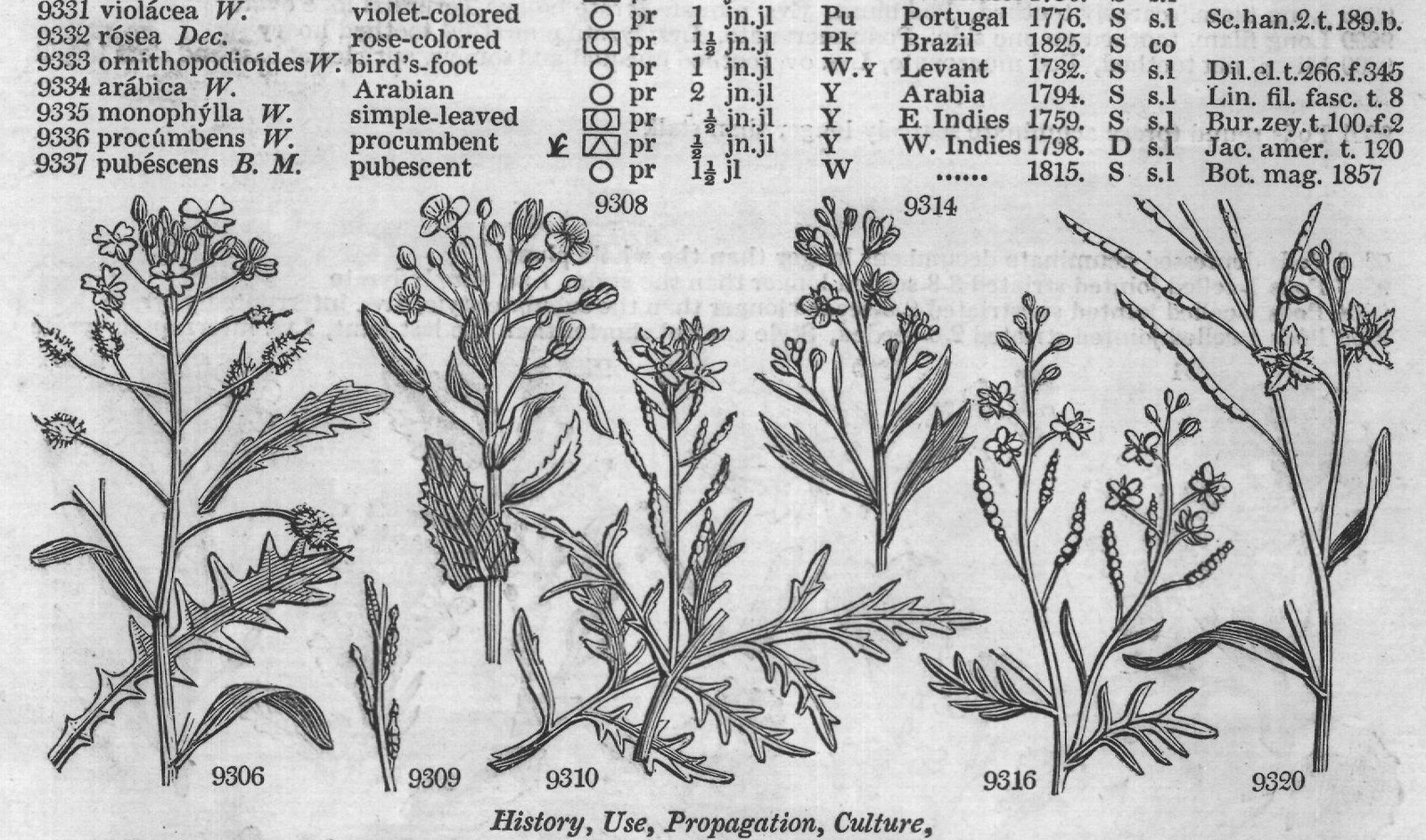
Sp. 3. prickly-podded Oun 1 jn.jl 9307 áspera Retz. rough Oun 1 jn oriental 9309 alep'pica Gærtn.
Aleppo un un 1446. HELIOPHILA. L. HELIOPHILA. 9311 filifórmis L. awl-podded pr1 jl.au 9312 amplexicaúlis L. opposite-leaved prin.s 9313 pinnáta Vahl. wing-leaved Opr 1 jn.s 9314 pilósa Lam. hairy pr 1 my.s 9306 Erucágo L. 9308 orientális L. 1445. ERUCA'RIA. Gærtn. ERUCARIA. 9310 crassifólia Del. thick-leaved Austria 1640. S co Portugal S co 1731. D co Aun 1 my.jl Y Levant