Important: Safety Warning
This page prescribes plants as medicine according to pre-modern medical theory. Several of the plants named are toxic, correct identification is difficult, and the doses given have no scientific basis. Do not ingest or apply any preparation described here.
This page presents medical treatment from an era before modern medicine. The remedies described are ineffective against the conditions named, and some of the ingredients or doses are harmful. Do not use them to treat any illness; consult a qualified medical professional.
This information has been left in for historical purposes but should not be acted upon.
Home › C › Cucurbitaceæ (Sp Bals mina W)
Cucurbitaceæ (Sp Bals mina W)
Sp. 5-17. 13555 Balsámina W.
Balsam Apple or 4 jn.jl Y 13556 Charántia W. hairy $ or 4 jn.jl Y 13557 operculáta W. rough-fruited or 4 jn.s Y 13558 Lúffa W.
Egyptian or 4 jl.au L.Y 13559 Elatérium W.
Squirting Cucumber or 4 jn.jl Y India 1568. S co E. Indies 1710. S co W. Indies 1731. S co E. Indies 1739. S co S. Europe 1548. Dr.m Bot. mag. 2455 Comm. rar. t. 22 Rum.am.5.t.147 Bot. mag. 1914 13560 ovífera W. 2021. CUCURBITA. W. GOURD. 13561 lagenária W. 13562 aurántia W. 13563 Pépo W. 13564 verrucósa W.
Cucurbitacea. Sp.8-13. egg-shaped clt 3 jl.s Y Astracan Sco ... bottle clt 10 jl.s W India Orange-fruited clt 3 jn.au Y ......
Pumpkin clt 16 jn.au Y warted clt 12 jn.jl Y ... 13565 subverrucósa W. 13566 Melopépo W. pimpled squash clt 12 jn.jl Y ...... clt 3 my.s Y 1597. S co 1802. S co Levant 1570. S co 1658. S co Sco 1597. S co Rum.am.5. t. 144 ... 13567 Citrúllus W.
Water Melon clt 6 my.s Y S. Europe 1597. S co Moris. s. 1.t.8.f.4 Rum.am.5. t.145 2022. CU CUMIS. W.
CUCUMBER.
Cucurbitaceæ.
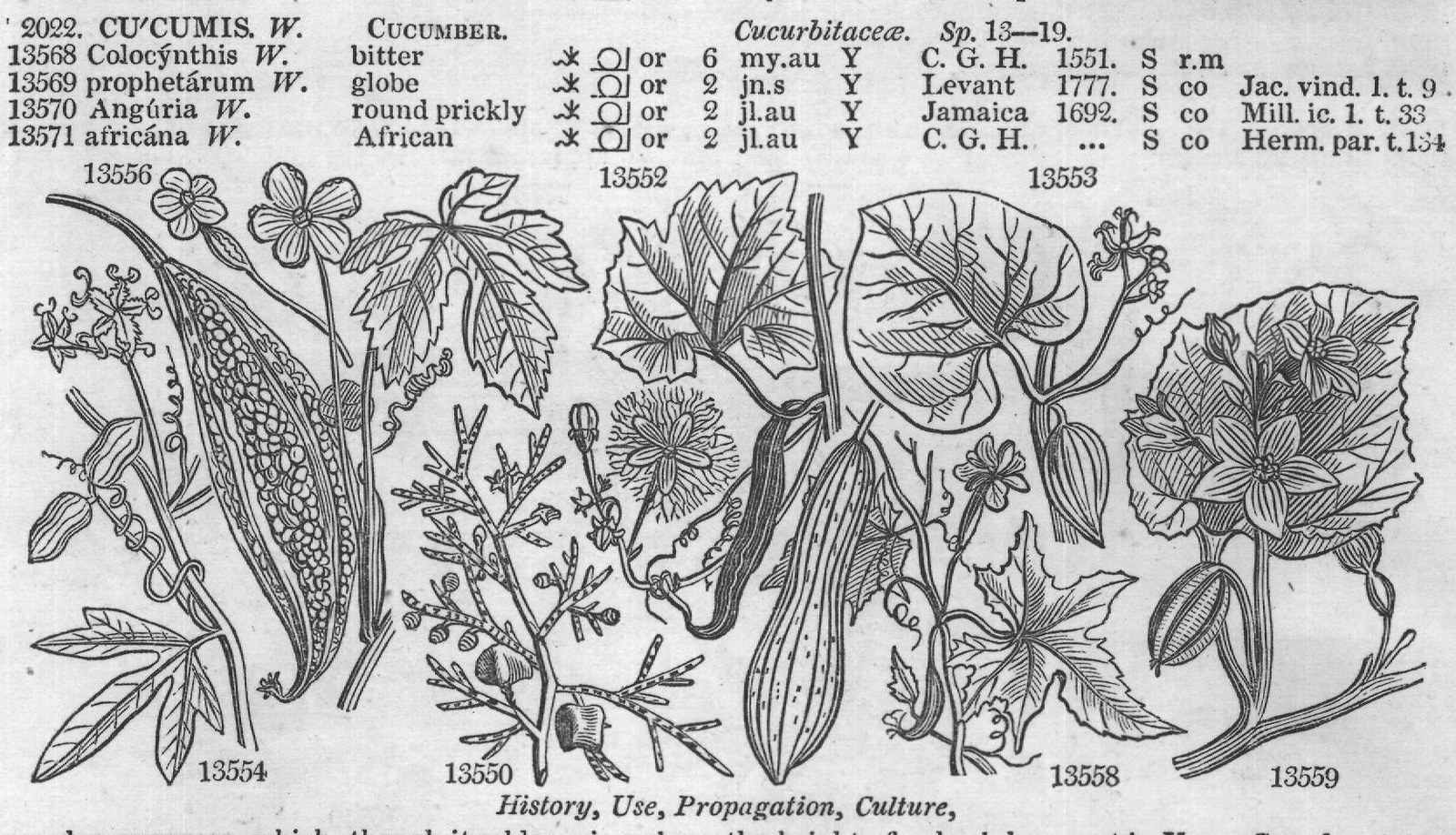
Sp. 13-19. 13568 Colocýnthis W. 13569 prophetárum W. 13570 Angúria W. bitter or 6 my.au Y globe or 2 jn.s Y round prickly or 2 jl.au Y 13571 africana W. 13556 African or 2 jl.au Y C. G. H. 1551. Sr.m Levant 1777. S co Jamaica 1692. S co C. G. H.
S co ...
Jac. vind. 1. t. 9.
Mill. ic. 1. t. 33 Herm. par. t. 134 13552 13553 13554 13550 13558 13559 History, Use, Propagation, Culture, popular evergreen, which, though it seldom rises above the height of a shrub here, yet in Upper Canada attains the height of a timber tree, and the wood is considered more durable than any other. The trunk is sawn up into planks and boards for houses and boat-building, and the branches used for posts and fencing. The smaller branches and spray form besoms, and the leaves, made into a salve, are used by the Indians to cure the rheumatism. In England, the timber has been chiefly employed by the turner and cabinet-maker. In its native country the Arbor-vitæ succeeds best in soils where the roots have abundance of moisture. It grows tallest in swamps and marshes; in very dry places it never comes to any degree of perfection. The first tree of this species sent to Europe, was planted in the royal garden of Fontainbleau, in the reign of Francis the first. T. orientalis is a shrub resembling the other in general appearance. Both these species are readily increased by seeds, cuttings, or layers. 2019. Trichosanthes. From 9iξ, hair, and avθoς, a flower. The limb of the flower is divided into ten parts, of which the five outer are reversed and acute, the five interior ciliated. T. Anguina is a popular annual, with the habit of the common cucumber. The flowers are cut into many small threads, and the fruit is taper, and nearly a foot long. T. cucumerina has smooth fruit of a red or orange color, the size of a pear. In the popular medicine of Malabar, the seeds are used for disorders of the stomach and bowels. Culture as for the common gourd. 2020. Momordica. From mordeo, momordi, to chew; its seeds have an irregular rugose surface, and the appearance of having been chewed. M. elaterium has a large fleshy perennial root, somewhat like that of Bryony. The stems are thick, rough, trailing, branching, with rough leaves on long footstalks. The fruit is an inch and a half in length, swelling like a cucumber, of a grey color like the leaves, and covered with short prickles. When fully ripe, it quits the peduncles, and casts out the seed and juice with great force and to a considerable distance through the hole in the base, where the footstalk is inserted. For medicinal use, the fruit is gathered in September, just before it is ripe; and the clear juice which runs from it and that obtained by the expression of the fruit are inspissated, and form the elaterium of the shops. This fruit is a very violent cathartic. It was much employed by the ancients, who regarded every part of the plant as purgative; but Dr. Clutterbuck has proved that this is an error. (Thomson's Lond. Disp. 388.) M. balsamina has a fleshy ovate fruit, remotely tubercled in longitudinal rows, smooth in the other parts, red when ripe, bursting irregularly, and dispersing the seeds with a spring. This fruit in Syria is famous for curing wounds. They cut it open when unripe, and infuse it in sweet oil, exposed to the sun for some days, until the oil is become red. It may then be applied to a fresh wound dropped on cotton. M. operculata has a green fruit, the top of which falls off when it is ripe like a lid; within it has no pulp, but is dry, and filled with netted fibres, very much interwoven. 2021. Cucurbita. A Latin word signifying a vessel. It is said to be derived from the Celtic cuce, a hollow thing. C. lagenaria has a fruit shaped like a bottle, with a large roundish belly, and a neck very smooth; when ripe of a pale yellow color, some near six feet long and eighteen inches round; the rind becoming hard, and being dried contains water; seeds quadrangular oblong, cut off and emarginate at top, three-cornered and beaked at bottom; edge keeled with a double raised line, smoothish, of a pale bay color. The Arabians call the bottle gourd Charrah. The poor people eat it boiled, with vinegar, or fill the shell with rice and meat, and thus make a kind of pudding of it. It grows in all parts of Egypt and in Arabia, wherever the mountains are covered with rich soil. In Jamaica, the shells are generally used for water cups, and frequently serve for bottles among the negroes and poorer sort of white people in the country. A decoction of the leaves ORDER VIII.
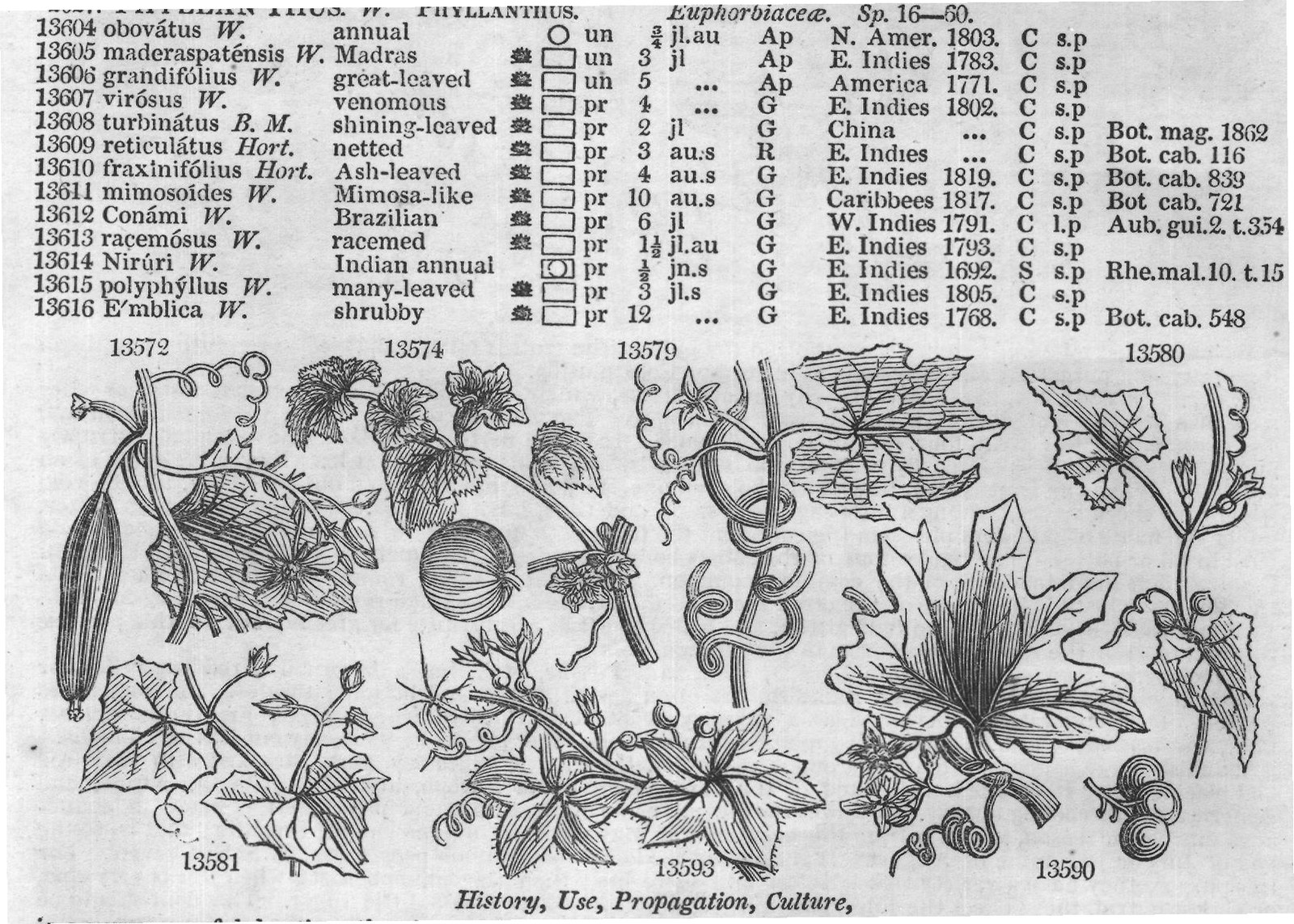
MONECIA MONADELPHIA. 13550 Branches compressed, Lvs. imbricated in 4 rows lanc. acute appressed warted under end, Cones 4-cornered 13551 Branches round, Leaves imbricated in 4 rows oblong appressed smooth, Cones 4-cornered roundish 13552 Fruit rounded oblong incurved, Leaves cordate repand mucronate toothletted 13553 Fruit ovate acute, Leaves roundish cordate angular repand 13554 Fruit oblong acute, Leaves 5-lobed palmated entire 13555 Fruit roundish ovate narrowed at each end angul. warted, Bract cordate toothed above midd. of pedunc. 13556 Fruit oblong acuminate angular warted, Bract cordate entire below the middle of the peduncle 13557 Fruit elliptical angular warted beaked, Beak deciduous forming a lid 13558 Fruit cylindrical oblong, Furrows chain-like, Bract cordate entire at the base of the peduncle 13559 Fruit elliptical hispid, Leaves cordate hispid blunt toothed, Stem without tendrils 13560 Leaves cordate angular 5-lobed toothletted downy, Fruit obovate striped with lines lengthwise 13561 Leaves cordate roundish obtuse downy toothletted with 2 glands at base beneath, Fruit woody clavate base beneath, Fruit woody clavate 13562 Leaves subcordate about 3-lobed cuspidate finely toothletted rough, Fruit globose smooth 13563 Leaves cordate obtuse about 5-lobed toothletted, Fruit roundish or oblong smooth 13564 Leaves cordate deeply 5-lobed: the middle lobe narrowed at base, Fruit roundish elliptical warted 13565 Leaves cordate deeply 5-lobed: middle lobe narrowed at base toothletted, Fruit clav. ellipt. somew. warted 13566 Leaves cordate obtuse about 5-lobed toothletted, Fruit depressed umbonate tumid at edge melle 13567 Leaves 5-lobed, Lobes sinuate pinnatifid blunt, Fruit elliptical smooth 13568 Leaves multifid, Fruit globose smooth 13569 Leaves cordate 5-lobed toothletted blunt, Fruit globose spiny muricated 13570 Leaves palmate sinuated, Fruit round echinate 13571 Fruit oval echinate, Leaves palmate sinuated, Stem angular 13561 13566 13567 سعد Cees 13569 13568 13570 and Miscellaneous Particulars. 13571 is recommended much in purging clysters; and the pulp of the fruit is often employed in resolutive poultices : it is bitter and purgative, and may be used instead of Coloquintida. C. pepo, Patisson, Fr., has hispid branchy tendril stems, which in good soil will extend forty or fifty feet in a season, and cover an eighth part of an acre. The fruit is oblong, ovate, varying in form and size some not less than four feet in circumference. In some parts of England the pompion (corruptly pumpkin) is sometimes planted by cottagers on dunghills, and suffered to trail at length over the grass of an orchard. When the fruit is ripe, they cut a hole on one side, and having taken out the seeds, fill the void space with sliced apples, adding a little sugar and spice, and then, having baked the whole, eat it with butter, under the name of pumpkin pie. On the continent the fruit, both unripe and ripe, is used in soups, stews, and fried in oil or butter. The tender tops of the shoots boiled as greens are much more delicate than the fruit. C. aurantia is more tender than the common pompion. The fruit is small, round, of a bright yellow when ripe, and may be used like those of the other species. C. verrucosa has a small round fruit, with a woody rind. In America it is gathered when half grown, and boiled to eat as a substitute for greens; but for this purpose this and most of the species are inferior to the succade Gourd .
C. melopepo, Potiron, Fr., Pfebin Kürbiss, Ger., and Popone, Ital., has a large fruit, reddish yellow or yellowish-white within and without, roundish, but often flatted at top and bottom; torulose, and sometimes warted. It is cultivated in America as a culinary vegetable. C. Citrullus, Pastèque, Fr., Wassermelone, Ger., and Cocomero, Ital., is readily distinguished from all the other species by its deeply cut leaves. The fruit is roundish, large, smooth, often a foot and a half in length, with a white icy flesh, streaked with dark red and black seeds. It is much cultivated in the warm countries of Europe, and also in Asia, Africa, and America, for its cooling quality. It serves the Egyptians for meat, drink, and physic. It is eaten in abundance during the season, which is from the beginning of May until the overflowing of the Nile; that is, to the end of July or beginning of August. It is the only medicine the common people use in ardent fevers. For this purpose they have a variety that is softer and more juicy than the common sort : when this is very ripe, or almost putrid, they collect the juice, and mix it with rose-water and a little sugar. This fruit should be eaten by Europeans with great caution; when taken in the heat of the day, whilst the body is warm, colics and other bad consequences often ensue, and it is well known that persons are much troubled with worms at the time this fruit is in season.
The Succade Gourd, a variety of C. ovifera, has an elliptic oblong pale-yellow fruit, by far the best for culinary purposes of any species of the genus. When very young, it is good fried with butter; when about half grown, it is excellent either boiled as a substitute for greens, or stewed in slices with rich sauce; when full grown, it is used for pies. Sabine, who has cultivated most species of Cucurbita, considers the vegetable marrow without a rival. (Hort. Trans. vol. ii. 255.) All the species may be raised on a hot-bed in April, and transferred to the open garden at the end of May, under a warm aspect and in a rich soil or they may be sown in a trench filled with hot dung, where they are finally to remain. Their after culture is of the easiest description. It is not very generally known, that the tender tops of all the species of the Cucurbita and Cucumis families, whose fruit may be eaten, when boiled form a very tender substitute for greens. 2022. Cucumis. A word with the same derivation as the last. C. Colocynthis has fruit the size and color of orange; the pulp light, spungy, and white, and most intolerably bitter. When ripe, it is peeled and dried in a stove, and in this state it is imported from the Mediterranean under the name of coloquintida. Medicinally, it MONECIA MONADELPHIA.
CLASS XXI. 13572 acutángulus W. acute-angled or 2 jn.s Y India 13573 Mélo W.
Melon cul 4 my.s Y 1692. S co Jac.vin.3.t.73,74 1570. Sr.m Sabb. hort. t. 65 13574 Dudáim W.
Apple-shaped or 6 jl.au Y 13575 Cháte W.
Levant hairy or 3 jn Y Levant 13576 pubéscens W. pubescent or 3 jn.s Y ...... 13577 satívus W. common cul 4 jl.s Y 13578 flexuósus W.
Snake or 6 my.s Y 13579 anguínus W.
Serpent Oor 6 my.s Y 13580 maderaspátanus W. Madras 1705. S r.m Bot. rep. 548 1759. S co 1815. S co Alp.ægypt. t.117 E. Indies 1573. S r.m Sabb. hort. t. 63 E. Indies 1597. Sr.m Ger.herb.763.f.3 E. Indies Sr.m Rumph. 5. t. 148 ... or 3 jl.au Y E. Indies 1805. S co Pluk.al. t. 170.f.2 2023. SIC YOS. W.
SINGLE-SEEDED CUCUMBER. Cucurbitaceæ. Sp. 2-6. 13581 anguláta W. angular-leaved 13582 vitifólia W. cul 3 jl.s Y Vinc-leaved cul 3 jl.s Y 2024. BRYONIA. W.
BRYONY. 13583 scábra W. 13584 tríloba W. 13585 verrucósa W. rough un 6 s.o un 4 ... 13586 grándis W. 13587 epigæa W. 13588 scabrélla W. 13589 latebrósa W. ... globe-fruited & un 6 s.o three-lobed great-flowered & un 8 my.au umbel-flower'd bristly hairy red-berried N. Amer. 1710. S co Plu.phyt.t.26.f.4 W.GC. G. H. 1774. C p.1 W.G C. G. H. 1825. C p.l W.G Canaries 1779. D Co W.G E. Indies 1783, C p.l R.am.5. t. 166. f.1 W.G E. Indies 1815. D co ...... ...
Sco