Dun
sol. t. 26 ...... 2521 tuberósum W. 2523 betáceum P. S. 2524 muricátum W.
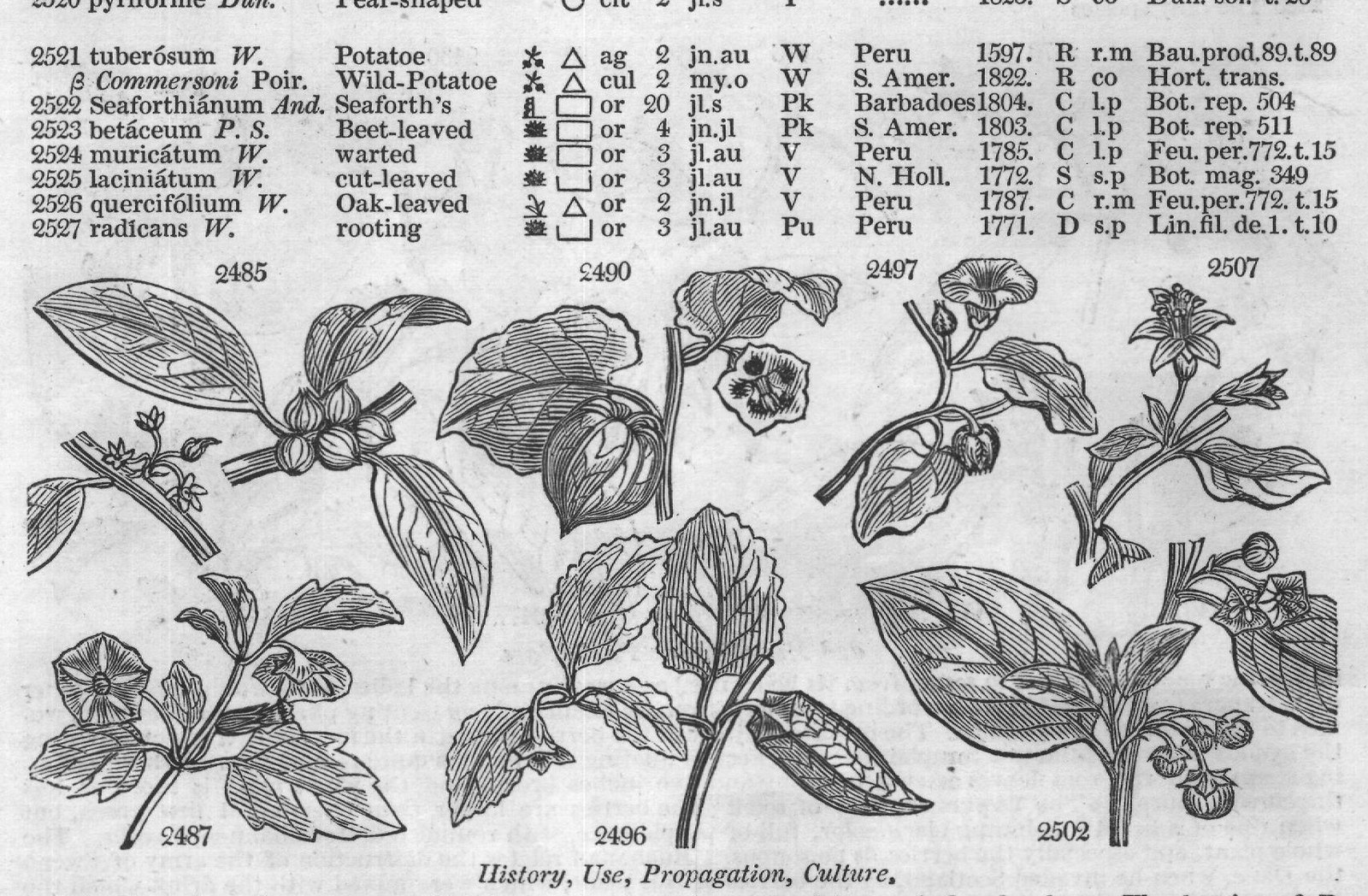
Potatoe ag 2 jn.au W B Commersoni Poir. Wild-Potatoe 2522 Seaforthiánum And. Seaforth's cul 2 my.o W Peru 1597. Rr.m Bau.prod.89.t.89 S. Amer. 1822. R co Hort. trans. or 20 jl.s Pk Barbadoes1804. C l.p Bot. rep. 504 Beet-leaved or 4 jn.jl Pk warted or 3 jl.au V S. Amer. 1803. C l.p Peru Bot. rep. 511 1785. C 1.p 2525 laciniátum W. 2526 quercifólium W. 2527 radícans W. cut-leaved or 3 jl.au V N. Holl.
Oak-leaved or 2 jn.jl V Peru rooting or 3 jl.au Pu Peru 1772. S s.p 1787. Cr.m 1771. D s.p 2485 2490 2497 Feu. per.772.t.15 Bot. mag. 349 Feu.per.772. t.15 Lin. fil. de.1. t.10 2507 2487 2496 History, Use, Propagation, Culture, 2502 448. Physalis. From φuσiς, a bladder. The fruit is enclosed in an inflated calyx. The berries of P. alkekengi are acidulous and slightly bitter; they were esteemed detergent and aperient by the ancients. In Spain, Germany, and Switzerland, they are eaten as a common fruit. Phy. peruviana produces a pleasant fruit for tarts, and is in some countries, and even English gardens, cultivated for that purpose. 449. Saracha. A plant resembling Atropa, or Physalis, to which it is too nearly related. It was named by the authors of the Flora Peruviana after Isidore Saracha, a Spanish botanist. 450. Lycium. So called because the original species was a native of Lycia, a country of Asia Minor. Some of the Cape species of this genus have elegant flowers and merit cultivation, and L. barbarum is valuable for covering naked walls, arbors, &c. It grows four or six feet in a season, flowers freely, and is readily propagated by cuttings at any season of the year. L. europæum is used for hedges in Tuscany, being armed with small thorns. Clusius says they eat the small shoots in Spain with oil and vinegar. L. ruthenicum is an ornamental shrub from its very white bark. The greenhouse species root readily in sand under a hand-glass. 451. Solanum. By some ingenious commentators this word has been derived from solari, to comfort. The derivation may be possible, but the application is not evident. This extensive genus, which belongs to the Luridæ of Linnæus's system of natural orders, does not contain many handsome plants; but it includes, besides the Tomato and egg plant, celebrated in cookery, the potatoe, whose tubers, as a human food, if equalled, are not surpassed by those of any other plant. Some of the species are singular on account of their leaves and ORDER I.
PENTANDRIA MONOGYNIA. 2484 Stem shrubby rounded, Branches upright, Flowers clustered 2485 Stem shrubby, Branches flexuose, Flowers clustered 2486 Stem shrubby, Leaves ovate tomentose 2487 Leaves in pairs repand obtuse subtomentose, Stem herbaceous panicled above 2488 Leaves ovate subrepand obtuse nearly naked, Flowers in pairs, Stein herbaceous 2489 Leaves in pairs entire acute, Stem herbaceous branching below 2490 Pubescent, Leaves cordate entire 2491 Pubescent, Stem angular, Leaves in pairs cordate nearly entire soft, Teeth of cal. acuminate 2492 Much branched, Branches angular smooth, Leaves ovate toothed 2493 Pubescent, Stem erect shrubby, Leaves subcordate toothed angular, Petioles decurrent 2494 Much branched, Leaves ovate cordate pub. Flowers pendulous, Calyx in fruit ovate acuminate angular 2495 Much branched, stalk of fruit much longer than the villous leaf 2496 Much branched, Leaves villous, Peduncles erect 2497 Much branched, Stem procumbent rounded hairy. Leaves rather fleshy 2498 Pubescent, Leaves ovate angular, Stem herbaceous, Berries viscid, Root tuberous 2499 Hairy, Leaves cordate acute toothed, Pedunc. at length reflexed, Cal. with segm. twice as short as cor. 2500 Leaves oval unequal acute toothed smoothish, Flowers solitary, Calyx powdered, Cor. tomentose 2501 Leaves in pairs toothed repand tomentose-viscid oval, Stem herbaceous panicled above 2502 Leaves in pairs unequal ovate smooth, Flowers in umbels 2503 Stem erect hairy, Umbels axillary stalked cernuous, Flowers plaited 2504 Branches diffuse spiny, Leaves linear fleshy attenuated at base fascicled, Pedunc. longer than cal. 2505 Branches upright spiny, Leaves linear fascicled, Pedunc. shorter than calyx, Stam. as long as tube of cor. 2506 Branches droop. spiny, Lvs. lin. lanc. atten. at base fasc. Ped. longer than cal. Stam, as long as limb of cor. 2507 Branches drooping, Buds spiny, Cal. trifid, Stam. as long as limb of cor. 2508 Branches drooping spiny rounded, Leaves sessile lanceolate acuminate, Cal. trifid, Berry turbinate 2509 Branches lax spiny, Leaves oblong lanc. obtuse obliquely bent, Stam. shorter than limb of cor. 2510 Branches erect flexuose at end recurved rounded much spreading spiny, Leaves subsessile lanc. acute 2511 Stem and branc. droop. striated rarely spiny, Lvs. stalked ov. obt. Cal. 5-toothed, Style longer than stam. 2512 Spiny, Leaves obovate fleshy smooth, Peduncles very short 2513 Spiny, Leaves ovate entire acute glaucous, Flowers panicled 2514 Unarmed, Leaves narrow spatulate oblong, Flowers 4-cleft tetrandrous 2515 Erect spiny, Branc. dif. angular, Lvs. stalked lanc. acute, Cal. 2 or 3-fid, Style scarcely longer than stam. §1. Lycopersicon (Love (Love Apples.) Anthers conical, joined at end. Berry many-celled. 2516 Villous hoary, Leaves stipulaceous unequally pinnatifid, Segm. obtuse, Pedunc. and pedicel bracteated 2517 Hairy, Leaves unequally pinnatifid, Segments cut glaucous beneath, Berries torulose furrowed smooth 2518 Hairy, Lvs. unequally pinnat. Segm. cut glauc. beneath, Sepals as long as cor. Berries round rather hairy 2519 Hairy, Lvs. unequally pinnat. Segm. cut glauc. beneath, Pedunc. with bract. Sepals twice as long as cor. 2520 Hairy, Lvs. unequally pinnatifid, Segm. cut glaucous beneath, Pedunc. without bract. Berries obconical §2. Unarmed. Leaves pinnate, pinnatifid, or entire. 2521 Root tuberous, Stem herbac. Segm. of Ivs. unequal, the altern. ones minute, Pedicels stalked, cor. 5-ang. jointed, Cor. 5-cleft Root tuberous, Stem herbaceous, Leaves pinnate sublyrate pilose, Pedic. joint 2522 Leaves pinnate waved, upper simple lanc. Racemes in panicled panicled cymes sometimes longer than petioles 2523 Leaves cordate ovate oblong hairy on each side waved at edge, Racemes pendulous as long as petioles 2524 Stem half shrubby rooting ascending runners muricated, Lvs. obl. lanc. pubescent simple, Racemes 2-fid 2525 Smooth, Leaves pinnatifid segments linear lanceolate terminal elongated, Racemes lateral corymbose 2526 Stem angular wavy rough, Leaves pinnatifid, Racemes cymose 2527 Stem rounded prostrate rooting, Lvs. deeply pinnat. Sinuses obtuse, Racemes cymose as long as petioles 2511 2516 2518 2515 2504 2513 2520 and Miscellaneous Particulars. 2522 spines; and others retain their fruit in our stoves during winter, which may be a recommendation to some to admit them in collections.
S. dulcamara has roots which smell like the potatoe; being chewed, a sensation of bitterness is first felt, and then of sweetness, whence the specific name. The berries excite vomiting and purging, and the twigs and leaves have been used in rheumatic and scorbutic cases with good effect. S. tuberosum, Pomme de Terre, Fr., Kartoffel, Ger., Pomo de Terra, Ital., Potades, Span., &c. is supposed to be a native of South America, and to be found in a wild state in elevated places in the tropical regions, and in the more temperate districts of the western coasts of that country. Some tubers, said to be of the wild potatoe, have been received from these parts by the Horticultural Society, and cultivated by them; their produce differs very little, if at all, from that of the common cultivated sort; they are small, roundish, and pink and white colored. (Hort. Trans. 5. 257.) It appears probable that the potatoe was first brought into Europe from the mountainous parts of South America in the neighbourhood of Quito, where they were called papas, to Spain, early in the 16th century. From Spain, where they were called battatas, they found their way to Italy, and there received the same name as the truffle, taratoufli. From Italy they went to Vienna, through the governor of Mons in Hainault, who sent some to Clusius in 1598. To England the potatoe found its way from North America, being brought from Virginia by the colonists sent out by Sir Walter Raleigh in 1584, and who returned in July 1586; and, "probably," says Sir Joseph Banks, "brought with them the potatoe." Gerarde, few-flowered 2528 corymbósum W. 2529 oligánthum Lk.
PENTANDRIA MONOGYNIA. corymbed 2530 Dulcamára W.
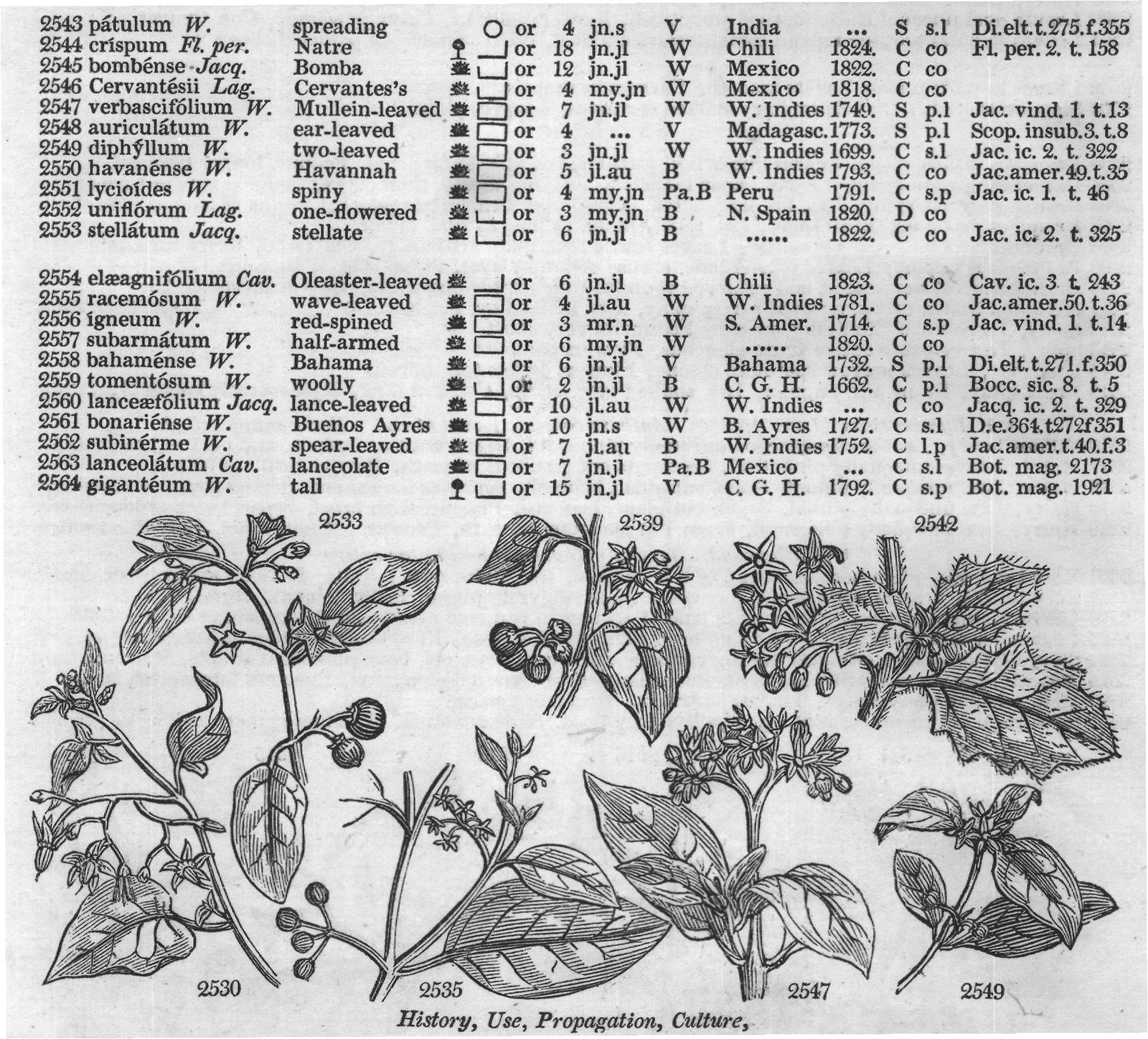
Bitter-sweet 2531 macrocárpon W. large-fruited 2532 æthiópicum W. Ethiopian 2533 Zuccágniánum Dun. scabrous 2534 Pseudo-capsicum W. Winter-cherry 2535 nodiflórum Jacq. thick-jointed 2536 guineénse W. en. large-berried 2537melanocérasum W.en.small-berried 2538 suffruticosum W.en. fringed-leaved or 4 my.s W 2539 nigrum W. black-berried 2540 miniátum Bern. red-berried 2541 húmile Bern. green-berried 2542 villósum W. en. orange-berried □□□○○○○○]○○○○ or 2 jl.au V Peru or W 1786. D co 1824. C co P 3 jn.jl V Britain or 1 my.s B Peru or 1 jl.s W or 1 jn.jl W ...... 1823. S co or 4 jn.s W ☐ w 10 jn.jl W hed. Cs.l 1759. C s.p Ethiopia 1597. C l.p Madeira 1596. Sr.m I. France 1822. S co CLASS V.
Jac. ic. 1. t. 40