Amaryllideæ (II)
Sp. 8.
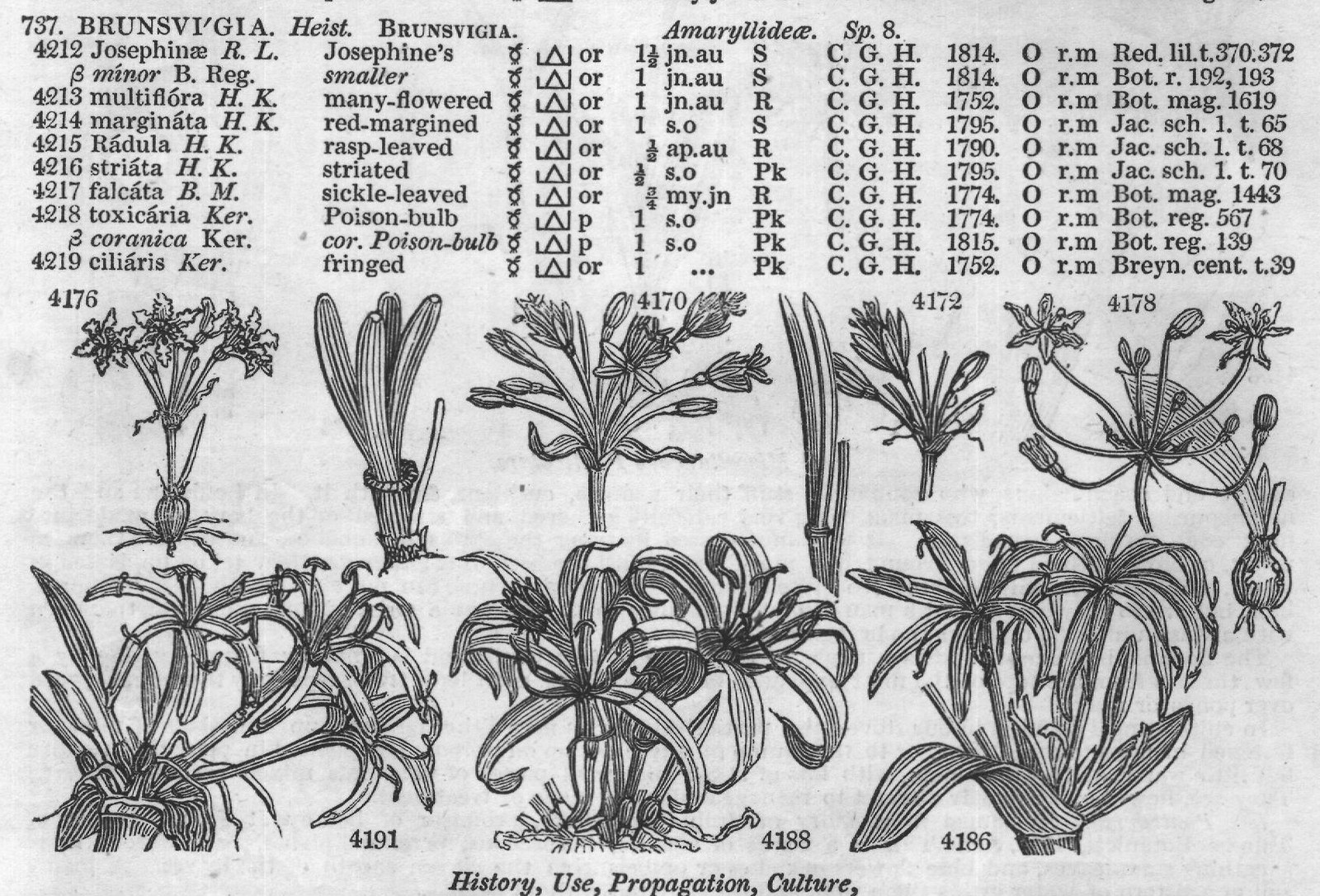
Josephine's or 1½ jn.au S C. G. H. 1814. smaller or 1 jn.au S C. G. H. 1814.
O r.m Bot. mag. 1133 O r.m Bot. reg. 168 O r.m Bot. reg. 503 O r.m Bot. mag. 2471 O r.m Red. lil.t.370.372 O r.m Bot. r. 192, 193 many-flowered red-margined or 1 jn.au R C. G. H. 1752.
O r.m Bot. mag. 1619 or 1 s.o S C. G. H. 1795.
Or.m Jac. sch. 1. t. 65 rasp-leaved A or ap.au R C. G. H. 1790.
O r.m Jac. sch. 1. t. 68 striated or S.O Pk C. G. H. 1795.
O r.m Jac. sch. 1. t. 70 sickle-leaved or my.jn R C. G. H. 1774.
O r.m Bot. mag. 1443 Poison-bulb p 1 s.o Pk C. G. H. 1774.
O r.m Bot. reg. 567 4 cor. Poison-bulb P 1 s.o Pk C. G. H. 1815. fringed or 1 ...
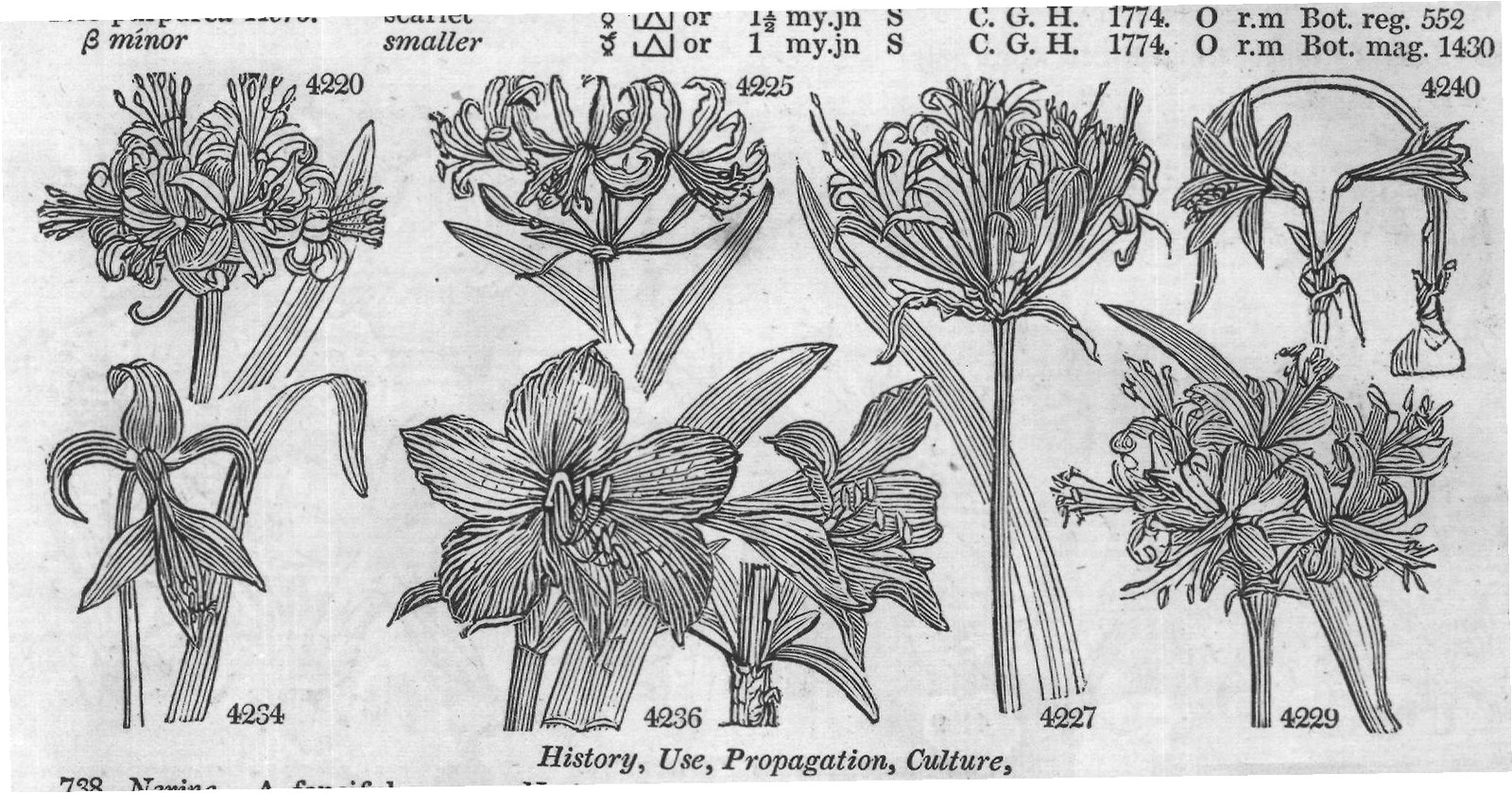
Pk C. G. H. 1752. 4170 4172 O r.m Bot. reg. 139 O r.m Breyn. cent. t.39 4178 4191 4188 4186 History, Use, Propagation, Culture, 734. Strumaria. From struma, a tubercle; a name given by Jacquin, on account of the swelling of the middle of the style. Pretty little delicate plants; their culture as in Hæmanthus. 735. Crinum. Kρivov is Greek for a lily. Its límits as a genus are defined by the hypocrateriform flower with linear reflexed segments. Some unwise attempts have been made to destroy this distinction, by admitting into this genus plants with the characters of Amaryllis. We, however, have adhered to the old, and, as we think, most intelligible, mode of understanding the genus. This is a fine stately genus of the Amaryllideæ : several beautiful species have lately been introduced. They grow best in rich loam, mixed with a little rotten dung, and potted in large pots they will flower abundantly. They may be increased by suckers from the root, or by seed. If the plant be shy in producing suckers, it may be cut down near to the root, and it will send out plenty. (Bot. Cult. 46.) 4170 Leaves linear ensiform rounded obtuse flat, Scape compressed, Stamens longer than cor. 4171 Leaves linear obliquely bent, Petals flat ORDER I.
HEXANDRIA MONOGYNIA. 4177 Sepals spreading alternately bearded beneath the ends 4172 Leaves linear flat, Germen with three glands 4173 Leaves linear ensiform rounded obtuse flat, Scape rounded, Stamens as long as cor. 4174 Leaves filiform, Petals acute 4175 Leaves filiform spiral, Petals acute colored outside 4176 Leaf filiform straight, Umb. many-flowered, Petals wavy flat 4178 Scape flexuose much longer than the lanceol. ciliated leaves, Pedunc. very long, Petals wavy channelled 4179 Leaves striated, Umbel sessile many-flowered, Tube furrowed about as long as limb 4180 Lvs. lanc. lor. with cartil. teeth, Umb. subs. many-fl. Tube longer than limb, Stam. little long. than style 4181 Ends of sepals hooked inwards, Leaves linear channelled, Scape 4-fl. 4182 Bulb with a very long tap-root, Leaves stiff erect with long points smooth at edge, Umb. sess. many-fl. 4183 Bulb spherical, Leaves narrow with a nearly smooth edge, Umb. few-fl. sess. Sep. lin. lanc. as long as tube smooth edge, Umb. few-fl. sess. Sep. lin. lanc. as long as tube 4184 Bulb oval not with a neck, Lvs. broad lin. lanc. straight with a white cartil. toothed edge, Umb. of fl. sess. 4185 Bulb round, Leaves narrowed lax channelled hispid at edge, Umb. sess. many-fl. Seg. shorter than tube 4186 Bulb ovate with a neck, Leaves broad subulate roughish at edge, Spathe herbaceous 4187 Bulb cylind. above ground, Lvs. lanc. smooth at edge longer than scape, Umb. stalk. Sep. long lin. reflexed 4188 Bulb very large with long red neck, Lvs. broad glauc. smth. at edge, Umb. many-fl. Tube shorter than limb 4189 Bulb with long neck, Lvs. obl. lanc. with obt. point smooth wavy at edge, Umb. many-fl. with pale bractes 4190 Bulb cylindrical scarcely with a neck, Leaves lorate with a smooth edge, Umb. on a very long stalk 4191 Bulb cylindrical like a leek, Scape central broad compressed, Umb. many-fl. lax stalked 4192 Bulb ovate, Leaves scattered straight of one form 4193 Bulb cylindrical ovate, Leaves lorate very long, Umb. many-fl. stalked 4194 Bulb colum. above ground, Lvs. many lanc. with smooth edge, Scape as long as lvs. Umb. stalk. 20-30-fi. 4195 Bulb columnar, Leaves many bluntly acuminate, Flowers sessile, Segments longer than tube 4196 Like C. asiaticum, but with leaves strong plaited backwards about their middle 4197 Bulb oblong, Leaves acute wavy smooth at edge, Flowers many stalked declinate 4198 Bulb oblong ovate red, Leaves rough at edge, Flowers spreading, Sepals lanceolate flat not revolute 4199 Bulb round, Lvs. wavy rough at edge, Sepals obov. flat, Flowers very large with a tinge of pink at back . flat, Flowers very large with a tinge of pink at back 4200 Bulb ovate, Leaves narrow channelled acute, Flowers upright crowded 4201 Bulb ovate, Leaves very long narrow green twisted, Flowers campanulate, Stamens spreading 4202 Bulb ovate, Leaves a little rough at edge, Umbel 5-flowered shortly stalked, Sepals lanc. flat 4203 Leaves long narrow weak, Scape shorter than leaves, Umbel 5-6-flowered 4204 Leaves long narrow recurved rough at edge, Scape 2-edged, Umb. 5-flowered, Sepals broad 4205 Leaves linear channelled, Flowers cernuous, Tube cylindrical 4206 Leaves 3 linear glaucous, Pedunc. somewhat shorter than flower, Stamens included 4207 Many-flowered, Leaves 3 ligulate spiral obtuse glaucous 4208 Leaves lanceolate obtuse flat oblique, Cor. pendulous obversely conical 4809 Leaf solitary linear glaucous, Limb as long as throat 4210 Flowers about 4 straightish nodding, Anthers included, Leaves linear not glaucous 4211 Leaves linear lanc. keeled appearing after the flowers, Cor. nodding, Limb as long as tube 4212 Lvs. strap-shaped erect spreading glaucous, Scape twice as long as the rays of the many-flowered umbel 4213 Leaves linguiform lying on the ground smooth 4214 Leaves lingulate pressed on the ground with a cartilaginous edge 4215 Leaves elliptical pressed on the ground rough with little pustules 4216 Leaves elliptical ovate erect edged 4217 Leaves falcate with a muricated discolored cartilaginous edge 4218 Umbel hemispherical close, Leaves many erect oblique glaucous 4219 Leaves strongly fringed with white hairs 4218 4197 4205 4199 4209 4213 4198 and Miscellaneous Particulars. 736. Cyrthanthus. From κuρτoς, curved, and avθoς, a flower. The tube of the flower is long and round. This is an elegant genus, and the species grow well in sandy loam mixed with a little peat. They require plenty of water when in a growing state, but scarcely any when dormant; and they should be fresh potted just before they begin to grow, then they will flower freely. They may be increased by offsets from the bulbs, or from seeds. (Bot. Cult. 176.) 737. Brunsvigia. Named after the noble family of Brunswick. This is a splendid genus; some of the bulbs grow to a great size, and require large pots to have them thrive and flower in perfection. They require plenty of water when in a growing state; but must when dormant be kept so by wholly withholding water. 738. NERI'NE. Herb. 4220 curvifólia W. 4221 corúsca B. M. 4222 sarniénsis W. 4223 venústa B. M. 4224 flexuósa W. 4225 húmilis W. 4226 unduláta W. 4227 aúrea W. 4228 radiáta 4229 rósea Herb.
HEXANDRIA MONCGYNIA.
CLASS VI.
NERINE.