Home › E › Eng (Bot Dill elt t f Sch hand t S)
Eng (Bot Dill elt t f Sch hand t S)
bot. 261 Dill.elt. t. 40. f.46 Sch.hand.3.t.350 S. h.3.p.538.t.350 S. h.3.p.539.t.349 14238 14244 14237 14246 14249 History, Use, Propagation, Culture, 2134. Ægilops. From aiξ aiγoς, a goat, and of, the eye. The ancients believed that the plant they named Ægilops had the power of curing a disease of one corner of the eye, which seems to have been what we call Fistula lachrymalis. The Ægilops ovata is a common Sicilian grass; when ripe, it is gathered by the peasantry, who tye the heads up in bunches, and set them on fire; they burn with rapidity, and so give the grains a slight roasting, which are then considered agreeable food. 2135. Manisuris. Said to be so called, from μavoς, relaxed, and sea, tail, or, in botanical langnage, a head of grass; because the spikes are loose, and not compact. A curious little plant remarkable for its wrinkled grains. 2136. Valantia. Miserable weeds of no beauty or use; called by their present name by Linnæus in reference to Sebastian Vaillant, a learned and excellent French botanist, who died in 1722. The author of the name would have employed his time better in considering the botanical writings of Vaillant, than in identifying with the most worthless part of vegetation an author whose merits he was not able to understand. No man was more given to sneers of this kind than Linnæus; and yet his followers manifest a most extraordinary degree of sensitiveness whenever he is retorted upon in a similar way; although few ever deserved criticism in some things in a higher degree than himself. 2137. Parietaria. From paries, a wall. Weeds which are commonly found upon old walls, or rubbish heaps. P. officinalis presents some curious anomalies in its inflorescence and fructification. To obtain a perfect idea of ORDER I.
POLYGAMIA MONECIA. 14232 Spike ovate, Cal. all with 4 beards scabrous, Culms ascending 14233 Spike cylind. Lower cal. with 2 beards: the rest with 3, Beards of 2 terminal florets longer than the rest 14234 Spike cylindrical, Cal, with 1 beard, Cor. beardless, Terminal beards very long 14235 Spike cylindrical, Cal. 2-toothed beardless, Co.r with 1 beard 14236 Spike cylindrical, Cal. 2-toothed: teeth unequal beardless, Valves of terminal floret with 1 valve only 14237 Valves of female fl. globose tessellated warted, Culm erect branched, Sheaths hairy 14238 Leaves 4 ellipt. obl. 3-nerved netted hispid, Peduncles branched smooth bracted, Fruit smooth 14239 Leaves 4 elliptical netted smooth, Male fl. trifid attached to the base of the hermaphrodite 14240 Leaves 4 obovate-oblong veinless roughish, Male fl. trifid attached to the base of the hermaphrodite 14241 Leaves 4 oblong ciliate toothletted netted smooth, Ovary oblong chaffy longer than pedicel 14242 Leaves 4 oblong ciliate hispid, Pedunc. subbifid ciliated, Male fl. trifid, Ovary smooth 14243 Leaves 4 oblong, Peduncles protected by the ovate deflexed bractea, Stem erect 14244 Leaves 6 linear lanceolate hispid at edge, Pedunc. 2-fl. naked, Male fl. trifid, Fruit warted 14245 Male fl. 4-fid, Pedunc. dichotomous leafless, Leaves cordate 14246 Leaves 4 elliptical ciliated, Pedunc. branched naked and fruit smooth 14247 Leaves 6 linear very rough at edge, Stalk and fruit hispid 14248 Leaves lanceolate, Stem erect 14249 Leaves oblong ovate acuminate at each end with pellucid dots, Pedunc. dichotomous, Cal. 2-leaved 14250 Leaves ovate, Stem erect, Invol. 3-flowered, Male corollas long cylindrical 14251 Leaves oblong lanceolate veiny with opaque dots, Involucre longer than flowers 14252 Leaves opposite stalked ovate serrated veiny downy, Flowers axillary 14253 Leaves roundish ovate obtuse the length of petiole, Stems filiform procumbent 14254 Leaves linear lanceolate subsessile hairy, Invol. longer than flower 14255 Stem shrubby, Leaves alternate or opposite oblong subrhomboid entire 14256 Stem shrubby, Leaves obovate-lanceolate entire silvery white 14257 Stem half-shrubby procumbent, Leaves ovate sessile entire: lower a little toothed 14258 Stem shrubby erect, Leaves hastate entire acute, Spikes terminal 14259 Stem herb. spreading, Leaves triangular hoary unequally toothed, Cal. of fruit quadrang. toothed 14260 Stem herbaceous spreading, Leaves rhomboid somewhat toothed, Cal. of fruit muricate toothed 14261 Stem herbaceous erect, Leaves oblong sinuated cuneate at base hoary beneath, Cal, of fruit toothed 14262 Stem herbaceous erect, Leaves triangular toothed whole-colored, Cal. of fruit ovate netted entire 14263 Stem herbaceous diffuse, Leaves ovato-deltoid dentato-sinuate very mealy beneath [tuberculat. at side 14264 Stem herb. spreading, Lvs. triang. hast. glab. above irregul. tooth.: upp. ones ent. Cal. of fr. more or less 14265 Stem herb. spread. Lvs. lanc. ent.: lower ones somew. hast. Cal. of fruit hastate slightly tuberculat. at sides 14266 Stem herbaceous erect, Leaves ovate-lanceolate; lower sinuated, Cal. of seeds muricated 14267 Stem herbaceous erect, Lvs. all linear ent, or toothed, Perianth. of fruit sinuated and muricated on back 14268 Stem herbaceous flexuose spreading, Leaves obovate entire, Female flowers stalked cuneiform 14269 Stem herbaceous erect, Leaves triang. hastate acutish a little toothed, Cal. of fruit ovate acute entire 14270 Branches diffuse, Leaves nearly opposite rhomboid-hastate entire smooth, Spikes terminal leafless 14259 14263 14256 14266 14268 14270 and Miscellaneous Particulars. 14264 the manner in which this is carried on, the flowers should be examined at a very early period of their expan. sion. The manner in which the stamens shed their pollen is curious. The filaments on their first appearance all bend inwards; as soon as the pollen is arrived at a proper state to be discharged, the warmth of the sun, or the least touch from the point of a pin will make them instantly fly back, and discharge a little cloud of dust. This process is best seen in a morning, when the sun shines on a plant in July or August: if the plant be large, numbers will be seen exploding at the same instant. Mr. Curtis remarks, that the same degree of cold (thirtyone Fahrenheit) which strips the mulberry of its leaves, will destroy the herbage of Parietaria. The ashes of the plant are said to contain a considerable quantity of nitre. 2138. Atriplex. The same name as Atraphaxis, which see. A. Halimus (ἁλiμoς, maritime) grows on the sea-coast of the south of Europe, and in this country its silver-colored foliage adds to the variety of our shrubberies. A. portulacoides requires to be planted on a poor gravelly soil; in its native state it prefers the seashore and salt marshes. A. hortensis, sometimes called mountain spinach, was formerly cultivated as a culinary herb, and is still grown to a considerable extent in the neighbourhood of Paris, and the leaves gathered as spinach. There are several varieties more or less tinged with red or purple. The leaves of all the species may no doubt be used as pot-herbs. 2139. Rhagodia. From ῥaγωδης, bearing berries. New Holland shrubs with alternate leaves, and flowers growing in racemose spikes.
POLYGAMIA MONŒCIA. 2140. TERMINA'LIA. W. TERMINALIA.
CLASS XXIII.
Combretaceæ. Sp. 4-11. 14271 Catappa W. broad-leaved 14272 moluccána W.
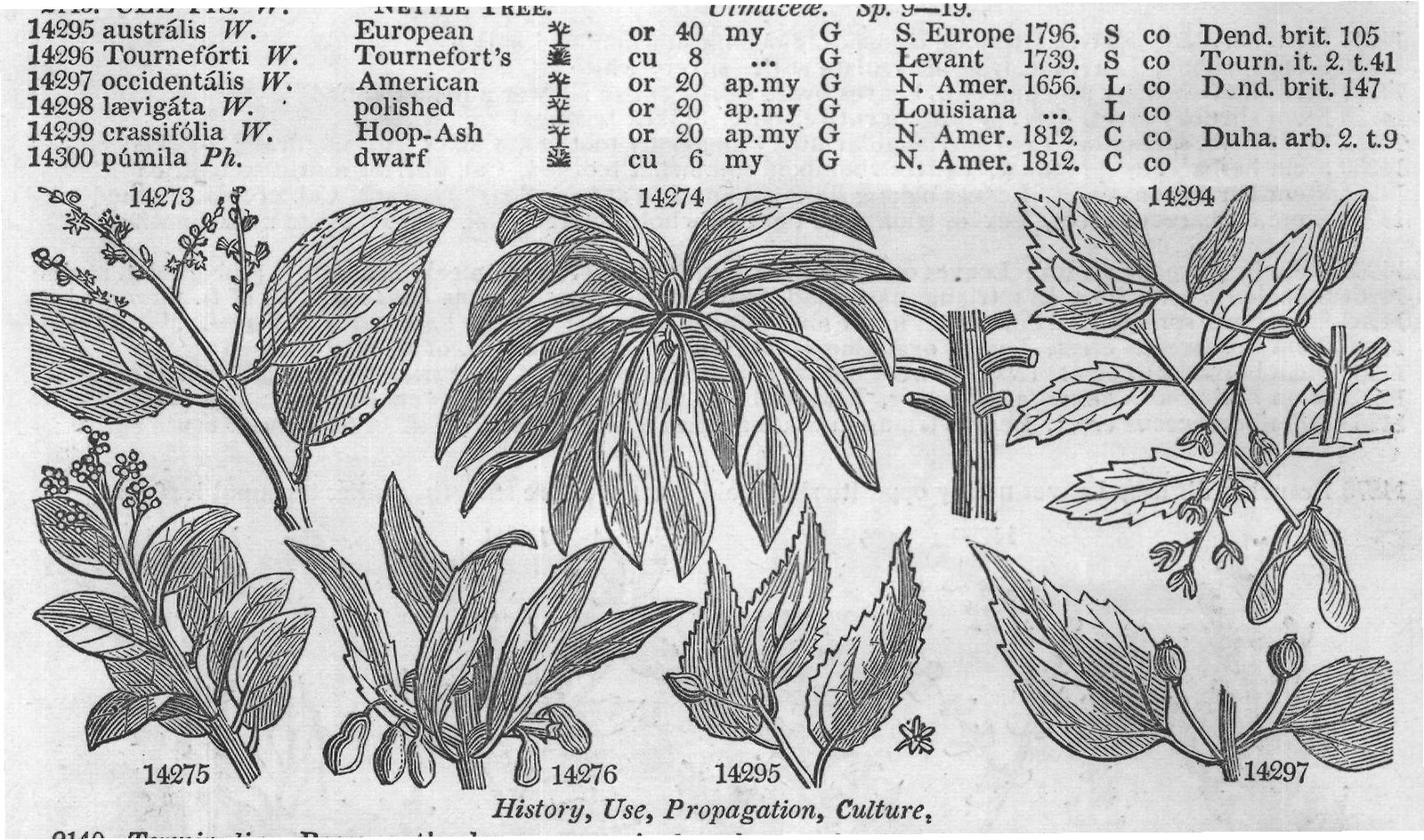
Molucca 14273 Chébula W. oval-leaved 14274 angustifolia W. narrow-leaved 어어어어 or 20 W.G E. Indies 1778. S p.l Jac. ic. 1. t. 197 or 20 or 20 or 20 W.G E. Indies 1804. C p.1 W.GE. Indies 1796. C p.1 W.G E. Indies 1692. S p.l Rox.cor.2. t. 197 Jac.vind.3. t.100 2141. FUSA'NUS. L.
COLPOON.
Santalaceæ. Sp. 1. 14275 compréssus L. flat-stalked un 1 ...
G.w C. G. H. 1776. C l.p Ber. ca.38. t.1.f.1 2142. BRABE JUM. W. AFRICAN-ALMOND.
Proteaceæ. 14276 stellátum Thunb. common or 15 mr.ap W Sp. 1.
C. G. H. 1731. C l.p Breyn.cent.1.t.1 2143. A'CER. W.
MAPLE.
Acerineæ.
Sp. 17-30. 14277 heterophýllum W. evergreen or 4 my.jn G Levant 1759. S co W.arb.10. t.1.f.1 14278 tatáricum W.
Tartarian tm 20 my.jn G 14279 Pseúdo-Plátanus Sycamore tm 50 ap.my G 14280 rúbrum W.
Red or Swamp tm 20 ap.my R Tartary 1759. L co Britain hed. S co N. Amer. 1656. L s.l Dend. brit. 160