Important: Safety Warning
This page prescribes plants as medicine according to pre-modern medical theory. Several of the plants named are toxic, correct identification is difficult, and the doses given have no scientific basis. Do not ingest or apply any preparation described here.
This page presents medical treatment from an era before modern medicine. The remedies described are ineffective against the conditions named, and some of the ingredients or doses are harmful. Do not use them to treat any illness; consult a qualified medical professional.
This information has been left in for historical purposes but should not be acted upon.
Mart
cent. 14 Apr 2 au.s Y N. Amer. 1732. D co pr 3 au.s Y N. Amer. 1811. D co Apr 1 s Y N. Amer. 1769. D co Apr 2 s.O Y N. Amer. 1805.
D co 12081 ulmifólia W.
Elm-leaved Apr 2 au.o Y N. Amer. 1805.
D co 12082 argúta W. sharp-notched pr 4 jl.au Y N. Amer. 1758. D co 12083 júncea W.
Rush-stalked 12084 ellíptica W. oval-leaved 12085 recurváta W. en. recurved 12086 sempervirens W. evergreen 12087 odóra W. sweet-smelling পপপপপ pr 2 au.s Y N. Amer. 1769. D co pr 3 au.s Y N. Amer. 1759. D co pr 2 s.n Y N. Amer. ...
D co pr 5 s.o Y N. Amer. 1699.
D co Apr 3 jl.au Y N. Amer. 1699.
D co Cor.canad. t. 169 Pluk.al. t. 116.f.6 12088 pauciflósculósa Ph. slender-flower. pr 2 au.o Y N. Amer. 1811. D co 12089 bícolor W. two-colored Apr 2 au.s Y N. Amer. 1759. D co Pluk.al. t.114.f.8 12090 petioláris W. late-flowered Apr 4 o.d Y 12091 strícta W.
Willow-leaved pr 3 s Y N. Amer. 1758, D co N. Amer. 1758. D co 12092 lanceoláta Ph.
Grass-leaved Apr 50 Y N. Amer. 1758.
D co Bot. mag. 2546 12093 tenuifólia Ph. slender-leaved Apr 2 s.o Y N. Amer. 1758.
D co 12094 cæ'sia W.
Maryland pr 2 S.O Y N. Amer. 1732.
D co Dil.el.t.307.f.395 12095 lívida W. en. livid Apr 2 s.o Y N. Amer.
D co ... 12096 hírta W. en. hairy Apr 2 s.O Y N. Amer.
D co ... 12097 lithospermifólia Ph. Gromwell-lvd.Apr 2 au.o Y N. Amer. 1811.
D co 12098 lævigáta W. fleshy-leaved pr 6 o.n Y N. Amer. 1699.
D co 12099 mexicána W.
Mexican pr 6 jl.o Y N. Amer. 1683. D co Dodar.ac.4.t.219 12100 vimínea W. twiggy pr 3 s Y N. Amer. 1759. D co 12101 erécta Ph. upright pr 3 au.o Y N. Amer.
D co ... 12102 macrophýlla Ph. large-leaved Apr 3 au.o Y N. Amer.
D co ... 12103 flexicaúlis W. crook-stalked Apr 2 s Y N. Amer. 1725. D co Herm.parad.244 12104 latifólia broad-leaved Apr 1s Y N. Amer. 1725. D co Pluk.al. t.235.f.4 12105 ambígua W. angular-stalked pr 2 jl.au Y ...... 1759. D co 12106 axilláris Ph. axillary Apr 2 au.o Y 12107 Virgaúrea W. common Apr 2 jl.s Y 12108 cámbrica W.
Welsh pr jl.au Y N. Amer. 1811. D co Britain woods. D co Wales D co Eng. bot. 301 ...
Dil.el.t.306.f.393 12109 multiradiáta W.
Labrador pr jl.au Y Labrador 1776. D co 12110 minúta W. least pr jl.au Y Pyrenees 1772. D co Bot. cab. 189 12111 húmilis Ph. dwarf Apr 1 jl.au Y N. Amer. 1811. D co 12112 eláta Ph. tall-hairy Apr 6 au.o Y N. Amer. 1811. D co 12113 rígida W. hard-leaved Apr 3 s Y N. Amer. 1710. D co Herm.parad.243 1741. CINERA'RIA. W. CINERARIA.
Compositæ. 12114 geifólia W.
Kidney-leaved 12115 canéscens Wendl. hoary parviflora H. K. כך or or 2 ap.au Y 2 ap.au Y 12116 auríta W. purple-flower'd or 1 jn.jl Pu Sp. 31-72.
C. G. H.
C. G. H.
Madeira 12074 12076 12092 1710. C p.l 1790. C p.1 1777. C 1.p Bot. mag. 1786 12094 Com.hort.2. t.73 Bot. mag. 1990 History, Use, Propagation, Culture, aromatic, pleasant to the taste, gently stimulant, diaphoretic, and carminative. An essence made by dissolving the essential oil in proof spirit, is used in the eastern states as a remedy in complaints arising from flatulence, and as a vehicle for unpleasant medicines of various kinds. It has been employed successfully to allay vomit- ORDER II.
SYNGENESIA SUPERFLUA. §2. Racemes 1-sided. Leaves not 3-nerved. 12074 Stem erect round hairy, Lvs. ov. rather ellipt. very rough rugged serrated without lateral ribs, Clusters panicled unilateral 12075 Stem erect hairy, Lvs. lanc. the lower ones deeply serrated very rough rugose, Panicles unilateral 12076 Stem erect hairy, Lvs. ovate-lanc. the lower ones closely serrated rugged very rough, Clusters panicled compound widely spreading unilateral 12077 Stem erect vill. Lvs. lanc. rather soft serrated without lateral ribs, Clusters panicled unilateral 12078 Stem erect hairy, Lvs. oblong pointed smooth above rugged and rough beneath, Clusters unilateral 12079 Stem erect downy, Stem lvs. lanc. hisp. ent.: radic. ones somew. wedge-shap. serrat. Clust. panic. unilateral 12080 Stem erect smooth angular, Lvs. ellipt. serrated smooth: the radic . ones obl.-spatulate, Clusters panicled 12081 Stem erect striated smooth, Lvs. ellipt. pointed deeply serrated vill. beneath: radical ones obovate, Clusters unilateral spreading, Pedunc. downy panicled unilateral, Pedunc. villous, Rays short obl. Clusters panicled unilateral, Rays elongate 12082 Stem erect smooth, Lvs. smooth sharply and unequally serr.: those of the stem ellipt.; radical ones ovate- 12083 Stem erect smooth, Lvs. lanc. smooth rough-edged: the lower ones serrated, Clusters panicled unilateral 12084 Stem erect smooth, Lvs. ellipt. smooth serrated, Clusters panicled unilateral, Rays of a middling length 12085 Stem erect downy, Lvs. lanc. serrated rough edged, Clusters elongated unilateral recurved panicled 12086 Stem erect smth. Lvs. lin.-lanc. rather fleshy smth. entire rough- 12087 Stem Stem erect smth. Lvs. lin.-lanc. rather fleshy smth. entire rough-edg. Clust. panic. unilateral, Ped. roughish edged, Clust. panic, unilateral nearly simple 3. Racemes erect. 12088 Smooth somewhat shrubby, Lvs. lanc. obtuse without ribs, Panicle compound many-fl. tuft of flowers erect, Invol. narr.-oblong with 5 flor. in the disk and 1 in the radius 12089 Stem hairy, Lvs. ellipt. hairy: the lower ones serr.; those on the fl.-branches entire numerous and small, Clusters erect, Scales of invol. obtuse 12090 Stem erect villous, Lvs. ellipt. roughish stalked, Clusters erect, Rays twice the length of the invol. 12091 Stem erect smth. Stem-lvs. lanc. entire smth. rough-edg .: radic. ones serrat. Clust. panic. erect, Ped. smth. 12092 Stem smooth. furrowed much branched, Lvs. almost lin. ent. roughish nearly erect with 3 or 5 rough ribs, Rays not longer than the disk smaller ones, Rays scarcely exceeding the disk Rays rather longer than the disk 12093 Stem rough angular branch. corymb. Lvs. spread. lin. very narr. slightly 3-ribb. rough with axilla tufts of 12094 Stem nearly erect very smooth and even, Lvs. lanc. smooth with roughish edges and ribs, Clusters erect, 12095 Stem smooth panic. Lvs. lanc. serrat. smth. rough-edged, Branches racemose at the extremity, Rays elong. 12096 Stem panic. hairy, Lvs. lanc. rough on both sides: those of the stem serrat.; of the branches ent. Clusters 12097 Stem branch. downy, Lvs. lanc. rough on both sides tapering 3-ribb. entire, Clusters erect, Rays elongated 12098 Stem erect smth. Lvs. lanc. fleshy entire smooth in every part, Clusters panic. erect, Pedunc. scaly hairy, erect, Rays elongated Radius twice the length of invol. 12099 Stem oblique smooth, Lvs. lanc. somew. fleshy entire smooth in every part, Clusters panic. erect, Pedunc. scaly smooth, Rays longer than invol. 12100 Stem erect slightly downy, Lvs. lin. lanc. smooth rough-edged tapering at the base: the lower ones somew. scaly smooth, Rays longer than invol. serrated, Clusters erect, Rays elongated 12101 Stem rather vill. Lvs. lanc. veiny smooth entire somewhat stalked 12102 Lower lvs. ov. pointed taper. unequally and sharply serr. smooth: those of the stem lanc. tapering at each end serr. nearly sess. Clusters axill. stalked leafy the length of the leaves 12103 Stem zig-zag roundish smooth, Lvs. lanc. pointed serrated smooth nearly sess. Clust. axill. erect 12104 Stem somew. zig-zag angular smooth, Lvs. ovate pointed strongly serrated smooth: tapering into a winged footstalk, Clusters axillary erect 12105 Stem slightly zig-zag smooth angul. branch. Lvs. ov.-lanc. pointed densely serrated rather hairy beneath tapering into a wing. footstalk: upper ones ent. Clust. axill. erect the upper ones much long. than the lvs. 12106 Stem smooth round erect, Lvs. lanc. serr. glabrous, Racemes axill. subglobose erect, Rays long 12107 Cauline leaves lanc.: the lower ones ellipt. Racemes panicled erect crowded 12108 Stem quite simple downy, Lvs . cuneiform lanc. downy, Racemes erect, Rays long 12109 Stem a little villous, Lvs. sessile lanc. smooth ciliated: lower serrated at end, Rays long numerous 12110 Stem quite simple pilose, Lvs. lanc. acute serrated smooth, Raceme term. simple erect, Rays long 12111 Stem simple erect smooth, Lvs. lanc. serrated smooth tapering and elongated at the base, Clusters erect 12112 Stem hairy round, Lvs. lanc, rather hairy beneath, Clusters erect, Rays elongated 12113 Lvs. ov.-obl. rough like the corymbose stem with minute rigid hairs: the lowermost serrat.; upper entire, [Clusters compact, Rays twice the length of the obtuse calyx 12114 Pedunc. branched, Lvs. reniform narrowed somewhat lobed downy, Petioles auricled at end 12115 Pedunc. branched, Lvs. cordate 5-lobed toothed woolly, Petioles with appendages, Ray 3-flowered 12116 Heads corymbose, Lvs. cordate somewhat angular downy beneath, Petioles auricled at base 12115 12107 12108 12110 and Miscellaneous Particulars. ing, and to relieve spasmodic pains in the chest of a milder kind. The leaves are also used in some parts of the United States as an agreeable substitute for tea. (Bigelow.) 1741. Cineraria. From cineres, ashes, in reference to the soft white down which clothes the lower, and 12117 láctea W. en. 12118 cruénta W. 12119 hýbrida W.en. 12121 lobáta W. 12122 malvæfólia W. 12123 Petasites B. M.
SYNGENESIA SUPERFLUA.
CLASS XIX. milk-colored or 3 jn.jl W 1816. C l.p purple-leaved or 2 f.my Pu Canaries 1777. R p.l Bot. mag. 406 hybrid or 2 f.my Pu 12120 populifólia H. K.
Poplar-leaved or 2 jn.s R C p.l Canaries 1780. C p.1 Vent. malm. 100 lobed or 3 jn.au Y C. G. H. 1774. C p.1 Mallow-leaved or 2 au Y Azores 1777. R p.l Butter-bur-lvd. L or 3 f.d Y Mexico 1812. C 1.p Bot. mag. 1536 12124 díscolor W. white-leaved or 4 jl.au Y Jamaica 1804. C l.p 12125 elátior Bouché tall or 5 jl.au W ...
D 1.p 12126 parviflóra Bieb. 12127 americána W. small-flowered or 2 jl.au Y American or 6 Y Caucasus 1820. D l.p Grenada 1825. C p.l ... 12132 glaúca W. 12128 bícolor L. 12130 sibírica W. glauca two-colored or 2 jl.au Y ...... 12129 speciósa Schrad. shewy or 6 jl.au Siberia Y Siberian or 4 jn.au Y Siberia 1784. C co 12131 gigantéa H. K. gigantic or 4 jl.au Y ...
C co 1815. D co Cape Horn1801. D co Bot, reg. 812 Bot. mag. 1869 Exot. bot. 2. t.65 glaucous-leav'dor 6 jn.jl Y Siberia 1790. D co 12133 palústris W. marsh or 3 jn.jl Y England mar. D m.s Gmel. sib. 2. t.74 Eng. bot. 151 12134 campéstris W. mountain or my.jn Y England ch.pa. D co Eng. bot. 152 integrifólia E. B. 12135 longifólia W. 12136 cordifólia W. 12137 alpína W. 12138 marítima W. 12139 canadensis W. 12140 linifólia W. heart-leaved Alpine long-leaved << or 2 jn.au Y Austria 1792. D co Jac. aust.2. t. 181 or 2 jl.au Y Austria 1739. D co Jac. aust.2. t.176 or 2 jn.au Y Austria 1683. D co Jac. aust.2. t.177 Sea Ragwort Canadian 豆or 2 jl.s Y S. Europe 1633. C l.p Lob. ic. t.227. f.2 or 2 jn.au Y Canada 1739. D co Flax-leaved or 2 jn.au Y C. G. H. ...
Cl.p Jac.schœ.3.t.308 12141 humifúsa W. trailing or jl.au Y C. G. H. 1704. R p.l 12142 viscósa W. clammy or 2 jn.au Y C. G. H. 1774. C p.1 Ja.frag. 12.t.7.f.2 12143 lanáta W. woolly or 3 my.s Pu Canaries 1780. C p.1 Bot. mag. 53 12144 amelloídes W. blue-flowered or 1½ f.s B C. G. H. 1753.
S p.1 Bot. mag. 249 1742. CALOʻTIS. R. Br. CALOTIS.
Compositæ.
Sp. 1-2. 12145 cuneifólia R. Br. wedge-leaved pr 1 my.jn B N. Holl. 1819. D co Bot. reg. 504 1743. KAULFUS'SIA. Nees. KAULFUSSIA.
Compositæ.
Sp. 1. 12146 amelloídes Nees.
Cape Aster-like pr 1 jl.au B C. G. H. 1819. D co Bot. reg. 490 1744. I'NULA. W.
INULA.
Compositæ. 12147 Helénium W.
Elecampane or 4 jl.au Y Sp. 25-37.
Britain 12148 O'culus-Chrísti W. hoary or 1 jl.s Y m. me. D co Austria 1759. D co Eng. bot. 1546 Jac. aust.3. t.223 12149 britannica W. creeping-rooted or 2 jl.s Y 12150 unduláta IV. wave-leaved or 1 jl.o Y Germany 1759. D co 1739. S co Egypt Fl. dan. t. 413 12151 índica W.
Indian or 1 jl.o Y 12152 squarrósa W. net-leaved প A or 1 jl.s L.Y 12153 viscósa W. clammy or 1 jl.au Y 12154 tuberósa P. S.
Erigeron tuberósum W. 12155 salicína W. 12156 glandulósa W. tuberous-rooted or 1 jl.au Y Willow-leaved or 2 au.s Y glandular A or 2 jl.au Y 12157 Bubónium W.
Austrian or 1½ jl.s Y 12158 hírta W. hairy or 1 jn.s Y 12159 suavéolens W. woolly-leaved or 14 jn.au Y 12160 Vaillantii W.
Vaillant's or 2 jn.au Y 12161 móllis Bernhardi soft or 2 jn.au Y 12162 odóra W. fragrant or 1 jn.au Y 12163 mariána W.
American Aor 1 jl.au Y 12164 germánica W. 12165 ensifólia W.
German or 4 jn.jl Y sword-leaved or jl.s Y 12166 crithmifólia W.
Samphire-leav.or 2 au.s Y 12167 provinciális W. 12168 montána W. oval-leaved or mountain পপ 1 jl.au Y or 1 jl.au Y E. Indies 1739. S co 1768. D co Italy S. Europe 1596. C p.1 S. Europe 1640. D co N. Europe 1648. D co Georgia 1804. D co Austria 1801. D co Austria 1759. D co S. Europe 1758. D co France 1739. D co ...
S. Europe 1821. D co N. Amer. 1742. D co Germany 1759. D co Austria 1793. D co England sal.m. D co France 1778. D co S. Europe 1759. D co Jac. vind. 2. t.165 Mor.s.7.t.19.f. 20 Fl. dan. t. 786 Bot. mag. 1907 Jac.aus.5.ap.t.19 Jac. aust.4. t.358 Jac. vind. 3. t. 51 M.h.3.s.7.t.21.f.6 Mill.ic.1. t.57. f.1 Jac. aust.2. t. 134 Jac. aust.2. t.162 Eng. bot. 68 Garid. aix. t. 10 Bur.zeyl.t.55.f.2 Plu.alm. t. 16. f.1 12118 12129 12131 12137 12140 12144 12134 History, Use, Propagation, Culture, often the upper surface of the leaves. C. discolor, populifolia, &c. are popular half-shrubby plants, well calculated for bearing the confined air of a sitting room. Most of the hardy herbaceous species are fine ornamental plants of easy culture. C. lanata and amelloides flower the greater part of the year the former species is considered the handsomest of the genus; its petals exteriorly are of a most vivid purple, interiorly they are white. 1342. Calotis. The name has been derived from κaλoς, beautiful, and 85 ωτoς, an ear, in allusion to the two membranous ear-shaped paleæ of the pappus, A pretty little New Holland herbaceous plant. 1743. Kaulfussia. Named after Dr. George Frederick Kaulfuss, professor of botany at Halle, a distinguished living Cryptogamic botanist. A small plant with bright blue flowers. 1744. Inula. The derivation of this word is uncertain. The Latins applied it to a plant which was caten as ORDER II.
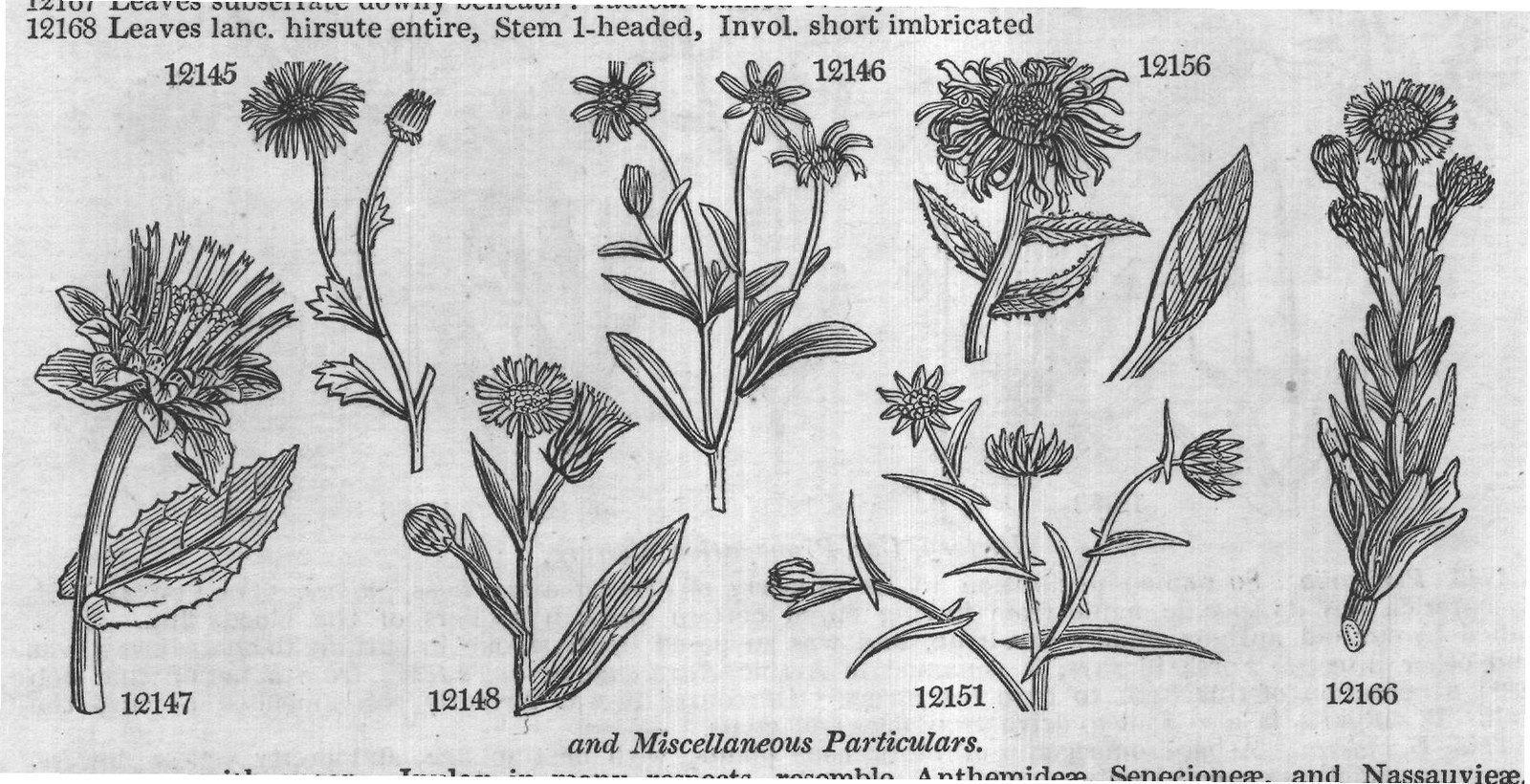
SYNGENESIA SUPERFLUA. 12117 Lvs. cordate angular downy beneath, Corymbs terminal panicled, Scales of invol. recurved at end 12118 Heads corymbose, Lvs. cordate angular toothed purple beneath, Petioles winged auricled at base 12119 Pedunc. about 1-headed, Branches corymb. Lvs. cord. angular toothed downy beneath, Petioles winged toothed downy beneath, Petioles winged 12120 Heads corymbose, Lvs. cordate subangular downy beneath, Petioles with many appendages at end 12121 Heads subcorymbose, Lvs. roundish many-lobed smooth, Petioles auricled at base, Invol. calyculate Invol, calyculate 12122 Heads cymose, Lvs. cordate angular downy beneath, Petioles simple 12123 Leaves large round lobed downy and green on each side 12124 Heads corymbose, Leaves oblong lanc. acuminate toothletted smooth white beneath 12125 Lvs. cord. subangular smooth above downy beneath, Petioles with an appendage at top, Heads corymb. at top, Heads corymb. 12126 Stem simple, Heads panicled, Lvs. smooth tooth. : lower deltoid stalked upper obl. lanc. amplexicaul. [above : upper obl. lanc. amplexicaul. 12127 Panicles axillary, Lvs. alternate stalked broad lanc. serrated smooth above hoary beneath 12128 Heads corymb. Invol. hoary pubesc. Lvs. obl. pinnatif. at base: segm. somew. toothed shining and smooth 12129 Raceme simple, Lvs. reniform toothletted, Petiole inflat. Stem simple leafy, Bractes in the midd. of stalk 12130 Raceme simple, Lvs. cordate blunt toothletted smooth, Stem simple 1-leaved 12131 Heads corymb. Lvs. cauline ov. acute finely serrated downy beneath: petioles winged at base; radic. cord. 12132 Raceme simple, Lvs. spatulate cordate entire smooth, Stem simple 12133 Heads corymbose, Lvs. broad lanc. tooth-sinuated, Stem villous 12134 Heads umbellate, Stem simple, Lvs. downy: radical ovate subcrenulate; cauline lanc. entire 12135 Heads in corymbose umbels, Stem simple, Lvs. somewhat toothed: radic. spatulate; caul, obl. lanc. 12136 Panicle few-headed, Stem simple, Lvs. all stalked cordate doubly toothed, Petioles toothed at base 12137 Heads corymbose, Lvs. pinnated term. pinnæ large cordate cut-toothed; lateral cuneate toothed at end toothed at end 12138 Heads panicled, Invol. downy, Lvs. pinnatifid: segments blunt about 3 -lobed downy beneath 12139 Heads panicled, Lvs. pinnatifid subvillous: segments sinuated, Stem herbaceous 12140 Pedunc. 1-headed axillary, Lvs. linear subulate glabrous, Stem shrubby 12141 Pedunc. 1-headed, Lvs. reniform somewhat angular, Petioles auricled at end or naked 12142 Pedunc. 1-headed, Lvs. pinnatifid lobed acute viscid fleshy 12143 Pedunc. 1-headed, Lvs. cordate roundish with 7 angles woolly beneath 12144 Pedunc. 1-headed, Lvs. opposite ovate naked 12145 Leaves cuneate cut-toothed at end 12146 The only species 12147 Lvs. amplexic. somewhat toothed ovate rugged downy beneath, Scales of the involucre downy 12148 Leaves amplexic. oblong entire hirsute, Stem pilose corymbose 12149 Leaves amplexic. lanc. serrated at base pilose beneath, Stem corymbose villous 12150 Leaves amplexic. cordate lanceolate wavy 12151 Leaves amplexic. cordate lanc. quite smooth serrated, Stem corymbose smooth, Pedunc. 1-headed filiform 12152 Leaves oval rigid sessile serrulate scabrous netted, Scales of invol. ovate reflexed 12153 Leaves sessile reflexed at base lanc. serrated, Stem downy clammy, Peduncles axillary leafy 12154 Leaves sessile lanc.-lin. Stem pilose branched, Branches spreading 1-headed, Root tuberous 12155 Leaves lanc. recurved serrate scabrous, Branches angular, Lower heads tallest 12156 Lvs. sess. obl. obsoletely serrated: serratures glandular, Stem hairy 1-headed, Scales of invol. lanc. villous 12157 Lvs. sess. obl. with cartilaginous teeth scabrous rigid, Stem corymbose, Scales of invol. blunt squarrose 12158 Lvs. sessile lanc. bluntly serrated rigid pilose, Stem villous 1-headed, Scales of invol. lanceolate 12159 Leaves ellipt. narrowed at base stalked pilose: lower toothed, Stem manyflowered 12160 Leaves sessile oblong lanc. serrated downy beneath, Heads stalked about 4 in terminal umbels 12161 Leaves lanc. acute serrulate hairy, Lvs. of invol. lanc. hairy outer reflexed 12162 Leaves amplexicaul. toothed very hairy: radical ovate; cauline lanceolate 12163 Leaves sessile oblong lanc. attenuated at base obtuse entire mucronate with a gland, Pedunc. fi if. viscid 12164 Leaves sessile obl. acute entire scabrous, Stem branched at top, Heads corymbose 12165 Leaves sessile lin. acuminate nerved smooth scattered, Stem about 1-headed 12166 Leaves linear fleshy generally 3-pointed 12167 Leaves subserrate downy beneath: radical stalked ovate, Stem erect 1-flowered 12168 Leaves lanc. hirsute entire, Stem 1-headed, Invol. short imbricated 12145 12147 12148 12146 12151 12156 12166 and Miscellaneous Particulars. a preserve with sugar. Inuleæ in many respects resemble Anthemideæ, Senecioneæ, and Nassauvieæ, especially in their style; but they are perfectly well characterized by the peculiarities of their ovarium, pappus, stamens, and corolla. They are also related to Carlineæ. They are found in every part of the world, and especially in southern Africa; almost all the Composite of the southern latitudes being referable to them.
I. Helenium, called Elecampane, from the officinal name Enula campana, is one of the largest of British herbaceous plants. It was formerly esteemed a tonic, and is still retained in the Materia Medica, though little used. Bruised and macerated in wine, with balls of ashes and whortle berries, it dyes a blue color. The young branches of I. Crithmifolia are frequently sold in the London markets for samphire, to which they bear some resemblance in appearance, but none in virtues. 12169 bifrons W. 12170 saturejoídes W. 12171 fœtida W. 1745. PULICA'RIA. 12172 vulgáris Gærtn. 12173 arábica Link. 12174 dysentérica Link. 1746. GRINDE'LIA. W.en. GRINDELIA.
Italian Savory-leaved stinking Gærtn. PULICA RIA.
Compositæ.
Small Fleawort W 1 au.s Y Arabian Apr 1½ au.s Y meadow Aun 2 au.s Y SYNGENESIA SUPERFLUA. or 1 jn.au Y or 1.
Y or 2 jn.au Y S. Europe 1713. D. co Vera Cruz 1733. Cl.p Malta 1688. S co Sp. 3.
England moi.h. S co Arabia 1823. D co CLASS XIX.
Herm. par. t. 127 Rel. Hous. 8. t.19 Boc. sic. 26. t. 13 Eng. bot. 1196 Pluk.al. t. 149.f.4 Eng. bot. 1115 England wat.pl. D co Compositæ.
Sp. 5-7. 12175 glutinósa H. K. glutinous or 2 ja.d Y Mexico 1803. C l.p Bot. reg. 187 12176 inuloídes W. en.
Inula-like or 1½ jn.s Y Mexico 1815. C L.p Bot. reg. 248 12177 squarrósa Ph.
Snake's-headed or 2 jl.s Y 12178 angustifólia Kunth. narrow-leaved or 1 jl.s Y Missouri 1811. Dl.p Mexico 1822. Dl.p Bot. mag. 1706 Bot. reg. 781 12179 ciliáta Nutt. ciliated or 1½ jl.s Y N. Amer. 1821. Dl.p Hook. ex. fl. 45 1747. PODOLE PIS. H. K. PODOLEPIS.
Composite.
Sp. 2. 12180 rugáta H. K. wrinkle-scaled or jl.au W N. Holl. 1803. C s.p 12181 acumináta H. K. sharp-scaled or my.au W N. S. W. 1803. C s.p č Lab.no.h.2.t.208 Bot. mag. 956 1748. CHÆTANTHE'RA. Fl. per. CHETANTHERA.
Composite.
Sp. 1-2. 12182 ciliáta Fl. per. ciliated or 2 jl.au Chili 1822. D co 1749. AR'NICA. W.
ARNICA.
Compositæ.
Sp. 5-34. 12183 montána W. mountain or 1 jl.au Y Europe 1731. D p.l 12184 scorpioídes W.
Bot. mag. 1749 alternate-leav.or jl.au Y Austria 1710. D p.l Bot. cab. 913 12185 Dorónicum W.
Alpine 12186 Bellidiástrum W. 12187 glaciális W. 2 or 1 jl.au Y Austria 1816. D I.p Jac. aust. 1. t. 92 Daisy-leaved or 1 jn.au W Austria 1570. D p.l Bot. mag. 1196 ice or 1 jn.au Y Switzerl. 1823. D p.l Jacq. ic. t. 586 1750. GERBERIA. Burm. GERBERIA.
Composite.
Sp. 1-2. 12188 crenáta Lindl. crenated pr jl.au Pu C. G. H. 1822. D p.1 Bot. reg. 855 1751. DOROʻNICUM. W. LEOPARD'S-BANE. 12189 Pardaliánches W. great Compositæ. or 3 my Y 12190 scorpioídes W. mountain or 3 ap.jn Y 12191 austríacum W.
Austrian or ap.jn Y 12192 altáicum W.
Siberian or 1 jn.au W 12193 orientále W.en. oriental or 1 jn.au Y 12194 plantagíneum W. Plantain-leav'd or 2 my Y Sp. 6-11.
Britain m.pas. D co Germany D co Austria 1816. D co Siberia 1783. D s.l Caucasus 1815. D l.p S. Europe 1570. D co Eng. bot. 630 ...
Jac. aust. t. 130 P.ac.p.1779. t.16 1752. PERDI CIUM. H. K. PERDICIUM.
Compositæ. 12195 Anándria H. K.
Siberian un mr Sp. 1-12.
Siberia 1759. D co Gm.sib.2.t.68.f.1 1753. TETRAGONOTHECA. W. TETRAGONOTHECA. Compositæ. Sp. 1. 12196 helianthoides W.
Sunflower-like or 4 au.o Y Virginia 1726. D p.1 Sch. han.3. t. 263 1754. XIMENE'SIA. W. XIMENESIA.
Compositæ.
Sp. 1. 12197 encelioídes W.
Mexican or 3 jn.n Y Mexico 1795. Sl.p Cav. ic. 2. t. 178 1755. HELENIUM. W. HELENIUM.
Composite.
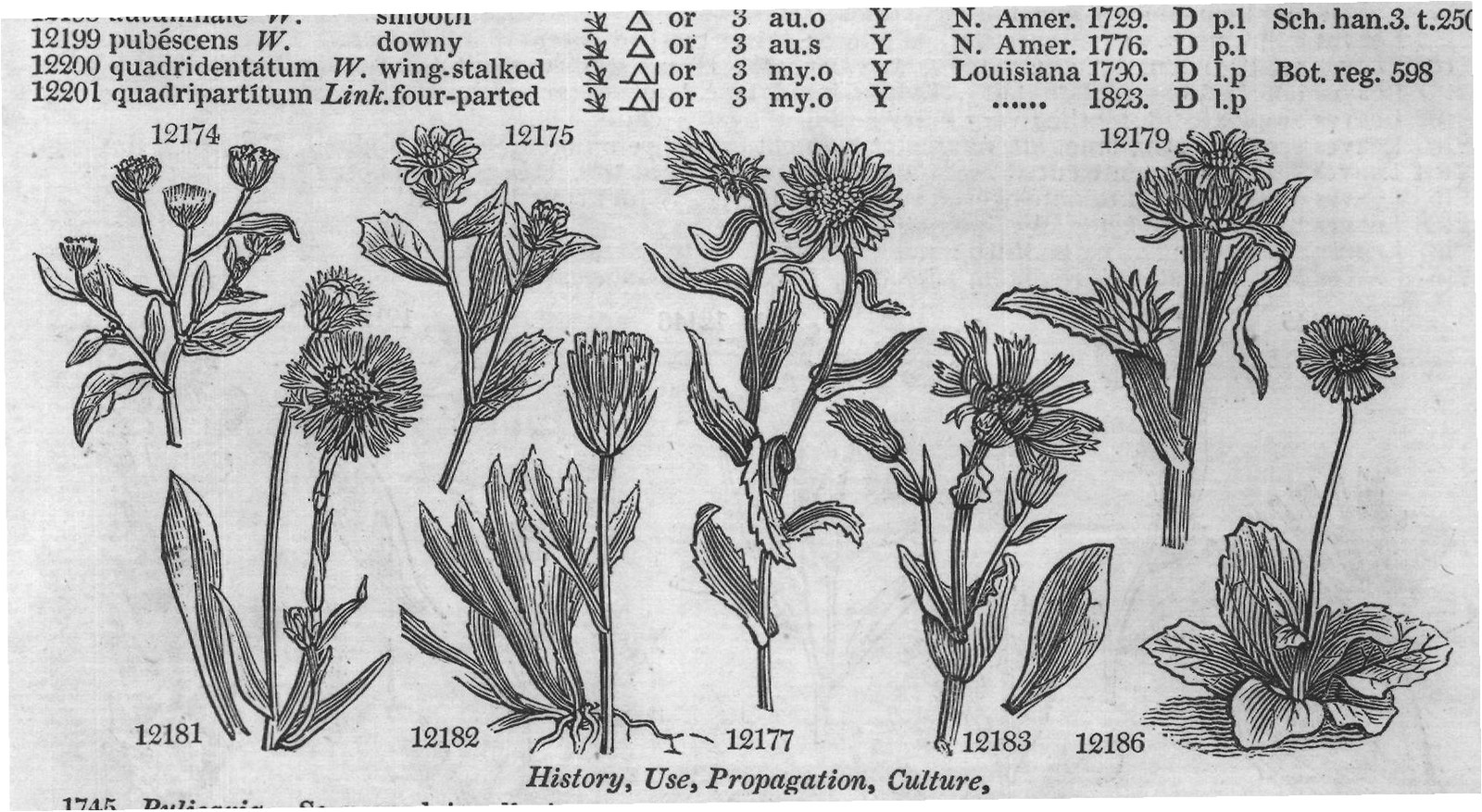
Sp. 4-8. 12198 autumnále W. smooth 12199 pubéscens W. அ or downy or 3 au.o 3 au.s Y Y 12200 quadridentátum W. downy wing-stalked or 12201 quadripartítum Link. four-parted Aor 3 my.o Y 3 my.o Y N. Amer. 1729. D p.l N. Amer. 1776. D p.1 Louisiana 1730. D Î.p Sch. han.3. t.250 Bot. reg. 598 ...... 12174 12175 1823. D l.p 12179 12181 12182 12177 12183 12186 History, Use, Propagation, Culture, 1745. Pulicaria. So named in allusion to its property of driving away fleas, pulices. See Conyza. P. dysenterica has its specific name from having cured certain Russian soldiers of the bloody flux. It is called by our old authors middle flea-bane, and was supposed by its smoke in burning to chase away fleas and other insects. Forskahl says, it is named in Arabic Rara ejub, or Job's tears, from a notion that Job used a decoction of this herb to cure his ulcers.
Of course it was formerly recommended to cure the itch. P. vulgaris is also said to drive away fleas and gnats. 1746. Grindelia. A handsome genus of herbaceous plants, with neat foliage, and pretty yellow flowers. They are sometimes called Donia. scales. 1747. Podolepis. From T85, a foot, and AETIS, a scale. The stalks of the flowers are covered with scales .
The stalks of the flowers are covered with 1748. Chætanthera. From χaiτa, hair, and avθηρa, an anther, the anther being furnished with a hairy tuft. 1749. Arnica. This is said to be a corruption of ptarmica, derived from πτaiξω, to sneeze. The Arnica montana is a powerful sternutatory; in the Vosges it is even called tabac on that account. The whole plant has important medicinal properties; it is fortifying, diuretic, emmenagogue, vulnerary, antiseptic, resolvative, and sternutatory. The root powdered is employed in diarrhea , dysentery, and quartan feers; it is also applied outwardly to bad ulcers, and in cases of gangrene. The flour is used in asthenia, rheumatic ers; pains, ORDER II.
SYNGENESIA SUPERFLUA. 12169 Leaves ovate-oblong decurrent toothed entire at end, Flowers corymbose clustered 12170 Leaves sessile opp. linear lanc. entire dotted beneath, Pedunc. long 1-headed 12171 Leaves lanceolate linear entire, Corymbs branched, Rays of flowers very short 12172 Leaves amplexicaul. oblong wavy villous, Stem erect panicled, Pedunc. 1-fl. opposite the leaves 12173 Leaves oblong sessile, Pedunc. filiform, Invol . cylindrical 12174 Leaves oblongo-cordate amplexic. rugged downy, Stem woolly panicled, Scales of involucre setaccous 12175 Leaves ovate-obl. serrated, Involucres viscid 12176 Leaves sessile obl. lanceolate acute serrated at end not viscid 12177 Leaves obl. amplexicaul. serrated, Scales of involucre filiform at end revolute squarrose 12178 Stems simple, Lower leaves spatulate : upper linear-oblong serrated 1-nerved 12179 Leaves oblong blunt half-amplexicaul. ciliate serrated, Leaves of invol, linear flat bristle-pointed 12180 Scales of invol. rugose blunt, Stem quite simple 12181 Scales of invol, equal ovate acuminate, Stem nearly simple 12182 Leaves lanceolate ciliated 12183 Leaves ovate entire: cauline twin opposite 12184 Leaves toothed, Teeth acuminate: radical stalked elliptical roundish; cauline alternate oblong 12185 Leaves remotely toothed hirsute: radical stalked obl. narrowed at base caul. alternate obl. lanceolate obovate repand 12187 Leaves somewhat toothed and hairy: radical stalked obl. rounded at base; caul. altern. obl. lanceolate 12188 Leaves obovate crenate smooth, Scape 1-headed 12189 Leaves cordate repando-dentate: radical ones petiolate; cauline ones amplexicaul. 12190 Leaves remotely toothletted: upper oblong amplexicaul.; lower ovate stalked, Petioles winged auricled 12191 Leaves toothletted: upper lanc. amplexicaul.; lower spatulate ovate; radical cordate stalked 12192 Leaves toothed obov. amplexic.: radical obov. spatulate narrowed into the stalk, Stem simple 1-headed 12193 Smooth, Radical leaves cordate deeply toothed ; cauline oblong amplexicaul. Stem about 1-headed 12194 Downy, Lower leaves stalked ovate with winged petioles: upper amplexicaul.; all toothed 12195 Leaves stalked or ovate toothed subsinuate at base downy beneath the old ones quite smooth 12196 The only species 12197 The only species 12198 Leaves serrated quite smooth 12199 Leaves serrated downy 12200 Lower leaves pinnatifid: upper entire smooth, Florets of disk 4-toothed 12201 Leaves lanceolate decurrent , Ray of corolla 4-parted 12195 12188 12196 12189 12191 12200 12197 and Miscellaneous Particulars. bruises, gutta serena, and paralysis of the bladder. The root is given in doses of six to twelve grains; the flowers of from three to four grains. Dr. Thomson not from three to four grains. Dr. Thomson observes, that in the hands of British practitioners it has Lond. (Lond. Disp. p. 169.) 1750. Gerberia. T. Gerber, a German naturalist, is only known as a traveller in Russia. A very pretty little greenhouse plant with neat purple flowers. 1751. Doronicum. Derived from the Arabic name Doronigi. Pardalianches is from πaρδoς, a tiger, and aγχεiv, to strangle; on account of the use said formerly to have been made of the plant for the purpose of destroying wild animals. 1752. Perdicium. A name given by Pliny to a plant of which the partridge, perdrix, is very fond. The plant is not now recognized. 1753. Tetragonotheca. From τετρa, four, γωvia, an angle, and θηκη, a capsule, in allusion to the four angles of the grains. 1754. Ximenesia. Named by the Abbé Cavanilles, after Joseph Ximenez, a Spanish apothecary, who is said to have attended to plants. 1755. Helenium. Named after the celebrated Helen, who is said to have availed herself of the cosmetic properties of the plant named after her. That is believed to be the modern Inula Helenium; the ancient name being unoccupied, it has been applied to this American genus, which resembles the other.
SYNGENESIA SUPERFLUA.
CLASS XIX. 1756. BEL/LIS. W.
DAISY. common large-double prolifera BELLIUM. yellow 12202 perénnis W.
B horténsis fistulósa 12203 sylvéstris W. 12204 ánnua W. 1757. BEL/LIUM. W. 12205 bellidioídes W. 12206 minútum W. 1758. DAHLIA. Cav. 12207 supérflua H. K. 12208 frustránea H. K.
ẞ coccinea aurántia lútea double-quilled Hen & Chickenprmr.au St small dwarf DAHLIA. fertile-rayed barren-rayed scarlet Orange-colored Apr my.jl W pr mr.jl W pr Composite. Sp. 3-4. mr.au W Britain past. D co Eng. bot. 424 pr mr.au R D co Bot. mag. 228 pr mr.au R D co D co large Portugal annual Portugal 1797. D co Bot. mag. 2511 S. Europe 1759. S co Bot. mag. 2174 Compositæ. pr jn.s W Sp. 2.
Italy 1796. S s.p Lam. ill. t. 684 A cu lin jn.o W Levant 1772. D co Sc.ac.up.1.t.5.f.2 Composite. Sp. 2-3. அ or 6 jl.n Pu Mexico 1789. R h.l Cav. ic. 1. t. 80 or 6 s.n Sc Mexico 1802. R h.l Cav. ic. 2. t. 226 or 6 s.n Sc Mexico 1802. R h.l Bot. mag. 762 Aor 6 s.n Or Mexico 1802. R h.l or 6 s.n Y Mexico 1802. R h.1 1759. BEBE'RA, W.
BÆBERA.
Compositæ.
Sp. 1. 12209 chrysarthemoídes W. Chrysanth.-like Opr 10 Y Carolina 1821. S l.p 1760. TAGETES. W.
TAGETES.
Compositæ.
Sp. 8-12. 12210 lúcida W. sweet-scented or 1 jl.n 12211 pátula W.
French Marygold O or 2 jl.o Y Y.o S. Amer. 12212 erécta W.
African Marygold or 3 jn.s Y Mexico 1798. D p.l Mexico 1573. S co 1596. S co Bot. mag. 740 Bot. mag. 150 12213 minúta W. small-flowered or 2 au.o Pa. Y Chili 1728. S co 12214 tenuifólia W. fine-leaved or 3 jl.o Y Peru 1797. S co Lam. ill. t. 684 Dil.el.t.280.f.362 Bot. mag. 2045 12215 clandestína Lag. concealed or 3 jl.o Y Mexico 1823. S co 12216 micrántha Cav. small-flowered O or 3 jl.o Y Mexico 1822. S co Oor 3 jl.o 12218 pinnátum W. 12219 abrotanoídes W. 1763. PEC'TIS. W.
PECTIS. 12220 ciliáris W. ciliated un 12221 linifólia W.
Flax-leaved 12217 glandulósa Schrank. glandular S. Amer. 1819. S co 1761. HETEROSPERMUM. W. HETEROSPERMUM. Compositæ. Sp. 1-3. wing-leaved Oun 2 au.s Y 1762. SCHKUH'RIA. W. SCHKUHRIA.
Wormwood-lvd. un 2 jl.s Y Compositæ. 1 jl un 1 jl.au Y Y Sp. 1.
Mexico 1798. S co Sp. 2-7.
Hispanio. 1793. S co Jamaica 1732. S co 1764. LONGCHAMP'SIA. Willd. LONGCHAMPSIA. Compositæ. Sp. 1. 12222 capillifólia Willd. hair-leaved 12202 Cav. ic. 3. t. 267 Sch.ha.3.t.250.b. pr Barbary 1822. S co 12207 12209 jn.jl W 12204 Y : New Spain 1799. S co Compositæ.
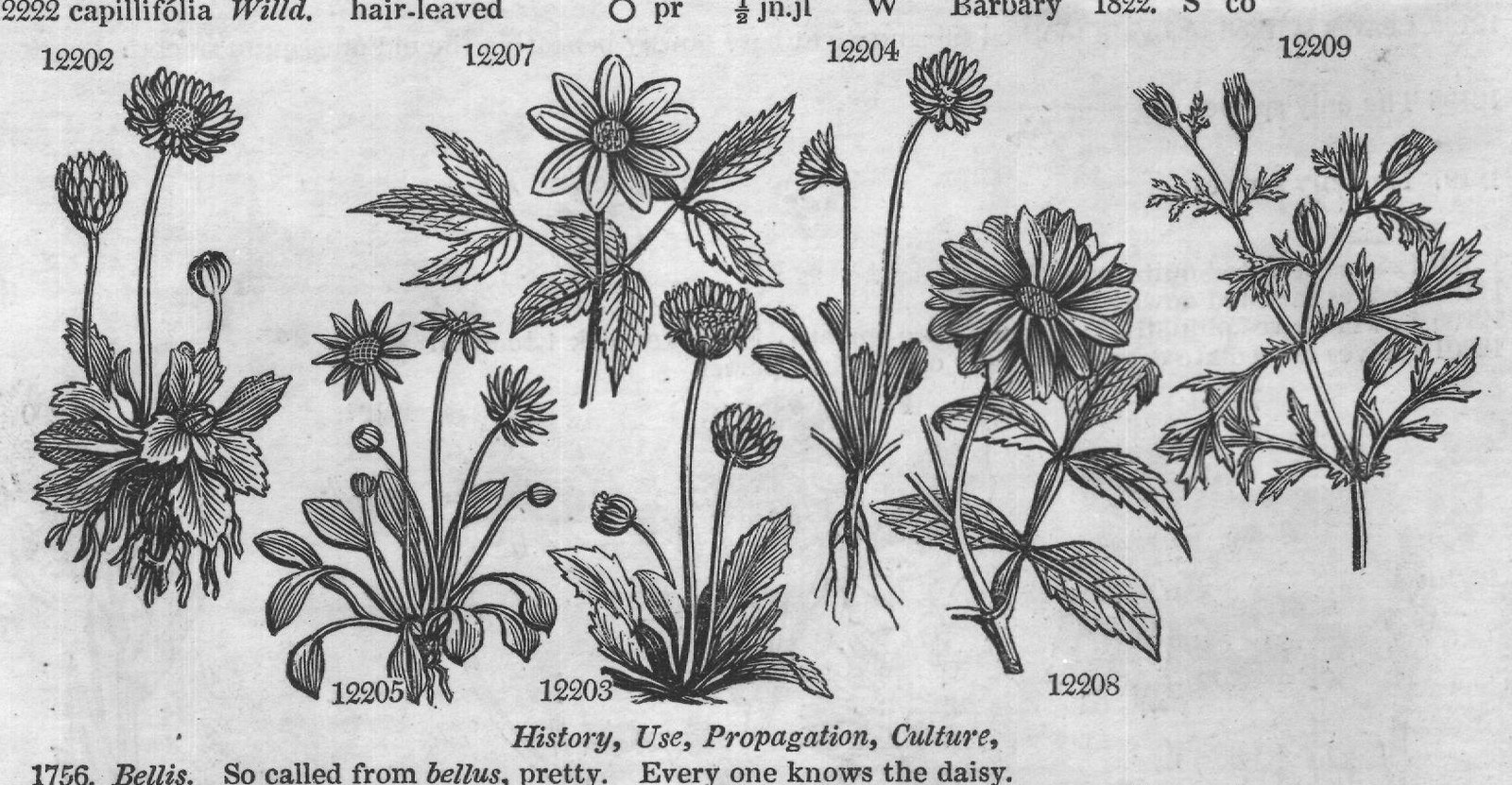
Plum. ic. 151. f. 2 Sl.jam.1.t.149.f.3 12205 12203 12208 History, Use, Propagation, Culture, 1756. Bellis. So called from bellus, pretty. Every one knows the daisy. 1757. Bellium. See Bellis, from which this genus differs chiefly in the pappus of the grains. 1758. Dahlia. Named after Andrew Dahl, a Swedish botanist, and pupil of Linnæus. Continental botanists call the genus Georgina. This genus grows in Mexico, in sandy meadows, and till the peace of 1814 was more cultivated in France than in England: at present it is one of the most fashionable hardy plants. Though its leaves are coarse, resembling those of the common dwarf elder, yet the flowers are showy, and continue in beauty till late in autumn. The plants grow freely in any soil or situation; but the poorer the ground is, the smaller the size of the plant, and the earlier and more abundant the flowers. The single-flowered varieties of D. superflua are almost without end; the double varieties of both species are much less numerous. Any number of the former may be raised from seeds, which ripen in abundance, and if sown in February on artificial heat, and transplanted in the end of April, they will flower in the July or August following. The double varieties are increased by dividing the roots, or by grafting, or by cuttings; they may also be sometimes raised from seeds. A very general way in which both kinds are propagated is by cuttings. They may be either taken from the root-shoots in spring, or the tops of the young shoots early in summer; the lower end of each cutting should be cut smoothly off in the middle of a joint, and all the leaves left on, excepting those that would be buried in planting the cutting. If planted in sandy soil, on a gentle bottom heat, and covered with a hand-glass, they will soon strike root, and produce both flowers and tubers the same autumn. The double sorts are grafted on tubers of the single varieties much in the manner of whip-grafting, but without a tongue. There must be no buds on the tuber; cut off a slice from the upper part of it, in a sloping direction, and make, at the bottom of the part so cut, a ledge, whereon to rest the graft; next, cut the scion sloping to fit, it should contain two joints, and be cut so that one of these may be at the bottom of it to rest on the ledge; from that joint the scion will occasionally put forth roots; from the other the future stem will be formed. Having tied the graft, clay it as in common grafting; then put the root in fine mould, burying half the graft, and place the pot in a gentle moist heat under a glass. If this be done in March, the plant may he shifted into a larger pot in April, and planted out in the end of May. As the Dahlia is a bulky plant, it requires either to be grown in a very large pot, or in from three quarters to a yard and a half of surface. They look well in rows, or occurring singly in a shrubbery. The treatment of the Dahlia bears a considerable resemblance to that of the potato and the marvel of Peru; as soon as the frost has blackened the tops of these three plants, their roots require to be taken up, and ORDER II.
SYNGENESIA SUPERFLUA. 12202 Scape naked single-headed, Leaves obovate crenate 12203 Scape naked single-headed, Leaves obovate crenate 3-nerved 12204 Stem somewhat leafy 12205 Stolones creeping, Scapes 1-headed, Leaves spatulate 12206 Stem leafy capillary 12207 Rachis of lvs. winged, Leafl. ovate acumin. serrated shining and smooth beneath, Outer invol. reflexed 12208 Rachis of lvs. naked, Leaflets ovate acuminate serrated roughish beneath, Outer invol. spreading 12209 Leaves pinnated: leaflets linear pinnatifid-toothed 12210 Leaves simple lanceolate finely serrated ciliate at base 12211 Leaves pinnated: leafl. lanc. ciliate-serrated, Pedunc. 1-headed thickened, Inv. smooth, Stem spreading 12212 Leaves pinnated: leaflets lanc. ciliate-serrated, Pedunc. 1-headed ventricose, Invol. angular, Stem erect 12213 Leaves pinnated: leaf. lanc. serrated; term, subdecurrent, Pedunc. many-fl. scaly, Flowers dense 12214 Leaves pinnated: leaflets linear serrated; lower serratures long, Stem panicled, Invol, clavate 12215 Leaves pinnated: leaflets filiform, Ray not longer than involucrum 12216 Leaves pinnated: leaflets filiform subulate entire, Stem branched diffuse, Pedunc. 1-headed solitary 12217 Leaves pinnated: lower segments lanceolate; upper linear, Serratures with intermediate glands 12218 Stem smooth, Leaves pinnated, Leaflets linear subulate entire 12219 Leaves aitern. pinnate linear setaceous 12220 Leaves linear amplexicaul. ciliated at base attenuated at end 12221 Leaves linear sessile acute ciliated at base 12222 Stem filiform branched, Leaves woolly subulate filiform, Peduncles naked axillary 1-headed 12210 12222 12211 12213 12218 12221 12214 12219 and Miscellaneous Particulars. kept in a dry place, where the frost cannot get at them till spring. About April they may be divided, and planted in the open air where they are to flower; or, what is more common planted in large pots, and forwarded in heat till the middle of May, when they may be turned out of the pots where they are finally to remain. In this case they will flower a month or six weeks earlier than by the other method, and will, in general, continue flowering till they are destroyed by frost. Some care is requisite to preserve the roots sufficiently moist and plump to maintain the living principle, and yet not to rot, shrivel, or freeze them. The safest mode is to plant them in pots or boxes of dry earth, and place them in a shed or cellar, or under an ample covering of litter thatched over. 1759. Bæbera. Bæber is said by Willdenow to have been a learned Russian botanist. 1760. Tagetes. Named after Tages, a Tuscan divinity, the son of Genius, and the grandson of Jupiter. T. patula is a tender annual, deservedly popular, from the brilliancy and variegation of its flowers: it is cultivated in Japan, China, and many parts of India, but does not appear to be indigenous of those countries. The varieties of T. erecta differ chiefly in the shades of the same color, but there are also double and quilled flowers. Both species are raised from seeds, upon a moderate hot-bed, in the beginning of April, and when they are three inches high, transplanted to where they are finally to remain. The varieties are very apt to degenerate, and can only be reproduced by the most careful selection and separation. This genus serves for the basis of M. Cassini's Tagetineæ, which do not appear to be at all distinct from Heliantheæ, from which they differ principally in the form of their ovarium. M. Cassini's principal motive for distinguishing them as a separate race, seems to have been his wish to reduce his tribe of Heliantheæ, which he finds too extensive. Nearly all the species are found in America. 1761. Heterospermum. From ἑτερoς, various, and σπερμη, seed; on account of the variable shape of the grains. 1762. Schkuhria. Named in honour of Christian Schkuhr, an acute German botanist, who has published some of the most accurate and useful, if not splendid, botanical works which the world has seen. It is to be regretted that their rarity makes them more generally unknown than they deserve to be. 1763. Pectis. From pecten, a comb, to which the teeth of the pappus may be compared. 1764. Longchampsia. So named after Doctor J. L. A. Loiseleur Deslongchamps, a French botanist, author of a useful Flora Gallica, in two small duodecimo volumes, published at Paris, the first in 1806, the second in 1807.
SYNGENESIA SUPERFLUA. 1765. LEYSE'RA W.
LEYSERA.
Composite. Sp. 2--8. 12223 gnaphalódes W. woolly pr 2 jl.s Or C. G. H. 1774. S p.1 CLASS XIX.
Jac. ic. 3. t. 588 12224 squarrósa W. squarrose pr 2 jl.s Or C. G. H. 1815. C 1.p Pluk. al.t.302.f.3 1766. SELLO'A. Spreng. SELLOA.
Compositæ.
Sp. 1. 12225 glutinósa Spreng. clammy un 3 f Y Brazil 1819. D co Bot. reg. 462 1767. RELHA'NIA. W. RELHANIA.
Compositæ.
Sp. 3-19. 12226 squarrósa W. cross-leaved pr 1 my.jn Y C. G. H. 1774. C p.l 12227 púngens W. pungent pr 1 s Y 12228 lateriflóra W. side-flowering 姓 ☐ pr Y 1768. ZIN'NIA. W.
ZINNIA.
Compositæ. 12229 pauciflóra W. yellow-flowered or 2 jl.au Y 12230 multiflóra W. red-flowered or 2 jn.o R 12231 verticilláta W. whorl-leaved or 2 jl.au R 12232 élegans W. purple-flowered or 2 jn.s Pu 12233 tenuiflóra W. slender-flowered or 2 jlau Sc C. G. H. 1820. C p.1 Bot. reg. 587 C. G. H. 1823. C p.1 Sp. 6-8.
Peru 1753. Sr.m Mill. ic. 1. t. 64 N. Amer. 1770. S r.m Bot. mag. 149 Mexico 1789. Sr.m Bot. rep. 189 Mexico 1796. S r.m Bot. mag. 52 Mexico 1799. S co Bot. mag. 555 12234 hýbrida B. M. hybrid or 2 jn.jl Sc 1769. CHRYSANTHEMUM. W. CHRYSANTHEMUM. Composite.
S. Amer. 1818. S co Sp. 23-43.
Bot, mag. 2123 12235 pinnatifidum W. cut-leaved pr 3 my.au W 12236 atrátum W. fleshy-leaved Apr 1. jl.au W Madeira 1777. C p.l Austria 1731. D co 12237 heterophýllum W. various-leaved Apr 1 jl.au W 12238 Leucánthemum W. Ox-eye Daisy pr 2 jn.jl W Britain 12239 montánum W. mountain pr 2 jn.jl W France 12240 ceratophylloídes All. Buckshorn Apr jn.jl W 12241 graminifólium W. Grass-leaved pr 1 my.jl W 12242 monspeliénse W.
Montpelier Apr 1 jn.s W 12243 Achilléæ W. 12244 argénteum W.
Milfoil-leaved silver-leaved Apr 1 jn.au 12245 árcticum W. northern Apr 1 jl.au Apr jn.au W W Switzerl. 1806. D co 1759. D co Piedmont 1803. D co