Home › O › Oleinæ (Sp common or my B Persia Sk co)
Oleinæ (Sp common or my B Persia Sk co)
Sp. 34. common or 8 my B Persia 1597. Sk co Schk. han. 1. t. 2 purple white Chinese or 8 my P Persia ...
Sk co Bot. mag. 183 or 5 my W Persia Sk co ... or 4 my.jn V China 1795. L L.p or 4 mn.jn V China L l.p 162 pérsica W.
ẞ alba y laciniata 黍 or 5 or 2 Persian white cut-leaved 38. NYCTAN'THES. W. NYCTANTHES. 163 arbor tristis W. square-stalked or 15 ... 39. JASMINUM. W.
JASMINE.
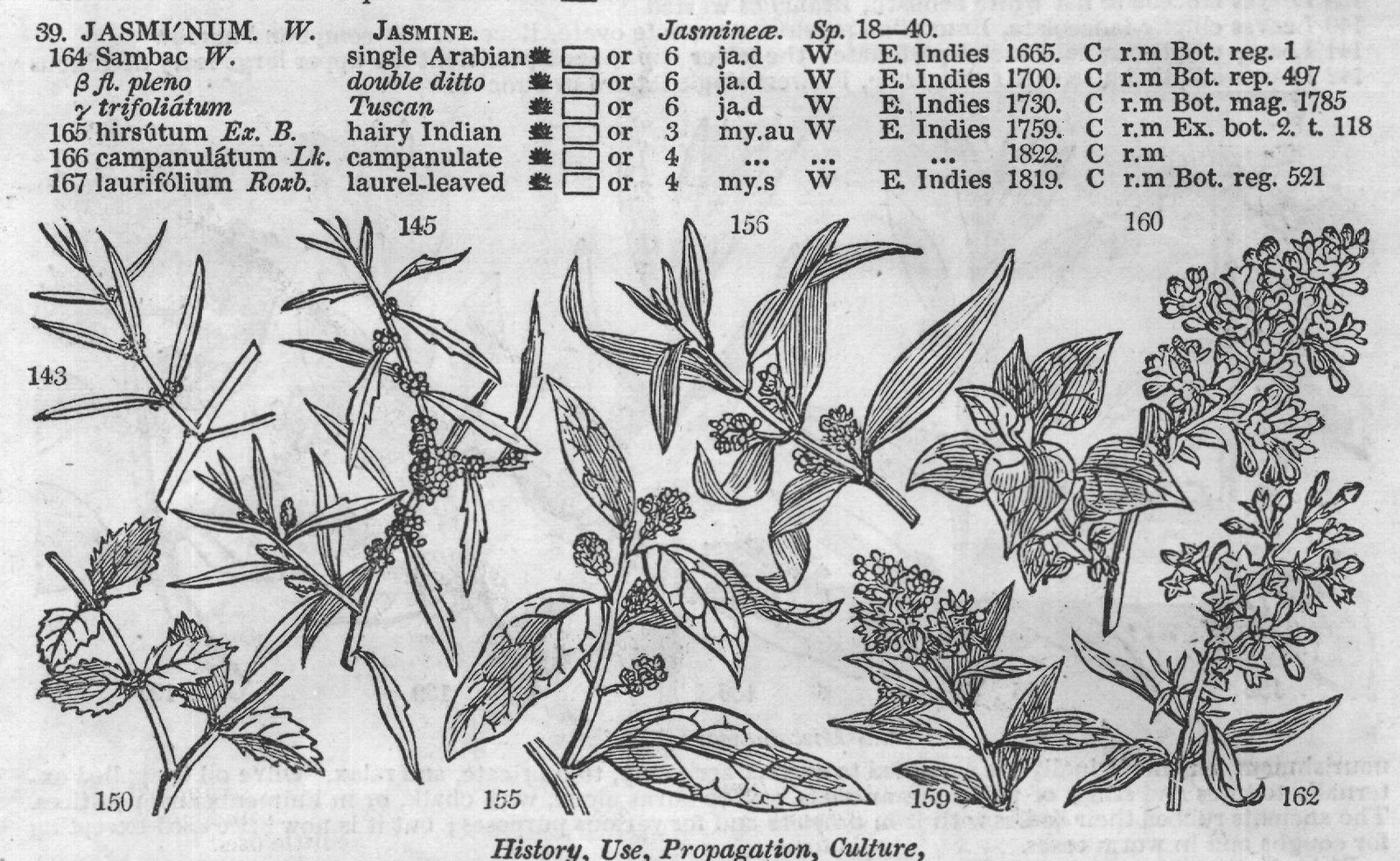
Jasmineæ. Sp. 18-40. 164 Sambac W. single Arabian or 6 ja.d W E. Indies 1665.
BA. pleno double ditto or 6 ja.d W trifoliátum Tuscan or 6 ja.d W 165 hirsútum Ex. B. hairy Indian or 3 my.au W E. Indies 1700.
E. Indies 1730.
E. Indies 1759. 166 campanulátum Lk. campanulate or 4 ... ... ... 1822.
Cr.m Bot. reg. 1 Cr.m Bot. rep. 497 Cr.m Bot. mag. 1785 Cr.m Ex. bot. 2. t. 118 Cr.m 167 laurifólium Roxb. laurel-leaved or 4 145 my.s W 156 E. Indies 1819.
Cr.m Bot. reg. 521 160 my P Persia 1640. L s.p Bot. mag. 486 my W Persia ...
Ls.p or 5 my P Persia Jasmineæ. Sp. 1.
W E. Indies 1781. Cr.m Bot. reg. 399 ...
L l.p Schm. ar. 2. t. 79 143 150 155 159 162 History, Use, Propagation, Culture, 33. Phillyrea. Said to derive its name from φuλλov, a leaf, an etymology far from satisfactory. The genus consists of ornamental evergreen shrubs, the supposed varieties of which have been considered distinct species by most modern botanists. Some authors have united the genus with Olea; but they have not been followed generally. 34. Chionanthus. From χiov, snow, and avθoς, a flower. Le Chionanthe, Fr. Der Schneeblume, Ger., and Albero de neve, Ital. Both species are highly ornamental shrubs or low trees; their leaves are above half a foot in length, and 1½ inch in breadth; their flowers white, in numerous long bunches, and their fruit of the size and color of a sloe. They are propagated by seeds or grafting on the common ash. 35. Notelæa. From voτoς, south, and ελaia, olive: the olive of the south. A small ornamental genus of nearly hardy shrubs, which would probably endure the climate of this country in a favorable situation. 36. Ligustrum. From ligare, to tie, on account of its long pliable branches. La Fresillon, Fr. Der Liguster, Ger., and Legustro, Ital. The privet in old authors is called primprivet, as Professor Martyn conjectures, from its patience under the sheers. Few shrubs exceed it as a garden hedge-plant: it will thrive in the middle of coal-burning cities, in the shade, and under the drip of trees; though to flower well it requires an open airy situation. Cows, sheep, and goats eat it, but horses refuse it. The Sphinx ligustri, L., or privet hawkmoth, and Phalæna syringaria feed on it in the caterpillar state: the blister beetle, Lytta vesicatoria, from which cantharides is formed, is also found on it. Fully grown, the wood is fit for the turner, and a rose-colored pigment may be prepared from the berries, which, with alum, dye wool and silk of a durable green. The berries remain on the tree during winter in elegant purple clusters, and are not eaten by birds excepting in very severe weather, when bullfinches and some others feed on them. Like most plants that have been long in cultivation, the privet varies in its leaves, flowers, and fruit, and in the duration of the former. In its cultivated state it is always evergreen; found wild in woods and hedges, is ge- ORDER I.
DIANDRIA MONOGYNIA. 143 Leaves linear lanceolate entire 144 Leaves lanceolate entire or serrate in the middle, Leaves 3-nerved 145 Leaves oblong lanceolate sub-serrate in the middle obsoletely veined, Branches erect 146 Leaves oblong lanceolate acute obsoletely serrated at the point veiny, Branches veiny 147 Leaves oblong lanceolate nearly entire obtuse narrowed at the base veiny 148 Leaves elliptic oblong nearly entire veiny somewhat obtuse 149 Leaves ovate oblong rounded at the base veiny serrated, Serratures with stiff points 150 Leaves ovate rounded at the base serrated acute veiny 151 Leaves oblong serrated acute at each end veiny 152 Racemes terminal, Stalks 3-flowered, Petals linear lanceolate, Leaves coriaceous 153 Leaves obovate lanceolate membranaceous pubescent, Panicles very lax, Fruit elliptic 154 Spikes axillary very short, Leaves oblong elliptic acute 155 Leaves lanceolate pointed sub-reclinate, Racemes length of the leaf-stalks 156 Leaves lanceolate acute sub-erect, Racemes as long as the leaves 157 Leaves opposite rigid broad lanceolate entire, Bunches axillary 158 Leaves ovate oblong pointed shining above, Flowers spreading 159 Leaves ellipt-lanceolate smooth, Racemes compound dense 160 Leaves ovate cordate, Branches stiff white colored 161 Leaves ovate-lanceolate, Branches stiff mottled 162 Leaves lanceolate, Branches virgate mottled 163 A delightfully fragrant plant, Leaves cordate, Flowers panicled 164 Leaves opposite sub-sessile oblong or cordate, Calyx with subulate teeth, Berries globular 165 Leaves cordate downy, Umbels terminal sessile many-flowered 166 Branches round pubescent, Leaves ternate oval pointed, Calyx bell-shaped with very short teeth 167 Leaves opp. shining lanc. 3-nerv. Fl. 1.5 ax. and term. Cal. 6.7 toothed, Cor. 9.12 part. Seg. lin. the length of tube 163 164 β 164 164 165 167 and Miscellaneous Particulars. nerally deciduous. Sometimes the leaves grow by threes, are enlarged at the base and variegated. The regular number of stamens is two; but sometimes there are three or four in a flower. The berries are usually purple or black, but some have been seen of a white color; and a yellow fruited variety is common in the gardens.
A kind of vegetable wax is said to be obtained from L. lucidum in China. 37. Syringa. inga. Some say from Σuρivέ, an Arcadian nymph, or, more properly, here, a pipe. The tubes of the finest Turkish pipes are manufactured from the wood of it; but the true root of the word is to be found in , its native name in Barbary. Lilac is a Persian word signifying a flower. Le Lilas, Fr. Die Syrene, Ger., and Syringa, Ital. All the species are most beautiful flowering shrubs, readily propagated by suckers, which they throw up in abundance. The common lilac seems to have been introduced before or during the reign of Henry VIII.; for in the inventory taken by order of Cromwell of the articles in the gardens of the palace of Nonsuch, are mentioned six lilackes; trees which bear no fruit, but only a pleasant smell. S. persica is well adapted for forcing in pots; but so treated its flowers are without fragrance. 38. Nyctanthes. From veš, night, and avθoς, flower, night-flower; its flowers expanding and smelling only in the night. L. Arbor triste, Fr. Der Trauerige baum, Ger. It grows freely in loam and peat soil mixed, but selnight. L. Arbor triste, Fr. Der Trauerige baum, Ger. It grows freely in loam and peat soil mixed, but seldom produces its exquisitely fragrant flowers in England. Sweet thinks it is generally kept too warm, and recommends a trial in the greenhouse or open air; but its appearance would probably be little improved by any manner of treatment, as it has but an indifferent aspect in its own country. Cuttings not too ripe, root readily in sand under a hand-glass. 39. Jasminum. From the Arabian jasmin (ysmyn). Linnæus obtained a fancied etymology from sa, a violet, and ooun, smell. Le Jasmine, Fr. Der Schasmine, Ger., and Il Gelsomino, Ital. The flowers of J. sambac oσμη, smell. Le Jasmine, Fr. Der Schasmine, Ger., and Il Gelsomino , Ital. The flowers of J. sambac are of exquisite fragrance, and in high esteem both in the East and West Indies. It grew in the Hampton there, was known in Europe only in the garden of DIANDRIA MONOGYNIA.
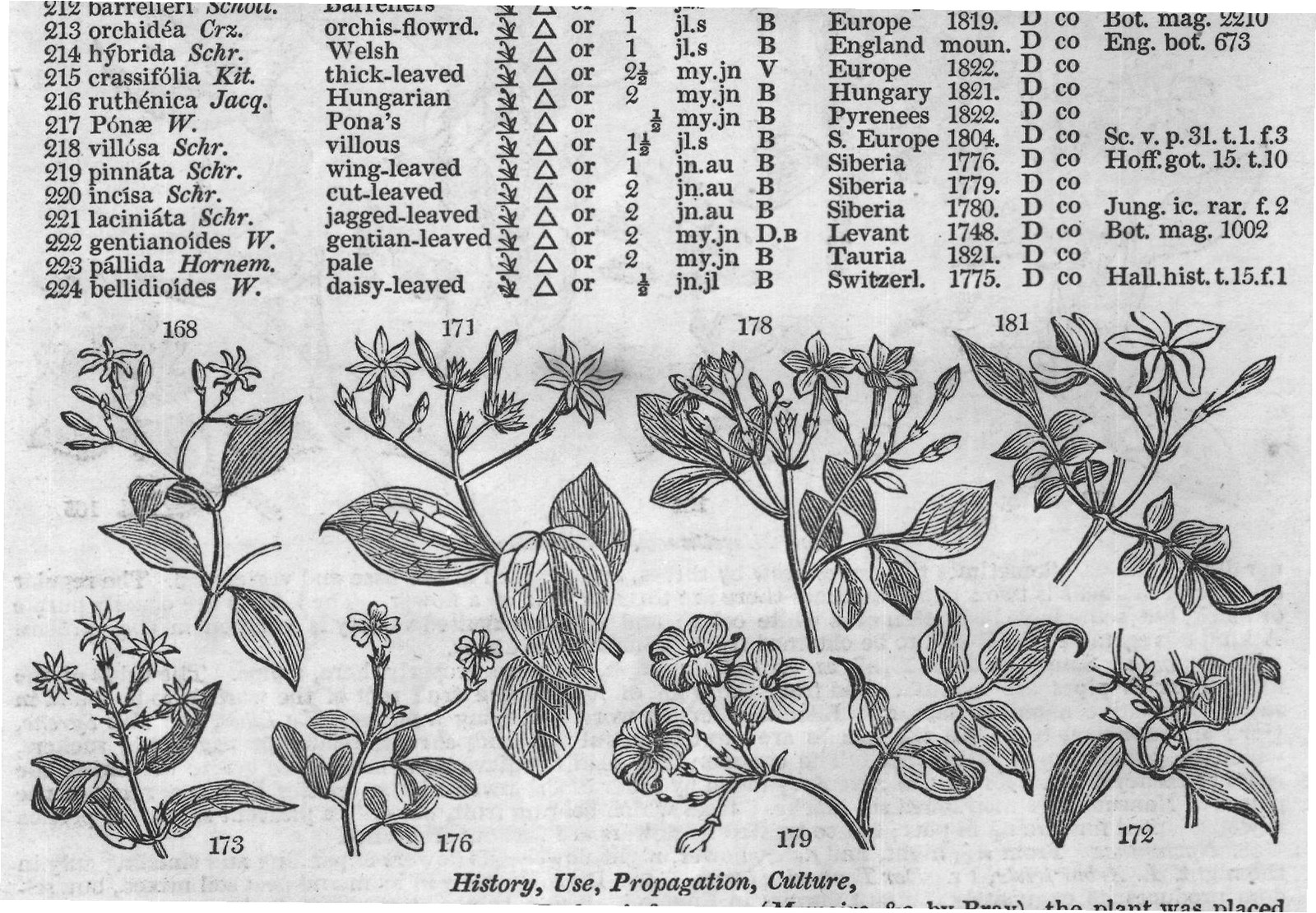
CLASS II. 169 glaúcum W. 168 grácile B. P. slender or 3 ja.d W Norfolk I. 1791. C s.p Bot. rep. 127 glaucous or 3 au W C.B.S. 1774. C 1.p Sal. st. ra. t. 8 170 trinérve W. three-nerved or 20 W Sylhet 1804. C l.p 171 simplicifólium W. simple-leaved ☐ ☐ or 3 jn.jl W S.Seas 1800. Cr.m Bot. mag. 980 172 paniculátum Roxb. panicled ja or W China 1818. Cr.m Bot. cab. 469 173 undulátum Vahl. wavy or 5 ja W China 1819. Cr.m Bot. reg. 436 174 auriculatum auriculated or 10 my.s W E. Indies 1790.
Cr.m Bot. reg. 264 175 azóricum W.
Azorian or 5 ap.n Y Madeira 1724.
Cr.m Bot. reg. 89 176 frúticans W. comm. yellow or 3 ap.o Y S. Europe 1570.
Cr.m Bot. mag. 461 177 húmile W.
Italian or 3 jn.s Y 178 odoratíssimum W. sweet-scented or 3 my.n W 179 revolútum B. R. curled flowered or 12 m.o Y S. Europe 1656.
Madeira 1656.
E. Indies 1812.
L co Bot. reg. 350 Cr.m Bot. mag. 285 Cr.m Bot. reg. 178 180 officinále W. common white or 15 jn.o W 1548. ... 181 grandiflórum W.
Catalonian or 15 jn.o W E. Indies 1629.
C co Bot. mag. 31 Cr.m Bot. reg. 91 40. VERONICA. W.
Scrophularinæ. 182 sibírica W.
Siberian or 3 jl.au B Sp. 84-136.
Siberia 1779. D co Am. rut. 20. t. 4 183 virgínica W.
Virginian or 5 jl.s W Virginia 1714. D co Hoff. got. 15. t. 1 ẞ incarnata flesh-colored or F 1 jl.s D co ...... 184 foliósa Schr. leafy or 2 jl.s B 185 crenuláta Vahl. notch-flowered or 1½ jl.s Hungary 1805. D co BS. Europe 1814. D co Wa. & K. 2. t. 102 Hoff. ph. t. E. f.3 186 marítima Schr. sea-side or 2 jl.s B Sweden 1570. D co Sc. v. p. 29. t. 1. f.1 187 angustifólia Fisch. narrow-leaved or 1½ jl.s B Siberia 1822. D co 188 spúria Schr. bastard or 2 jl.s L.B 189 paniculáta panicled or 1 jn.jl B Siberia 1731. D co Russia Gmel. it. 1. t. 39 1797. D co 190 complicáta W. en. folded-leaved or 2 S.O B S. Europe 1812. D s.l Hoff. ph. t. E. f. 4 191 azúrea Lk. sky-blue or 3 jl.s B 1821. D co 192 polystáchya Lk. many-spiked or 2 jl.s.
B 1821. D co 193 glábra Schr. smooth or 4 jl.s B S. Europe 1804.
D co Sc. v. p. 25. t. 1. f.4 B álba white or 4 jl.s W D co ...... ... 194 amethýstina W. en. fine blue or 4 jl.s B S. Europe 1812. D co 195 elátior W. en. tall or 7 jl.s B S. Europe 1808. D co 196 acúta Mart. acute or 5 jn.jl B ...... 1822. D co 197 argúta Schr. sharp-notched or 3 jl.s B S. Europe 1812. D co Sc. v. p.22. t.2. f.2 198 média Schr. long-spiked or 3 jl.s B Germany 1804.
D co Sc.v. p.23. t.1. f.2 199 persicifólia Schott. peach-leaved or 2 jl.s B 1823.
D co ...... 200 austrális Schr. pubescent Aor 1 jl.s B S. Europe 1812.
D co 201 longifólia Schr. long-leaved or 3 jl.s B S. Europe 1731.
D co Sc. v. p.24. t.2. f.1 Sc. V. p.24. t.2. f.3 ẞ incarnata or 3 jl.s F D co ...... ... y álba 202 gróssa. Mart. short 203 ambígua Mart. doubtful পপপ or 3 jl.s W D co ...... ... or 2 jn.jl B Crimea 1821. D co or 3 jn.jl B Sweden 1823. D co 204 neglécta W. en. 205 incána Schr. 206 rígens Mart. 207 êlegans D. C. 208 brevifólia Lk. 209 spicáta Schr. 210 clúsii Schott. 211 menthæfólia Schott. 212 barreliéri Schott. 213 orchidéa Crz. 214 hýbrida Schr. 215 crassifólia Kit. 216 ruthénica Jacq. 217 Pónæ W. 218 villósa Schr. 219 pinnáta Schr. 220 incísa Schr. evanescent or 1 jl.au D.B Siberia 1797. D co Wa. & K. 3. t.244 hoary or 2 jl.s Russia B 1759. D co Hoff. got. 15. t. 6 stiff or 2 my.jn B ...... 1823. D co elegant or 2 my.jn Pk S. France 1822. D co short-leaved or 1 jn.jl B 1822. D co ...... spiked or 1 jl.s B England ch. pa. D co Eng. bot. 2 Ecluse's or jl.s B Hungary 1822. D co mint-leaved or 1 jl.s B Austria 1823. D co Barreliers or 1 jl.s B S. Europe 1823. D co orchis-flowrd.or 1 jl.s B Europe 1819. D co Bot. mag. 2210 Welsh or 1 jl.s B England moun. D co Eng. bot. 673 thick-leaved or 2 my.jn V Europe 1822. D co Hungarian or 2 my.jn B Hungary 1821. D co Pona's or 1 my.jn B Pyrenees 1822. D co villous or 1 jl.s B S. Europe 1804. D co Sc. v. p. 31. t. 1. f.3 wing-leaved or 1 jn.au B Siberia 1776. D co Hoff.got. 15. t.10 cut-leaved or 2 jn.au B Siberia 1779. D co 221 laciniáta Schr. 222 gentianoídes W. jagged-leaved or 2 jn.au B Siberia 1780. D co Jung. ic. rar. f. 2 gentian-leaved or 2 my.jn D.B Levant 1748. D co Bot. mag. 1002 223 pállida Hornem. 224 bellidioídes W. 168 pale or 2 my.jn B Tauria 1821. D co daisy-leaved or jn.jl B Switzerl. 1775. D co Hall. hist. t. 15.f.1 171 178 181 173 176 179 172 History, Use, Propagation, Culture, the Grand Duke of Tuscany at Pisa, where Evelyn informs us (Memoirs, &c. by Bray), the plant was placed under guard that no cuttings might be purloined. A plant sent to Miller in 1730 restored it to England, and it is now a common greenhouse shrub. Plants of J. humile, also very odoriferous, are commonly imported from Genoa along with orange-trees. J. officinale has been a favorite wall-shrub from time immemorial. Its native country, as well as the date of its introduction are unknown. Gerarde, in 1597, says it was in common use for covering arbors. J. hirsutum is a tall tree, whose sweet-smelling flowers open during the night and fade at sun- ORDER I.
DIANDRIA MONOGYNIA. 168 Leaves opposite simple ovate ellipt. Calyx smooth campanulate: teeth very short 169 Leaves lanceolate mucronate sub-coriaceous, Flowers 3 terminal 170 Leaves polished 3-nerved pointed, Fl. sol. Cal. 6,7 toothed, Cor. 6.8 part. Seg. filif. longer than the long tube 171 Spreading, Leaves obl. polished, Flowers 3 or many term. Cor. 6.8 part. Segm. linear acute equal to tube 172 Erect every part polished, Leaves ternate oval obtusely acuminate, Panicles terminal 173 Leaves simple cordate obl. shining, Branches and flower-stalks hairy, Racemes 3-flow. Calyx-teeth straight 174 Leaves sub-ternate, Leaflets ovate the pair minute or wanting, Teeth of cal. 5 gland. Cor. 7 part. Berr. glob. 175 Leaves compound ternate ovate and sub-cordate, Calyx campan. smooth, Segm. of corolla equal to its tube 176 Leaves alternate ternate and simple, Leaflets sub-cuneate, Calyx-teeth subulate 177 Leaves alternate acute ternate and pinnate, Branches angular, Calyx-teeth very short 178 Leaves alternate obtuse ternate and pinnate, Branches slender, Calyx-teeth very short 179 Leaves in about 3 pairs ovate lanc. on short stalks, Cym. term. few or many-fl. loose, Anth. mucr. partly exsert. 180 Leaves pinnate acuminate, Buds upright 181 Leaves opposite pinnate exterior 3 or 5 leaflets confluent, Flowers terminal, Buds horizontal Racemes or Spikes terminal, Leaves whorled and opposite. 182 Leaves 5 6 or 9 together lanceolate sessile 183 Leaves 4 5 together lanceolate ovate stalked, Flowers cylindrical 184 Leaves 3 or 4 together ovate or ovate-lanceolate sub-biserrate; serratures unequal 185 Leaves ternate and opposite obl.-lanc. serrate, Cal. acute, Cor. notched. [equal shorter than capsule 186 Leaves 3 or 4 togeth. lin. lanc. from an ov. base acumin. deeply doubly serr. with the stem sub-pub. Cal. nearly 187 Leaves opp. linear narrowed by degrees very acute remotely serrated, Bractes longer than the flower-stalks 188 Leaves 3 or 4 together nearly sessile lanceolate simply serrate; serratures equal 189 Leaves narrow lanc. remotely serr. or lin. and very ent. Bract. much longer than fl.-stalks, Stem ascending 190 Spikes lateral short nodding, nodding, Leaves opp. folded together toothed: teeth thick, Segments of corolla entire 191 Leaves lan. lin. narr. by deg. to very end finely serr. the serrat. at base of leaf deep. Bract. longer than flower-st. 192 Leaves sub-sess. ovate acute serrated pubes. Flower bearing branches in bundles, Flow. sub-sess. very small 193 Leaves opp. 3 togeth. sub-cord. lanc. simply serrated with the stem smooth, Serratures remote nearly equal 194 Stem pubes. Leaves opp. and tern. lanc. rather fleshy simply and remotely serrate wedge-shaped at the base 195 All over slightly pubes. Leaves 3 togeth. lanc. acumin. sub-cord. at base doubly serrate: serrat. of base deepest 196 Leaves very long almost coriaceous opp. or 3 together on short stalks cordate at base acutely and unequally dentate serrate hanging down 197 Leaves lanceolate acute simply serrate entire at the end, Serratures distant simple equal 198 Leaves opposite and 3 together lanceolate acute serrate with the stem downy, Serratures near unequal 199 Leaves opp. and tern. lanc. very much lengthened out serrated to the very end, Bract. longer than f.-stalk 200 Leaves ovate lanceolate simply serrate entire at the end with the stem pubescent, Serratures near unequal 201 Leaves opposite 3 or 4 together cordate lanceolate acuminate doubly serrated with the stem downy 202 Leaves 3 or 4 tog. at base widely cord. lanc. deeply doubly acutely uneq. dent. serr. Serr. sprdg. lowest distant. 203 Leaves 3 or 4 tog. ov. acum. cord. at base doubly acutely and uneq. serr. beneath and with the stem pubesc. Racemes terminal, Leaves opposite. 204 Hoary, Leaves lanceolate serrate acute at the base wedge-shaped and entire, Stem erect 205' Hoary, Leaves lanceolate crenate and nearly entire obtuse, Stem erect 206 Leaves on short stalks stiffish cordate at the base pointed closely acutely and doubly serrate, Stem pubescent 207 Leaves ovate oblong crenate stalked obtuse with the stem pubescent, Spikes many, Bractes very small 208 Stem simp. pub. Lvs. op. lan. obl. by deg. narr. fr. base point. ser. ent. at end, up. ones sub-ser. Br. lon. than fl.-st, 209 Slightly pub. Lvs. cren. the rad. ov. obl. running down into stalk, Caul. lanc. sess. Fl. spkd. Br. and cal. pilose 210 Toment. with stlkd. glands, Lvs. tooth. rad. ov. runn. down into st. Caul. lan. stlkd. Fl. in spks. Br. & cal. cil. 211 Villous, Leaves serr. rad. ovate, Caul. obl. acute stalkd. at base and end entire, Fl. in racemes, Bractes linear 212 Villous, Leaves cren. rad. ov. Caul. obl. obtuse sub-sess. Flow. in racemose spikes, Br. and cal. smooth ciliate 213 Slightly pubesc. Leaves crenulate radical oblong ovate running down into stalk, Cauline lanceol. acuminate sub-sessile, Flowers in close spikes 214 Lvs. uneq. tooth serr. with stem pub. rad. stlkd. ov. Caul. sub-sess. ellipt. obl. Fl. in spks. Br. lin. lon. than cal. 215 Leaves opp. ov. lanc. runn. down into st. the lower cren. the upp. ent. Spks. term. or 3 tog. Fl. like an orchis 216 Leaves ov. lan. uneq. ser. Br. lan. as long as cal. Cal. 4 part. uneq. Seg. ov. obl. Caps. smth. rather long. than cal. 217 Leaves cordate ovate sessile very obtuse with the very simple stem hairy, Racemes few-fl. Calyx smooth 218 Leaves oblong ovate cut and serrated with the stem somewhat villous 219 Stem ascending, Leaves in fasc. the lower pinnate, the upper pinnatifid and simp. Leafl. and div. filif. sprdg. 220 Leaves in fasc. stalked pinnatifid lanc. Segm. nearly entire, Racemes several, Seg. of the Calyx lanceolate 221 Leaves in fasc. on short stalks linear pinnatifid: Seg. entire, Raceme nearly sol. Seg. of calyx oblong ovate 222 Raceme corymbose term. Leaves radical obl. connate sheathing cartil. crenate or ent. Stem simp. ascending 223 Stem ascend. feeble, Lvs. lanc. obt. sub-serr.: lower sheathing, Rac. loose, Up. seg. of cor. wider than side ones 224 Leaves obov. cren. with simple ascend. stem pilose, Cauline Ivs. remote, Rac. corymb. hairy about 5-flowered 182 184 188 209 214 224 213 and Miscellaneous Particulars. rise. All the species thrive in any light loamy soil or loam and peat, and cuttings root freely in sand under a hand-glass. 40. Veronica. A word said to have been altered from Betonica. (See that name.) La Veronique, Fr., and Ehrenfreiso, Ger. V. officinalis has been much recommended in Sweden and Germany as a substitute for tea, than which Professor Martyn says, it is more astringent and less grateful. Withering prefers V. Chamædrys for the same purpose. Several species were formerly in repute in medicine, and given in disorders of the lungs, DIANDRIA MONOGYNIA.
CLASS II. 225 fruticulósa W. flesh-colored or jn.au F 226 saxátilis W. blue-rock or B 227 alpína W. alpine or my B ẞ integrifólia entire-leavedmy.jn B 228 depauperáta Kit. impoverished or ap.jl B 229 serpyllifólia W. smooth or ap.jl B Scotland Sc. alp. D co Scotland Sc. alp. D co Scotland Sc. alp. D co Silesia 1814. D co Hungary 1823. D s.p Britain me.pa. D co Eng. bot. 1028 Eng. bot. 1027 Eng. bot. 484 Krock. sil. 28. t.3 W. & K. 3. t. 245 Eng. bot. 1075 230 hirsúta Lk. hairy 231 microphýlla Kit. small-leaved A or ap.jl W .... 1820. D s.p or ap.jl B Hungary 1822. D s.p 232 decussata W. cross-leaved or 1 jn.au B Falkl. I. 1776. Cr.m Bot. mag. 242 233 aphýlla W. naked-stalked or my B Italy 1775. D co Seg. ver.1. t.3. f.2 234 Beccabúnga W.
Brook-lime clt 2 my.jn B Britain rivul. D co Eng. bot. 655 235 anagállis W. long-leav.-wat.or 2 jl B Britain mar. D co Eng. bot. 781 236 scutelláta W. marsh △or 2 jn.au F Britain mar. D co Eng. bot. 782 237 orientális W. various-leaved or jn.au L.B Levant 1748. D co Bot. cab. 419 238 Jacquíni Schott.
Jacquins or 1 my.jn B Austria 1748. D co Jac. aust. 4. t.329 239 austríaca Jac.
Austrian or 1 jn.au L.B Austria 1748. D co M. his.2. t.23.f.12 240 multífida W. fine-cut or my.jl L.B 241 Alliónii W. shining-leaved or jn.au L.B 242 officinális W. officinal or ap.jl B Siberia 1748. D co S. Europe 1748. D co Britain bar. gr. D co Bot. mag. 1679 All.ped.1.t.46.f.3 Eng. bot. 765 243 prostráta W. trailing or 1 my.jn B Germany 1774. D co Riv. mon. 95 244 micrántha Hoff. small-flowered or 1 my.jn W Portugal 1822. D co Fl. port. t. 57 245 latifólia W. broad-leaved or 1 my.jn W.B Austria 1748. D co Sw. fl. gard. 23 246 Teúcrium P. S. rugged-leaved or 2 jn.au L.B Germany 1596. D co Bot. cab. 425 247 criníta Kit. long-bracted or 1 jl.au B Hungary 1822. D 248 Chamædrys W.
Germander W 1 2 jlau B Britain m. pas. D co Eng. bot. 623 249 urticæfólia W. nettle-leaved or 1 jn.jl L.B Austria 1776. D co Jac. aust. 1. t. 59 250 montána W. mountain or jlau B Britain moi.w. D co Eng. bot. 766 251 perfoliáta B. P. perfoliate or 1 jlau B N.S.W. 1815. Dr.m Bot. mag. 1936 252 labiáta B. P. labiated or 1 ap.jl L.B N. Holl. 1802. Cr.m Bot. mag. 1660 253 polymórpha W. en. variable or 1 jn.au B 1817. D co 254 vérna W. vernal 255 digitáta W. digitated 256 triphýllos W. 257 hederifólia W. fingered ivy-leaved ○○○4 W ap.my B Britain san. fi. S S Eng. bot. 25 W jl B W ap.my B W mr.jn B 258 cymbalária Bertol. twining or 2 au.my W 259 peregrína W. knotgrass-leav. or mr.jn W 260 filifórmis W. long-stalked or my L.B 261 crista gálli Stev. cocks-comb or ap.my B 262 præcox All. early or mr B 263 acinifólia W. basil-leaved or 264 arvénsis W. wall 265 agréstis W. field W W ap.jl B 41. GALIPE'A. Aub.
GALIPEA.
Rutace. Sp. 1. 266 trifoliáta W. three-leaved or 4 ?...
G 42. SCHWEN CKIA.
W. SCHWENCKIA. 267 americána W.
American E 43. GRATIOLA. W. HEDGE-HYSSOP. 268 officinális W. officinal 269 verónicifólia W. speedwell-lvd. 270 virgínica W.
Virginian 271 quadridentata Mich. four-toothed 44. SCHIZAN'THUS. Fl. per. SCHIZANTHUS. r m 1 or B or 1 au Y or Sp. 445.
Europe 1568. D co E. Indies 1798. C co Virginia 1759. D co N. Amer. 1821. D co 1 ap.my L.B mr.jl B S. Europe 1805. S co Britain san. fi. S S Britain clt. gr. D co S. Europe 1821. S co N. Europe 1680. S co Levant 1780. S co Caucasus 1813. S co S. Europe 1775. Sco S. Europe 1788. S co Britain old w.
S co Britain clt. gr. S co Fl. græc. t. 9 Fl. dan. 407 B. cen. 1. t.40. f. 1 Linn. trans All. auc. 5. t.1.f.1 P.et T. fl. p.1.t.23 Eng. bot. 734 Eng. bot. 783 Guiana 1803. C p.l Aublet 662. t.269